What Are the Key Features of Polyester Acoustic Felt for Soundproofing Projects?
When noise control becomes an important part of a building or interior project, choosing the right acoustic material can directly affect the final acoustic performance, installation efficiency, and overall project cost. Polyester acoustic felt has become a popular option for walls, ceilings, studios, entertainment spaces, and other noise-control applications because it combines acoustic absorption with lightweight construction, easy processing, and functional performance.
Made primarily from polyester fiber, polyester acoustic felt is formed through controlled fiber layering and thermal bonding. Its three-dimensional fiber structure creates numerous internal spaces that help absorb sound energy and reduce unwanted reflections.
Compared with some traditional acoustic materials, polyester acoustic felt offers a practical balance between sound absorption, appearance, weight, processing convenience, and environmental considerations. This makes it suitable for both architectural projects and customized industrial applications.
For companies sourcing acoustic nonwoven materials in volume, working directly with an experienced nonwoven felt manufacturer can also make it easier to control material specifications, thickness, density, color, and production consistency.
Where Is Polyester Acoustic Felt Commonly Used?
The application range of polyester acoustic felt is relatively broad. It can be used as an exposed acoustic panel material or installed as an internal sound-absorbing layer.
In residential projects, it can be used on walls, ceilings, bedrooms, home theaters, and other areas where reducing reflected noise is important.
In commercial and entertainment environments, it can be applied in KTV rooms, recording studios, cinemas, conference rooms, music rooms, sports facilities, auditoriums, and other acoustic spaces.
Depending on the project design, the material can be directly attached to walls and ceilings or installed as an internal filling layer for acoustic and thermal applications.
For manufacturers and distributors, different thicknesses, densities, colors, and dimensions can also be developed according to the intended application.
11 Important Features of Polyester Acoustic Felt
1. High Sound Absorption Performance
The primary function of polyester acoustic felt is its ability to absorb unwanted sound.
The interconnected fiber structure creates numerous small spaces inside the material. When sound waves enter these spaces, part of their energy is dissipated through friction and repeated interactions with the fibers.
According to the supplied product specifications, 100% polyester fiber acoustic material can achieve a sound absorption coefficient of up to 0.94 within the 125–4000 Hz frequency range, depending on the specific material structure and test conditions.
This makes it suitable for projects requiring improved acoustic comfort and reduced sound reflection.
2. Decorative and Design-Friendly Surface
Acoustic materials do not always need to be hidden behind decorative structures.
Polyester acoustic felt has a soft textile-like appearance and can be produced in different modern colors. This allows it to become part of the interior design rather than simply functioning as an invisible acoustic layer.
Designers can combine different colors, shapes, thicknesses, and installation patterns to create customized wall and ceiling treatments.
For commercial projects, this provides greater freedom to balance acoustic performance and visual appearance.
3. Thermal Insulation Capability
The internal fiber structure of polyester acoustic felt contains numerous air spaces.
These spaces can help reduce heat transfer and provide a certain level of thermal insulation in addition to sound absorption.
For projects where acoustic control and thermal comfort are both considered, polyester fiber materials can therefore serve multiple functions within the same structure.
4. Flame-Resistant Performance
Safety is an important consideration when acoustic materials are installed in public or commercial spaces.
Certain polyester acoustic felt products can be manufactured with flame-resistant properties and tested according to applicable fire-safety standards.
The supplied product specification indicates a B1 fire-performance test report for the relevant material. However, actual fire classification depends on the specific product, formulation, thickness, and testing standard.
For projects in different countries, buyers should confirm the required flame-retardant rating and certification requirements before placing a bulk order.
5. Environmentally Friendly Material Choice
Environmental considerations are becoming increasingly important when selecting interior and building materials.
Polyester acoustic felt is produced from polyester fibers and can be designed without relying on traditional fiberglass or mineral-fiber structures.
The supplied product information also indicates compliance with relevant formaldehyde and radioactive safety requirements for the specified product.
For buyers developing environmentally conscious acoustic products, material composition and testing documentation should be evaluated together rather than relying only on the word “eco-friendly.”
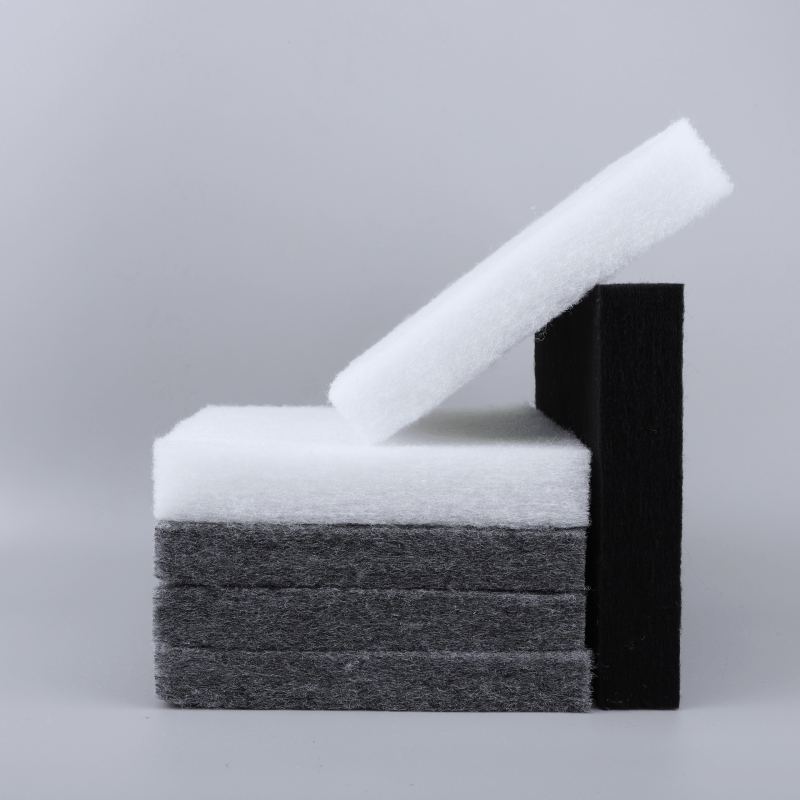
6. Lightweight Construction
One of the practical advantages of polyester acoustic felt is its low weight.
Compared with many heavier acoustic construction materials, lightweight polyester felt can reduce the load placed on walls and ceilings and make transportation and installation easier.
This is particularly useful for renovation projects where the existing structure has limitations or where installers need to complete a large installation area efficiently.
7. Easy Cutting and Processing
Another advantage is its processing flexibility.
The material can be cut into different shapes and sizes using relatively simple tools. This allows installers and manufacturers to create acoustic panels, decorative patterns, wall coverings, ceiling elements, and customized components.
For OEM projects, buyers can also work with a custom nonwoven manufacturer to develop specific widths, thicknesses, densities, colors, and dimensions.
8. Stable Physical Structure
Dimensional stability is important for acoustic materials used in long-term architectural applications.
A properly engineered polyester fiber structure can maintain its shape under normal environmental conditions and reduce the risk of excessive expansion, contraction, or deformation.
For large-scale projects, stable material dimensions can also make installation and panel alignment more predictable.
9. Good Impact Resistance
Polyester fibers provide a flexible structure rather than a brittle one.
As a result, polyester acoustic felt can offer good resistance to everyday impact and handling compared with some rigid acoustic materials.
This characteristic can be valuable in sports facilities, children's areas, entertainment venues, music rooms, and other spaces where wall surfaces may occasionally experience physical contact.
10. Independent Acoustic and Decorative Performance
A major advantage of polyester acoustic felt is that it can combine several functions within one material.
Depending on the application, it may be installed directly onto a wall or ceiling without requiring a complicated multilayer decorative system.
Basic installation methods such as bonding, cutting, drilling, or fastening can be used according to the project structure.
This can potentially reduce the number of auxiliary materials required and help shorten installation time.
For commercial projects, fewer installation steps can also contribute to better control of overall project costs and construction schedules.
11. Easy Maintenance
Acoustic materials installed in public and commercial spaces inevitably collect dust over time.
Polyester acoustic felt is relatively easy to maintain. Routine dust and loose particles can generally be removed with a vacuum cleaner or soft duster.
For localized dirt, appropriate cleaning methods can be used according to the product's care requirements.
Simple maintenance can help acoustic installations maintain their appearance and functional performance throughout their service life.
Why Is Polyester Acoustic Felt Suitable for Customized Projects?
Not every acoustic project has the same requirements.
A home bedroom may require a different thickness and appearance from a professional recording studio. A KTV project may focus more heavily on sound absorption, while a commercial interior project may place greater emphasis on decorative design.
Therefore, purchasing a standard acoustic material may not always provide the best solution.
A professional nonwoven manufacturer China can adjust the material structure according to the intended application. Parameters such as fiber composition, thickness, density, GSM, dimensions, color, hardness, and surface structure can be considered during product development.
For distributors, contractors, and acoustic-material manufacturers, this flexibility makes custom nonwoven products more suitable for different project requirements.
How Does Polyester Acoustic Felt Compare With Traditional Acoustic Materials?
Traditional acoustic materials such as fiberglass, mineral wool, and foam each have their own application advantages. However, they may also present limitations related to weight, processing, appearance, handling, or environmental requirements.
Polyester acoustic felt provides a different material solution by combining sound absorption, lightweight construction, flexible processing, decorative possibilities, and functional performance.
The most suitable material should still be selected according to the target frequency range, required sound absorption coefficient, installation structure, fire requirements, thickness, density, and project budget.
Instead of selecting an acoustic material simply because it has a high GSM or thickness, buyers should evaluate the complete performance of the material under the actual application conditions.
Why Choose an Experienced Nonwoven Manufacturer for Polyester Acoustic Felt?
For large-volume buyers, product performance is only one part of the purchasing decision. Production consistency, raw material control, customization capability, quality management, and delivery stability are equally important.
HUIZHOU JINHAOCHENG NONWOVENS CO., LTD. has more than 20 years of nonwoven manufacturing experience and operates a production facility of approximately 26,000 square meters with 15 automated needle punching production lines.
As a professional nonwoven manufacturer China and needle punched nonwoven felt manufacturer, we provide a wide range of nonwoven materials for construction, automotive, acoustic, industrial, and other applications.
Our capabilities include custom nonwoven products, OEM nonwoven manufacturing, ODM development, needle punched felt, polyester acoustic materials, floor protection felt, painter felt, anti-condensation felt, thermal bonded wadding, and laminated foam fabric.
For customers developing acoustic products or purchasing materials for large-scale projects, direct cooperation with an experienced OEM nonwoven manufacturer can simplify sample development, specification adjustment, quality control, and mass production.
What Should Buyers Check Before Ordering Polyester Acoustic Felt?
Before purchasing polyester acoustic felt in bulk, it is important to confirm the actual requirements of the project.
The first consideration should be the required sound absorption performance and target frequency range.
The second is the required thickness and density, because acoustic performance can change significantly according to material structure and installation conditions.
The third is the required fire performance, particularly for hotels, cinemas, KTV rooms, public buildings, commercial interiors, and other regulated environments.
Color, dimensions, cutting method, installation method, environmental requirements, packaging, and order quantity should also be confirmed before mass production.
Most importantly, buyers should request samples and relevant test documentation before finalizing large-volume orders.
Conclusion: Why Is Polyester Acoustic Felt a Practical Acoustic Material?
Polyester acoustic felt combines sound absorption with lightweight construction, flexible processing, decorative possibilities, thermal insulation capability, and convenient maintenance.
Its versatility allows it to be used in residential interiors, recording studios, KTV rooms, cinemas, conference rooms, sports facilities, music rooms, and many other noise-control environments.
For buyers looking for a material that can be customized according to thickness, density, GSM, color, dimensions, and application requirements, polyester acoustic felt provides a flexible option.
Choosing the right product is not simply about selecting the highest density or thickest material. The better approach is to match the fiber structure, acoustic performance, fire requirements, physical properties, and installation method to the final application.
As an experienced needle punched felt manufacturer, nonwoven felt manufacturer, and custom nonwoven manufacturer, Jinhaocheng can support customers from sample development to customized production and large-volume supply.