Rollaway Nesting Box Liners: Dimensions and Cutouts That Matter
For poultry equipment manufacturers, nesting box brands, poultry supply importers, and wholesalers, sourcing rollaway nesting box pads involves more than selecting a suitable padding material. The liner must fit the existing nest box structure and allow eggs to roll smoothly into the collection area.
If a liner is too large, its edges may overlap the egg-roll channel or curl against the sidewalls. If it is too small, unnecessary areas of the nest floor may remain exposed, and the liner may shift during use. Incorrectly positioned cutouts can also interfere with mounting structures or the normal operation of the egg collection system.
Before purchasing rollaway nesting box pads, buyers should therefore address one key question:
How can you determine the correct liner dimensions and cutout shape for an existing rollaway nest box without obstructing egg roll-out?
The answer depends on the specific nest box design, including the sloped floor, egg-roll channel, available installation space, fixing points, and the liner's condition after installation.
This guide explains how to measure the nest box, design cutouts and edges, specify die-cutting tolerances, and approve samples before bulk production. Following these steps can help buyers reduce errors caused by dimensional or structural mismatches.
1. Why Do Rollaway Nesting Boxes Require Specific Liner Dimensions?
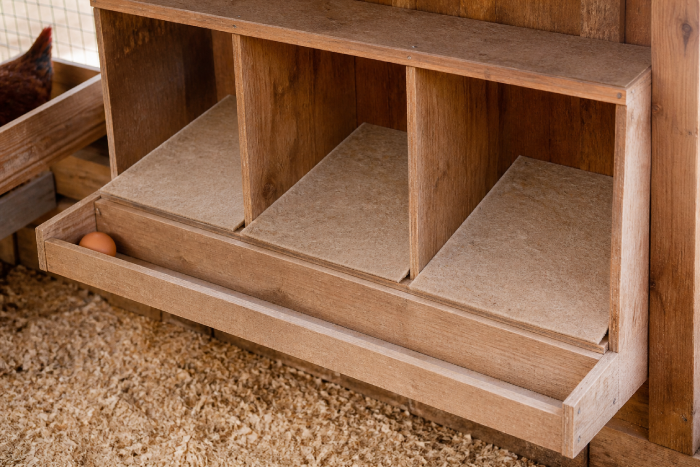
Rollaway nest boxes are designed to let eggs leave the laying area and move along a designated path into a collection area. Unlike conventional nest boxes with flat floors and loose nesting materials, rollaway systems may contain sloped floors, egg-roll channels, transition areas, retaining edges, or separate collection trays.
These structural features determine where a liner can be installed and how much surface area it should cover.
For example, a liner designed for a flat-bottomed nest box may not be suitable for a rollaway model with a narrow egg-roll channel. If the liner extends into the channel, it may interfere with egg movement. If the liner is too small, parts of the intended coverage area may remain exposed.
For this reason, the external dimensions of the nest box alone are usually insufficient to determine the final liner size.
Buyers should distinguish between three measurements: the external dimensions of the nest box, the usable surface area that the liner needs to cover, and the final cut dimensions of the finished liner.
These measurements may differ, particularly when the nest box has sloped sidewalls, raised edges, molded corners, or a separate egg collection area.
Before choosing a standard liner or developing a custom shape, buyers should confirm the exact nest box model and determine whether the liner needs to cover the entire sloped floor or only a designated section.
2. What Should Buyers Measure Before Ordering?
Accurate measurement should begin with the actual installation area rather than the outside frame of the nest box.
Before requesting a quotation, buyers should record the following dimensions.
Usable floor width and length. Measure the area that the liner is intended to cover. If the floor becomes narrower toward the front or back, measure the width at several positions instead of assuming that the surface is rectangular.
Actual length of the sloped floor. Measure along the surface that the liner will follow. The surface length of a sloped floor may differ from the horizontal distance between its front and rear edges. The drawing should clearly identify which measurement is being provided.
Sidewalls and corner geometry. Record any sloped edges, rounded corners, raised sections, grooves, or molded features that may affect the liner's outline.
Egg-roll channel and collection area. Identify the starting point of the egg-roll path, the channel opening, and the boundary between the nest floor and the collection area. Mark these features clearly on the drawing.
Mounting and fixing points. If the liner uses clips, hooks, grooves, fasteners, or another fixing method, record the relevant positions and dimensions.
Available clearances. Measure the space between the liner and surrounding structures, paying particular attention to areas near functional or moving components.
For an irregular nest box, a clearly annotated dimensional drawing is generally more useful than a simple length-and-width measurement. Photos showing a ruler can help explain structural details, but they should supplement rather than replace the required measurements.
If buyers are replacing an existing liner, the old product can serve as a reference. However, the nest box itself should still be checked. An old liner may have stretched, curled, or been trimmed during use, so its current shape should not automatically be treated as the original design specification.
3. What Should Buyers Consider Around the Slope, Egg-Roll Channel, and Collection Area?
The sloped floor and egg-roll channel are among the most important structural features to consider when developing rollaway nesting box liners.
The liner must not alter the intended functional layout of the nest box or interfere with the designed egg movement path.
First, identify the exact area that needs to be covered. Some nest boxes require a liner only on the main sloped floor, while others use separate inserts or collection trays. Buyers should not assume that every internal section needs to be lined.
Second, clearly mark the egg-roll channel on the drawing. Specify where the liner must stop, which edges must remain clear, and whether the liner is allowed to extend toward the collection area.
Third, inspect the transition between the liner edges and the egg-roll path. A curled edge, loose flap, or noticeable raised section may interfere with egg movement. The required clearance should therefore be determined from the actual nest box structure and verified during sample testing.
Fourth, consider how liner thickness and flexibility affect installation. A liner that fits the outline when laid flat may behave differently when installed on a sloped or curved surface. Material thickness, bending characteristics, and the fixing method can all affect the final fit.
There is no single slope angle or egg-roll channel clearance that applies to every rollaway nest box. The actual values should follow the equipment design.
Whenever possible, buyers should provide the original nest box drawing or a verified physical sample. If the original design information is unavailable, measurements and the egg movement path should be checked on the actual nest box before the final cutting pattern is approved.
4. How Should the Liner Outline, Cutouts, and Edges Be Designed?
The liner cutting pattern should follow the actual installation surface while avoiding functional components of the nest box.
Some models can use a simple rectangular outline. Others may require tapered sides, corner notches, rounded corners, recesses, or openings designed to avoid mounting structures.
Outer outline. If the nest floor narrows toward one end, the liner may need a matching trapezoidal or irregular outline. Using a rectangular liner without checking the geometry may cause edge overlap or leave parts of the intended coverage area exposed.
Corner notches. If the nest box has molded corners, mounting brackets, or raised features, mark their positions and required notch shapes on the drawing. Specify whether the corners are square, rounded, or angled.
Egg-roll channel openings. If the liner requires an opening or recessed edge near the egg-roll path, define its position and dimensions using fixed reference points on the nest box. This helps prevent misunderstandings during cutting.
Clearance around retaining edges. If the liner needs to fit inside a frame or groove, specify the available installation space. The liner should not cover functional edges or create an additional obstruction.
Cutout positions and symmetry. Specify whether each cutout is centered, offset, mirrored on both sides, or required on only one side. The drawing should also identify the reference edge and installation orientation.
Edge finishing. If exposed edges may curl, fray, or interfere with installation, communicate the required edge finish in advance. Confirm with the supplier whether the selected material and cutting method can meet the requirement.
An effective cutting drawing should show the finished outer outline, the positions and dimensions of all openings, the installation orientation, the functional areas that must remain clear, and the critical installation clearances.
It should also distinguish the final cut dimensions of the finished liner from the dimensions of the raw material used in production.
This is particularly important when ordering custom chicken nesting pads in bulk. Ambiguous drawings can lead to different interpretations of the product shape during sampling and mass production.
5. How Should Buyers Specify Fixing Methods and Die-Cutting Tolerances?
The fixing method affects the cutting pattern and the liner's stability during use.
Depending on the nest box structure, the liner may be positioned by its shape, fitted into a groove, secured with clips, or installed using another specified method. Buyers should confirm the intended fixing method before finalizing the cutting drawing.
If the liner fits into a groove, the design should account for the available space and how the material behaves during installation. If clips or fasteners are used, their positions and the corresponding openings should be clearly marked.
If the liner relies on friction or a close fit to remain in position, buyers should confirm whether the material's flexibility and thickness support stable installation. Matching the measured dimensions on a flat drawing does not automatically guarantee that the liner will remain in place during use.
Die-cutting tolerance is another technical requirement that should be confirmed in advance.
Die-cutting tolerance refers to the permitted deviation of the finished dimensions from the specified dimensions. It is not the same as the intentional installation clearance included in the design.
For example, a buyer may require a gap between the liner edge and the nest box. This is a design requirement. Die-cutting tolerance determines how far the actual manufactured outline may deviate from the approved drawing.
Buyers should identify the dimensions that are most critical to fit and function, including overall width and length, cutout positions, and clearances around the egg-roll channel.
The actual tolerances should be agreed with the supplier according to the material, thickness, cutting method, and equipment requirements. Buyers should not assume that every liner can use the same tolerance standard.
For complex shapes, the drawing should also define the measurement method, reference edges, and whether the tolerance applies to the entire outline or only to specified critical features.
These requirements should be included in the final approved drawing and sample specifications before bulk production begins.
6. How Can Buyers Verify That a Sample Does Not Interfere With Egg Roll-Out?
The sample should be tested inside the actual nest box or a test fixture that accurately reproduces its structure. Checking whether the liner lies flat on a table is not sufficient to determine whether it will function correctly in use.
Sample approval should verify both dimensional fit and functional compatibility.
Step 1: Check the overall fit. Place the sample inside the nest box and confirm that it covers the intended area without excessive overlap, unnecessary gaps, or abnormal deformation.
Step 2: Inspect all edges and openings. Check the liner's position around sidewalls, corners, fixing structures, and designated openings. Look for curled edges, raised sections, or areas that interfere with the equipment.
Step 3: Inspect the egg-roll path. Confirm that the liner does not extend into areas that must remain clear and does not create raised edges that could obstruct egg movement.
Step 4: Conduct a controlled egg-roll test. Following the equipment manufacturer's recommended procedure, use a suitably sized test egg to check whether it travels along the intended path and reaches the collection area. Observe whether the liner introduces additional resistance, causes sticking, or changes the egg's movement.
Step 5: Check for liner movement. Repeat the installation and functional checks. Observe whether the liner slides, lifts, folds, or moves away from its intended position. If the equipment requires repeated cleaning or removal, inspect the fit after these operations as well.
Step 6: Record the test results. Photograph the installed liner, document any areas requiring adjustment, and mark the approved dimensions and cutout positions on the final drawing.
Testing should reflect the actual nest box structure and expected conditions of use as closely as possible. A sample that fits one model should not automatically be approved for another model simply because their external dimensions are similar.
If the sample interferes with egg roll-out or shifts during use, the cutting outline, installation clearance, edge design, or fixing method should be reviewed before bulk production is approved.
7. What Drawings and Specifications Should Buyers Provide When Requesting a Quotation?
To reduce repeated measurements and sample revisions, buyers should prepare clear technical requirements before requesting a quotation, particularly when sourcing rollaway nesting box liners.
The technical information should identify the nest box model, the area to be covered, the finished dimensions, the cutting outline, the fixing method, and any areas that must remain clear.
Whenever possible, provide a fully dimensioned drawing showing the outer outline, sloped floor, egg-roll channel, openings, reference edges, and critical clearances.
Photos of the actual nest box can help the supplier understand structural details that are difficult to communicate through dimensions alone. An existing liner or nest box insert can also be provided as a reference, but its current dimensions and condition should be verified first.
Buyers should also specify the required material thickness, intended application, sample quantity, bulk order quantity, and any packaging or labeling requirements.
If a particular dimension or clearance is critical to egg movement, highlight its importance instead of treating every dimension as equally critical.
Before approving bulk production, buyers should confirm that the supplier is working from the latest approved drawing and that the sample meets the agreed production specifications.
For custom orders, retain the approved drawing, sample reference, material specifications, and agreed cutting tolerances as a consistent reference for repeat purchases. This helps reduce differences between the approved sample and subsequent production batches.
Conclusion: Confirm the Nest Box Structure Before Finalizing the Liner
The key to sourcing rollaway nesting box pads is structural fit, not simply choosing a standard size.
Buyers should measure the actual usable floor area, confirm the slope and egg-roll channel positions, define all required cutouts, and specify the fixing method and critical installation clearances. The final outline and die-cutting tolerances should then be confirmed with the supplier through a clear drawing.
Most importantly, the approved sample should be tested in the target nest box to verify that the liner remains stable and does not obstruct normal egg movement.
HuiZhou JinHaoCheng Nonwovens Co., Ltd.provides a range of nonwoven and needle-punched felt material solutions and can discuss customization options according to different application requirements. For buyers developing custom chicken nesting pads, providing actual nest box dimensions, cutting drawings, and functional requirements at the quotation stage helps both parties clarify the product structure and production specifications.
A reliable sourcing process begins with the equipment drawing, confirms compatibility through sample testing, and proceeds to bulk production based on approved specifications. This helps reduce rework caused by dimensional mismatches and supports the development of liners suited to the target rollaway nest box.