
Checking Surface-Gripping Film Before Reusing Floor Protection Fleece
For contractors who regularly handle painting, renovation, and refurbishment projects, reusable floor protection fleece can help reduce material consumption across multiple jobs. However, after a roll has been used for one project, an undamaged appearance does not necessarily mean that its surface-gripping backing film is still suitable for the next application.
Dust, grit, oil, wax, and wear caused by handling can all affect how the backing film contacts the floor. Before reusing a reusable painter fleece roll, site personnel should inspect the backing for contamination and visible damage, then verify how the material performs on the actual floor where it will be used.
For buyers, the goal is not to assume that a product can be reused a certain number of times. It is to establish a simple, repeatable inspection process so that each reuse decision is based on clear criteria.
Why Doesn't Reusable Mean the Same Gripping Performance After Every Use?
Reusable describes the possibility of using a material again under suitable conditions. It does not mean that the material will perform exactly the same way after every job.
Glue-free, surface-gripping floor protection relies on the surface characteristics of its backing film, the contact between the film and the floor, and the overall product construction to provide grip or slip resistance. It is different from a product that adheres to the floor with an adhesive. Neither “glue-free” nor “reusable” alone proves how well the material will perform in actual use.
During the first application, the backing film may be relatively clean and intact. After the job, it may have been exposed to construction dust, grit, oily substances, or other residues. Repeated unrolling, rolling, and handling may also cause creases, scratches, or localized deformation.
These changes do not necessarily mean that the backing has failed, but they may affect its contact with the floor during the next application.
Therefore, reusable floor protection fleece should be assessed according to its actual condition rather than its product description, appearance, or previous use history alone.
Which Contaminants Can Affect Contact Between the Backing Film and the Floor?
The condition of the backing depends not only on the material itself but also on contamination left by the previous job. Pay particular attention to the following.
Dust and grit. Fine dust may accumulate on the backing surface, while grit can create raised spots that prevent the film from making even contact with the floor. If particles become trapped between the backing and the floor during installation, they may also increase the risk of scratching the floor surface.
Oil and other construction residues. Oily substances, waxy residues, and certain construction materials may change the friction or contact characteristics of the backing. Even when contamination affects only a small area, buyers should not assume that the backing will perform as expected in that area.
Cleaning product residues. If the material or floor was cleaned after the previous job, remaining cleaning agents or a surface that has not fully dried may affect the next application. The actual effect depends on the type of residue, the backing construction, and the floor material.
The purpose of inspection is not to assume that every contaminant makes the material unusable. It is to identify factors that may affect contact and determine whether the backing can be restored to a condition suitable for reuse. If contamination cannot be reliably removed, or abnormal conditions remain after cleaning, do not treat the backing as acceptable based on appearance alone.
What Problems Can Develop During Handling and Storage?
After a roll of floor protection is removed from a job site, its backing may undergo further changes during rolling, transportation, and storage. Before reuse, check for the following conditions.
Attached debris. Look for dust, grit, dried paint, and other foreign materials on the backing. Pay particular attention to folded areas, edges, and locations where contaminants may accumulate.
Scratches, tears, or localized damage. Check the film for visible scratches, tears, punctures, or other damage that may affect its integrity. For composite products, also look for separation between the backing film and the felt layer or unusual wrinkling.
Creases and deformation. Prolonged compression or improper handling may leave pronounced creases, curling, or deformation. These conditions may affect how evenly the material unfolds and contacts the floor.
Irregular edges and seams. Torn, delaminated, or curled edges may make it more difficult for the material to remain stable after reinstallation. These issues deserve particular attention when the protection must cover a large area continuously.
Storage time alone cannot determine whether the backing remains effective. Assess the material's actual condition, the product instructions, and the requirements of the next job rather than using the number of days in storage as the sole criterion.
How Can You Inspect Whether the Backing Is Still Suitable for Reuse?
To help different site personnel follow a consistent procedure, inspect the material before each new application.
Step 1: Inspect the backing surface.
Unroll the floor protection in a well-lit area and check for visible debris, oil, and other construction residues. Do not inspect only the outer layer of the roll. Check the edges and material from the inner sections as well.
Step 2: Check the integrity of the film.
Look for tears, punctures, obvious scratches, pronounced creases, or localized deformation. For composite materials, check whether the backing film has separated from the felt layer. If damage is found, assess its location and extent to determine whether it may affect the product's intended use.
Step 3: Look for abnormal surface conditions.
Check for noticeable surface changes, residues, or other conditions that differ from the backing's normal state. For glue-free, surface-gripping products, do not automatically treat the backing as an adhesive layer or use residual stickiness as the sole inspection criterion.
Step 4: Assess abnormal areas separately.
If contamination or damage is limited to a specific area, determine whether that area could affect the performance of the material as a whole. If you cannot establish whether the problem will affect safe use or gripping performance, suspend reuse and follow the product instructions or supplier's recommendations.
After these checks, an on-floor verification is still necessary. Visual inspection can reveal obvious problems, but it cannot by itself prove that the backing will deliver the expected gripping or slip-resistance performance during the next job.
Why Must You Verify the Material on the Intended Floor?
The suitability of the backing depends not only on its condition but also on the surface it will contact. The same protective fleece may perform differently on different floors. Therefore, check the installation condition on the intended floor before every reuse.
First, confirm that the floor meets the product's application requirements. Check for dust, grit, oil, waxy residues, or cleaning products that have not fully dried. Do not test the material on surfaces where the product instructions prohibit its use.
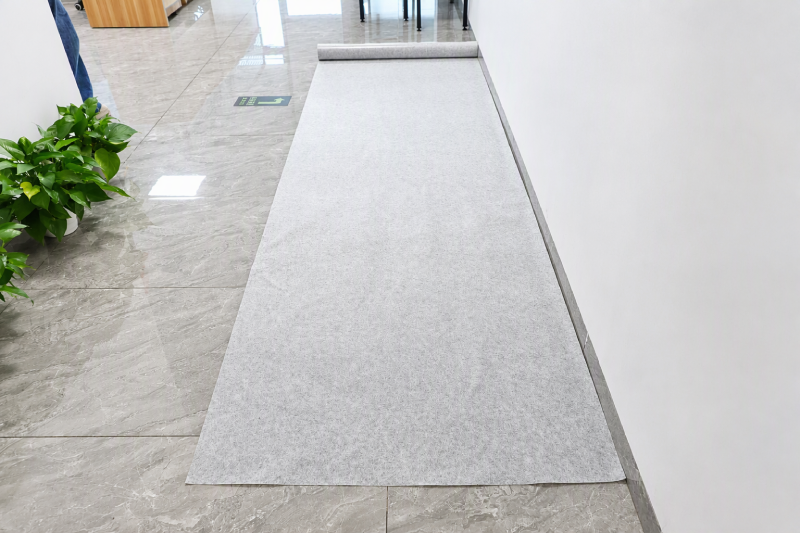
Next, lay the material flat and check whether the backing makes normal contact with the floor. Observe the edges, seams, and localized areas for obvious lifting, curling, or an inability to sit evenly against the surface.
Then, where permitted by the product instructions, observe the material under appropriate, normal-use conditions. Check whether it moves too easily during expected site activities, whether the edges continue to lift, or whether other abnormalities appear. Do not use extreme actions that could damage the floor or create a slipping hazard simply to test the material.
Finally, inspect the floor after removing the material. For wood flooring, natural stone, or other sensitive surfaces, test a small, inconspicuous area first and follow the product instructions. A non-staining floor protector may be a purchasing objective, but the product name alone cannot guarantee that every floor will remain free from marks or damage.
If the material cannot remain stable on the intended floor, or if abnormal marks appear after removal, do not put it directly into full-scale use even if the backing looks intact.
When Can You Continue Using the Material, and When Should You Stop?
The decision to reuse the material should take into account the inspection results, the intended floor, and the requirements of the next project.
Conditions under which reuse may be considered: The backing has no obvious tears, punctures, or severe deformation; there are no contaminants that cannot be reliably removed; no obvious separation is found in the composite structure; the material remains in the expected position during a trial installation on the intended floor; and no abnormal marks are found after removal.
Conditions requiring further assessment: The backing has unidentified residues, localized damage, or unusual deformation; the trial installation reveals localized lifting, noticeable movement, or abnormal contact; or compatibility with a sensitive floor has not been confirmed.
Conditions requiring discontinuation or replacement: The backing has visible damage that may affect normal use; contamination cannot be reliably removed; the material cannot maintain the required stability on the intended floor; or inspection reveals floor damage, residue, or another unacceptable result.
Stability is particularly important in corridors, stairways, and areas with frequent foot traffic. If site personnel cannot confirm that the material is suitable for reuse, they should not ignore potential risks simply to save material.
These criteria are not universal laboratory standards for every product. Actual decisions should also consider the product construction, supplier instructions, intended floor, and project risks. Purchasing requirements for anti-slip painter fleece should specify the intended application rather than assuming that a “slip-resistant” description means the product is suitable for every floor or working condition.
How Can Contractors Record Inspection Results and Improve Purchasing Requirements?
For contractors managing multiple projects, tool rental suppliers, and material distributors, relying only on individual workers' judgment can lead to inconsistent decisions between sites.
A practical approach is to maintain a brief reuse inspection record. Before each new application, record the material identification or batch, previous project, backing contamination, visible damage, intended floor, trial installation results, and final decision.
If the same roll repeatedly develops backing contamination, edge problems, or unstable installation after use, investigate whether these issues are related to the work environment, floor type, handling practices, or product construction. The value of these records lies in identifying recurring problems, not in calculating a fixed number of reuse cycles for every product based on limited site observations.
Buyers can also turn these observations into clearer product requirements. For example, specify the expected reuse scenarios, intended floor types, required gripping or slip-resistance performance, acceptable material condition, and verification steps required before purchasing.
For overseas bulk buyers, specifications should not simply state “reusable” or “anti-slip.” A more effective approach is to provide the actual application conditions and verify suitability through sample trials and mutually agreed acceptance criteria.
As a Chinese manufacturer of needle-punched nonwovens and floor protection materials, HuiZhou JinHaoCheng Nonwovens Co., Ltd. can discuss material construction, specifications, and customized solutions according to project requirements. For contractors, wholesalers, and importers sourcing areusable painter fleece roll, providing details about the backing type, intended floor, working environment, and reuse requirements helps the supplier assess suitable product configurations and establish clearer specifications for OEM/ODM and bulk orders.
Conclusion: Recheck the Backing Before Every Reuse
Whether glue-free, surface-gripping floor protection fleece is suitable for reuse cannot be determined solely by a reusable product label or the absence of obvious surface damage.
A more reliable approach is to inspect the backing for contamination and visible damage, check the integrity of the film and composite structure, and then verify the material's performance on the intended floor. If the material cannot remain stable, has damage or contamination that cannot be ruled out, or presents an unacceptable risk to the floor, suspend reuse and assess whether replacement is necessary.
For professional contractors and bulk buyers, recording inspection results and using them to improve future purchasing specifications is more practical than simply trying to maximize the number of reuse cycles.




