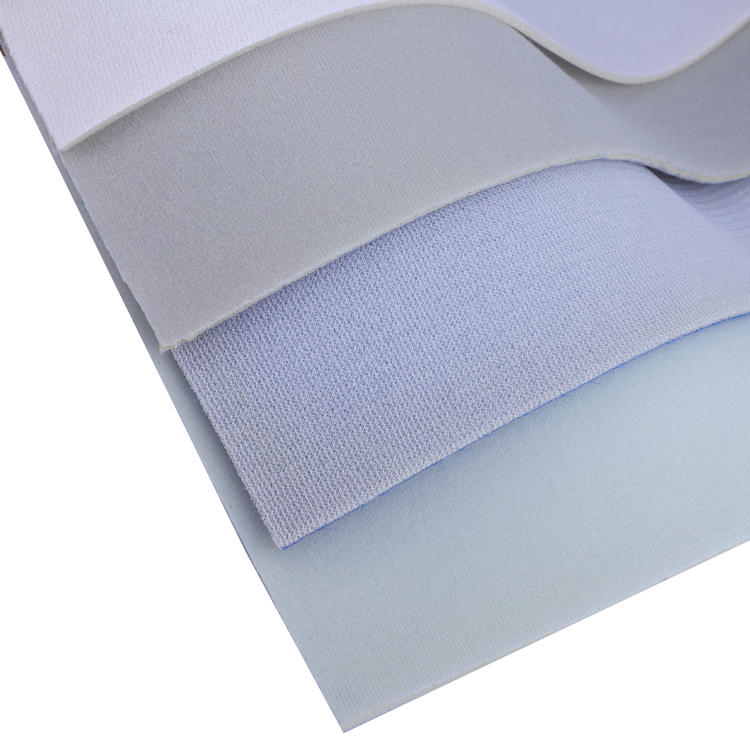
Knee Brace Foam Lining: Padding Materials for Sleeves and Orthopedic Supports
Knee braces may appear to consist of simple elastic fabrics and lining materials. However, different product designs can require different foam and fabric combinations. A basic elastic knee sleeve, a knee brace with additional support components, and a sports knee pad with localized cushioning do not necessarily use the same material structure.
When developing Knee Brace Foam Lining, manufacturers need to consider foam type, thickness, density, fabric substrates, lamination layers, and whether the material will undergo cutting, bending, and sewing. Selecting materials based only on descriptions such as "soft," "high density," or "breathable mesh" is usually not enough to determine whether a laminated material is suitable for the final product.
For material suppliers, foam laminated fabric is an intermediate material used in the manufacturing of protective supports. It can be laminated with different fabrics according to the product design and then processed by the support manufacturer through cutting, sewing, and assembly. It is not a complete knee brace and cannot independently demonstrate specific medical, therapeutic, or joint-support benefits.
This guide explains how knee brace manufacturers can evaluate different support structures, select foam and fabric substrates, choose lamination constructions, and verify material suitability through samples before bulk purchasing.
What Foam Padding Is Used in Different Knee Support Structures?
Knee supports do not follow one fixed construction. Different products may use elastic sleeves, wraparound straps, localized padding, or additional structural support components. The position and intended role of foam can therefore vary with the product design.
For a basic elastic knee sleeve, material development may focus on the overall fit, fabric stretch characteristics, and flexibility during bending. If the design includes localized padding around the knee area, manufacturers also need to evaluate the thickness, flexibility, and cutting shape of the laminated material.
For a wraparound knee brace, materials may be used in different contact areas. Some sections may require flexible padding, while others may need elastic straps, fastening components, or separate support structures. Foam laminated fabric serves only as the designated padding or fabric layer. It does not replace the fastening structure or other functional components of the brace.
For sports knee pads with localized cushioning, manufacturers also need to consider the shape and thickness of the foam area, its coverage, and how it connects with the surrounding fabric. Localized padding and full lining structures may require different material specifications and should not be assumed to use the same construction.
Support structure or component | Possible material requirements | Key purchasing considerations |
Elastic knee sleeve | Stretch fabric and optional foam laminated layers | Stretch direction, overall thickness, bending flexibility |
Localized knee padding | Foam laminated with fabric | Foam thickness, density, firmness, padding shape |
Wraparound knee brace lining | Flexible fabric, foam, and other supporting layers | Contact surfaces, bending areas, sewing methods |
Knee brace with support components | Localized foam padding and separate support structures | Position of the foam relative to support components, assembly space |
Sports knee protection | Foam and fabric composites selected for the product design | Material construction, cutting, sewing, and sample validation |
These are common material development considerations, not a claim that every knee support contains all of these components. The actual material solution should be determined by the product drawings, samples, and the manufacturer's structural requirements.
What Are the Material Structure Differences Between Knee Sleeves, Knee Braces, and Knee Supports?
When searching for knee support materials, buyers often encounter terms such as Knee Sleeve, Knee Brace, and Knee Support. These terms may overlap in market usage, but they should not be treated as interchangeable descriptions of a specific internal material structure.
Knee Sleeve usually refers to a sleeve-style knee support, which may primarily consist of stretch fabric. Manufacturers need to consider fabric stretch direction, recovery characteristics, thickness, and the overall construction. If foam lining is added to the design, they should also check whether the laminated layer affects the sleeve's bending and stretching behavior.
Knee Brace generally describes a knee support with a more defined structural design. Some products may include wraparound straps, fastening components, support elements, or localized padding. Foam lining for these products needs to fit the available space and assembly requirements of the other components. Foam laminated fabric should not be treated as the complete support structure.
Knee Support is a broader product term. It may refer to a sleeve-style product or a support with fastening or additional structural components. Suppliers therefore cannot determine material specifications based only on the term Knee Support.
Product name | Possible structural characteristics | Foam laminated material considerations |
Knee Sleeve | Sleeve-style elastic construction | Stretch fabric, stretch direction, overall flexibility |
Knee Brace | May include straps, support components, and localized padding | Padding position, assembly space, material thickness |
Knee Support | Broad product category; construction depends on the specific design | Confirm the product structure before selecting material combinations |
For buyers, providing only a product name is not the most effective way to request a quotation. It is better to provide product photos, structural drawings, material cross-sections, or existing samples, and clearly identify the areas where foam laminated material is required.
If the same knee support includes both an elastic sleeve and localized padding, specify the requirements for each area separately. This helps prevent the supplier from assuming that every component requires the same laminated construction.
How Should Soft PU Foam and High Resilience PU Foam Be Evaluated?
When developing Knee Support Foam Padding, both Soft PU Foam and High Resilience PU Foam can be evaluated as candidate materials. However, neither should be selected based on its name alone.
Soft PU Foam can be considered for flexible padding structures. Buyers need to evaluate the actual foam type, thickness, density, and firmness to determine whether it suits the target support construction and processing requirements.
High Resilience PU Foam can also be considered when a project needs to evaluate the recovery characteristics of foam after compression. However, the term "High Resilience" alone does not prove that a particular foam grade is suitable for a specific knee brace. Buyers still need the corresponding material specifications and technical information, followed by sample evaluation.
The following parameters should be confirmed separately:
Parameter | What it represents | What buyers should confirm |
Foam Thickness | Physical thickness of the foam layer | Target thickness and tolerance |
Foam Density | Mass per unit volume of the foam | Density specification of the foam itself |
Foam Hardness / Firmness | Resistance to compression under specified conditions | Test method and target requirement |
Resilience | Recovery characteristics after deformation | Relevant technical data and test conditions |
Overall Laminated Thickness | Total thickness after foam and fabric lamination | Finished composite thickness and measurement method |
Foam density, hardness, and resilience are different properties. Higher density does not automatically mean that a material is harder, softer, or more resilient. It also cannot independently determine the comfort of the finished knee support.
Buyers should also distinguish the density of the foam itself from the overall weight of the laminated fabric. Fabric layers and other supporting materials affect the total weight of the composite, but they should not be included in the foam density calculation unless both parties have specifically agreed that the measurement refers to the complete laminated material.
In addition, material softness is not the same as clinical comfort and does not demonstrate improved knee joint stability. The actual wearing experience depends on the complete product construction, dimensions, pressure distribution, fabric, and method of use. It cannot be determined by a single foam parameter.
How Should Knitted Fabric, Nylon Mesh, and Spacer Mesh Be Selected?
Fabric substrates are just as important as foam when developing Knee Sleeve Foam Lining. They do more than provide the surface on one side of the composite. They can also affect stretch, bending behavior, appearance, and subsequent sewing performance.
Knitted Fabric is made using yarn loops. Different knitting structures, fiber compositions, and fabric weights can produce different stretch directions, surface textures, and dimensional behavior. Buyers should therefore confirm the specific knitted construction rather than providing only the broad description "Knitted Fabric."
Nylon Mesh generally refers to mesh fabric made primarily from nylon fibers. Buyers need to confirm the mesh opening size, distribution, fiber composition, GSM, and thickness. The open structure of a mesh fabric does not automatically mean that the laminated composite has a specific level of breathability.
Spacer Mesh usually has a three-dimensional spacer construction and should not simply be treated as the same material as ordinary single-layer mesh. Buyers should confirm its specific structure, thickness, compression behavior, and lamination method, then evaluate whether the finished composite meets the product design requirements.
Fabric substrate | Structural characteristics | What to confirm for knee support development |
Knitted Fabric | Made from yarn loops; structures can vary considerably | Fiber composition, knitting structure, GSM, thickness, stretch direction |
Nylon Mesh | Mesh fabric made from nylon fibers; openings vary by product | Mesh opening size, distribution, fiber composition, surface condition |
Spacer Mesh | Three-dimensional fabric with a spacer layer | Structural thickness, compression behavior, overall flexibility after lamination |
When selecting a substrate, buyers should also identify which side will contact the skin and which side will face the foam or other support components. If the material needs to bend repeatedly around the knee, actual samples should be used to check whether the fabric wrinkles, deforms, or shifts relative to the foam.
If a project has specific breathability requirements, buyers need to clarify whether the test applies to the fabric substrate or the complete foam laminated composite. The test method and acceptance criteria should also be agreed upon. Finished material breathability cannot be inferred simply from the names "Mesh" or "Spacer Mesh."
For a broader explanation of fabric structures and lamination compatibility, refer to the guide to fabric substrates for foam laminated materials. That article covers general substrate differences, while this guide focuses on how to evaluate those substrates for knee brace lining applications.

How Can Single-Sided and Double-Sided Lamination Be Used for Knee Brace Lining?
Knee brace foam lining can use different laminated constructions depending on the product design. Buyers should first confirm what each side of the foam will contact and whether the finished product requires fabric surfaces on both sides.
One common construction is Fabric + Foam, in which one fabric layer is laminated to one foam layer. This can be considered when only one side of the material requires a fabric surface. The other side can then be connected to other support materials according to the design.
Another construction is Fabric + Foam + Fabric, in which the foam is placed between two fabric layers. This provides fabric surfaces on both sides of the composite, but it also adds material layers and changes the overall thickness and bending behavior.
Lamination structure | Layer arrangement | Key purchasing considerations |
Fabric + Foam | One fabric layer laminated to one foam layer | Which side serves as the outer surface and how the other side will be connected |
Fabric + Foam + Fabric | One foam layer between two fabric layers | Surface requirements on both sides, total thickness, bending and sewing compatibility |
For knee brace lining, single-sided lamination may be a candidate when one side needs to connect with other support components and the other side serves as the contact surface. If both sides require fabric coverage, a three-layer construction can be evaluated.
However, double-sided lamination is not necessarily better than single-sided lamination. Adding another fabric layer may change the material's thickness, weight, and flexibility. It may also affect bending and sewing performance. The final choice should depend on the brace structure, contact surfaces, assembly method, and sample results.
The lamination process should also be evaluated together with the material combination. Different fabrics, foam types, and thicknesses may have different requirements for flame lamination, adhesive lamination, or hot-melt lamination. One process should not be assumed to work for every material combination.
For a broader explanation of construction differences, refer to the guide to single-sided and double-sided foam laminated fabric structures, then confirm the final layer arrangement through actual knee brace samples.
What Are the Differences Between Foam Thickness, Density, and Composite Flexibility?
When purchasing knee support materials, foam thickness, foam density, and composite flexibility are often discussed together. However, they describe different material characteristics.
Foam Thickness refers to the physical thickness of the foam layer, usually measured in millimeters (mm). It affects the overall composite thickness and bending behavior, but it cannot independently determine whether the material is suitable for a knee brace.
Foam Density refers to the mass per unit volume of the foam. Buyers should specify the measurement unit and confirm exactly which material layer is being measured. Density is not the same as hardness and cannot independently represent compression or resilience performance.
Composite Flexibility depends on several factors, including foam type, foam thickness, fabric construction, fabric stretch direction, the number of laminated layers, and the overall condition of the finished composite. Even when the same foam thickness is used, different fabric substrates can produce different bending behavior.
Therefore, buyers should not provide only one foam thickness value when requesting a quotation. They should also explain the final knee support construction and processing requirements.
Parameter to confirm | What should be specified | Why it matters |
Foam Thickness | Foam layer thickness and tolerance | Confirms padding space and material construction |
Foam Density | Density of the foam itself | Identifies the foam material specification |
Foam Hardness | Test method and target requirement | Evaluates the material's compression behavior |
Fabric GSM | Weight per unit area of each fabric layer | Confirms substrate specifications and weight |
Overall Laminated Thickness | Thickness of all completed laminated layers | Confirms the final material dimensions |
Overall Flexibility | Actual bending direction and use conditions | Helps determine suitability for the brace structure and processing |
The total thickness of a laminated composite cannot be determined by foam thickness alone, because fabric and other supporting layers also affect the final result. Different lamination processes and material conditions may also cause variations, so the measurement conditions should be agreed upon.
For supports that need to bend with knee movement, buyers should provide the actual product construction or a diagram showing the bending areas. Suppliers can then suggest candidate foam, fabric, and layer combinations for sample evaluation, rather than promising that one thickness will suit every knee brace.
How Can Cutting, Bending, and Sewing Samples Confirm Material Suitability?
Foam laminated materials are generally supplied as rolls or sheets. After entering the support manufacturer's production process, they may still need to undergo cutting, sewing, edge binding, or assembly with other components. Meeting the material specifications does not automatically mean that the composite is suitable for the final production line.
Before confirming a bulk order, buyers should evaluate samples using the actual knee support manufacturing process.
First, confirm that the sample construction matches the intended bulk order.
The foam type, thickness, density, fabric, lamination layers, and lamination process used for the sample should be as close as possible to the planned bulk material. If the sample differs from the bulk material, its results cannot be directly used as the basis for bulk production approval.
Second, check the cut edges using the actual cutting shape.
Use the knee brace drawings or cutting templates to make trial cuts. Observe whether the edges are clean, whether the foam shows noticeable deformation, and whether the fabric and foam shift relative to each other. Complex curves and localized padding areas should be tested using their actual shapes rather than only checking a rectangular sample.
Third, conduct actual bending and wrapping tests.
Bend the laminated material according to the knee brace design. Check whether the fabric surface wrinkles, whether the foam deforms in an unacceptable way, and whether the material can accommodate the required bending directions.
Next, conduct sewing and assembly tests.
Use the customer's actual equipment and production methods for trial sewing. Check stitch appearance, the effect of material thickness on sewing, and whether the fabric and foam shift during the process. Stitch length, needle type, thread, and equipment settings need to be determined according to the actual material and production equipment. Universal values should not be assumed.
Finally, confirm the sample acceptance criteria.
If buyers have requirements for layer bonding, bending durability, compression performance, or breathability, they should specify the test object, method, conditions, and acceptance criteria in advance. Not all performance characteristics can be judged by touch or appearance, and specific cushioning or durability results should not be promised without supporting test evidence.
The purpose of sample validation is to confirm whether the material suits a specific brace construction and downstream processing requirements. It is not to prove that foam laminated fabric itself can provide medical treatment, prevent injuries, or improve joint stability.
What Information Should Knee Brace Manufacturers Provide Before Purchasing Foam Laminated Materials?
For Knee Brace Padding Material purchasing, a product name and a reference picture are usually not enough to determine accurate specifications. The more clearly buyers describe their requirements, the easier it is for suppliers to evaluate material combinations, processing methods, and sample solutions.
The following information should be prepared before requesting a quotation:
Purchasing information | Details to provide |
Final Product | Knee Sleeve, Knee Brace, Knee Support, or another specific support type |
Material Application Area | Full lining, localized knee padding, wraparound area, or another specified position |
Product Construction | Product photos, structural drawings, material cross-sections, or existing samples |
Foam Requirements | Soft PU, High Resilience PU, EVA, PE, or materials to be evaluated |
Foam Specifications | Thickness, density, hardness, and relevant technical requirements |
Fabric Requirements | Knitted Fabric, Nylon Mesh, Spacer Mesh, or other substrates |
Fabric Specifications | Fiber composition, GSM, thickness, color, surface, and stretch requirements |
Lamination Structure | Fabric + Foam or Fabric + Foam + Fabric |
Processing Methods | Cutting, die cutting, bending, sewing, edge binding, and assembly requirements |
Performance Requirements | Required breathability, compression, resilience, bonding, or durability tests and their corresponding standards |
Supply Format | Rolls, sheets, or specified dimensions |
Order Information | Sample quantity, estimated bulk quantity, target lead time, and packaging requirements |
If buyers have not yet decided on the foam or fabric type, they can first provide existing knee brace samples, product drawings, and target material requirements. Suppliers can then discuss candidate foam, fabric, and lamination structures based on the actual construction.
For foam laminated material development, HuiZhou JinHaoCheng Nonwovens Co., Ltd. offers sports protective material options that include EVA, PU, High Resilience PU, and PE foam, as well as knitted fabric, nylon, mesh, spacer mesh, and nonwoven fabric. Customization options include thickness, density, hardness, GSM, and color. Available lamination process options include flame lamination, adhesive lamination, and hot-melt lamination, with roll and sheet supply formats. Specific material combinations, processing feasibility, and order requirements still need to be confirmed according to project information and sample evaluation.
If you are developing knee sleeves, knee braces, or localized foam padding, you can provide product photos, structural drawings, target foam thickness, and fabric requirements. The suitable foam laminated fabric for medical supports construction can then be evaluated before sampling and quotation.
Selecting suitable knee brace foam lining is not simply a matter of choosing between Soft PU, High Resilience PU, mesh, or knitted fabric. The key is to confirm whether the foam, fabric, lamination layers, and final brace construction are compatible, and whether the material can pass the actual cutting, bending, and sewing processes. Clarifying these requirements before sampling helps ensure that material specifications are better aligned with downstream production.