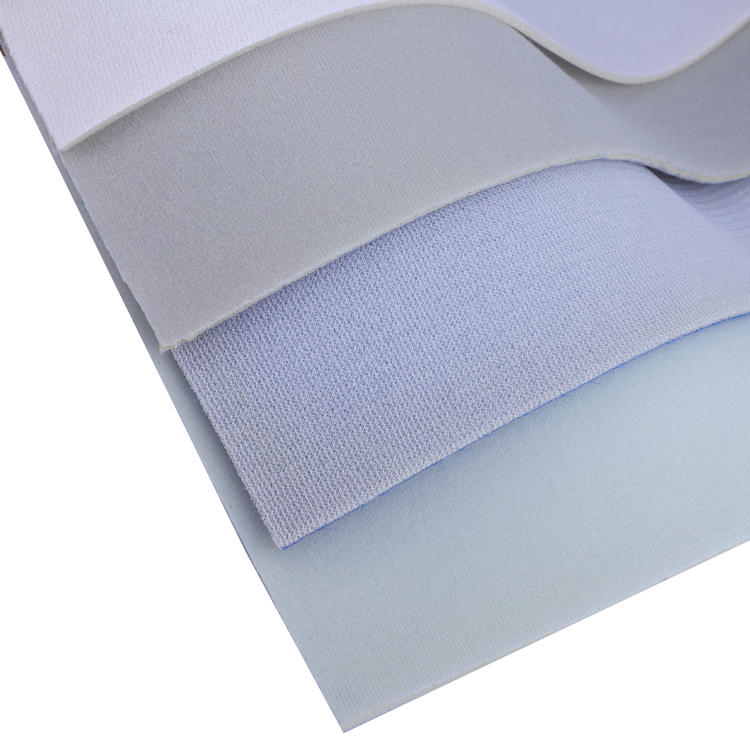
Foam Fabric for Lumbar Supports: Padding Structures for Back Braces and Support Belts
Lumbar support belts and back braces may look similar from the outside, but their internal constructions, body-contact areas, and padding positions can differ. Some products require a soft inner lining, while others use foam padding in specific areas. In certain designs, foam laminated fabric is combined with other support components to form the finished product.
For manufacturers of lumbar belts and back braces, selecting foam laminated materials involves more than choosing a soft foam or specifying a thickness. Foam type, fabric substrate, lamination structure, material thickness, and compatibility with subsequent cutting and sewing processes all need to be evaluated in relation to the final product design.
This article explains the common structures of lumbar support belts and back braces, the differences between inner padding and outer fabric, and how to evaluate PU foam, EVA, and different fabric substrates. It also covers how manufacturers can confirm material suitability through actual product samples before bulk purchasing.
What Are the Common Structures of Lumbar Support Belts and Back Braces?
Lumbar Support Belts and Back Braces are both used in products designed for the waist or back, but their structural designs are not necessarily the same.
Lumbar support belts are generally designed to wrap around the waist. Common constructions include wrap-around belts, overlapping straps, and designs with localized padding. Depending on the product, the structure may include outer fabric, inner padding, hook-and-loop fasteners, or other connecting components. Foam laminated fabric can be used in the inner padding area or as a localized composite material layer according to the product design.
Back braces may have more complex constructions. Some products cover a larger area of the back in addition to the waist and may combine elastic fabrics, webbing, support stays, or other structural components. The coverage area and material combination depend on the specific product design. Not all back braces use the same construction.
From a material sourcing perspective, manufacturers should first identify which type of material they need:
Inner lining material for the side of the product that contacts the body.
Localized foam padding for specific cushioning or filling sections.
Foam laminated fabric that combines a foam layer with textile fabric in advance, making it suitable for subsequent product manufacturing.
These materials may all be used in lumbar or back support products, but they should not be confused with a complete belt, support board, or finished brace. Supplying foam laminated fabric does not automatically mean that the supplier also manufactures complete braces or internal support components.
Before selecting a material, manufacturers should clarify the product type, the intended material position, and the overall construction.
What Is the Difference Between Inner Padding and Outer Fabric in Lumbar Support Belts?
In lumbar support belts and back braces, inner padding and outer fabric serve different structural roles. They should not be treated as interchangeable materials during procurement.
Inner padding is generally positioned on the side of the product closest to the body. It may consist of foam, knitted fabric, brushed fabric, or another composite structure. Its selection should match the product's contact areas, coverage shape, and manufacturing method. If foam laminated fabric is used, manufacturers need to confirm whether the combination of foam and fabric is suitable for the intended product construction.
Outer fabric usually forms the visible surface or external fabric layer of the product. Depending on the design, it may need to be connected to hook-and-loop fasteners, webbing, elastic fabrics, or other components. Its material requirements may include surface appearance, dimensions, flexibility, and compatibility with subsequent processing.
It is important to understand that inner padding and outer fabric do not necessarily need to use the same material. Even when both layers are textile fabrics, they may differ in construction, thickness, surface treatment, and lamination requirements.
If manufacturers plan to use pre-laminated foam fabric, they should specify which side contains the foam, which side contains the fabric, and where the composite will be used in the finished product. For example, single-sided and double-sided lamination have different layer structures. The appropriate option cannot be determined from the product name alone.
For lumbar support products, material selection should begin with the final product construction rather than choosing one foam type and assuming that the same composite material can be used for every component.
How Should PU Foam, High-Resilience PU Foam, and EVA Be Evaluated?
PU Foam, High-Resilience PU Foam, and EVA Foam are possible material options to evaluate when developing foam laminated fabrics. However, they are not automatically interchangeable in every lumbar support belt or back brace application.
Soft PU Foam can be considered for projects that require a soft foam layer. Manufacturers can evaluate it according to the padding position, target thickness, fabric substrate, and finished product construction. However, the term "Soft PU" alone does not define the exact softness, recovery characteristics, or final performance of the material. The corresponding specifications and physical samples still need to be checked.
High-Resilience PU Foam is another candidate for projects that require different recovery characteristics. Manufacturers should compare the actual foam specifications, the condition of the foam after lamination, and the intended product construction. The name "High Resilience" alone does not prove that a particular foam is suitable for every lumbar support product.
EVA Foam can also be considered in some foam lamination projects. Its material characteristics and processing compatibility should be evaluated separately from PU foam. Whether it is suitable for a particular belt lining or back brace padding application depends on the actual thickness, hardness, fabric combination, and finished product design.
During procurement, manufacturers should also distinguish between several basic foam parameters. Foam density is not the same as hardness, and density alone cannot determine the material's recovery, softness, or support capability. Different foam densities may result in different physical properties, but the final characteristics also depend on the foam formulation, structure, and specific grade.
Manufacturers should therefore clarify which foam type they want to evaluate, together with the required thickness, density, hardness, and other specifications. If the foam requirements have not yet been finalized, they can provide an existing product sample or material reference. The supplier can then discuss possible material options, which should be compared through laminated samples.
How Should Knitted Fabric, Brushed Fabric, and Spacer Mesh Be Selected?
The fabric substrate affects the surface, structure, flexibility, and processing characteristics of foam laminated materials. For lumbar support belts and back braces, Knitted Fabric, Brushed Fabric, and Spacer Mesh are different fabric options that can be evaluated according to the product design.
Knitted Fabric is formed by interlooping yarns. Its stretch and flexibility depend on the yarn, knitting structure, and fabric specifications. For projects that need to follow the waist's curved shape or the product's wrapping construction, manufacturers can evaluate the fabric's actual stretch characteristics and surface requirements. Not all knitted fabrics have the same elasticity or processing behavior.
Brushed Fabric has a surface texture that differs from conventional flat fabrics. It can be considered for the inner side of a product, depending on the surface design and contact requirements. Manufacturers should confirm which side of the fabric will face outward after lamination and whether the finished surface meets the product requirements. The term "Brushed Fabric" alone cannot determine the final wearing experience.
Spacer Mesh has a three-dimensional structure with an intermediate spacing layer. It can be considered as a substrate option for certain foam lamination projects. Manufacturers should evaluate its thickness, construction, surface, and overall condition after lamination. Spacer mesh and conventional single-layer mesh are not the same structure, so the exact fabric type should be specified during procurement.
Other fabric substrates, such as conventional mesh, nonwoven fabric, or other textiles, may also be considered for some projects. The final selection should be based on the product construction and actual material samples.
It is also important to note that a breathable base fabric does not automatically mean that the finished laminated material will maintain the same breathability. The foam layer, lamination method, and overall composite structure can all affect the final material properties.
When selecting a fabric substrate, lumbar support manufacturers should clarify its intended position, surface requirements, flexibility requirements, target thickness, and whether single-sided or double-sided lamination is needed. The final decision should then be confirmed through physical samples.

How Do Foam Thickness and Density Affect the Laminated Material Structure?
Foam thickness and density are two common specifications that need to be confirmed when purchasing foam laminated fabric. However, neither should be directly equated with the support capability of the finished product.
Foam Thickness affects the overall dimensions and space requirements of the composite material. If a lumbar support belt or back brace uses foam lining in a specific area, manufacturers should check whether the material thickness is suitable for the available space, wrapping construction, and subsequent sewing process.
Foam Density is a separate material parameter. Foam samples with the same thickness do not necessarily have the same density, and foams with the same density do not necessarily have the same hardness or recovery characteristics. Providing only a thickness measurement is therefore insufficient for a supplier to identify the exact foam required.
In addition, foam thickness is not the same as the total thickness of the finished laminated material. The fabric substrate, foam layer, lamination method, and processing conditions can all affect the final composite thickness. For double-sided lamination, manufacturers also need to specify the fabric requirements on both sides of the foam.
When requesting a quotation, manufacturers should provide as much of the following information as possible: foam thickness, density or hardness requirements, fabric type, number of layers, and target thickness of the finished composite. If these specifications have not yet been finalized, an existing material sample or product construction drawing can help suppliers evaluate the project.
For lumbar and back support products, material thickness should not be treated as a direct measure of support capability. Whether a material is suitable for a particular section depends on the product design, other support components, and the complete product construction. It cannot be determined by foam thickness or density alone.

What Should Be Considered for Cutting, Sewing, and Edge Binding of Lumbar Support Belts?
Foam laminated fabric usually needs to go through downstream manufacturing processes before becoming part of a finished product. Therefore, manufacturers should evaluate not only the material itself but also its compatibility with the required cutting, sewing, and edge-finishing methods.
During cutting, manufacturers should check whether the material can be cut into the required shapes according to the product drawings and whether the cut edges meet subsequent processing requirements. For composite materials with different thicknesses and layer structures, the edge condition should be confirmed through actual samples.
During sewing, foam thickness, fabric construction, and the overall lamination structure may affect how the material is handled by production equipment. Manufacturers should conduct trials using their actual sewing equipment, needle and thread configurations, and product construction rather than assuming that all foam laminated fabrics can use the same sewing parameters.
During edge binding, the composite may need to be folded, covered, or connected to other fabrics. Its thickness, flexibility, and edge structure should be considered. Excessive thickness or an unsuitable construction may make binding more difficult and affect the appearance of the finished edge.
In addition, lumbar support belts may include hook-and-loop fasteners, webbing, elastic fabrics, or other connecting components. The connection points between foam laminated fabric and these components should be confirmed according to the final product design.
It is important to understand that equipment, processing methods, and product constructions differ between manufacturers. There is no universal needle type, stitch spacing, thread, or binding specification that can be applied to every lumbar support belt. Manufacturers should provide the intended processing method and product sample so that the suitability of the composite material can be evaluated for the required production steps.
How Can Foam Laminated Materials Be Confirmed Against the Final Product Design?
A flat piece of foam laminated fabric cannot fully demonstrate whether the material is suitable for a particular lumbar support belt or back brace. A more reliable approach is to evaluate it in relation to the final product construction.
First, manufacturers need to identify the position of the foam laminated material in the finished product. Will it be used as an inner lining, localized foam padding, or another composite layer? Different positions may have different requirements for fabric surfaces, thickness, and material construction.
Next, the foam and fabric combination should be confirmed. Manufacturers need to specify the foam type, thickness, density or hardness requirements, and the exact specifications of the knitted fabric, brushed fabric, spacer mesh, or other substrate. If single-sided or double-sided lamination is required, the layer structure should also be clarified during the sampling stage.
Material trials can then be carried out according to the actual product design. The composite material can be cut into the intended shapes, and the cut edges and dimensions can be checked. It can then be tested using the planned sewing and edge-binding methods to evaluate its compatibility with downstream manufacturing.
After assembling a representative sample, manufacturers should check how the material fits into the actual product, its surface appearance, any wrinkles in bending areas, and whether there is any separation or movement between material layers.
If a project has specific requirements for softness, recovery, compression, durability, or other properties, the test methods, testing conditions, and acceptance criteria should be agreed upon in advance. These requirements should be verified using actual samples. They should not be assumed from the foam category or material name.
For suppliers, complete product drawings, reference samples, material structures, and processing requirements make it easier to evaluate the feasibility of a composite material. For manufacturers, confirming the material sample and finished product construction before bulk purchasing helps reduce the risk of selecting a material that does not match the actual product requirements.
What Information Should Lumbar and Back Support Manufacturers Provide Before Purchasing?
If manufacturers of lumbar support belts or back braces need customized foam laminated fabric, it is helpful to prepare the following project information before requesting a quotation.
Product Type: Specify whether the material will be used for a lumbar support belt, back brace, lumbar brace lining, or another back support product. Product photos, construction drawings, or existing samples can help the supplier understand the actual design.
Material Position: Explain whether the foam laminated fabric will be used as an inner lining, localized padding, or another layer. Identify its exact position in the finished product.
Foam Specifications: Provide the candidate material, such as PU Foam, High-Resilience PU Foam, or EVA, together with the required thickness, density, hardness, and other technical requirements. If the specifications have not yet been finalized, provide a reference sample and the intended application requirements.
Fabric Specifications: Specify whether the project requires knitted fabric, brushed fabric, spacer mesh, or another substrate. Include the required color, surface, thickness, and other relevant details.
Lamination Structure: Clarify whether single-sided or double-sided lamination is required, how the foam and fabric layers should be arranged, and the target thickness of the finished composite.
Processing Requirements: Provide the cutting shapes, sewing methods, edge-binding construction, and any requirements for connecting the material to hook-and-loop fasteners, webbing, or other components.
Quality and Performance Requirements: If the project has specific requirements for softness, compression, recovery, or durability, provide the corresponding test methods and acceptance criteria. Avoid relying only on general descriptions such as "soft," "supportive," or "durable," which are difficult to evaluate without defined requirements.
Supply and Order Information: Specify whether the material is required in rolls or sheets, the target width and dimensions, estimated order quantity, sampling schedule, and expected bulk order plan.
HuiZhou JinHaoCheng Nonwovens Co., Ltd. has project experience in laminating PU and EVA foam with different fabric substrates. The lamination approaches involved include flame lamination, adhesive lamination, and hot-melt lamination. Depending on the project, processing may be arranged internally or externally. The specific foam and fabric combinations and final structures required for lumbar and back support products still need to be confirmed according to project specifications and actual samples.
For projects that require cutting, sewing, or edge binding, manufacturers should also provide their processing requirements in advance. The factory needs to confirm the relevant processing capabilities and sample evaluation arrangements. It should not be assumed that every downstream manufacturing process can be completed by the material supplier without prior confirmation.
The selection of materials for lumbar support belts and back braces ultimately depends on the product construction, lining position, foam and fabric combination, and downstream processing methods. Providing clear product information and reference samples during the inquiry stage, followed by confirmation of the actual laminated material structure before bulk purchasing, helps reduce material selection errors and improve communication throughout the project.