
When Should Absorbent Painter Fleece Be Removed After a Paint or Liquid Spill?
During painting, renovation, and refurbishment projects, absorbent painter fleece can help capture some liquid splashes and reduce direct contact between construction liquids and the floor. However, absorbent protective fleece cannot absorb unlimited amounts of paint, water, or other liquids. When liquid continues to enter the material, the contaminated area expands, or the floor underneath may have been affected, site personnel need to decide whether the material can remain in use or should be removed and replaced promptly.
For professional painters, renovation contractors, and site managers, the decision should not be based only on whether the surface of the fleece looks clean. It should also consider the type of liquid, the extent of contamination, the condition of the material, the backing construction, and the condition of the protected floor. This article explains how to decide when absorbent painter fleece should be removed or replaced after a spill, and how to turn these practical observations into clearer purchasing requirements.
Why Can't Absorbent Painter Fleece Absorb Liquid Indefinitely?
Absorbent painter fleece typically uses fibrous materials and their internal structure to absorb or temporarily hold a certain amount of liquid. However, this capacity has limits. Actual performance depends on factors such as material construction, liquid properties, contact time, and conditions of use.
When only a small amount of liquid enters the material, the fleece may still be able to absorb more. When liquid continues to flow in, the same area is repeatedly contaminated, or liquid begins to accumulate on the surface, the material may be approaching its practical absorption limit. Leaving it in place does not guarantee that the floor underneath will remain protected.
Buyers should also distinguish between liquid absorption and liquid barrier performance. An absorbent layer may take up some liquid, but that does not mean the complete product can prevent liquid from passing through to the floor below. If a project involves hardwood, stone, tile, or another finished floor, buyers should confirm whether the complete product construction provides the required liquid barrier performance rather than relying only on the terms “absorbent” or “painter fleece.”
For this reason, site personnel should treat absorbent fleece as temporary protective material with defined conditions of use. When a noticeable spill occurs, they should inspect the affected area and the material's condition instead of assuming that the fleece can remain in place until the job is finished.
What Is the Difference Between Small Splashes and Large Liquid Spills?
Small splashes and large spills do not necessarily require the same response. The decision should consider the amount of liquid, the affected area, whether liquid continues to enter the material, and how sensitive the protected floor is.
If a small splash is limited to a localized area, liquid is not visibly accumulating, and there are no signs of persistent wetness, penetration, or contamination on the backing, site personnel can inspect the affected area and consult the product's instructions to determine whether continued use is appropriate. A small spill area alone does not prove that the material is still safe to use.
If liquid continues to flow into the same location, forms visible pools, or spreads across a larger area of the fleece, the situation requires greater attention. This is particularly important when the liquid's composition is unknown, it contains solvents, it is corrosive, or it may damage the floor finish. Site personnel should not wait for the fleece to absorb everything before responding.
For large spills, continuous leaks, or situations that may affect the floor underneath, the first steps should be to control the source of the liquid and isolate the affected area. Contaminated material should then be handled according to the nature of the liquid and the site's safety requirements. If it is unclear whether liquid has passed through the fleece, the area should be treated as requiring further inspection rather than assumed to be safe for continued use.
There is no single absorption-volume threshold that applies to every product and liquid. The same spill area can produce different results depending on material construction, liquid properties, and working conditions. Buyers and site teams should therefore establish response criteria based on the specific product's validation results and the risks of the intended application.
What Signs Suggest That the Fleece May Be Approaching Its Absorption Limit?
It is usually not possible to determine the exact absorption limit from a single visual sign. However, the following conditions should prompt site personnel to inspect the material and the floor underneath more carefully.
First, liquid begins to accumulate on the surface. If the liquid is no longer being absorbed effectively, or fresh liquid continues to enter the same area, the protective material may be unable to handle the current liquid load.
Second, the affected area remains wet, contamination continues to spread, or liquid begins moving toward edges, seams, and adjacent areas. These signs suggest that the liquid may be spreading beyond the original spill location. Inspecting only the point where the spill first occurred may not be sufficient.
Third, the fleece becomes noticeably heavier, sags locally, or changes shape. Changes in weight and appearance do not prove that liquid has penetrated the material, but they may indicate that a substantial amount of liquid has entered it. The material may also be more likely to drip or spread contamination during handling.
Fourth, the backing becomes damp or shows signs of leakage or contamination. If liquid has reached the underside, the continued absorption capacity of the upper layer should not be used as the sole basis for deciding whether the floor remains protected.
Fifth, the contaminated material can no longer remain in place without creating a risk of secondary contamination. For example, foot traffic may transfer liquid to other areas, or subsequent work may compress the fleece and squeeze out absorbed liquid. In such cases, removal and replacement should be considered even if the exact absorption limit has not been established.
These signs are practical warning indicators, not standardized test criteria that apply to every product. More cautious handling is necessary when dealing with high-risk liquids, continuous leaks, or situations that may damage the protected floor.
Why Must Buyers Inspect the Underside of the Fleece and the Floor?
Inspecting only the upper surface may overlook the most important risk: whether liquid has passed through the material or entered underneath through seams, edges, or gaps in the coverage.
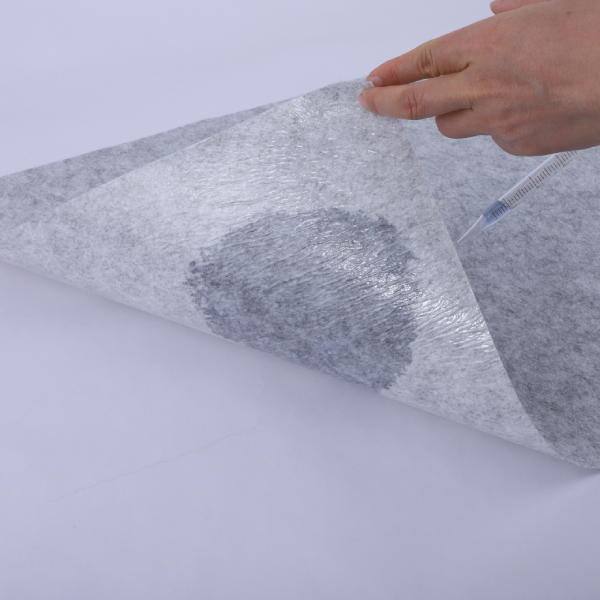
An absorbent layer and a waterproof layer perform different functions. Some composite protective fleece products combine an absorbent material with a PE film or another liquid barrier layer. However, actual performance depends on the complete product construction, material integrity, seam treatment, and conditions of use. Ordinary absorbent fleece should not automatically be treated as waterproof.
After a spill, site personnel should inspect the backing and the floor in the affected area when it is safe and practical to do so. For localized contamination, carefully lifting the relevant section may help reveal whether the underside is damp, whether liquid marks are present, and whether the floor shows discoloration, coating changes, or other abnormalities.
The inspection should also consider whether liquid may have entered through adjacent roll seams, wall edges, doorways, cut edges, or areas outside the protected coverage. Even if the main body of the fleece shows no obvious penetration, liquid may have bypassed the material and reached the floor below.
If the floor is damp or visibly contaminated, the appropriate response should be based on the liquid type and floor material before new protective material is installed. For sensitive flooring, unknown liquids, solvents, corrosive substances, or other potentially hazardous materials, follow the relevant safety procedures and flooring manufacturer's recommendations. Do not wipe the area or apply cleaning products without confirming that the method is suitable.
When Should Contaminated Material Be Removed and Replaced?
Site personnel do not need to wait until the fleece has completely lost its absorption capacity before taking action. If the material's condition or the site circumstances indicate that continued use may increase the risk of floor contamination, the affected material should be considered for removal and replacement.
The following situations should generally trigger an assessment for removal or replacement.
Liquid continues to accumulate or flow into the material. If the source of contamination has not been controlled and the fleece cannot manage the incoming liquid, first stop or control the source, then remove the affected material and inspect the area underneath.
There are signs of penetration or contamination on the backing. If the underside is damp, leakage is visible, or suspicious liquid marks appear on the floor, remove the affected section and inspect the floor to establish the extent of contamination. Confirmed penetration should not be treated as a problem that can be resolved simply by replacing the top layer.
The contaminated area is too large for reliable localized treatment. When a large area is affected or liquid has spread to seams and adjacent sections, local treatment may not restore reliable protection. Decide whether to replace a localized section or remove the material across a wider area based on the extent of contamination.
The liquid may damage the floor or pose a risk to site personnel. Liquids with unknown compositions, solvents, corrosive properties, or other hazards must be handled according to site safety procedures. The fact that fleece has absorbed a liquid does not automatically mean that leaving it in place is safe.
The material is compressed, torn, or otherwise damaged. If contaminated fleece can no longer lie flat, the backing is damaged, seams have failed, or the material is likely to drip during movement, replace the affected section to prevent further loss of protection.
The conditions of subsequent work have changed. If later operations will bring repeated foot traffic, tools, or equipment across the contaminated area, or may compress or drag the fleece, reassess whether the material is suitable to remain in place.
When replacement is necessary, first control the source of contamination and remove the affected material in accordance with site safety requirements. Inspect the floor and adjacent areas. Resume work in the affected area only after the floor condition has been checked, the contamination has been appropriately addressed, and suitable protective material has been installed again.
How Can Site Teams Prevent Saturated Material from Spreading Liquid During Removal or Rolling?
Fleece that has absorbed a large amount of liquid may release it when moved, folded, or rolled up. It may also transfer contamination to areas that were previously clean. During removal, preventing secondary contamination should take priority over simply rolling up the material as quickly as possible.
First, control the spill source and restrict access to the affected area. This helps prevent footwear, tools, or carts from transferring liquid elsewhere. If the liquid may be hazardous, follow the relevant site safety procedures for that substance.
Second, choose a removal method based on the degree of contamination and the material's construction. Do not step on, compress, or drag saturated fleece without assessing the risk. Where necessary, isolate the affected area in sections and remove the material carefully, avoiding contact between the contaminated surface and clean flooring.
Even if the fleece includes a liquid barrier layer, do not assume that it cannot leak during rolling. Folding, bending, tears, seam locations, and localized liquid accumulation can all affect liquid containment. During removal, watch for escaping liquid and collect or dispose of contaminated material according to site requirements.
After removal, inspect the original spill area, the route along which the material was moved, and adjacent flooring. If liquid has spread, expand the inspection area. Before installing replacement protection, confirm that the floor has been appropriately treated.
For projects involving repeated work or large protected areas, site teams can define procedures for isolating spills, assigning responsibility for material removal, inspecting the floor, and disposing of contaminated material. This helps reduce inconsistent responses between different crews.
How Can Buyers Turn On-Site Liquid Risks into Purchasing Requirements?
Records of spills and contamination during construction can help buyers define more accurate requirements for future protective materials. Instead of asking only whether a product has “high absorbency,” buyers should identify the types of liquids likely to occur, the ways contamination happens, and the risks to the protected floor.
First, describe the actual application. Buyers can explain whether the product is intended for indoor painting, renovation, material handling, or a specific work area where liquid spills are likely. They should also identify whether the main liquids involved are water-based paint, clean water, or other substances. Different liquids may require different handling procedures, so one material should not be assumed suitable for every liquid.
Second, clarify whether the product needs absorption or liquid barrier performance. If the objective is to capture small splashes, an absorbent layer may be an important requirement. If the project also requires preventing liquid from reaching the floor underneath, buyers should confirm whether the complete product construction includes a suitable barrier layer and verify its performance under application-relevant conditions. An absorbent layer and a waterproof layer are not interchangeable.
Third, include site-handling requirements in purchasing discussions. Buyers can ask suppliers to explain the intended use, suitable conditions, and limitations of the material. During sample verification, they can observe the material's condition after liquid contact, check for signs of liquid on the underside, and assess whether removal is likely to spread contamination. The test method and acceptance criteria should be agreed upon according to the product construction and intended application.
Fourth, report recurring problems to the supplier. If site records show that the same type of liquid repeatedly causes localized saturation, contamination underneath, or difficulty during removal, buyers can reassess the material construction, roll dimensions, liquid barrier requirements, and site-handling method. Simply increasing the basis weight will not necessarily solve every problem.
For long-term supply programs, record the product specification, spill scenario, observed problem, response taken, and outcome. Include confirmed requirements in future RFQs or specification sheets. This helps buyers compare suppliers' technical responses and align bulk product configurations more closely with actual construction needs.
As a manufacturer of nonwoven and composite materials, HuiZhou JinHaoCheng Nonwovens Co., Ltd. can discuss absorbent needle-punched felt, composite constructions, and customized configurations based on project requirements. For projects requiring absorbent floor protection roll or painter fleece for renovation, buyers should provide information about the target liquid, intended working environment, protected floor type, and whether a liquid barrier layer is required. This helps the supplier assess suitable custom floor protection solutions.
Conclusion: Make Spill Response Part of the Site Protection Process
Absorbent painter fleece can help manage a certain amount of liquid splashing, but its absorption capacity is limited, and it does not automatically prevent liquid from reaching the floor underneath. After a spill, site personnel should consider the extent of contamination, whether liquid continues to enter the material, the condition of the fleece, signs on the backing, and the sensitivity of the floor when deciding whether to continue using the material, treat a localized area, or remove and replace it.
When liquid continues to accumulate, contamination spreads, the underside becomes damp, or the material can no longer provide reliable coverage, the source should be controlled, the affected material removed, and the floor inspected. Care is also needed during movement or rolling to prevent liquid from being transferred to other areas.
For buyers, the most useful approach is to turn real site experience into clear material requirements, distinguish absorption from liquid barrier performance, and confirm product construction, conditions of use, and acceptance methods before purchasing. This supports better material selection for actual working conditions and provides a basis for consistent supply and future specification improvements.




