Mattress Bottom Fabric Explained: Material Requirements for Mattress Base Covering
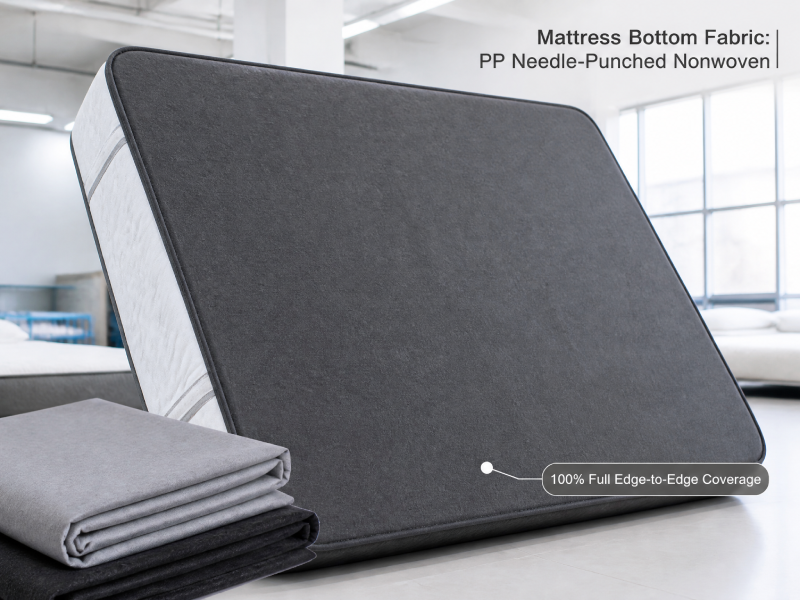
Mattress bottom fabric is a covering material used on the underside of a mattress. Its main purpose is to cover the bottom surface, provide a neat finish, and, depending on the mattress design, serve as a base lining or protective backing.
For mattress manufacturers, sourcing bottom fabric involves more than comparing material names or prices. Fiber composition, GSM, thickness, tensile strength, tear resistance, roll width, and the actual cutting and assembly methods can all affect whether a material is suitable for the production requirements.
PP needle-punched nonwoven is one material option that can be considered for mattress bottom covering. However, its suitability for a specific mattress structure needs to be evaluated according to the installation position, material specifications, and actual assembly requirements. Mattress bottom fabric should not automatically be treated as a load-bearing material, nor should it be confused with mattress spring wrapping fabric or exterior mattress cover fabric.
This guide explains the functions of mattress bottom covering materials, the potential applications of PP needle-punched nonwoven, and the key specifications mattress manufacturers should confirm before purchasing.
What Is Mattress Bottom Fabric?
Mattress bottom fabric is a covering material installed on the exterior underside of a mattress. It may also be referred to as mattress base fabric, mattress bottom cloth, or mattress base covering material.
It is generally positioned on the bottom surface of a mattress to cover the underlying structure and create a relatively complete and neat appearance. Depending on the mattress design, the material may also serve as a base lining or backing layer.
It is important to understand that mattress bottom fabric is a term defined by its installation position and intended use. It does not refer to one fixed fiber composition or manufacturing process.
Different mattress manufacturers may use needle-punched nonwoven, other nonwoven materials, or textile fabrics for bottom covering. The actual choice depends on the mattress structure, assembly method, purchasing specifications, and finished product requirements.
Buyers should also distinguish between three related material terms:
Material Term | Typical Installation Position | Main Function |
Mattress Bottom Fabric | Exterior underside of the mattress | Covers the mattress bottom surface |
Mattress Base Lining | Lining position within the mattress base or bottom structure | Provides a lining or backing layer, depending on the design |
Mattress Spring Wrapping Fabric | Around spring components or spring systems | Used for spring wrapping or related spring component structures |
Mattress Bottom Fabric and Mattress Spring Wrapping Fabric are not the same purchasing application. The former covers the underside of a mattress, while the latter is used to wrap spring components. Even if both materials are made from needle-punched nonwoven, this does not mean they can be used interchangeably.
Why Do Mattress Manufacturers Use Nonwoven Bottom Fabric?
Mattress bottom covering materials need to match the mattress design and production assembly requirements. Compared with conventional textile fabrics, nonwoven materials can be produced with different fiber compositions, weights, thicknesses, and structures. This makes them a potential material option for certain mattress bottom covering applications.
For mattress manufacturers purchasing materials in rolls, several factors need to be considered, including supply consistency, compatibility with cutting and assembly processes, and specification consistency between production batches.
When selecting nonwoven mattress bottom cloth, buyers generally need to consider the following factors:
Purchasing Consideration | What Buyers Need to Confirm |
Material structure | Whether the material is needle-punched nonwoven or another specified nonwoven structure |
Fiber composition | PP, PET, or another specified fiber type and ratio |
Fabric weight | Whether the GSM meets the bottom covering design requirements |
Thickness | Whether the material fits the mattress base structure and assembly method |
Mechanical properties | Whether the material meets the requirements of cutting, fixing, and handling |
Dimensions | Whether the roll width and length are suitable for production equipment |
Surface and color | Whether the appearance meets the mattress bottom requirements |
Batch consistency | Whether subsequent batches can be produced according to the confirmed specifications |
Nonwoven fabric is not a universal solution for every mattress bottom structure. Buyers should first identify the material's installation position and then determine the appropriate material type according to their actual production requirements.
What Functions Can Mattress Base Covering Serve?
The functions of mattress bottom covering materials depend on the mattress structure. Buyers should not determine a material's function based only on the term mattress bottom fabric. Instead, they should clarify its actual position and purpose in the finished product.
Bottom Covering
This is the most direct application of mattress bottom fabric.
The material is installed on the exterior underside of the mattress to cover the bottom structure and create a relatively complete finished appearance. Buyers should confirm the required coverage area, finished dimensions, edge treatment, and how the material will be attached to the mattress structure.
If mattresses have different sizes or bottom structures, the required material width and cutting dimensions may also vary.
Base Lining
Some mattress designs use a lining material within the bottom structure. In this case, the material needs to meet not only the coverage dimensions but also the requirements of its combination with other bottom components.
Buyers should explain whether the material will serve directly as the outermost bottom fabric or be positioned underneath or between other materials. These different installation positions may require different material specifications.
Protective Backing
In some mattress structures, the bottom material may serve as protective backing by covering bottom components and reducing their direct exposure.
However, whether additional protective properties are required depends on the actual contact conditions and product design. Buyers should not assume that a thicker or firmer material automatically provides sufficient abrasion resistance or long-term protection.
Internal Component Covering: Understanding the Application Boundary
Some suppliers introduce mattress bottom fabric and internal mattress component covering materials together. However, these are not necessarily the same application.
If a material is installed inside a mattress to wrap springs or other components, it needs to be evaluated according to the specific component structure and production process. It should not automatically be treated as an exterior mattress bottom covering material.
Therefore, buyers should provide installation photos, structural drawings, or existing material samples when requesting a quotation. This helps suppliers understand the actual application and avoid misunderstandings.
Why Consider PP Needle-Punched Nonwoven Fabric?
PP needle-punched nonwoven fabric is a nonwoven material made primarily from polypropylene fibers. The fibers are mechanically entangled through a needle-punching process to form a fabric structure.
During needle punching, barbed needles repeatedly penetrate the fiber web, causing the fibers to interlock mechanically in both the thickness and horizontal directions. This structure differs from conventional woven fabric and should not be treated as the same material as PP spunbond nonwoven.
For mattress manufacturers, PP needle-punched nonwoven can be considered as a potential material for mattress bottom covering or base lining. However, its suitability needs to be confirmed according to the actual specifications and mattress assembly method.
The following factors should be evaluated:
Evaluation Factor | What Buyers Need to Confirm |
Fiber composition | Whether the material contains 100% PP fibers or a blend of PP and other fibers |
Manufacturing structure | Whether it is needle-punched nonwoven rather than another nonwoven process |
GSM and thickness | Whether they are suitable for the mattress bottom structure |
Tensile strength | Whether the material meets the stress requirements during production and assembly |
Tear resistance | Whether the material is likely to tear during cutting, fixing, and handling |
Dimensional compatibility | Whether the roll width and length match production equipment |
Sample evaluation | Whether the material meets the mattress manufacturer's requirements after actual assembly |
The existing PP needle-punched nonwoven product information from HuiZhou JinHaoCheng Nonwovens Co., Ltd. describes the material as being made from 100% polypropylene staple fibers and identifies mattress bottom covering and related furniture and mattress material applications. The fiber composition, GSM, thickness, and dimensions for a specific order should be confirmed against the specifications and samples approved by both parties.
PP needle-punched nonwoven should not be directly described as an exterior mattress surface fabric or as the primary load-bearing material of a mattress. Its suitability for a particular mattress depends on the mattress structure, actual assembly process, and material evaluation results.
What Specifications Should Mattress Buyers Confirm?
After selecting a material type, buyers need to translate their requirements into technical specifications that can be measured, confirmed, and inspected. A product name such as mattress bottom fabric or PP nonwoven fabric alone is usually insufficient for an accurate quotation.
GSM
GSM means grams per square meter and is one of the basic specifications used when purchasing nonwoven materials.
Mattress manufacturers should provide a target GSM or acceptable range and clarify whether it refers to the weight of the bottom fabric itself or the finished weight after lamination or other processing.
If the material has a multilayer structure, the GSM of each layer should not be confused with the total weight of the finished material.
Thickness
Thickness affects how the material fits into the mattress bottom structure and may also influence cutting and fixing processes.
Buyers should provide the target thickness or a reference sample and confirm the measurement method and acceptable tolerance. Needle-punched nonwoven has a certain degree of softness and compressibility, so the measurement pressure and method may affect the final reading.
For mattress projects with specific assembly space requirements, it is advisable to record both GSM and thickness during sample approval.
Tensile Strength
Tensile strength indicates the material's ability to withstand pulling forces.
Mattress bottom fabric may experience different levels of tension during cutting, handling, fixing, and assembly. Buyers should therefore define tensile strength requirements according to the actual production process.
If a project requires test data, the testing direction, test method, and target values should be agreed upon in advance. In many cases, buyers need to distinguish between machine direction (MD) and cross direction (CD) requirements.
Tensile strength cannot be determined simply by looking at the material name or feeling its surface. Specific strength values should not be claimed without supporting test evidence.
Tear Resistance
Tear resistance relates to how a material performs when subjected to localized tearing forces.
If mattress bottom fabric needs to go through cutting, sewing, stapling, or other fixing processes, buyers should evaluate whether the material is likely to tear during these operations.
If a project has specific tear resistance requirements, buyers should provide the test method and target values. These requirements should then be confirmed through sample evaluation or an agreed testing procedure.
Tensile strength and tear resistance are different properties. One should not be used as a substitute for the other.
Width and Roll Length
Roll dimensions directly affect material utilization and production arrangements in mattress manufacturing.
Buyers should specify the required roll width and length per roll, as well as whether the material needs to be slit into specific widths.
If the material will be processed on existing equipment, buyers should also confirm the usable machine width, core dimensions, maximum roll outer diameter, and feeding requirements.
For mattresses in different sizes, buyers can provide product dimensions or cutting layout information to help suppliers evaluate suitable roll dimensions.
Color and Surface
The color and surface appearance of mattress bottom fabric should also be confirmed in advance.
Buyers should specify the required color, surface appearance, and whether any special texture or surface treatment is needed. If color consistency between batches is important, the color standard should be confirmed during sample approval and included in the bulk order requirements.
Color and surface requirements should not rely only on written descriptions. When necessary, both parties should use an approved sample as the reference.
How to Prepare a Mattress Bottom Fabric RFQ
For mattress manufacturers, a complete RFQ should include more than the product name and estimated quantity. Providing the installation position, material specifications, production method, and finished product requirements helps suppliers evaluate whether the material is suitable for the project.
The following information is recommended when preparing an inquiry:
RFQ Item | Information to Provide |
Product application | Mattress Bottom Fabric, Mattress Base Fabric, or Mattress Base Lining |
Installation position | Exterior underside, base lining, or another specific position |
Mattress structure | Photos, cross-sectional drawings, or design drawings of the mattress bottom |
Fiber composition | 100% PP, PET, or a specified fiber blend |
GSM | Target weight or acceptable range |
Thickness | Target thickness and acceptable tolerance |
Tensile Strength | MD and CD tensile strength requirements and test methods |
Tear Resistance | Tear resistance requirements and test methods |
Width | Required roll width |
Roll Length | Required length per roll |
Color and Surface | Required color, surface condition, and special treatment |
Processing Method | Cutting, sewing, stapling, bonding, or other assembly methods |
Quantity | Initial order quantity and estimated regular purchasing volume |
Sample | Existing material sample, reference photos, or structural drawings |
Packaging | Roll packaging, core, and labeling requirements |
If buyers already use an existing bottom covering material, it is advisable to send a sample to the supplier together with the corresponding GSM, thickness, and dimensional requirements.
If some technical specifications have not yet been finalized, buyers can first provide the mattress bottom structure, installation position, and intended application. The final specifications can then be determined through material samples and actual assembly evaluation.
For bulk purchasing, both parties should confirm the material specifications, approved sample standards, and acceptance requirements before production. This helps prevent situations where materials have the same product name but different technical requirements in subsequent orders.
Conclusion: Define the Mattress Bottom Covering Application Before Confirming the Material
The purchasing requirements for mattress bottom fabric mainly relate to its installation position, material structure, dimensional compatibility, and assembly requirements. It is different from mattress spring wrapping fabric, which is used to wrap spring components, and mattress internal layer felt, which is used for separation and protection within a mattress.
PP needle-punched nonwoven can be considered as a potential material for certain mattress bottom covering and base lining applications. However, this does not mean it is suitable for every mattress structure, nor should it be described as a primary load-bearing material or exterior mattress surface fabric.
For mattress manufacturers and material purchasing teams, a more reliable sourcing approach is to define the installation position and actual function first, then confirm fiber composition, GSM, thickness, tensile strength, tear resistance, roll dimensions, and processing requirements. The material should also be evaluated through samples and actual assembly.
Clear material specifications help reduce misunderstandings between suppliers and buyers and support greater consistency in subsequent bulk orders.