How Should Buyers Evaluate Heavy-Duty PP Needle-Punched Nonwoven for Furniture Manufacturing?
What Does Heavy-Duty PP Needle-Punched Nonwoven Mean?
In furniture manufacturing, heavy-duty PP needle-punched nonwoven generally refers to polypropylene fabric selected for furniture components that need to withstand handling, cutting, sewing, wrapping, or other converting processes. Buyers may consider this material for applications such as sofa bottom dust covers, furniture lining, and mattress bottom fabric.
However, the term “heavy-duty” should not be treated as a standardized performance rating. A higher basis weight does not automatically mean that a fabric has better tensile strength or tear resistance. The actual suitability of a material depends on its fiber structure, manufacturing consistency, physical properties, and the requirements of the final application.
When sourcing PP needle-punched nonwoven fabric, furniture manufacturers should therefore evaluate the material against specific production requirements rather than relying on a product name or GSM value alone.
How Does Needle Punching Create a Strong Fiber Structure?
Needle punching is a mechanical bonding process. During production, barbed needles repeatedly pass through a fiber web, moving and entangling fibers through the material thickness. This mechanical entanglement helps form a coherent nonwoven structure without relying solely on adhesive bonding.
The resulting fabric properties depend on several factors, including the raw material, fiber characteristics, web formation, needle-punching conditions, and the finished fabric specifications. These factors work together to influence the fabric's structure, thickness, surface appearance, and mechanical performance.
For furniture manufacturers, a consistent fiber structure is important because the material may need to pass through continuous converting operations. Noticeable differences in density, thickness, or surface uniformity can affect handling and processing.
It is important to distinguish the manufacturing process from the final performance result. Needle punching creates the bonded fiber structure, but the actual tensile strength and tear resistance still need to be evaluated through suitable testing.
Tensile Strength vs. Tear Resistance: What Is the Difference?
Tensile strength and tear resistance are two different mechanical properties. They should not be used interchangeably when evaluating nonwoven fabric for furniture manufacturing.
Tensile strength describes the force a fabric can withstand when it is pulled in a specified direction until it breaks. It helps buyers understand how the material responds to tension during handling and processing.
Tear resistance describes the material's ability to resist the propagation of an existing tear. This property is relevant when a fabric may be exposed to edge damage, cuts, or localized stress during converting and use.
A fabric may show acceptable tensile performance but still require further evaluation for tear resistance. For this reason, buyers should request the two properties separately rather than assuming that a high tensile-strength result guarantees good tear performance.
When comparing suppliers, buyers should also check the test method, specimen dimensions, testing direction, and reported units. Results obtained under different test conditions may not be directly comparable.
Which Technical Specifications Should Buyers Compare?
Before placing a bulk order, furniture manufacturers should establish a clear specification for the intended application. The following parameters can help buyers compare different polypropylene nonwoven fabric rolls more systematically.
GSM and Thickness
GSM refers to the fabric's mass per unit area, usually expressed in grams per square metre. Thickness describes the distance between the two fabric surfaces under specified measurement conditions.
Both values are important, but they represent different characteristics. A higher GSM does not necessarily indicate greater tensile strength, better tear resistance, or better converting performance.
Buyers should confirm the required GSM and thickness range, together with the acceptable tolerances. They should also check whether the supplier can maintain these specifications consistently across production batches.
MD/CD Strength
MD means machine direction, which is the direction in which the fabric travels during production. CD means cross direction, which is perpendicular to the machine direction.
The mechanical properties of a nonwoven fabric may differ between MD and CD. Buyers should therefore clarify which direction is important for their application and request separate test results when directional performance matters.
Comparing only one strength value without identifying the testing direction may lead to an incomplete evaluation.
Tear Resistance
Tear resistance should be assessed separately from tensile strength. Buyers should clarify the required tear performance for the actual furniture component and ask whether the supplier can provide test results using an agreed method.
If the material will be cut, sewn, or handled by automated equipment, sample trials can help determine whether the fabric performs appropriately under the buyer's real processing conditions.
Fabric Uniformity
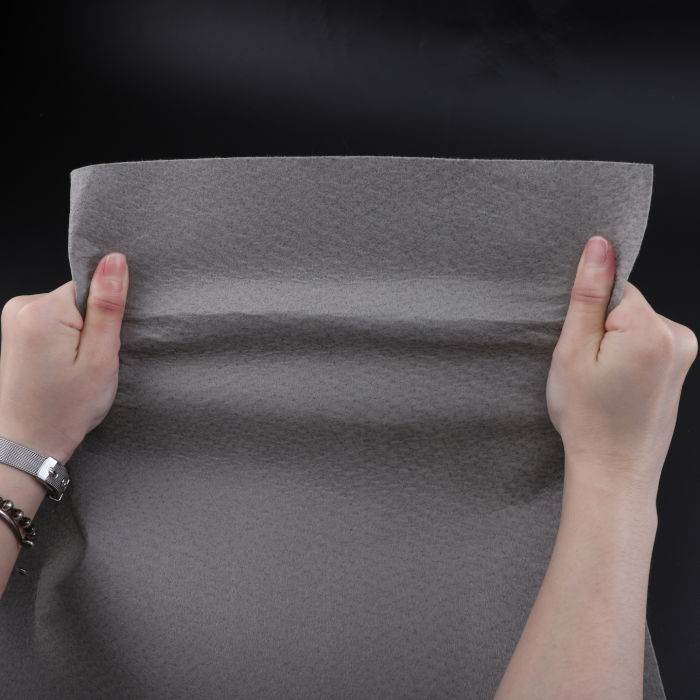
Fabric uniformity affects both appearance and production handling. Buyers should inspect whether the material has noticeable variations in thickness, density, surface texture, or overall structure.
For roll materials, inspection should not be limited to one small area. Samples from different positions can help buyers identify potential variations across the roll.
Roll Width and Length
Roll dimensions should match the buyer's converting equipment and production plan. Before ordering, confirm the required fabric width, roll length, and acceptable dimensional tolerances.
Buyers should also clarify the roll core specifications and outer roll diameter if these dimensions affect loading, storage, or machine compatibility.
Specification | What Buyers Should Confirm | Why It Matters |
GSM | Target weight and tolerance | Helps control material weight per unit area |
Thickness | Target thickness and measurement conditions | Supports fit and processing requirements |
MD/CD strength | Separate values and test direction | Shows directional tensile performance |
Tear resistance | Test method and required result | Evaluates resistance to tear propagation |
Fabric uniformity | Consistency across the roll | Helps reduce material variation during converting |
Roll width and length | Dimensions and tolerances | Supports equipment compatibility and production planning |
For a more structured inspection process, buyers can also refer to this guide on testing needle-punched nonwoven before bulk purchase. The test items should be selected according to the material structure and its intended application.
Why Is Batch Consistency Important for Furniture Manufacturing?
A sample may meet the buyer's requirements, but that does not automatically mean every subsequent bulk production batch will have exactly the same properties.
For furniture manufacturers, changes in GSM, thickness, width, surface uniformity, or mechanical performance may affect material handling and downstream processing. If a fabric is used in continuous production, inconsistent rolls can create adjustments, interruptions, or additional quality checks.
Buyers should therefore evaluate not only whether the initial sample is acceptable, but also whether the supplier can maintain the agreed specifications during repeat orders.
A practical approach is to approve a reference sample before mass production and define the key acceptance criteria in the purchase specification. These criteria may include GSM, thickness, width, roll length, appearance, and any agreed mechanical test results.
For repeat orders, buyers should compare production samples or inspection records with the approved reference. A clear agreement on inspection items and tolerances helps both parties manage expectations.
The article batch consistency for needle-punched nonwoven provides further guidance on why sample approval and production-batch control matter when purchasing nonwoven materials in volume.
What Should Buyers Request from a PP Nonwoven Fabric Supplier?
Before confirming an order, buyers should provide the supplier with the intended furniture application and the required material specifications. This allows the supplier to assess the request against the actual product and production conditions.
For a PP needle-punched nonwoven fabric roll, buyers should clarify the required GSM, thickness, width, and roll length. If mechanical performance is important, they should also specify the required tensile strength and tear resistance, including the testing direction and test method.
Buyers should request relevant technical information or test reports where available. If a particular performance value is essential to the application, it should be confirmed through an agreed testing process rather than assumed from the material name or weight.
Sample evaluation is also important. The buyer should check the fabric's appearance, dimensions, handling characteristics, and performance in the intended converting process before approving bulk production.
When discussing an order with a supplier, the following information should be clearly confirmed:
Item | Information to Confirm |
Application | Sofa bottom dust cover, furniture lining, mattress bottom fabric, or another component |
Raw material | Polypropylene (PP) |
GSM and thickness | Required values and acceptable tolerances |
Width and roll length | Required dimensions and tolerances |
Mechanical properties | Tensile strength and tear resistance, if required |
Test requirements | Test methods, directions, and reporting units |
Sample approval | Reference sample and buyer's evaluation criteria |
Bulk production | Agreed specifications and batch inspection requirements |
Packaging | Roll packaging and identification requirements |
As a nonwoven manufacturer, HuiZhou JinHaoCheng Nonwovens Co., Ltd. can discuss PP needle-punched nonwoven requirements with buyers based on the intended application and confirmed production specifications. For this product, buyers can discuss customization of GSM, thickness, width, and roll length before confirming an order.
The key is to define the required performance and dimensions clearly, evaluate a representative sample, and establish consistent acceptance criteria before bulk purchasing. This helps furniture manufacturers make a more informed sourcing decision and reduces the risk of specification mismatches during production.