
Reusable Cleaning Cloth for Commercial Kitchens: What Should Buyers Look For?
Choosing a reusable cleaning cloth for commercial kitchens involves more than comparing prices or looking for a product with high absorbency. Restaurants, hotels, cafes, and central kitchens have different cleaning requirements. A cloth used for wiping food preparation counters may not be suitable for cleaning equipment exteriors, sinks, or dining tables.
For commercial buyers, the selection process should consider the intended cleaning task, material properties, product specifications, and daily use management. Factors such as fiber composition, absorbency, softness, thickness, dimensions, color, washing requirements, and packaging can all affect whether a cleaning cloth is suitable for a particular application.
Before placing a bulk order, buyers should understand these differences and confirm the relevant specifications with their suppliers.
1. Why Should Commercial Kitchens Avoid Relying on One Universal Cleaning Cloth?
Commercial kitchens involve several cleaning tasks throughout the day. Different surfaces and cleaning areas may require different cloth characteristics.
For example, food preparation counters need cloths that can handle frequent wiping and routine cleaning. Sinks and other wet areas may require materials with suitable water absorption and easy rinsing properties. Dining tables and service counters may need softer cloths that are comfortable to use on frequently touched surfaces.
Using the same cloth for every cleaning task can also make cleaning management more difficult. If cloths are not properly separated by cleaning area, there may be a risk of cross-contamination.
Therefore, commercial kitchens should consider assigning different cleaning cloths to different tasks or zones. The appropriate arrangement should follow the kitchen's internal hygiene procedures and applicable local requirements.
For buyers purchasing cleaning cloths in bulk, this means that product selection should start with the actual cleaning tasks rather than simply choosing one general-purpose product.
2. Match Cleaning Cloths to Different Commercial Kitchen Tasks
Before selecting a commercial cleaning cloth, buyers should identify where and how the product will be used.
Food preparation counters
Food preparation counters require regular wiping during daily operations. Buyers should consider the cloth's absorbency, surface softness, and ability to withstand the intended cleaning routine. If the cloth will be used around food preparation areas, its suitability for the intended application must be verified separately.
Sinks and wet areas
Cleaning around sinks involves frequent contact with water and cleaning solutions. A suitable cloth should be easy to rinse and comfortable to handle when wet. Buyers should also consider how quickly the cloth can be cleaned and dried under their actual operating conditions.
Dining tables and service counters
Dining tables and service counters are frequently wiped throughout the day. Softness, wiping feel, and surface compatibility are important considerations. A cloth that feels too rough or leaves unwanted residue may not be suitable for these applications.
Equipment exteriors
Kitchen equipment exteriors may have different surface finishes. Buyers should check whether the cloth's texture and thickness are appropriate for the surfaces being cleaned. The actual cloth should be tested on the intended equipment before large-scale purchasing.
Coffee and beverage counters
Coffee shops and beverage counters often need cloths for wiping water, drink spills, and work surfaces. Buyers should consider absorbency, handling comfort, cleaning frequency, and the ability to maintain separate cloths for different working areas.
These applications may have different requirements. A single product may cover several general wiping tasks, but buyers should not assume that every cleaning cloth is suitable for every commercial kitchen surface or hygiene procedure.
3. How Do Fiber Materials Affect Cleaning Cloth Performance?
The fiber composition is an important factor when evaluating a reusable cleaning cloth.
Common material options include polyester, viscose, bamboo fibers, and different fiber blends. Each material can influence the cloth's handling characteristics, softness, absorbency, and overall structure.
However, the fiber name alone does not determine the final performance of a cleaning cloth. Actual results also depend on fiber proportions, fabric weight, thickness, density, and manufacturing structure.
For example, a viscose-containing material may be considered when absorbency is an important purchasing requirement. Polyester may be selected as part of a customized fiber blend, depending on the required product characteristics. Bamboo fibers and blended materials can also be considered for different product specifications.
Buyers should avoid selecting a product based only on marketing descriptions such as "super absorbent" or "premium material." Instead, request samples and compare products under the same conditions.
A practical comparison should consider how much liquid the cloth absorbs, how it feels during wiping, whether it is easy to rinse, and whether its performance meets the requirements of the intended cleaning task.
If absorbency is a key purchasing requirement, buyers should also clarify whether the supplier's data refers to absorption rate, absorption capacity, or liquid retention. These are different performance indicators and should not be treated as interchangeable.
For material and manufacturing differences, buyers can also refer to absorbency, softness, and structural stability when comparing nonwoven fabric technologies.
4. Why Do GSM, Thickness, and Size Matter?
Material composition is only one part of cleaning cloth selection. GSM, thickness, and dimensions also influence the product's handling and suitability.
GSM refers to grams per square meter and indicates the fabric's weight per unit area. In general, different GSM levels can produce different fabric structures and handling characteristics. However, a higher GSM does not automatically mean better cleaning performance.
Thickness can affect how a cloth feels in the hand, how it handles liquid, and how easily it can be folded or used on different surfaces. Buyers should evaluate thickness together with material composition and fabric structure.
Size is another practical consideration. Smaller cloths may be convenient for individual wiping tasks, while larger cloths may be preferred for broader surfaces or different cleaning routines.
Before confirming an order, buyers should consider the following points:
The cloth should be comfortable to hold and easy to use during repeated wiping.
Its thickness should match the intended cleaning task rather than being selected solely by weight.
Its dimensions should be suitable for the cleaning area and the user's working habits.
The cloth surface should be compatible with the surfaces being cleaned.
For bulk purchasing, buyers should confirm the actual GSM, thickness, and finished dimensions in the approved product specifications. These details help reduce misunderstandings between samples and mass production.
5. Reusable vs. Disposable Cleaning Cloths: What Should Buyers Consider?
When choosing between reusable cleaning cloths and disposable options, commercial buyers should look beyond the initial purchase price.
Reusable cloths may be suitable for operations that have established washing, drying, inspection, and replacement procedures. However, reusable does not mean that a cloth can be used indefinitely.
During daily use, cloths should be cleaned and dried according to the applicable hygiene procedures. They should also be inspected regularly and replaced when they become damaged, excessively worn, or unsuitable for continued use.
Disposable cloths may be considered for tasks where single-use handling is required or where washing and reuse are not practical.
The choice depends on the kitchen's operating model, cleaning frequency, labor arrangements, hygiene procedures, and purchasing budget.
Comparison Factor | Reusable Cleaning Cloths | Disposable Cleaning Cloths |
Initial purchase | Requires purchasing reusable products | Requires regular replenishment |
Daily management | Needs washing, drying, and inspection | Needs disposal and replacement |
Reuse | Designed for repeated use when properly maintained | Generally intended for limited or single use |
Operating costs | Should include washing, labor, and replacement costs | Should include ongoing purchasing and disposal costs |
Suitable choice | Depends on the kitchen's washing and management capacity | Depends on the cleaning task and disposal arrangements |
For a more accurate cost comparison, buyers should calculate the total operating cost rather than comparing only the unit price.
For reusable products, this may include washing, drying, labor, and replacement frequency. For disposable products, it may include the quantity used, replenishment frequency, and disposal costs.
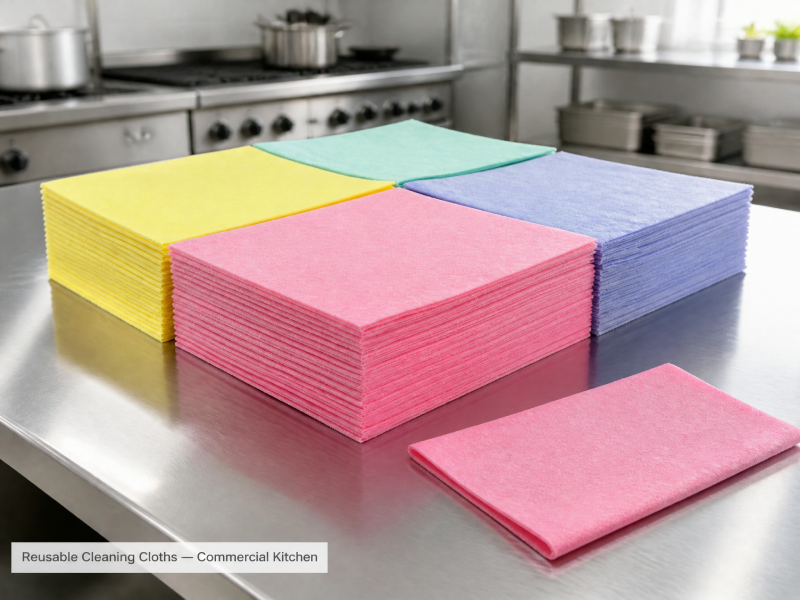
6. Color Coding and Cleaning Zone Management
Color can help commercial kitchens organize cleaning cloths by task or working area.
For example, a kitchen may use different colors for food preparation areas, sinks, dining areas, and equipment cleaning. This can make it easier for staff to identify which cloth should be used in each zone.
However, there is no single color-coding system that applies to every commercial kitchen. Buyers should follow their own internal sanitation procedures and applicable local hygiene requirements.
When purchasing cleaning cloths in multiple colors, buyers should confirm the available color options, color consistency, and whether the supplier can maintain the agreed specifications during repeat orders.
For distributors and brand buyers, color customization may also be relevant to product identification and private-label requirements.
7. What Specifications Should Buyers Confirm Before Bulk Ordering?
Before placing a bulk order for commercial kitchen cleaning cloths, buyers should provide clear product requirements to the supplier.
The following information can help both sides confirm whether the product is suitable.
Specification | What Buyers Should Confirm |
Product type | Reusable nonwoven cloth, disposable cloth, or another cleaning cloth type |
Fiber composition | Polyester, viscose, bamboo, or a specified fiber blend |
GSM | Required fabric weight |
Thickness | Required thickness and acceptable tolerance |
Dimensions | Finished cloth size or customized dimensions |
Color | Available colors and color requirements for different cleaning zones |
Intended application | Counters, sinks, dining tables, equipment exteriors, or beverage counters |
Cleaning method | Wet or dry use, washing method, and intended detergent |
Packaging | Individual packs, bulk packs, cartons, or customized packaging |
Quantity | Pieces per pack, pieces per carton, and total order quantity |
Branding | Logo printing, labels, or private-label packaging |
Order plan | Sample quantity, initial order quantity, and expected repeat orders |
Clear specifications are especially important for repeat purchasing. If buyers need consistent products across multiple orders, the approved sample and confirmed specifications should be used as the reference for future production.
For buyers comparing different materials, reusable needle-punched nonwoven cleaning cloths can be considered as one product option. The final material, GSM, thickness, dimensions, color, and packaging should be confirmed according to the intended application.
8. What Should Buyers Check for Food-Contact Applications?
Not every cleaning cloth is suitable for direct food-contact applications.
If a cloth is intended to be used in areas where it may directly contact food, buyers should verify the material composition, dyes, finishes, intended use, and applicable regulations in the target market.
Relevant compliance documents or test reports should be requested when required. Buyers should not assume that a product is food-contact safe simply because it contains viscose, bamboo, polyester, or another commonly used textile fiber.
The intended application also matters. A cloth used for wiping an external work surface does not necessarily have the same requirements as a material intended for direct food contact.
In addition, cleaning cloths should not be treated as replacements for approved detergents, disinfectants, or established food-safety sanitation procedures.
Before ordering, buyers should clearly explain the intended application and ask the supplier to confirm which product information and supporting documents are available.
9. How Can Buyers Confirm the Right Cleaning Cloth with JHC?
When contacting a supplier, buyers can improve the quotation and sample evaluation process by providing specific purchasing requirements.
For example, buyers should explain the type of commercial kitchen, the surfaces to be cleaned, the expected cleaning frequency, and whether the cloth will be used wet or dry.
They should also provide their preferred fiber composition, GSM, thickness, dimensions, colors, washing requirements, packaging preferences, and estimated order quantity.
HuiZhou JinHaoCheng Nonwovens Co., Ltd. provides needle-punched nonwoven cleaning cloths and related customized product options. The existing reusable cleaning cloth product page lists polyester, viscose, bamboo fibers, and customized fiber blends, together with customization options for GSM, thickness, dimensions, colors, and packaging.
Before confirming a bulk order, buyers should request samples and evaluate them under actual working conditions.
For example, test the cloth on the intended surface and with the cleaning solution used in daily operations. If the product is expected to be reusable, conduct washing and drying evaluations according to the planned cleaning routine.
Buyers should record the approved sample, material composition, GSM, thickness, dimensions, color, and packaging details. These confirmed specifications can then serve as a reference for mass production and future repeat orders.
The most suitable cleaning cloth is not necessarily the thickest, most expensive, or most heavily promoted option. It is the product that matches the actual cleaning tasks, operating procedures, and purchasing requirements.
For commercial kitchens, a clear understanding of the application and product specifications is the starting point for selecting a reliable reusable cleaning cloth.




