
Can PP Meltblown Fabric Handle Your Process Liquid? Compatibility Checks Before Ordering
When sourcing industrial liquid filtration media, PP (polypropylene) is often included in the list of potential materials. However, confirming whether a filter material is suitable involves more than checking whether a supplier offers PP Meltblown Fabric. The fact that polypropylene has chemical resistance in many applications does not mean it is suitable for every acid, alkali, solvent, or industrial process liquid.
The key question is: Can this specific PP meltblown material maintain the required material condition and filtration performance after prolonged contact with the target liquid under actual operating temperatures and pressures?
For industrial filter manufacturers, cartridge converters, and liquid filtration equipment buyers, material selection should start with the actual process medium. The liquid's chemical composition, concentration, temperature, contact time, flow rate, and pressure can all affect material suitability.
This article explains the compatibility checks buyers should make before using PP meltblown fabric for industrial liquid filtration, helping them determine whether a material is suitable for sample evaluation before confirming filtration ratings or placing a bulk order.
Why Should You Not Judge Liquid Compatibility by the PP Material Name Alone?
PP stands for polypropylene, a commonly used thermoplastic polymer. It has value in many industrial and filtration applications. However, this does not mean that every PP product will perform in the same way when exposed to different liquid environments.
First, chemical compatibility depends on the specific chemical substance, not simply on the material name. Different acids, alkalis, salt solutions, organic solvents, oxidizing agents, and mixed liquids may affect materials differently. Even the same chemical can produce different results at different concentrations and temperatures.
Second, PP resin and PP meltblown fabric are not identical test subjects. Chemical compatibility data for PP resin can serve as an initial reference, but an actual filtration material also has a fibrous web structure. Fiber diameter, fiber bonding, material density, thickness, surface treatment, and whether the material is combined with other layers can all affect its performance.
For example, even if a particular PP resin shows good resistance under certain conditions, this does not automatically prove that a meltblown fiber web made from that resin will maintain its structure during continuous liquid filtration. Nor does it prove that the material will meet the required filtration performance.
Buyers should therefore distinguish between two stages of evaluation:
Initial material screening: Use the known properties of PP and available chemical compatibility data to decide whether the material is worth evaluating further.
Application-specific validation: Test a PP meltblown sample matching the intended purchasing specification under conditions representative of the actual process liquid and operating environment.
General chemical compatibility charts can help narrow down material options, but they cannot replace validation based on the actual liquid, concentration, temperature, and contact time.
Start with the Liquid Itself: Chemical Composition, Concentration, and Mixtures
Before deciding whether PP meltblown fabric is suitable for a target process liquid, the first step is to identify exactly what the material will come into contact with.
Descriptions such as "industrial wastewater," "cleaning solution," "acidic liquid," or "chemical solution" are usually not enough for a reliable compatibility assessment. Process liquids used in different factories may have very different chemical compositions.
1. Identify the main chemical components
Where possible, buyers should provide the specific chemical names, main components, and CAS numbers of the liquid. If the liquid is a commercial formulation or a mixture, its technical documentation or SDS (Safety Data Sheet) should be provided.
If several chemicals are present, compatibility should not be judged only by the component with the highest concentration. Other ingredients, additives, cleaning agents, or residual substances may also affect material performance.
2. Confirm the actual concentration
The compatibility of a material with a chemical may differ between a diluted solution and a highly concentrated solution.
Buyers should provide the actual working concentration and explain whether it changes during production, replenishment, or recirculation. If the equipment also involves cleaning, disinfection, draining, or concentration stages, the liquids used during these stages should be disclosed as well.
3. Explain whether the liquid is a mixture
Industrial process liquids may contain solvents, surfactants, salts, oxidizing components, oils, or other additives. Even if a material shows no obvious issue when exposed to one component individually, the combined liquid may produce a different compatibility result.
For this reason, buyers should not rely solely on a compatibility chart for one chemical when evaluating a complex formulation.
4. Do not provide only the pH value
The pH value helps describe the acidity or alkalinity of an aqueous solution, but it does not fully identify the liquid's chemical composition. It also does not reveal whether the liquid contains oxidizing agents, organic solvents, or other components that may affect a polymer.
If a buyer provides only a value such as "pH 3" or "pH 11," the supplier still cannot accurately determine whether PP meltblown material is suitable. Specific chemical components, concentrations, and the source of the liquid should be provided whenever possible.
Temperature, Contact Time, and Operating Cycles Can Change the Evaluation
Liquid compatibility is not a fixed conclusion that can be separated from actual operating conditions. Even when the liquid composition remains the same, changes in temperature and contact time may affect material performance.
1. Operating temperature and maximum temperature
Buyers should provide the normal operating temperature, not just the ambient temperature around the equipment.
If the process involves short periods of elevated temperature, temperature fluctuations, hot cleaning, or high-temperature liquid remaining in the system after shutdown, these conditions should also be disclosed. A material that performs under lower-temperature conditions should not automatically be assumed suitable at higher temperatures.
It is also important to distinguish between a material's temperature resistance and its chemical compatibility. Higher temperatures may change reaction rates and the extent to which a material is affected. Both the specific liquid and the exposure time must be considered.
2. Continuous or intermittent contact
Will the filter material remain in the liquid continuously, or will it only contact the liquid during filtration? These two situations may require different validation approaches.
For continuous recirculation filtration, buyers should explain the operating time per cycle, daily operating hours, and expected service period. If the material is drained or cleaned after each production batch, the cleaning frequency and cleaning medium should also be specified.
3. Service life and replacement interval
Buyers should also provide the expected service life or planned replacement interval of the filter material.
A short-term sample test may help identify obvious material changes, but it does not automatically prove that the material will remain stable during continuous operation over several weeks or months. If the project has a defined service-life requirement, the validation period should be designed accordingly.
Pressure, Flow Rate, and Mechanical Loads Also Affect Material Stability
Chemical compatibility is only one part of material selection. During liquid filtration, the filter material may also be exposed to differential pressure, flow, pressure pulses, installation tension, and mechanical forces from the equipment structure.
1. Operating pressure and differential pressure
Buyers should distinguish between the system's operating pressure and the pressure difference across the filter material. In an actual filtration assembly, differential pressure, material support, and installation conditions can all affect media stability.
If the equipment experiences pressure fluctuations, start-up surges, or backwashing, these conditions should be disclosed in advance. A static immersion test alone cannot replace validation under dynamic filtration conditions.
2. Liquid flow rate
The flow rate affects the operating conditions experienced by the material. Buyers should provide the flow rate, filtration area, equipment operating mode, and expected processing volume whenever possible.
If the filter material must operate at a relatively high flow rate, its resistance to deformation, localized damage, or other structural changes should also be evaluated.
3. Mechanical support and filter assembly structure
PP meltblown fabric may be used as a filtration layer on its own or combined with support layers, protective layers, or other filtration materials.
Buyers should therefore explain whether the material will be used independently or installed in a filter cartridge, filter bag, filter housing, or another assembly. They should also specify whether folding, heat sealing, bonding, wrapping, or other converting processes are required.
If the finished product depends on a support material or composite structure to maintain its shape, confirming the chemical compatibility of the PP meltblown layer alone is not sufficient. Other components in contact with the liquid must also be evaluated, including support meshes, adhesives, seals, cartridge cores, and housings.
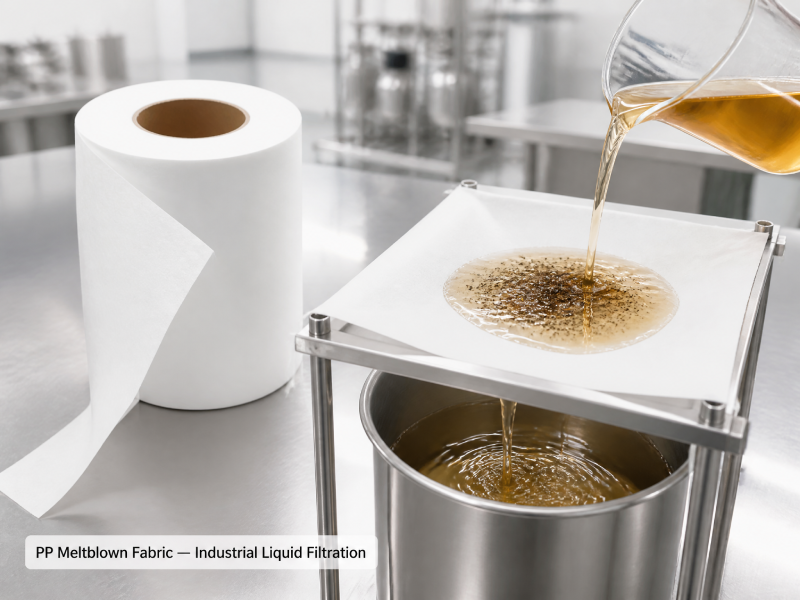
Chemical Compatibility, Filtration Performance, and Structural Stability Must Be Evaluated Separately
When evaluating PP meltblown filter media, buyers sometimes treat "resistant to the liquid," "filters effectively," and "suitable for long-term use" as if they were the same conclusion. In fact, they are three different technical questions.
Chemical Compatibility
The first question is whether contact with the liquid causes unacceptable material changes. Potential changes may include swelling, softening, embrittlement, discoloration, weight changes, or other effects that could influence use. The specific changes that need to be monitored should be determined according to the material and application requirements.
Filtration Performance
The second question is whether the material meets the project's requirements for particle retention, flow rate, differential pressure, or other filtration indicators. Good chemical resistance does not automatically mean that the material can achieve the required filtration rating.
Structural Stability
The third question is whether the material can maintain its integrity under actual temperatures, pressures, flow rates, and operating times. Relevant observations may include deformation, damage, fiber release, or separation between composite layers.
These three aspects should have separate test items and acceptance criteria.
For example, if a sample shows no obvious visual change after short-term liquid exposure, this only indicates that no corresponding change was observed under those particular test conditions. It does not prove that filtration efficiency, differential pressure, or long-term structural stability will meet the project requirements.
Likewise, a material that passes a filtration performance test in a dry condition cannot automatically be assumed to maintain the same performance after prolonged exposure to a process liquid.
For important industrial liquid filtration projects, buyers should define test requirements according to the final application rather than relying on a single material statement or one test result to represent the entire evaluation.
Why Can't PP Resin Compatibility Data Replace Testing on Meltblown Fabric?
Many PP chemical compatibility charts and polymer chemical resistance references are available online. These resources can help buyers screen potential materials, but it is important to understand what materials and test conditions they actually cover.
A compatibility chart may be based on PP pipes, containers, sheets, laboratory equipment, or other solid plastic products. The material grade, thickness, manufacturing method, and test environment may differ from those of the actual PP meltblown filter media.
In addition, a compatibility rating may only apply to a specific temperature and exposure time. Different sources may also use different rating systems. Terms such as "Excellent," "Good," and "Suitable" should not be treated as directly comparable performance standards across different references.
When using third-party compatibility data, buyers should verify at least the following information:
Item to Verify | What Buyers Should Check |
Material tested | Was the test conducted on PP resin, solid PP products, or actual meltblown filter media? |
Chemical substance | Does it match the actual process liquid? |
Concentration | Is the test concentration close to the actual working concentration? |
Temperature | Does the test temperature cover normal and maximum operating conditions? |
Contact time | Is the exposure period relevant to the expected service conditions? |
Mechanical conditions | Were pressure, flow, tension, or other mechanical loads considered? |
Test results | Were appearance, weight, strength, or filtration performance evaluated? |
If a reference only states that a particular PP resin has a certain level of chemical resistance under specific conditions, buyers should not interpret this as proof that a particular PP meltblown fabric has been validated for use with their process liquid.
A more reliable purchasing approach is to use published data for initial screening and then test the actual meltblown material specification against the intended process liquid.
How Should Buyers Validate Samples Before Ordering?
Before placing a bulk order, buyers should work with the supplier to define a sample validation plan. The purpose is not simply to prove whether "PP can be used," but to determine whether a specified filter material can meet the project's requirements under defined operating conditions.
Step 1: Confirm the sample specification and material identity
Record the sample's material type, product grade, basis weight, thickness, width, structure, and relevant batch information.
If the actual purchase involves composite filter media, also record the material composition of each layer, layer arrangement, and converting method. This helps ensure that the tested sample matches the material intended for the subsequent order.
Step 2: Define the actual process liquid and test conditions
Provide the liquid's chemical composition, concentration, normal operating temperature, maximum temperature, contact time, operating pressure, flow rate, and expected service period.
If the liquid is a commercial formulation, provide sufficient technical information to support the evaluation, such as an SDS or an authorized composition description, subject to applicable safety and confidentiality requirements.
Step 3: Determine the compatibility observation items
Depending on project requirements and risk, decide whether to monitor appearance, dimensions, weight, thickness, strength, flexibility, structural integrity, or other changes.
A sample should not be considered fully suitable simply because it "looks fine after immersion." Critical properties should have agreed test methods and acceptable variation limits.
Step 4: Check whether filtration performance changes
If the material is intended to perform a filtration function, relevant filtration indicators should be evaluated before and after liquid exposure or under representative operating conditions.
Depending on the application, these indicators may include filtration efficiency, flow rate, differential pressure, particle retention, or other project-specific requirements. Test methods should match the actual application. An air filtration test result should not be treated as proof of liquid filtration performance.
Step 5: Conduct actual equipment or simulated-condition testing when necessary
For continuous operation, elevated temperatures, complex chemical formulations, or critical industrial applications, a short static immersion test may not provide enough evidence to support a purchasing decision.
Where project conditions allow, testing can be carried out using representative equipment or simulated operating conditions to observe changes during operation. For important projects, buyers may also arrange testing through a third-party laboratory with the appropriate capabilities.
Step 6: Establish sample approval and bulk acceptance criteria
After sample approval, record the sample identification, specification, liquid conditions, test methods, results, and approved version.
For bulk orders, also define material specifications, performance requirements, sampling methods, inspection documents, and procedures for handling nonconforming products. Passing a sample test does not mean that quality control can be omitted for subsequent production batches.
What Information Should Buyers Prepare Before Requesting a Quotation?
If a buyer only asks, "Do you have PP meltblown fabric for liquid filtration?", the supplier usually does not have enough information to determine whether a specific material is suitable for the project.
To make technical communication more efficient, buyers should provide as much of the following information as possible.
Information Category | Recommended Details |
Final application | Liquid filter, cartridge, filter bag, filtration assembly, or another product |
Liquid name | Specific chemical name, main components, or liquid type |
Liquid documentation | SDS, CAS number, or available technical documentation |
Concentration | Actual working concentration and possible variation |
Temperature | Normal operating temperature, maximum temperature, and fluctuations |
Contact time | Continuous or intermittent exposure and expected service period |
Operating conditions | Working pressure, differential pressure, flow rate, and flow velocity |
Filtration requirements | Target particles, filtration rating, flow rate, or other performance requirements |
Material specification | PP meltblown fabric basis weight, thickness, width, and supply format |
Product structure | Single-layer use, composite structure, support layers, or other components |
Testing requirements | Compatibility testing, filtration performance testing, and third-party report requirements |
Purchasing information | Sample requirements, estimated quantity, bulk purchasing plan, and packaging requirements |
If some parameters have not yet been finalized, buyers can also provide an existing filter sample, equipment information, product drawings, or process details. These materials can help the supplier identify which additional technical information is needed.
For drinking water, food-contact, pharmaceutical, or other regulated applications, buyers must separately verify the applicable regulations, standards, migration requirements, and documentation for the final product and all materials in contact with the liquid. A material should not be assumed to meet these requirements simply because it is made from PP.
For customized filtration projects, buyers should also confirm whether the supplier can provide the required material specifications, sample support, and subsequent converting services. Available structures, testing items, and documentation should be confirmed based on the supplier's actual capabilities and the project requirements.
Conclusion: Verify Liquid Compatibility Before Confirming Filtration Specifications
Whether PP meltblown fabric is suitable for a particular industrial liquid cannot be determined by the polymer name alone.
Buyers should first identify the liquid's chemical composition and concentration, then check temperature, contact time, pressure, flow rate, and operating cycles. Chemical compatibility, filtration performance, and structural stability must be evaluated separately. One test result should not be used as a substitute for the other two.
Before bulk purchasing, buyers should confirm the actual material specification, validate samples using representative liquids and operating conditions, and document the approved specifications, test methods, and acceptance requirements.
HuiZhou JinHaoCheng Nonwovens Co., Ltd. provides product information on PP meltblown materials and customized filtration media on its website. For projects involving specific industrial liquids, buyers should provide the liquid composition, concentration, temperature, operating conditions, and target filtration requirements so that the material specification and sample evaluation needs can be reviewed further. Specific compatibility conclusions and performance indicators should be based on the actual material, test conditions, and validation results.
For industrial liquid filtration, a suitable material must do more than allow liquid to pass through. It must meet the project's combined requirements for filtration performance, material stability, and operating conditions.




