
Mesh vs. Knitted Fabric for Shoe Lining: Building Foam-Backed Footwear Materials
When developing shoe lining materials, buyers often need to consider both the fabric substrate and the foam layer. Even when the same type of PU foam is used, combining it with different mesh, knitted fabrics, or warp-knitted fabrics can create different composite structures.
For footwear manufacturers, selecting the right Shoe Lining Foam Fabric involves more than choosing a fabric name or foam thickness. The fabric construction, fiber composition, surface characteristics, flexibility after lamination, and subsequent cutting and sewing requirements all need to be evaluated according to the intended footwear design.
For example, Polyester Mesh, Knitted Fabric, Jersey, and Tricot can all be considered as potential fabric substrates for footwear development. However, they are not four completely separate and unrelated fabric categories. Mesh does not necessarily represent a fabric construction independent of knitted or woven structures, while Tricot is itself a type of warp-knitted fabric.
This guide examines the selection of foam-backed shoe lining materials from a practical purchasing perspective. It explains the structural differences between fabric substrates and PU foam laminates, as well as the key points buyers should check before sample approval and bulk purchasing.
What Role Does Shoe Lining Play in Footwear Construction?
Shoe lining is a material layer used inside footwear, generally positioned on the inner side of the upper material and in contact with the internal shoe space and the wearer's foot. It is different from the outer upper material, tongue padding, collar padding, and insole materials.
Shoe lining materials need to be selected according to the shoe construction and their specific installation positions. Different footwear designs may use different lining structures, so manufacturers should not assume that all sneakers, casual shoes, or work shoes use the same material combination.
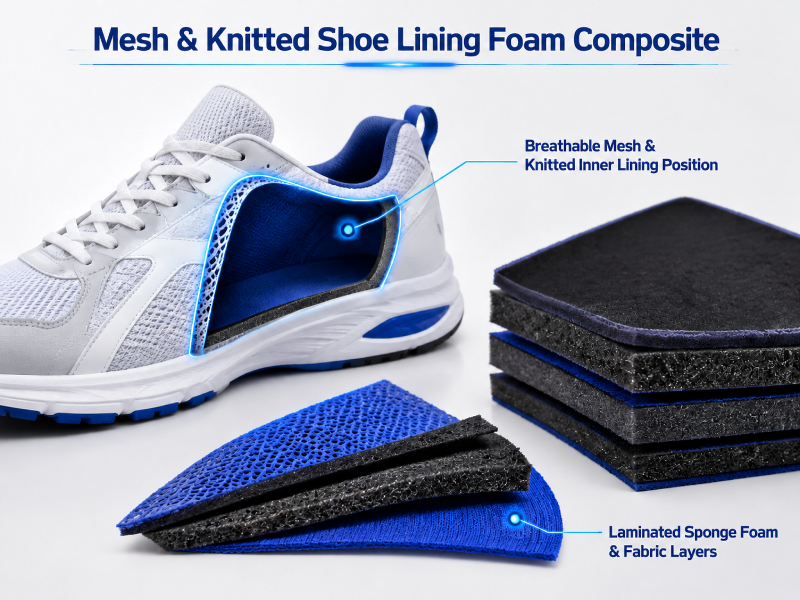
In some footwear development projects, shoe lining may consist of a single fabric layer or a laminated structure combining fabric and foam. The foam can serve as a cushioning layer within the composite, while the fabric forms the surface or an additional supporting layer. The final construction should be determined according to the shoe design, contact area, and subsequent processing requirements.
It is important to distinguish shoe lining from the outer shoe upper.
The outer upper generally needs to meet requirements related to appearance, shoe shape, and external use conditions. Shoe lining, on the other hand, needs to be evaluated in relation to the internal contact surface, material flexibility, overall thickness, and footwear assembly requirements.
Shoe lining should also not be confused with shoe tongue and collar padding. The tongue and collar are specific footwear components with their own shapes, thickness requirements, and sewing methods. Insoles are positioned at the bottom inside the shoe and represent another material application.
Therefore, when sourcing Footwear Lining Fabric, buyers should first identify the actual installation position and determine whether the material needs to be laminated with foam. Once the intended application is clear, suppliers can better evaluate the fabric substrate, foam, and composite structure.
What Are the Differences Between Polyester Mesh, Knitted Fabric, Jersey, and Tricot?
When developing foam laminated shoe lining materials, buyers may encounter material names such as Polyester Mesh, Knitted Fabric, Jersey, and Tricot.
These terms do not describe exactly the same aspect of a fabric. Mesh mainly describes an open structure with visible openings. Knitted Fabric refers to a fabric construction formed by interlooped yarns. Jersey is a common type of knitted fabric, while Tricot is a type of warp-knitted fabric.
Therefore, these four names should not be treated as four completely independent fabric categories with no overlap.
Polyester Mesh
Polyester Mesh generally refers to an open-structured fabric made primarily from polyester fibers. Its specific construction may be produced through different methods, including knitting or weaving.
When selecting mesh, buyers should not provide only the general name "Mesh." They should also confirm the opening size, distribution, fiber composition, fabric weight, thickness, and actual construction.
An open mesh structure may give the material an open surface appearance. However, this does not mean that the finished foam laminated composite will necessarily maintain a particular level of air permeability.
Knitted Fabric
Knitted fabric is formed by yarns arranged into interconnected loops. Different knitting structures, yarn materials, and knitting densities can affect the fabric surface, stretch characteristics, and overall construction.
For footwear lamination projects, knitted fabric can be considered as a potential substrate for foam bonding. Buyers should evaluate its specific construction, GSM, thickness, stretch direction, and condition after lamination.
Not all knitted fabrics have the same elasticity. Different knitted constructions may behave quite differently, so the actual performance needs to be confirmed for each material.
Jersey
Jersey generally refers to a common type of knitted fabric. It is a specific category of knitted fabric rather than a completely separate major category alongside Knitted Fabric.
In footwear projects, Jersey can be considered as a potential fabric substrate. Buyers should confirm its fiber composition, construction, GSM, thickness, and surface requirements rather than judging its suitability based only on the name.
Tricot
Tricot is a type of warp-knitted fabric. Its loop construction differs from that of common weft-knitted fabrics.
In foam lamination projects, Tricot can be considered as a potential substrate depending on the product structure and surface requirements. Buyers should confirm its construction, fiber composition, GSM, thickness, and performance after lamination.
The main relationships between these four material terms can be summarized as follows:
Material name | Main description | What buyers should confirm |
Polyester Mesh | Polyester material with an open mesh structure | Opening size, construction, fiber composition, GSM, and thickness |
Knitted Fabric | Knitted fabric construction | Specific knitting structure, yarn material, stretch characteristics, and surface |
Jersey | A type of knitted fabric | Specific construction, fiber composition, GSM, and thickness |
Tricot | Warp-knitted fabric construction | Warp-knit structure, surface condition, fiber composition, and lamination compatibility |
These material names cannot replace complete material specifications. Even when two suppliers both offer Polyester Mesh or Tricot, their actual constructions, fiber compositions, and material parameters may differ.
Therefore, buyers should provide fabric samples, technical information, or clearly defined material specifications whenever possible. This helps avoid sourcing decisions based only on general fabric names.
What Should Be Considered When Laminating Mesh with PU Foam?
Foam Bonded Mesh Fabric is a composite material formed by combining mesh fabric with foam. For footwear development projects, buyers need to consider both the original mesh construction and the overall condition of the material after lamination with PU foam.
Mesh has an open structure, but its opening size, distribution, yarn construction, and fabric thickness can all affect the final surface of the composite.
When mesh is combined with PU foam, the first consideration is whether the mesh is suitable for the intended internal shoe construction. Buyers should identify which side of the composite the mesh will occupy and what function that side is expected to serve in the finished product.
Next, the bonding condition between the foam and mesh needs to be evaluated. Foam thickness, mesh structure, and lamination method may all affect the surface condition and overall flexibility of the composite. Buyers should not judge the suitability of the finished material based only on the appearance of the mesh before lamination.
For shoe lining projects with specific breathability requirements, one point is particularly important: the open structure of the mesh itself does not mean that the finished laminated composite will have the same air permeability.
The foam structure, whether the mesh openings are covered, adhesive distribution, and the specific lamination method may all affect the pathways through which air can pass.
Therefore, if a project has defined breathability requirements, buyers should first determine whether the test applies to the mesh fabric alone or to the complete mesh-and-foam composite. The test method and acceptance criteria should also be agreed upon in advance.
The following points should be checked when laminating mesh with PU foam:
Evaluation item | What needs to be confirmed |
Mesh specifications | Fiber composition, mesh structure, GSM, thickness, and color |
Foam specifications | PU foam type, thickness, density, and firmness |
Lamination structure | Layer arrangement and bonding side of the mesh and foam |
Surface condition | Actual appearance of the mesh, foam, and laminated interface |
Flexibility | Overall behavior when the laminated material is bent |
Breathability requirements | Whether the complete composite needs to meet a defined air permeability requirement |
Subsequent processing | Cutting, sewing, and footwear assembly requirements |
If a project requires a specific mesh structure, buyers should provide an actual mesh sample or reference image and check the final result using a laminated sample.
A mesh fabric should not automatically be considered more suitable for shoe lining simply because its openings appear larger than those of another material. The important question is whether the complete composite meets the structural and processing requirements of the intended footwear design.
What Should Be Considered When Laminating Knitted Fabric with PU Foam?
When Knitted Shoe Lining Fabric is laminated with PU foam, buyers should pay particular attention to the knitted construction, fabric surface, stretch characteristics, and overall flexibility after lamination.
Unlike materials that are evaluated mainly by their mesh openings, knitted fabrics need to be assessed according to their specific loop construction and yarn structure. Different knitted fabrics may have different stretch directions, surface textures, and thicknesses. Even when the same type of foam is used, they may not produce the same laminated result.
For example, some knitted fabrics may be considered for structures requiring a certain degree of softness and conformability, while others may be selected for particular surface stability or appearance requirements.
These differences cannot be determined by the general term Knitted Fabric alone.
For Jersey and Tricot, buyers also need to confirm the specific fabric construction and material specifications. Jersey is a type of knitted fabric, whereas Tricot is a warp-knitted construction. They should not be treated as identical substrates.
When laminating knitted fabric with PU foam, the following aspects should be evaluated:
Fabric construction and fiber composition. Confirm the specific knitting structure, fiber type, yarn characteristics, and GSM. Avoid providing only a broad material name.
Stretch direction and flexibility after lamination. Stretch characteristics may differ by direction. After foam lamination, the overall bending and stretching behavior of the composite may also change. These characteristics need to be confirmed through actual samples.
Surface feel and appearance. If the knitted fabric will serve as the contact surface of the shoe lining, the surface texture, softness, and overall hand feel should be evaluated using the laminated sample.
Foam thickness and overall construction. Foam thickness affects the overall thickness and bending behavior of the composite. Buyers should confirm the specifications of the individual fabric and foam layers as well as the finished laminated material.
Cutting and sewing compatibility. Different knitted constructions may produce different edge conditions and stretch behavior during cutting and sewing. The processing results should be verified using actual footwear material samples.
After knitted fabric is laminated with PU foam, the final softness cannot be predicted directly from the softness of the original fabric. Foam type, thickness, lamination method, and overall layer construction all influence the final result.
Therefore, when selecting PU Foam Laminated Fabric for Shoes, footwear manufacturers should evaluate the fabric and foam together rather than selecting a fabric first and assuming that it will form a suitable composite with any type of foam.
How Do Different Fabric Substrates Affect Flexibility, Surface Feel, and Subsequent Processing?
Mesh, knitted fabric, Jersey, and Tricot have different constructions. After lamination, they may produce different surface conditions, flexibility, and processing behavior.
However, these differences cannot be simplified into a claim that one fabric type is always softer, more breathable, or more durable than another. Actual results also depend on fiber composition, fabric construction, GSM, thickness, foam specifications, and lamination conditions.
For footwear buyers, the following aspects should be considered when comparing different substrates.
Flexibility and bending behavior
Shoe lining materials may need to follow the internal shape and assembly structure of the footwear. Buyers should check how the laminated material behaves when bent, folded, or fitted around the curved surfaces of the intended shoe design.
Mesh and knitted fabrics have different constructions, but this does not automatically determine which finished composite will be more flexible. Foam thickness and the overall lamination structure also affect the final result.
Surface feel and contact characteristics
If the laminated material will serve as a contact surface inside the shoe, the fabric texture, softness, and surface condition should be confirmed through sample evaluation.
Different Jersey, Tricot, or Mesh fabrics may have different surface structures. Even when the same type of foam is used, their contact feel may not be the same.
Breathability and air pathways
The open structure of mesh may provide pathways for airflow, but the foam and other laminated layers can change how air passes through the material.
Therefore, the breathability of the original fabric should not be treated as equivalent to the breathability of the complete laminated composite. If a shoe lining project has a defined air permeability requirement, the complete composite should be tested rather than relying only on the test results of the fabric substrate.
Cutting and sewing performance
Different fabric constructions may produce different edge conditions during cutting and different stretching or material displacement behavior during sewing.
The composite should also be checked for noticeable layer misalignment, wrinkles, or localized delamination between the foam and fabric. Actual results need to be verified under the intended equipment and processing conditions.
Overall thickness and available space inside the shoe
The thickness of the shoe lining material affects the overall construction. Buyers should confirm the foam thickness, fabric thickness, and finished composite thickness, then evaluate them against the available space in the intended footwear design.
The suitability of the finished material cannot be determined from foam thickness alone. The thicknesses of individual layers should also not simply be added together and treated as the final laminated thickness.
Therefore, when selecting Foam Backed Shoe Lining, buyers should evaluate the fabric substrate, foam, lamination structure, and subsequent processing requirements as one complete system rather than assessing each layer separately.
How Should Buyers Choose Between Single-Sided Lamination and a Fabric + Foam + Fabric Structure?
Foam laminated shoe lining materials can be developed with different layer arrangements according to the product design. Common structures to consider include single-sided lamination and a three-layer Fabric + Foam + Fabric construction.
Single-sided lamination: Fabric + Foam
A single-sided laminated structure consists of one fabric layer and one foam layer. Depending on the product design, the fabric forms one surface of the composite, while the foam forms the other layer.
This can be considered as an option for shoe lining development, particularly when the component requires fabric coverage on only one side.
Buyers should confirm which side of the composite contains the fabric, whether the foam will directly contact other footwear components, and whether an additional lining layer is required during subsequent assembly.
Three-layer lamination: Fabric + Foam + Fabric
A three-layer structure places the foam between two fabric layers, providing fabric coverage on both sides of the composite.
This arrangement may be considered when the shoe lining construction requires different surface materials on the two sides or when both sides need fabric coverage.
The two fabric layers do not necessarily need to be identical. Buyers can specify the fiber composition, construction, color, GSM, and surface requirements of each side according to the product design.
However, a three-layer structure is not automatically better than a single-sided laminated structure. Adding another fabric layer also changes the overall thickness, weight, and processing behavior of the composite. These factors need to be evaluated against the intended footwear design.
The main differences between the two structures are summarized below:
Composite structure | Layer arrangement | Main points to confirm |
Single-sided lamination | Fabric + Foam | Fabric side, foam surface application, overall thickness, and subsequent processing |
Three-layer lamination | Fabric + Foam + Fabric | Fabric specifications on both sides, overall thickness, surface requirements, and processing compatibility |
If the two sides of the shoe lining contact different footwear components, buyers should identify the requirements and installation positions of both sides before deciding whether fabric coverage is needed on each side.
If only one side requires a fabric surface, a three-layer structure should not be selected simply to increase the number of layers.
When developing Foam Bonded Mesh Fabric or knitted fabric foam composites, buyers should first confirm the actual shoe lining construction and then determine which lamination structure is appropriate.
How Can Actual Footwear Samples Confirm Whether Foam Laminated Shoe Lining Is Suitable?
For footwear manufacturers, material names and specification sheets can help with initial screening, but they cannot completely replace actual sample evaluation.
In particular, after mesh, knitted fabric, and PU foam are laminated together, the overall material may behave differently from the original fabric or foam alone. Buyers should use samples that are as close as possible to the final footwear construction.
Step 1: Identify the actual installation position of the shoe lining.
Confirm which shoe model and lining area the material will be used for, as well as its relationship with the outer upper, tongue, collar, and other footwear materials.
If the shoe lining has different sections or material combinations, describe them separately. Avoid applying one material specification to every area without evaluation.
Step 2: Confirm the fabric and foam specifications.
Specify the fabric type, fiber composition, GSM, thickness, color, and the PU foam type, thickness, density, and firmness.
If the buyer has not yet selected mesh or knitted fabric, an existing footwear material sample can be provided so the supplier can evaluate potential substrates according to the intended application.
Step 3: Check the surface and construction of the laminated material.
Confirm whether the fabric surface meets the requirements and whether there are noticeable defects such as delamination, bubbles, misalignment, or other abnormalities between the foam and fabric.
The finished composite thickness, overall flexibility, and surface conditions on both sides should also be checked.
Step 4: Test the material using the actual footwear processing methods.
If the material needs to be cut, sewn, folded, or assembled, it should be tested using processing methods that are as close as possible to the intended shoe production process.
Pay particular attention to cut edges, stitching positions, material stretching, localized deformation, and the overall condition after assembly.
Step 5: Confirm that the approved sample and bulk product have consistent specifications.
After sample approval, record the fabric substrate, foam, layer arrangement, thickness, width, and other agreed specifications.
If the subsequent bulk order uses a different fabric, foam, or lamination structure, the original sample approval cannot automatically be applied to the new material combination.
If the buyer has specific requirements for air permeability, abrasion resistance, tear strength, or other properties, the test object, test method, and acceptance criteria should be defined in advance. The suitability of the complete composite should not be judged only by hand feel, appearance, or test results from the fabric substrate alone.
For footwear material projects requiring long-term supply, sample approval should be completed before bulk purchasing, with the material specifications and acceptance conditions for subsequent batches clearly documented.
What Information Should Footwear Manufacturers Provide Before Purchasing Shoe Lining Foam Fabric?
When purchasing Shoe Lining Foam Fabric, providing clear material information helps suppliers evaluate whether the fabric substrate, foam, and composite structure are suitable for the intended footwear design.
If buyers provide only broad names such as Mesh, Knitted Fabric, or PU Foam, this is usually not enough to determine the complete composite specifications.
The following information should be prepared in advance:
Purchasing information | Details to provide |
Final application | Sneakers, casual shoes, work shoes, or other footwear |
Material position | Specific shoe lining location and its relationship with other footwear components |
Fabric type | Polyester Mesh, Knitted Fabric, Jersey, Tricot, or another material |
Fiber composition | Polyester, Nylon, or other fiber compositions |
Fabric specifications | GSM, thickness, color, surface condition, and fabric construction |
Foam specifications | PU foam type, thickness, density, and firmness |
Lamination structure | Fabric + Foam or Fabric + Foam + Fabric |
Finished material specifications | Width, length, finished composite thickness, and dimensional requirements |
Subsequent processing | Cutting, sewing, folding, assembly, and other processing methods |
Performance requirements | If air permeability, abrasion resistance, tear strength, or other properties are required, provide the test methods and acceptance criteria |
Order quantity | Sample requirements, trial order quantity, and estimated bulk quantity |
Reference information | Existing footwear material samples, structural drawings, shoe photographs, or technical specifications |
If the buyer has not yet selected a specific fabric substrate, an existing shoe lining sample, footwear photograph, or structural drawing can be provided. The supplier can then evaluate potential combinations of mesh, knitted fabric, and foam according to the intended application.
For foam lamination projects, HuiZhou JinHaoCheng Nonwovens Co., Ltd. has experience in laminating PU and EVA foam with different materials. Related projects may involve flame lamination, adhesive lamination, or hot-melt lamination. Depending on the project, some processing is handled internally while other requirements may involve external processing arrangements. The specific fabric, foam combination, and lamination method still need to be confirmed according to the project requirements.
The available footwear product information does not mean that every combination of Mesh, Jersey, Tricot, and PU Foam is already an established standard production structure. Shoe lining-specific laminated solutions still need to be evaluated according to the actual materials, samples, and processing requirements.
When developing Foam Backed Shoe Lining, the real purchasing question is not simply which fabric name is better. It is which fabric and foam combination is suitable for the structure, surface requirements, and subsequent processing of the intended footwear design.
By defining the material specifications, confirming the laminated layer structure, and evaluating actual footwear samples, manufacturers can make a more reliable decision when selecting foam laminated shoe lining materials for bulk purchasing.




