
Foam Laminated Fabric vs. Wool Felt for Insoles: Different Material Roles in Footwear
When developing footwear insoles, one important question is often overlooked: are you sourcing a composite material with a fabric surface and a cushioning layer, or a needle-punched felt material with a specific fiber structure and thickness?
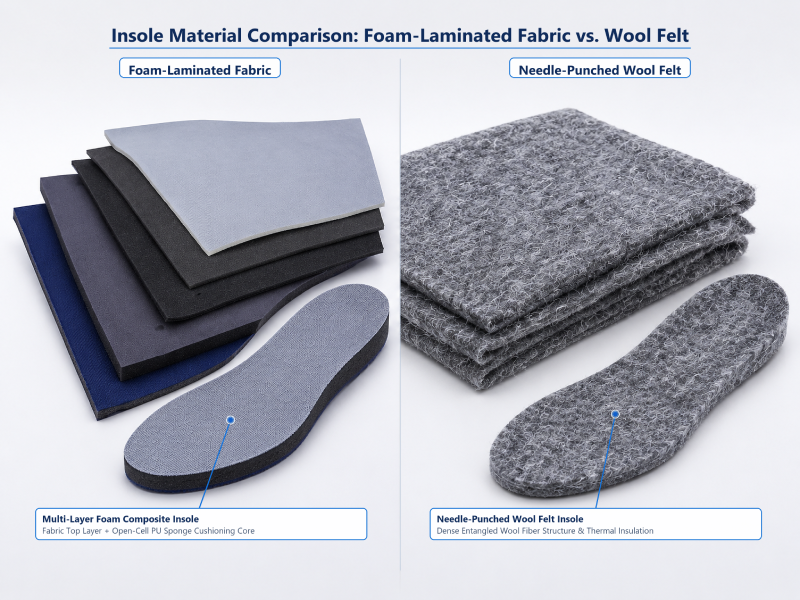
Foam laminated fabric and wool blend needle punched felt can both be considered for footwear applications, but they are not the same type of material. Foam laminated fabric is generally made by bonding foam with one or more fabric layers. Wool blend needle punched felt, on the other hand, is a nonwoven material formed from wool and other fibers through a needle-punching process. Their layer structures, surface characteristics, material development approaches, and downstream processing requirements are different.
For insole brands and footwear manufacturers, the key question is not which material is superior. It is whether the material matches the intended insole construction, foot-contact requirements, thickness limitations, and manufacturing process.
Are Insoles, Footbeds, and Shoe Linings the Same Material?
Before requesting a quotation, it is important to identify where the material will be used in the footwear structure. The terms insole, footbed, and shoe lining are sometimes used interchangeably in everyday communication, but they do not refer to exactly the same components.
Insole generally refers to the material or component positioned inside the shoe beneath the foot. Depending on the footwear design, an insole may consist of a single material or multiple layers, such as a surface layer, cushioning layer, and bottom supporting layer.
Footbed usually refers to the area or structure that directly contacts and supports the foot. It may consist of several combined material layers or include a molded supporting structure. A footbed is not necessarily the same as a flat sheet of insole material.
Shoe lining refers to materials positioned along the inner sides or other interior surfaces of the shoe. Its location and function differ from those of materials placed directly beneath the foot. Shoe lining requirements may focus more on fit, surface feel, flexibility, and sewing compatibility.
Therefore, insole materials should not be confused with shoe lining materials. Even if both contain foam or fiber layers, their installation positions and application requirements may be different.
Material or component | Main position | Purchasing considerations |
Insole | Beneath the foot | Thickness, construction, surface contact, cushioning layers, and processing |
Footbed | Foot-supporting area | Overall construction, fit, support design, and layer combinations |
Shoe lining | Inner sides or other interior surfaces | Surface feel, flexibility, bending, and sewing requirements |
If you are sourcing an insole surface material, a foam cushioning layer, or a complete footbed construction, specify the intended component clearly in your inquiry instead of using only the general term "insole material."
What Role Does Foam Laminated Fabric Play in Insole Construction?
Foam laminated fabric is generally a composite material made by combining foam with fabric or other materials. It is not a single foam layer, nor is it a finished insole that has already been cut, shaped, and assembled.
In insole development, the foam layer can serve as part of the cushioning structure, while the fabric may form one or both surface layers. The actual construction depends on the insole design.
Common structural options include:
Structure | Material layers | What buyers need to confirm |
Single-sided lamination | Fabric + Foam | Whether the fabric is the exposed surface and whether the foam meets the required thickness |
Double-sided lamination | Fabric + Foam + Fabric | Whether the two fabric surfaces have different functional or surface requirements |
Combination with other materials | Fabric + Foam + Other supporting layer | The purpose of each additional layer, bonding method, and final thickness |
Different foam types, such as PU or EVA, may be considered according to project requirements. However, the foam type alone cannot determine the comfort, cushioning performance, or durability of the finished insole. The specific foam grade, thickness, density, hardness, and compression behavior may all affect the final composite material.
The fabric also influences the finished material. Its fiber composition, construction, GSM, and surface characteristics should be evaluated together with the foam and the intended downstream processing method.
For buyers, Shoe Insole Foam Fabric should not simply be understood as "fabric with foam." It is important to clarify whether the material will be used as a composite insole surface, an internal cushioning layer, or one component of a multilayer footbed construction.
What Are the Characteristics of Wool Blend Needle Punched Felt for Insoles?
Wool blend needle punched felt has a different structure from foam laminated fabric. It is a nonwoven material formed from fibers through a needle-punching process.
Wool can be blended with other fibers, such as polyester. Different fiber ratios and material structures can affect the finished felt's surface feel, softness, structural stability, and processing behavior. The actual results need to be evaluated according to the material specifications rather than inferred from wool content alone.
In footwear development, wool blend needle punched felt can be evaluated as an independent fiber-based insole material. It may be a suitable material option for footwear projects that focus on wool fiber content, material feel, or thermal insulation requirements.
However, wool felt is not a layered structure made by laminating foam with fabric. Its material characteristics come from its fiber composition and needle-punched structure, rather than from separate foam and fabric layers.
When sourcing wool blend needle punched felt, buyers should look beyond the wool percentage. The following specifications also need to be confirmed:
Specification | What buyers need to confirm |
Fiber composition | Wool percentage and the specific types of other fibers |
GSM | Material weight per square meter |
Thickness | Target thickness and measurement conditions |
Density or structural condition | Material compactness and needle-punched structure requirements |
Hand feel | Soft, firm, or another required feel |
Dimensions | Roll width, sheet size, or customized dimensions |
Further processing | Cutting, die cutting, or other insole processing requirements |
The same wool blend ratio does not necessarily produce identical hand feel or structural performance across different batches and specifications. GSM, thickness, fiber composition, and needle-punched structure should all be confirmed during sample approval.
If your project focuses on the characteristics of wool fibers, you can also refer to wool blend needle punched felt for insoles to learn more about the material's role in footwear insole applications.
What Are the Main Differences Between Foam Laminated Fabric and Wool Blend Needle Punched Felt?
The most important difference between these two materials is how their structures are formed.
Foam laminated fabric consists of a foam layer combined with fabric or other material layers. Buyers need to confirm the material used in each layer, the layer arrangement, and the bonding method.
Wool blend needle punched felt is a fiber-based nonwoven material. Its main purchasing considerations include fiber composition, GSM, thickness, structural condition, and further processing requirements.
Comparison | Foam laminated fabric | Wool blend needle punched felt |
Basic structure | Foam combined with fabric or other material layers | Needle-punched nonwoven structure made from wool and other fibers |
Material composition | Foam, fabric, and possible additional layers | Wool and other blended fibers |
Surface characteristics | Depend on the selected fabric and lamination structure | Depend on fiber composition, needle-punched structure, and surface treatment |
Cushioning layer design | Can be designed by selecting foam type and specifications | Determined by fiber structure, thickness, and material condition |
Main specifications | Foam type, thickness, density, hardness, fabric GSM, and total laminated thickness | Fiber ratio, GSM, thickness, density or structural condition |
Processing considerations | Layer bonding, cutting, sewing, and bending compatibility | Felt cutting, die cutting, edge condition, and shaping compatibility |
Purchasing focus | Confirm each material layer and the lamination structure | Confirm fiber composition and needle-punched felt specifications |
It is important not to conclude that foam laminated fabric is automatically softer, more comfortable, or more durable than wool felt. Similarly, wool felt should not automatically be considered warmer or more suitable for every winter insole.
The final performance depends not only on the material name but also on its specifications, insole construction, processing method, and actual application environment.
If an insole design requires a defined fabric surface combined with a separate foam layer, foam laminated fabric can be considered as a material option. If the project requires an overall needle-punched felt material containing wool fibers, wool blend needle punched felt may be worth evaluating.
How Should Buyers Consider These Two Materials for Different Footwear Applications?
Material selection should start with the actual insole design. Buyers should not choose a material name first and then expect it to fit every footwear application.
Casual Shoes and Athletic Footwear
For these projects, the first step is to identify the insole's layer construction. If the design includes a fabric contact surface and a foam cushioning layer, foam laminated fabric can be evaluated. If the proposed insole relies more on an overall fiber-based material structure, needle-punched felt may be another option.
Buyers should also confirm thickness limitations, cutting shapes, edge finishing, and compatibility with the available space inside the shoe.
Winter Shoes and Insulated Footwear
If the insole design emphasizes wool fiber content and the material's insulation-related role, wool blend needle punched felt can be considered.
If the design requires a composite layer made from foam and fabric, foam laminated material may also be evaluated. However, a foam structure alone does not prove that the material provides better thermal insulation. Specific insulation requirements should be verified through the actual material and finished-product testing.
Insoles or Footbeds with Multilayer Structures
Some insoles or footbeds may contain a surface material, cushioning layer, and other supporting layers. In these cases, buyers should first define the function of each layer before deciding whether to use foam laminated fabric, wool blend needle punched felt, or a combination of different materials.
However, combining materials does not automatically produce a better result. Additional layers may change the overall thickness, weight, flexibility, and processing difficulty. The complete structure needs to be evaluated against the actual product design.
Customized Insoles and Specially Shaped Footbeds
If the insole requires a specific outline, curved surface, or die-cut shape, cutting and shaping compatibility are also important.
For foam laminated fabric, buyers should check the condition of the composite layers during processing. For wool blend needle punched felt, they should pay attention to cutting edges, thickness consistency, and material structure.
For both materials, a roll sample alone is not enough to determine the final product result.
What Specifications and Processing Requirements Should Buyers Confirm When Sourcing Insole Materials?
Foam laminated fabric and wool blend needle punched felt require different specification checks. Buyers should provide material-specific information instead of simply requesting a quotation based on one target thickness or GSM value.
If you are sourcing foam laminated fabric, provide:
Item | Information to provide |
Final application | Insole, footbed, or another footwear component |
Foam type | PU, EVA, or another specified material |
Foam specifications | Thickness, density, hardness, and other confirmed technical requirements |
Fabric requirements | Fabric type, fiber composition, GSM, color, and surface requirements |
Lamination structure | Single-sided lamination, double-sided lamination, or another layer arrangement |
Finished specifications | Total thickness, width, length, or sheet dimensions |
Further processing | Cutting, die cutting, sewing, bonding, or other processing requirements |
Order information | Sample quantity, estimated bulk quantity, and delivery requirements |
If you are sourcing wool blend needle punched felt, provide:
Item | Information to provide |
Fiber composition | Wool percentage and other fiber contents |
GSM | Target weight or acceptable range |
Thickness | Target thickness and measurement requirements |
Material condition | Required softness, compactness, and structural characteristics |
Color | Natural color or specified color |
Finished dimensions | Roll width, sheet size, or die-cut dimensions |
Further processing | Cutting, die cutting, or other processing requirements |
Order information | Sample quantity, estimated bulk quantity, and delivery requirements |
For both materials, buyers should also specify whether they have particular compression, resilience, abrasion resistance, thermal insulation, or other performance requirements.
If test results are required from the supplier, the test method, test conditions, and acceptance criteria should be agreed upon first. General descriptions such as "comfortable," "durable," or "high resilience" are not sufficient as purchasing specifications.
How Can Actual Insole Samples Confirm Whether a Material Is Suitable?
Material names and specifications can help buyers narrow down their options, but they cannot completely replace testing with actual insole samples.
The material should be evaluated according to the development process of the finished product.
First, provide the target insole or footbed drawings, photos, or an existing sample. Explain where the material will be installed and how the different layers are arranged. This helps prevent suppliers from confusing shoe lining, insole surface material, and cushioning layers.
Next, confirm the sample specifications for either foam laminated fabric or wool blend needle punched felt.
For foam laminated fabric, record the foam type, fabric composition, lamination structure, and total thickness. For wool blend needle punched felt, record the fiber ratio, GSM, thickness, and material condition.
Then, evaluate the material using the actual processing workflow. Check the cut edges, whether the material thickness meets the design requirements, whether any laminated layers shift during processing, whether the felt develops unacceptable edge conditions, and whether the material can match the required insole shape and assembly method.
If the insole requires bending, compression, or other forming processes, the material should also be evaluated under the actual production conditions. A flat material sample alone cannot fully demonstrate how the finished component will perform inside the shoe.
Finally, use the approved sample specifications as the basis for bulk purchasing. The sample and bulk materials should remain consistent in fiber composition, foam type, fabric, thickness, GSM, lamination structure, and other key requirements. If the material or processing method changes later, the impact of that change on the finished insole should be reviewed and approved again.
For projects with specific cushioning, compression, resilience, thermal insulation, or abrasion resistance requirements, the relevant test methods and acceptance criteria should be agreed upon during product development. Without supporting test evidence, performance should not be guaranteed based only on the material name.
In footwear material development projects, HuiZhou JinHaoCheng Nonwovens Co., Ltd. has experience in needle-punched felt production and projects involving the lamination of PU and EVA foam with different materials. These projects involve flame lamination, adhesive lamination, and hot-melt lamination. Processing arrangements vary by project, and some projects involve external processing. Therefore, the suitability of a specific foam laminated structure for an insole still needs to be evaluated according to the fabric, foam specifications, insole drawings, and actual samples. Existing lamination experience should not be interpreted as proof that every insole construction has already been validated.
For footwear brands and manufacturers developing insole materials, the most effective purchasing approach is not to decide which material is better at the beginning. Instead, define the insole's layer construction, material functions, and processing requirements first, then evaluate foam laminated fabric and wool blend needle punched felt separately. Only when the material structure matches the final insole design can sample approval and bulk purchasing proceed with clear requirements.




