
Inside Luggage Construction: Foam Laminated Fabrics for Suitcase Linings and Travel Bags
The internal construction of luggage and travel bagsis not simply an outer fabric combined with a lining layer. Depending on the bag design, the interior may also include divider fabrics, flexible padding materials, pocket panels, partition structures, and other auxiliary materials.
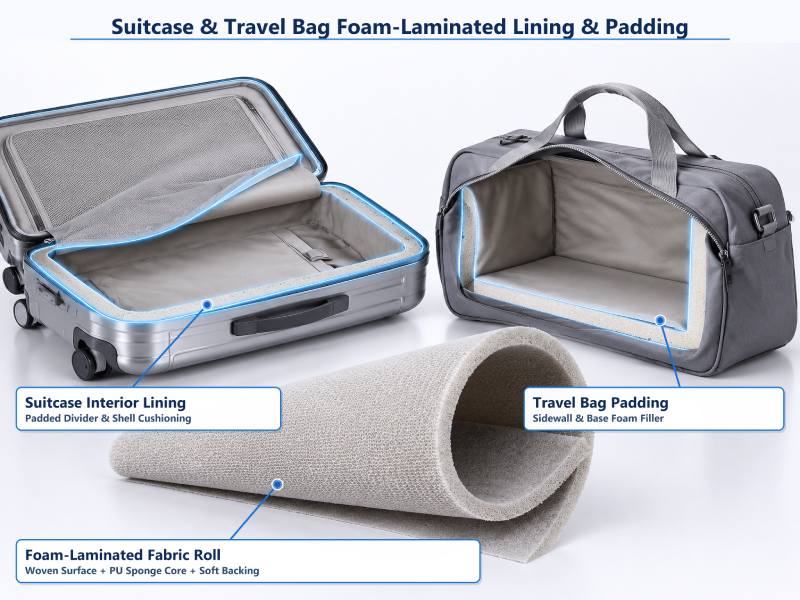
Although these materials are all located inside the bag, they do not necessarily serve the same purpose. Ordinary lining fabric mainly covers the interior surface. Foam laminated fabric can be used as a flexible padded panel or composite lining material. Components that need to maintain their shape or provide structural support may require separate support materials.
Foam laminated fabric is one material option to consider when developing the interiors of suitcases and travel bags. It combines foam with fabric to create a material with a certain thickness and degree of flexibility, which can be cut and processed for subsequent bag manufacturing.
However, foam laminated fabric is not a complete suitcase lining, nor can it directly replace rigid structural support boards. Buyers should first identify the specific position and function of the material inside the bag before deciding on the foam, fabric, lamination structure, and supply format.
What Materials Are Commonly Used in the Interior Construction of Suitcases and Travel Bags?
The internal construction of different suitcases and travel bags depends on the case type, fabric materials, compartment design, and intended use.
Hard-shell suitcases and soft travel bags have different constructions. A hard-shell suitcase generally uses a rigid outer shell to provide its overall shape. Its interior may then use lining fabric, divider panels, pockets, and fixing straps to organize the available space. A soft travel bag may use a combination of outer fabric, lining fabric, and localized padding materials to form its structure.
Common internal materials can be understood as follows:
Internal material or component | Main function | What buyers should consider |
Lining Fabric | Covers the interior surface and creates a finished inner structure | Fabric type, GSM, color, surface texture, and sewing requirements |
Foam Laminated Fabric | Forms flexible padding or cushioning panels for further cutting and assembly | Foam type, thickness, density, fabric structure, and lamination method |
Divider Panel | Separates the interior into different compartments | Panel dimensions, construction, material layers, and connection methods |
Structural Support Material | Helps specific components maintain their shape or provides structural support | Stiffness, thickness, shape, installation position, and processing method |
Pocket and Auxiliary Fabric | Forms internal storage spaces or connects with other components | Fabric flexibility, dimensions, sewing positions, and assembly requirements |
These materials may be used together, but they should not be treated as interchangeable simply because they are all located inside a bag.
For example, lining fabric mainly provides surface coverage. Foam laminated fabric can serve as a flexible padded panel. Rigid support materials need to be selected separately according to the structural requirements.
Before purchasing, manufacturers should identify the position and function of each material rather than providing only a general description such as "luggage lining."
What Is the Difference Between Lining Fabric, Foam Padding, and Structural Support Layers?
This is one of the first points that should be clarified when developing materials for suitcase and travel bag interiors.
Lining fabric mainly covers the interior surface of a bag. It may be used on the inside of the case, inside pockets, or on compartment surfaces. Buyers generally need to confirm the fabric type, color, GSM, thickness, and sewing suitability.
Foam padding is mainly used to create a flexible padded structure. It can be laminated with knitted fabric, woven fabric, nonwoven fabric, or other suitable substrates to form a foam laminated material. Whether the material is suitable for a particular bag component depends on its thickness, flexibility, and downstream processing requirements.
Structural support layers serve a different purpose. They help maintain the shape of specific components or provide structural support. Depending on the bag design, they may use rigid boards, dedicated support sheets, or other structural materials.
The differences can be summarized as follows:
Comparison | Lining Fabric | Foam Padding | Structural Support Layer |
Main function | Interior surface coverage | Flexible filling or cushioning | Shape retention or structural support |
Common material form | Textile or nonwoven fabric | Foam or foam laminated fabric | Rigid boards or dedicated support materials |
Flexibility requirements | Depends on the lining position | Generally evaluated together with the bag construction | Determined by the intended support function |
Further processing | Cutting, sewing, and edge binding | Cutting, lamination, sewing, or assembly | Die cutting, shaping, installation, or connection |
Foam laminated fabric is not the same as a structural support board. Even when foam laminated fabric has a certain thickness, its ability to maintain the shape of a case or divider cannot be determined by thickness alone.
If a bag component requires a higher level of stiffness or stable structural support, buyers should specify the support material separately rather than assuming that ordinary foam laminated fabric can replace it.
Where Can Foam Laminated Fabric Be Used Inside Suitcases and Travel Bags?
Foam laminated fabric can be considered as a flexible composite material for the interiors of suitcases and travel bags. However, not every internal position requires foam.
Whether foam laminated fabric is appropriate depends on the structure of the component, surface requirements, and subsequent processing methods.
Internal bag position | Material structure to evaluate | Key points to confirm |
Localized panels inside the case | Fabric + Foam | Panel thickness, flexibility, cutting, and connection to the inner lining |
Internal divider panels | Fabric + Foam or other composite structures | Divider shape, surface requirements on both sides, thickness, and support requirements |
Localized padding on the sides or bottom of travel bags | Fabric + Foam | Material flexibility, sewing positions, and overall bag construction |
Inside lid panels or areas around internal pockets | Lining fabric or foam laminated fabric | Pocket construction, opening space, material thickness, and connection methods |
Flexible protective panels | Foam laminated fabric or other suitable materials | Specific protection requirements, material combinations, and actual sample performance |
These are potential application areas to evaluate during material development. They do not mean that every suitcase or travel bag uses the same internal construction.
For example, the outer shell of a hard-shell suitcase generally provides its overall shape and main structural support. Foam laminated fabric may be evaluated for localized flexible panels or lining materials inside the case. It cannot automatically replace the hard shell, frame, or other structural components.
The internal construction of a soft travel bag may rely more heavily on fabrics, padding materials, and sewn assemblies. Some panels may require foam laminated materials, while other positions may only need ordinary lining fabric.
Manufacturers should therefore provide the actual bag construction drawings or existing samples before deciding which areas require foam laminated fabric.
If the project also involves protective compartments for laptops or cameras, refer to foam padding materials for laptop and camera bags. These applications focus on equipment compartment dimensions and protection requirements, which are different from the purchasing requirements for ordinary suitcase interior panels.
How Should PU, EVA, and PE Foam Be Combined with Different Fabrics?
When developing foam laminated materials for suitcases and travel bags, PU, EVA, and PE foam are possible foam types to evaluate. However, their material characteristics and processing suitability are different. Buyers should not determine which type is most suitable for a bag component based only on its material name.
Foam type | Specifications to confirm during development | Considerations when combining with bag fabrics |
PU Foam | Type, thickness, density, hardness, and compression characteristics | Flexibility, total thickness, bending behavior, and subsequent sewing |
EVA Foam | Material grade, thickness, hardness, and specific physical characteristics | Bonding condition with the fabric, material flexibility, and processing suitability |
PE Foam | Material type, thickness, density, and processing requirements | Surface characteristics, lamination suitability, and subsequent processing requirements |
The fabric substrate also affects the final composite structure.
Knitted fabric may be considered for composites that require a certain degree of flexibility. Woven fabric can be evaluated according to its textile construction and dimensional stability requirements. Nonwoven fabric needs to be assessed based on its fiber composition, GSM, and thickness.
For suitcase linings and travel bag interior panels, buyers should also specify whether the fabric is positioned on one side of the foam or on both sides, and whether the finished material needs to maintain a particular surface appearance.
For example, Fabric + Foam may be used when fabric coverage is required on only one side. Fabric + Foam + Fabric may be considered when both sides need fabric surfaces. However, adding another fabric layer does not automatically make the material more suitable. The total thickness, flexibility, and downstream processing requirements must also be considered.
If the foam type has not yet been determined, manufacturers can first evaluate the intended function of the bag component and the actual material samples before deciding on a suitable combination. Material selection should not be based only on foam price or density.
For more information about foam material differences, refer to the comparison of PU, EVA, and PE foam laminated materials. To evaluate fabric substrate options, see the guide to fabric substrates for foam laminated materials.
Should Luggage Interior Materials Be Supplied in Rolls, Sheets, or Pre-Cut Pieces?
Foam laminated fabric can be supplied in different formats depending on the subsequent manufacturing process. Rolls, sheets, and pre-cut pieces are not simply different packaging options. They can affect how the material enters and moves through the bag factory's production process.
Supply format | Basic characteristics | Production stages to consider |
Rolls | Supplied as continuous material | Unwinding, slitting, nesting, cutting, and continuous processing |
Sheets | Supplied in specified sheet dimensions or sizes | Sheet dimensions, cutting allowance, material utilization, and further processing |
Pre-cut Pieces | Supplied after cutting to specified shapes or dimensions | Drawing accuracy, shape confirmation, dimensional tolerances, and batch consistency |
Rolls may be suitable for production processes that require continuous material feeding, slitting, or in-house nesting and cutting. Buyers need to consider how the material width matches their cutting equipment and the dimensions of the luggage panels.
Sheets may be used in production processes where materials are processed according to individual panels or components. Their dimensions should be checked against the actual cutting layout to avoid excessive offcuts.
Pre-cut pieces can reduce some downstream cutting work, but the drawings, cutting shapes, dimensions, and material direction must be confirmed first. Internal panels may differ between bag models, so bulk cutting specifications should not be finalized before the drawings are approved.
It is important to note that rolls, sheets, and pre-cut pieces are different supply format options. Their availability does not mean that every supplier has an established standard supply capability for all three formats. The actual supply format, processing responsibilities, and delivery requirements need to be confirmed for each project.
For luggage manufacturers, the most suitable supply format depends on their production equipment, cutting methods, order quantities, and in-house processing arrangements. It should not be selected simply because one format appears more convenient.
How Do Luggage Interior Structures Affect Foam Thickness, Flexibility, and Cutting?
Interior materials for suitcases and travel bags need to fit the actual bag construction. Foam thickness, total laminated thickness, flexibility, and cutting shapes can all affect whether a material is suitable for subsequent production.
First, buyers should distinguish between foam thickness and total laminated thickness. Foam laminated fabric may contain foam, fabric, and other supporting layers. The total thickness should not be determined by looking at the foam thickness alone.
Second, the material needs to match the shape and bending requirements of the specific panel. The inside of a case, lid panels, the sides of a travel bag, and bottom panels may have different bending conditions and connection methods. A material that meets the thickness requirement when flat is not necessarily suitable after installation into the bag.
During cutting, manufacturers also need to consider the composite layers, edge condition, foam deformation, and the dimensions of the cut material. For internal dividers with more complex shapes, the cutting result should be checked through actual samples before bulk production.
During sewing and assembly, material thickness may affect seam positions, edge binding, and connections between multiple layers. If the composite material is too thick or does not have the required flexibility, it may affect the flatness of the interior panels and the assembly result.
Buyers should pay particular attention to the following points:
Panel construction: Identify whether the material will be used inside the case, on a divider, on a lid panel, or as localized padding in a travel bag.
Material layers: Provide the sequence of the fabric, foam, and any auxiliary layers to avoid misunderstandings about the required composite structure.
Bending and folding: If the material needs to bend along the edge of the case or be sewn to other fabrics, check its surface condition after bending through actual samples.
Cutting method: Specify whether die cutting, equipment-based cutting, or another processing method will be used. Confirm that the cut edges meet the requirements of the next production stage.
Assembly method: Explain whether the material will be sewn into the bag, wrapped around another component, or combined with separate support materials.
These requirements must be determined according to the specific bag design. There is no single foam thickness or density specification that applies to all suitcases and travel bags.
How Should Actual Bag Samples Be Used to Validate Materials Before Bulk Purchasing?
Material specifications help buyers establish an initial material direction, but they cannot fully replace validation using actual suitcase or travel bag samples.
Because luggage interiors involve connections between different materials, checking the foam laminated fabric alone is not enough to confirm whether it is suitable for the finished product.
Sample approval should follow the actual production sequence.
Step 1: Confirm the material application position. Identify whether the foam laminated fabric will be used inside the case, on the lid, in a divider, or in a localized padded area of a travel bag. Provide the corresponding structural drawing or photographs.
Step 2: Confirm the lamination structure. Check the sequence of the fabric, foam, and other supporting layers. Confirm whether the foam type, fabric substrate, and total laminated thickness meet the development requirements.
Step 3: Conduct cutting and sewing trials. Process the sample using the planned cutting method and sewing equipment. Check the edges, material deformation, seam positions, and panel flatness.
Step 4: Complete an actual bag assembly. Install the material into the luggage interior and check the panel dimensions, bending condition, connection methods, and internal space against the design.
Step 5: Confirm bulk acceptance criteria. Use the approved material specifications, sample construction, dimensions, and appearance requirements as references for subsequent bulk purchasing.
If the buyer requires compression, impact, or drop performance, the test object, test method, conditions, and acceptance criteria must be clearly defined. The impact or drop resistance of a complete suitcase cannot be inferred from foam type, density, or thickness alone.
Similarly, ordinary foam laminated fabric should not automatically be considered waterproof. If a luggage project requires water resistance or moisture protection, the specific material construction and testing requirements must be identified. A waterproof membrane or waterproof treatment should not be assumed to be a standard feature of foam laminated fabric.
Only by evaluating the material within the actual luggage construction can manufacturers more accurately determine whether it is suitable for bulk production.
What Information Should Luggage and Travel Bag Manufacturers Confirm Before Requesting a Quotation?
For luggage manufacturers, the most important information to provide before requesting a quotation is not simply the required foam thickness. Suppliers need to understand where the material will be used, what function it needs to perform, and which processing steps will follow.
The following information should be prepared:
Information category | Details to provide |
Bag type | Hard-shell suitcase, soft suitcase, travel bag, duffel bag, or another bag type |
Material application position | Inside the case, lid panel, divider, around pockets, side panel, or bottom panel |
Drawings or photographs | Internal construction drawings, panel drawings, existing material samples, or reference photographs |
Material layers | Sequence of lining fabric, foam, auxiliary fabric, or other materials |
Foam requirements | PU, EVA, PE, or another specified material, together with thickness, density, and hardness requirements |
Fabric requirements | Fabric type, fiber composition, GSM, color, and surface requirements |
Lamination structure | Fabric + Foam, Fabric + Foam + Fabric, or another specified structure |
Further processing | Cutting, sewing, edge binding, assembly, or other processes |
Supply format | Rolls, sheets, or pre-cut pieces |
Project requirements | Sample quantity, estimated order quantity, lead time, and acceptance requirements |
If buyers have not yet determined the foam type or lamination structure, they can first provide bag photographs, panel drawings, and existing samples. Suppliers can then discuss possible material options according to the actual application.
For projects with a confirmed material structure, buyers should also specify roll width, roll length, thickness, dimensional tolerances, and packaging requirements. For these general purchasing specifications, refer to the guide to foam laminated fabric roll width and thickness specifications.
In foam laminated materials, HuiZhou JinHaoCheng Nonwovens Co., Ltd. has experience combining PU/EVA foam with different fabric materials. The projects involve flame lamination, adhesive lamination, and hot-melt lamination. Depending on individual project requirements, processing may be completed internally or through external processing partners.
For specific suitcase and travel bag applications, the material combination and suitability still need to be confirmed according to the bag construction, material requirements, samples, and processing conditions. General foam lamination experience should not be treated as proof of established mass-production capability for every luggage-specific material or finished suitcase lining.
For buyers, providing accurate luggage interior construction details, material application positions, and actual processing requirements is a practical starting point for selecting a foam laminated fabric solution and moving forward with sample development.




