
Laptop and Camera Bag Padding: Foam-Lined Fabrics for Electronic Equipment Protection
Laptop bags, tablet bags, and camera bags need internal materials that help separate and protect electronic equipment during storage and transportation. Unlike ordinary bag linings, protective compartments must be developed around the dimensions of the equipment, the internal compartment structure, and the requirements of subsequent cutting and sewing.
Foam laminated fabric is one material option for these applications. However, it is important to distinguish foam laminated fabric from pre-formed foam inserts and die-cut foam dividers. They have different structures and functions, and they should not be treated as interchangeable materials.
For bag manufacturers, selecting a suitable material requires more than choosing a foam type. Fabric construction, foam specifications, total laminated thickness, compartment dimensions, and actual sample performance all need to be considered.
What Are the Common Internal Padding Structures in Laptop, Tablet, and Camera Bags?
The internal construction of an electronic equipment bag depends on the type of equipment, the bag design, and the required compartment arrangement. A laptop bag, tablet sleeve, and camera bag may use different combinations of lining fabrics, foam padding, and supporting materials.
Common internal structures may include the following components:
Component | Main role | Material considerations |
Outer bag fabric | Forms the exterior of the bag and connects with the overall bag construction | Fabric type, thickness, durability, and sewing requirements |
Inner lining fabric | Provides the surface inside the bag or compartment | Surface texture, color, fabric weight, and contact with the equipment |
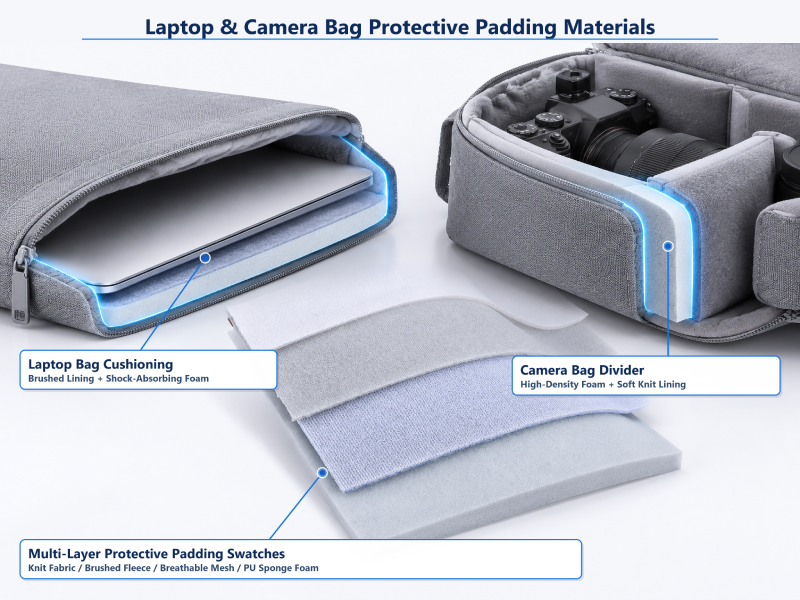
Foam laminated fabric | Combines a fabric layer with foam to form a padded intermediate material | Foam type, thickness, density, fabric substrate, and lamination structure |
Pre-formed foam insert | Provides a shaped internal structure for a specific compartment | Shape, dimensions, fit, and the required supporting structure |
Die-cut foam divider | Separates equipment or accessories into individual compartments | Divider thickness, cutting shape, compartment layout, and fit |
For a laptop bag, the internal structure may include a padded compartment designed around the laptop's length, width, and thickness. A tablet sleeve may use a different structure because the device dimensions and compartment design are different.
Camera bags can require more complex internal arrangements. A camera body, lenses, batteries, and other accessories may need separate compartments. The materials and internal dividers should therefore be evaluated according to the actual equipment and bag design.
Not every bag requires the same padding construction. Some projects may use foam laminated fabric as an intermediate material for sewing into the bag, while others may require separately shaped foam inserts or dividers.
The first step is to identify the intended compartment and its function before selecting the material.
What Is the Difference Between Protective Compartments and Ordinary Bag Linings?
Ordinary bag lining mainly forms the interior surface of a bag. It may provide a finished appearance and separate the contents from the outer bag material.
A protective compartment for electronic equipment has additional requirements. Its construction needs to consider the equipment's dimensions, the space available inside the bag, the contact surface, and how the equipment is positioned and secured.
For example, a laptop compartment needs enough space for the laptop to be inserted and removed without making the compartment excessively loose. A camera bag may need separate spaces for different pieces of equipment, depending on their shapes and dimensions.
The material structure also needs to be clearly identified before purchasing.
Material type | Structure | Main role |
Ordinary bag lining fabric | Fabric layer | Forms the inner surface of the bag |
Foam laminated fabric | Fabric bonded with a foam layer, or a multi-layer fabric and foam construction | Provides an intermediate padded material for further bag manufacturing |
Pre-formed foam insert | Foam shaped into a specific three-dimensional form | Fits a designated space or equipment shape |
Die-cut foam divider | Foam cut into specific shapes | Separates equipment and accessories inside the bag |
These materials serve different purposes. Foam laminated fabric is generally a composite material supplied for further processing. It is not automatically a finished protective compartment.
A pre-formed foam insert or die-cut foam divider may require separate shaping and processing according to the bag design. Buyers should not assume that a roll of foam laminated fabric can directly replace these components.
When requesting a quotation, manufacturers should clarify whether they need roll material for sewing, foam sheets for further processing, or shaped inserts and dividers.
How Should PU, EVA, and PE Foam Be Selected?
PU foam, EVA foam, and PE foam are possible material options for padded bag applications. However, their suitability should be evaluated according to the intended compartment structure and the actual requirements of the finished bag.
Foam type | What buyers should evaluate | Important considerations |
PU foam | Foam type, thickness, density, hardness, and compression characteristics | Confirm whether the selected grade and structure meet the requirements of the intended compartment |
EVA foam | Material grade, thickness, hardness, and processing requirements | Evaluate its suitability for the required shape, structure, and subsequent processing |
PE foam | Material grade, thickness, density, and physical characteristics | Confirm whether its structure and processing characteristics fit the intended application |
The material name alone does not determine the final protective performance. Different grades of the same foam type may have different physical characteristics.
Buyers should also distinguish between density, hardness, softness, and resilience. These are different material properties. A higher density does not automatically mean that a foam is harder, softer, or more protective.
The final performance also depends on the fabric layer, lamination structure, foam thickness, and the way the material is incorporated into the bag.
For this reason, manufacturers should provide the intended application and required material specifications rather than selecting foam based only on its name or price.
How Should Foam Thickness and Density Match Equipment Size and Weight?
Foam thickness and density are two important specifications when developing padded compartments for electronic equipment. However, they should not be selected independently of the equipment dimensions and the overall bag construction.
A laptop, tablet, and camera may have different shapes, weights, and surface areas. Their compartments may also have different internal dimensions and structural requirements.
When evaluating foam specifications, manufacturers should consider the following factors:
Equipment dimensions: The length, width, and thickness of the device determine the basic compartment dimensions. The compartment must provide sufficient space for insertion and removal.
Equipment weight: Weight is one factor to consider when evaluating the padding structure, but a heavier device does not automatically require thicker or higher-density foam.
Protective cases: Some devices are already used with protective cases. The additional space occupied by these cases should be included when determining compartment dimensions.
Compartment clearance: The space between the equipment and the compartment walls affects how the device fits inside the bag. Excessive clearance may allow the equipment to move, while insufficient clearance may make insertion and removal difficult.
Internal fixing structure: Elastic straps, dividers, pockets, and other internal components may affect how the equipment is positioned and held in place.
Buyers should also distinguish between foam thickness and total laminated thickness. The total thickness of a foam laminated material may include the foam layer, fabric layer, and other supporting layers. It should not be treated as the foam thickness alone.
Density is another separate specification. It cannot independently indicate the cushioning or impact protection performance of the finished bag.
The appropriate thickness and density should therefore be confirmed through material samples and the actual compartment design rather than selected using a universal specification.
How Should the Inner and Outer Fabrics of Equipment Compartments Be Selected?
The inner and outer fabric layers of an equipment compartment have different roles. Their selection should consider the contact surface, the overall bag construction, and the requirements of subsequent sewing and assembly.
The inner fabric layer is the surface that may come into contact with the electronic equipment. Buyers should consider its surface texture, color, thickness, fabric weight, and cleaning requirements.
The outer fabric layer may connect with the main bag material, zippers, binding materials, and other structural components. Its suitability should be evaluated according to sewing, edge finishing, and assembly requirements.
Different fabric substrates can be considered for foam lamination, including knitted fabric, woven fabric, nylon fabric, nonwoven fabric, and mesh materials.
Fabric type | What buyers should check |
Knitted fabric | Fabric construction, stretch direction, surface characteristics, and sewing performance |
Woven fabric | Fabric structure, thickness, flexibility, and compatibility with the intended lamination process |
Nylon fabric | Specific fabric construction, weight, surface, and processing requirements |
Nonwoven fabric | Fiber composition, weight, thickness, surface condition, and bonding suitability |
Mesh fabric | Mesh structure, opening size, stability, and the condition of the finished laminated material |
These descriptions should not be treated as completely separate fabric categories. For example, nylon describes a fiber type rather than one specific fabric construction. Mesh describes an open structure and may also be produced using different textile methods.
Similarly, a fabric's name alone cannot confirm whether its surface is suitable for protecting a particular device. Buyers should evaluate the actual fabric sample and the finished foam laminated structure.
The fabric substrate and foam should be assessed together. A fabric that has certain characteristics before lamination may behave differently after being bonded with foam.
For a closer comparison of substrate options, see the guide to fabric substrates for foam laminated materials.
How Should Single-Sided and Double-Sided Lamination Structures Be Selected?
The lamination structure determines how the foam layer is combined with the fabric layers. For equipment bag applications, buyers may consider single-sided or double-sided fabric and foam constructions.
A common single-sided structure is:
Fabric + Foam
In this construction, one fabric layer is bonded to one foam layer. The foam side may be used as the backing or connected with other materials during subsequent bag manufacturing.
A double-sided construction may use:
Fabric + Foam + Fabric
In this structure, fabric layers are positioned on both sides of the foam. It may be considered when both surfaces of the padded material require fabric coverage.
Structure | Construction | What buyers should consider |
Single-sided lamination | Fabric + Foam | Whether one fabric surface is sufficient for the intended compartment |
Double-sided lamination | Fabric + Foam + Fabric | Whether both sides require fabric surfaces and whether the additional layer fits the bag construction |
A double-sided structure is not automatically better or more protective than a single-sided structure. The choice depends on the surface requirements, the compartment design, the material thickness, and the subsequent manufacturing process.
Adding another fabric layer may change the total thickness and flexibility of the composite material. It may also affect how the material is cut, sewn, and assembled.
Manufacturers should therefore confirm the required structure before requesting samples or placing a bulk order.
For more details, refer to the guide to single-sided and double-sided foam laminated fabric structures.
How Can Samples Confirm Lamination, Sewing, and Equipment Protection Performance?
Material specifications provide a starting point, but they cannot fully confirm whether a foam laminated fabric is suitable for a specific laptop bag or camera bag.
Before bulk purchasing, manufacturers should evaluate samples using the actual compartment design and relevant production processes.
A practical sample evaluation can include the following steps:
Confirm the equipment and compartment dimensions. Use the actual device or a model with the same dimensions to check whether the compartment provides sufficient space for insertion, removal, and positioning.
Check the fit of the compartment. Evaluate whether the equipment fits appropriately and whether there is excessive clearance that may allow unnecessary movement inside the bag.
Inspect the laminated material. Check the bonding condition between the foam and fabric layers, the surface appearance, and whether the material maintains the required structure.
Carry out cutting and sewing trials. Process the sample according to the intended manufacturing procedure. Check the cutting edges, material deformation, sewing appearance, and compatibility with the bag construction.
Evaluate the assembled sample. Install the material into the actual bag or compartment structure and check the fit, access, and overall construction.
If a project requires drop or impact testing, the test conditions and acceptance criteria must be defined in advance. These may include the equipment weight, drop height, impact direction, number of test cycles, test environment, and the construction of the complete bag.
A foam type or thickness alone cannot establish a specific drop-protection level. Ordinary foam laminated fabric should not be regarded as a professional shockproof material without relevant testing and validation.
It is also important to distinguish between the performance of the material itself and the protection provided by the complete bag. The final result may depend on the foam, fabric, compartment dimensions, internal fixing structure, and overall bag construction.
What Information Should Laptop and Camera Bag Manufacturers Provide Before Requesting a Quotation?
To evaluate a suitable foam laminated fabric structure, buyers should provide enough information about the intended equipment compartment and the subsequent manufacturing requirements.
The following information can help suppliers assess the project more accurately.
Information required | Details to provide |
Bag application | Laptop bag, tablet bag, camera bag, camera case, or another equipment bag |
Equipment information | Equipment dimensions, weight, shape, and whether a protective case is used |
Compartment design | Number of compartments, internal dimensions, divider structure, and required clearance |
Drawings or samples | Bag drawings, compartment sketches, existing material samples, or reference photographs |
Foam specifications | Preferred foam type, thickness, density, hardness, and other available technical requirements |
Fabric specifications | Fabric type, fiber composition, weight, thickness, color, and surface requirements |
Lamination structure | Fabric + Foam or Fabric + Foam + Fabric |
Total material thickness | Required thickness of the complete laminated material |
Further processing | Cutting, sewing, edge binding, assembly, or other manufacturing requirements |
Protection requirements | Intended equipment protection requirements and any specified test methods or acceptance criteria |
Supply format | Roll material, sheets, or pre-cut components |
Order information | Estimated quantity, order frequency, sample requirements, and delivery expectations |
The more clearly the application and processing requirements are defined, the easier it is to evaluate the material structure and prepare suitable samples.
For buyers who are still comparing foam types, PU, EVA, and PE foam laminated fabric materials can provide a general reference. For broader purchasing specifications, see foam laminated fabric specifications for custom bag applications.
HuiZhou JinHaoCheng Nonwovens Co., Ltd. has experience in combining PU/EVA foam with different fabric materials through flame lamination, adhesive lamination, and hot-melt lamination. Depending on the project, processing may be completed internally or through external processing partners.
For laptop and camera bag projects, the specific foam, fabric, lamination structure, and finished material requirements still need to be evaluated according to the customer's drawings, samples, and application. Dedicated laptop or camera bag protection products, drop-test performance, and specialized shockproof insert production capabilities should not be assumed without project-specific confirmation.
Providing equipment dimensions, compartment drawings, material specifications, and actual processing requirements is the most practical way to start a material evaluation.




