
Jute vs. Coco Coir, Rockwool and Paper Grow Mats for Microgreens: How Should Buyers Choose?
For microgreens growers, choosing a growing medium is not simply a matter of comparing material prices. Different microgreens growing media can vary in water absorption, drainage, root support, handling convenience, and post-use disposal requirements. These differences affect how well a medium fits an existing irrigation system, growing tray, and daily production workflow.
Jute grow mats, coco coir, rockwool, and paper grow mats are all options that buyers may encounter, but they are not exactly the same type of product. Some are supplied as fiber mats or sheets, while others are available as loose substrates, compressed blocks, or products with different structures. Therefore, buyers should compare more than material names. The actual product structure, specifications, and method of use also need to be considered.
For commercial growers, growing-medium importers, and horticultural brands, a more practical purchasing approach is to define the requirements of the growing system first, then compare samples and confirm specifications to determine which material best fits the production process.
Why Should Buyers Look Beyond the Material Name?
The same raw material can be processed into products with different structures. Even when two grow mats are both made from plant fibers, their GSM, thickness, fiber arrangement, and overall structure may differ. As a result, their water absorption, moisture retention, and root-support performance cannot be reliably predicted from the material name alone.
Buyers should first identify the exact form of the growing medium. Needle-punched jute felt, compressed coco coir mats, rockwool growing blocks, and paper grow mats have different structures. Treating all of them simply as “grow mats” may overlook important differences between the product form and the intended irrigation method.
Growing-medium performance is also affected by seed type, seeding density, water supply, growing conditions, and the intended use period. The purpose of comparing materials is therefore not to prove that one material is always better than all the others. It is to determine which product is more suitable for a specific growing setup.
What Are the Structural Differences Between Jute, Coco Coir, Rockwool, and Paper Grow Mats?
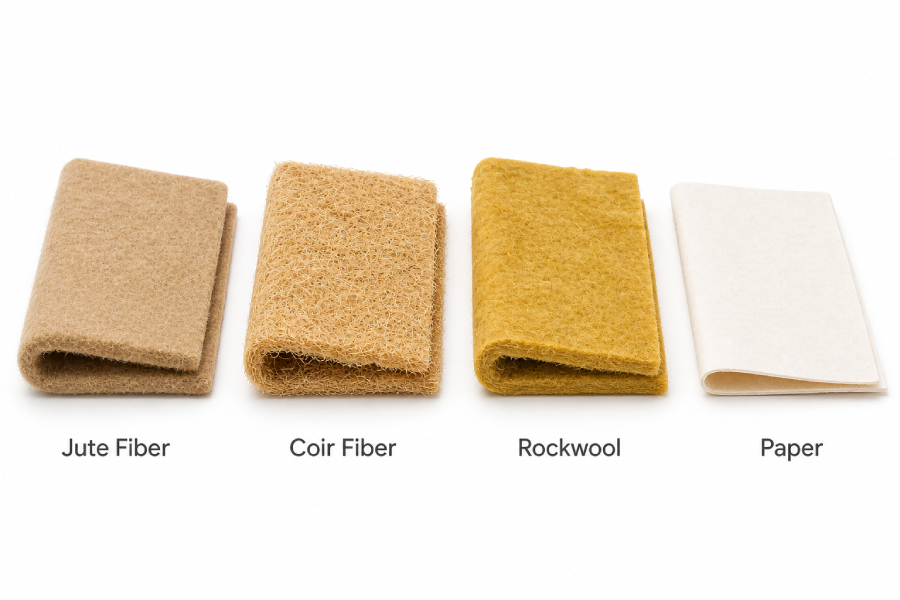
Jute grow mats are generally made primarily from plant fibers and can be formed into an integrated fibrous mat through processes such as needle punching. Buyers should check the fiber composition, GSM, thickness, surface structure, and whether the mat maintains the required shape when wet.
Coco coir is derived from coconut husk fibers and related processed materials. Commercial coco coir products may be supplied as loose growing media, compressed blocks, or formed mats. Different products can vary in particle composition, fiber content, and compression state. Buyers should confirm the actual product form rather than treating all coco coir products as structurally identical.
Rockwool is a mineral-fiber growing medium that is manufactured into specific shapes and structures. Buyers should confirm that the product is intended for the target growing system and check its dimensions, thickness, water-supply requirements, and post-use handling requirements. Rockwool growing products have a different structure from fibrous mats, so they should not be compared directly based only on appearance or weight per unit area.
Paper grow mats are generally made from paper fibers or related fibrous structures. However, products can differ significantly in thickness, number of layers, wet strength, and manufacturing method. Buyers should pay particular attention to whether the material maintains its required structure under actual irrigation conditions and throughout the intended use period.
When comparing different soil-free growing media, buyers should first confirm material composition and product structure before evaluating moisture management, root support, and handling. The names “jute,” “coco coir,” “rockwool,” and “paper” alone are not enough to support a reliable purchasing decision.
Water Absorption, Drainage, and Irrigation: What Should Buyers Evaluate?
Water management is one of the key factors to consider when comparing growing media for microgreens. However, a higher water absorption capacity does not automatically mean that a product is suitable for every growing system. Buyers also need to consider how water enters the medium, how it is distributed, and the condition of the medium between watering cycles.
For systems using bottom watering, buyers should observe whether water can move from the water-contact side into the medium and whether the wetted area reaches the expected range. Differences in material structure and thickness may affect water movement. Samples should therefore be evaluated using trays, watering methods, and operating times that closely resemble actual growing conditions.
For top watering or other irrigation methods, buyers should observe whether water tends to collect in localized areas, whether noticeable wet and dry patches develop across the surface, and whether the medium maintains the expected moisture condition after drainage. During testing, the water volume, watering duration, medium dimensions, and environmental conditions should be kept as consistent as possible.
Buyers should also distinguish between water absorption speed, total water absorption, and moisture retention. These are not the same measurement. A material may absorb water quickly, but its moisture condition after watering stops may not suit every growing requirement. Conversely, slower water absorption does not necessarily mean that a material is unsuitable. The actual result must be evaluated in relation to the irrigation method and production workflow.
For projects involving repeat purchases, it is useful to record the irrigation conditions in the sample evaluation report. For example, specify whether bottom watering or top watering is used, the amount of water supplied per cycle, the observation period, and the conditions to be recorded. This allows the purchasing team to make decisions based on comparable results rather than broad claims such as “high absorbency” or “excellent moisture retention.”
Root Support and Harvesting: What Affects Daily Operations?
A growing medium must not only match the irrigation method but also suit the practical workflow of seeding, germination, root development, routine handling, and harvesting.
For fibrous grow mats, buyers can observe whether the surface is suitable for the intended seeding method, whether the mat shows noticeable deformation when wet, and whether it maintains the required overall structure as roots develop. Actual performance depends on factors such as fiber composition, GSM, thickness, and manufacturing process. It should not be assumed from the material name alone.
For coco coir products, buyers should confirm whether they are purchasing loose substrate, compressed blocks, or formed mats. These formats may require different preparation, filling, and handling procedures. If a product needs pre-treatment or expansion before use, the associated steps should also be included when evaluating practical operating costs.
For rockwool products, buyers should confirm whether the shape, dimensions, and structure match the existing growing equipment and operating workflow. For paper grow mats, particular attention should be paid to structural integrity when wet and whether the product meets the handling requirements for moving, transplanting, or harvesting.
No single growing medium automatically performs best under every growing condition. A more practical approach is to evaluate samples within the intended production workflow and record their performance during seeding, irrigation, root development, and harvesting. For buyers, ease of handling, manageability, and compatibility with existing equipment can be more useful decision factors than a single material label.
Post-Use Disposal: Why “Natural” or “Biodegradable” Is Not Enough
Post-use handling is also part of the purchasing decision. However, the fact that a raw material comes from plants does not automatically mean that the finished product will biodegrade quickly in every environment or be suitable for every composting system.
Jute and coco coir are plant-derived materials, but the disposal options for finished products may still depend on fiber composition, processing methods, added materials, and local waste-management conditions. Paper grow mats must also be assessed according to their actual structure and local disposal requirements. Rockwool is a mineral-fiber material, so collection, transportation, and disposal after use should be confirmed in accordance with local requirements and information provided by the supplier.
If a purchasing project requires biodegradable, compostable, or other environmentally relevant product claims, buyers should confirm whether those claims apply to the actual finished product rather than only to one raw material. Where necessary, request documentation or test evidence that corresponds to the product composition and the specific environmental claim.
Buyers should also consider whether used growing media will be mixed with other materials or contaminated with growing residues or other substances. These factors may affect subsequent disposal options, so conclusions should not be based solely on whether the material comes from a natural source.
For importers and horticultural brands, clarifying the disposal requirements of the target market in advance can help identify products that better fit actual business needs and reduce the risk of making claims that do not match real-world use conditions.
Which Specifications Should Be Confirmed Before Bulk Purchasing?
Even after choosing a material category, buyers need to define the actual product specifications. More complete specification information helps suppliers provide suitable samples and quotations and makes it easier to maintain consistent requirements during bulk production.
First, confirm the material composition. For jute grow mats, specify whether the product is made from pure jute fiber or contains other plant fibers or blended materials. If the project has requirements for raw material origin or fiber proportions, include them in the product specification rather than relying on a broad description such as “natural grow mat.”
Second, define GSM, thickness, length, width, and dimensional tolerances. GSM and thickness help buyers identify product specifications, but neither measurement alone represents water absorption performance or growing results. When comparing samples from different suppliers, use matching or comparable specifications wherever possible to avoid attributing differences caused by product specifications to the material itself.
Third, confirm the supply format. Whether a product is supplied in rolls, sheets, or pre-cut mats can affect storage, transportation, cutting, and handling. If the product must fit a specific tray, provide the usable tray dimensions in advance and clarify whether individual mats or other customized processing are required.
Fourth, define quality acceptance requirements. For repeat-purchasing projects, buyers can record material composition, GSM, thickness, dimensions, surface condition, and sample evaluation results. They should also agree on how bulk products will be checked against the approved sample. If water absorption or wet-state structural integrity is critical, the test conditions and mutually accepted evaluation methods should be defined in advance.
Finally, verify packaging, minimum order quantity, lead time, and sample approval procedures. For importers, wholesalers, and private-label buyers, these details directly affect inventory planning, product specification management, and repeat-order arrangements.
How Can Buyers Compare Samples from Different Suppliers Under the Same Conditions?
When comparing growing media from different suppliers, the most important step is to standardize the evaluation conditions as much as possible. Simply placing several materials with different appearances side by side is not sufficient.
The first step is to record sample information, including material composition, GSM, thickness, dimensions, and product structure. If these basic parameters differ significantly, the differences should be noted in the evaluation results. Not every performance difference can be attributed to the material category itself.
The second step is to simulate the actual growing workflow. Use the same tray, seed type, seeding density, irrigation method, and observation period wherever possible. Record the moisture condition, structural changes, and any practical handling issues. If different materials require different preparation steps, record the time and procedures involved for each one.
The third step is to establish clear comparison criteria. For example, buyers can record whether water distribution meets expectations after watering, whether the medium shows noticeable deformation, whether it is easily damaged during handling, and whether it fits the existing growing and harvesting workflow. The specific criteria should be determined by the project's actual requirements. Without supporting test evidence, buyers should not assume in advance that one material must perform better than another.
The fourth step is to translate the sample results into purchasing specifications. Once a sample is approved, record the approved material composition and critical dimensions, and clearly state which parameters must be maintained in the order. For long-term supply projects, also confirm whether subsequent batches will be produced and inspected against the same specifications and acceptance requirements.
This evaluation approach helps buyers rely less on material names and marketing descriptions and select a growing medium based more closely on actual production needs.
Which Growing Medium Best Fits Your Purchasing Requirements?
If a project requires a plant-fiber growing mat, jute grow mats can be included among the candidate materials. Buyers should evaluate the product structure, condition when wet, root support, and specification consistency. For projects requiring sheets or mats, it is also important to confirm whether the supply dimensions match the actual irrigation system.
If a production system already uses a particular coco coir or rockwool product, buyers should focus on whether changing the medium could affect the existing watering method, equipment compatibility, or daily operations. For paper grow mats, confirm whether wet-state structural integrity and the intended use period meet the requirements of the target growing process.
Buyers should not make purchasing decisions solely on the basis of natural material claims, a single water absorption measurement, or unverified environmental statements. More reliable decision criteria include actual growing conditions, sample evaluation results, product specifications, and supply consistency.
For customized growing-medium projects, HuiZhou JinHaoCheng Nonwovens Co., Ltd. can discuss the composition, GSM, thickness, dimensions, and supply format of needle-punched fibrous materials according to project requirements. As a manufacturer with years of nonwoven research, development, and production experience, the company offers OEM/ODM customization services. For microgreens grow mat projects, buyers should first define the intended application, irrigation method, and critical specifications, then use sample evaluation to confirm whether the proposed product is suitable.
Conclusion: Choose According to the Growing System, Not a Simple Material Ranking
Jute, coco coir, rockwool, and paper grow mats have different material compositions and product structures. Their performance may vary in water absorption, drainage, root support, handling, and post-use disposal. However, these differences cannot be evaluated independently of the actual product specifications and growing conditions.
For commercial growers, importers, and horticultural brands, the recommended approach is to define the irrigation method, growing workflow, product specifications, and post-use disposal requirements first, then evaluate samples under consistent conditions. Purchasing decisions should be based on observable product performance and clear acceptance criteria rather than labels such as “natural,” “biodegradable,” or “highly absorbent.”
By matching material selection to actual production conditions, buyers can identify a more suitable microgreens growing medium for their systems and establish clearer specifications for future bulk purchasing.




