Fireplace and Stove Floor Protection Mats: Material Selection and Testing Guide
For manufacturers of fireplace accessories, stove products, and home safety products, developing a floor protection mat involves more than simply selecting a thick piece of flame-retardant felt.
Fireplaces, wood-burning stoves, pellet stoves, and other home heating appliances may transfer heat to their surroundings in different ways. The distance between the mat and the heat source, the installation location, the flooring material, and the possibility of contact with sparks or hot ash can all affect material selection.
When sourcing a fireplace protection mat or stove protection mat, buyers should first determine whether the product is designed to protect the floor, reduce heat transfer, or address specific risks such as sparks and hot ash.
A floor protection mat is not the same as a firebox liner or a fire blanket. Ordinary wool felt and wool blend needle punched felt should not be considered suitable for direct contact with open flames, burning charcoal, or high-temperature ash simply because of their fiber composition or flame-retardant properties.
For brands, importers, and manufacturers developing fireplace and stove accessories, the right approach is to define the actual conditions of use first, then evaluate fiber composition, material structure, thickness, composite construction, and testing requirements.
Why Do Fireplace and Stove Products Need Floor Protection Mats?
Fireplaces and stoves may transfer heat to surrounding areas through radiation, convection, and, in some situations, direct contact.
When these appliances are installed on hardwood floors, laminate flooring, tiles, stone, or other surfaces, the surrounding areas may face different conditions and risks.
For example, sparks, hot ash, or burning residue may occasionally reach the area in front of a fireplace. The floor beneath and around a wood-burning stove may also be exposed to heat over time. Different appliance designs, fuels, and operating conditions create different heat exposure requirements.
Therefore, the design of a fireplace floor protection mat should consider more than whether the material is flame retardant. It must also meet the requirements of its specific installation location and intended use.
Product developers should first clarify three questions.
First, what surface is the mat intended to protect? Is it designed for hardwood flooring, laminate flooring, tiles, stone, or another surface?
Second, how far is the mat from the heat source? Will it be placed in front of a fireplace, beneath a stove, or around the appliance?
Third, what type of heat exposure may occur? Will the mat be exposed to indirect radiant heat, occasional sparks, hot ash, or possible contact with hot charcoal or other high-temperature objects?
These conditions determine which material properties need to be evaluated. Buyers should not select a material based only on its product name.
What Is the Difference Between Floor Protection and Direct Heat Shielding?
When developing fireplace and stove protection products, floor protection and direct heat shielding are two different design objectives.
A floor protection mat is generally placed beneath, in front of, or around a fireplace or stove to protect the installation surface. Its design needs to consider the appliance location, distance from the heat source, flooring type, and possible heat exposure.
Direct heat shielding materials may be installed between a heat source and other components to reduce heat transfer in a specific direction. Their operating conditions may involve higher thermal loads, more complex installation structures, and more demanding performance validation.
These two product types should not automatically use the same material specifications.
For example, a needle punched felt composite mat designed for floor protection near an appliance does not necessarily mean it can be installed inside a firebox. It also does not mean that the material can withstand long-term contact with burning charcoal or open flames.
Similarly, a material with flame-retardant properties does not automatically prevent heat from transferring to the floor.
Before developing a product, buyers should define its intended function and ask the supplier to evaluate the material according to the actual structure and conditions of use. They should not make decisions based only on labels such as "Fire Resistant" or "Heat Resistant."
What Material Requirements Should Hearth Protection Mats Meet?
Fireplace and stove floor protection mats may need to meet several material requirements depending on the final product design.
Flame-Retardant Performance
If a product may be exposed to sparks, hot ash, or other potential ignition sources, flame-retardant performance may be an important consideration during material selection.
However, flame-retardant testing evaluates how a specific material behaves under defined test conditions. It does not automatically prove that the material can withstand continuous high temperatures, direct flame exposure, or contact with hot charcoal.
Buyers should confirm which fiber composition, material thickness, GSM, treatment, and test conditions are covered by the test report.
If the final product consists of needle punched felt, a backing layer, and other composite materials, buyers should also confirm whether the material-level test results represent the performance of the complete composite product.
Heat Transfer and Thermal Insulation
A floor protection mat may need to reduce heat transfer to the flooring underneath.
However, thermal insulation performance cannot be determined simply by checking whether a material is flame retardant or whether it has a greater thickness.
Fiber type, material density, thickness, structure, and composite construction may all affect the final product's heat transfer performance.
If buyers have specific requirements for floor temperature or thermal protection, they should first define the heat source, exposure time, installation distance, and flooring material. A corresponding sample evaluation plan can then be developed.
Surface and Backing Performance
For composite floor protection mats, the backing layer may provide slip resistance, moisture resistance, surface protection, or other functions.
However, different backing materials have different heat resistance, bonding methods, and long-term stability.
If a product requires a composite backing, buyers should confirm whether the backing material is suitable for the intended thermal environment. They should also evaluate whether heating, bending, and regular use may cause delamination, deformation, or other problems that affect product performance.
Dimensional Stability and Structural Integrity
Fireplace floor protection mats may remain in a fixed position for extended periods. Material dimensions, thickness, edge construction, and overall flatness should therefore be considered.
For rolls or die-cut products, buyers should specify product dimensions, edge finishing methods, thickness tolerances, and batch consistency requirements.
If the final product needs to be moved, rolled up, or cleaned repeatedly, these actual usage conditions should also be included in the sample evaluation.
How Do Thickness, Density, and Material Structure Affect Protection?
When sourcing needle punched felt, GSM, thickness, and density are three separate specifications that buyers should confirm.
GSM (grams per square meter) indicates the weight of the material per unit area. It helps buyers define material specifications, but it cannot independently prove better thermal insulation or flame-retardant performance.
Thickness affects material volume, installation space, and product design. For a floor protection mat, thickness also needs to match the edge construction, placement stability, and final dimensions.
Density is related to the internal fiber structure and may affect the material's softness, compression behavior, and structural stability.
Even if two needle punched felt materials have the same GSM, their actual performance may differ because of variations in fiber composition, thickness, and needle-punched structure.
Therefore, buyers should not assume that a higher GSM or greater thickness will always provide better floor protection.
A more practical approach is to determine a suitable combination of material specifications based on the final product's installation space, expected heat exposure, surface protection requirements, and processing methods.
If the product also requires lamination, bonding, or die cutting, these processes should be evaluated during sample development to confirm whether they affect the overall material structure and intended performance.
How Should Buyers Evaluate Heat Exposure and Surface Protection?
This is an important step in developing fireplace and stove protection mats.
Different heat sources affect materials in different ways. A general "heat resistant" claim cannot replace testing under the actual conditions of use.
Radiant Heat
Radiant heat transfers energy from a heat source through thermal radiation.
If a protection mat is installed near a fireplace or stove without directly contacting the appliance, radiant heat may be one of the conditions that needs to be evaluated.
Testing should define the heat source, distance, exposure time, and sample installation method. The temperature changes in the material and flooring can then be evaluated against the final product requirements.
Sparks and Hot Ash
Sparks or hot ash may occur around fireplaces and wood-burning stoves.
This is different from ordinary radiant heat because high-temperature particles may land directly on the material surface.
Buyers should clarify whether the product needs to withstand sparks or hot ash and define the actual particle temperature, quantity, contact time, and product structure.
Without corresponding sample testing, suppliers should not claim that the material can resist all types of sparks or hot ash.
Hot Charcoal
Hot charcoal may create localized high-temperature contact. This should not be treated as the same condition as ordinary radiant heat.
If the product is expected to come into contact with hot charcoal, this condition should be evaluated separately in the material and finished-product validation plan.
Passing a particular flame-retardant test does not prove that a material can withstand contact with hot charcoal.
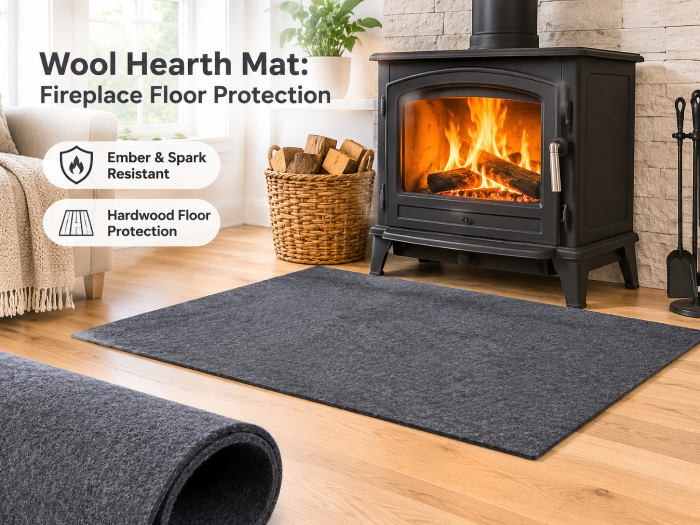
Direct Flame Exposure
Direct flame exposure represents a more demanding use condition.
Ordinary wool felt or wool blend needle punched felt should not be promoted as suitable for direct contact with open flames based only on its fiber composition or flame-retardant test report.
If the product design requires direct flame exposure, the material system, product structure, applicable standards, and actual testing requirements must be reassessed. Test results for an ordinary floor protection mat cannot be used as proof of direct flame protection.
Flooring Surface Protection
In addition to the material's own properties, the final product must also be evaluated for its effect on the flooring it is intended to protect.
Different flooring materials may respond differently to temperature, thermal shock, and localized heat exposure.
If buyers intend to use the product to protect hardwood or laminate flooring, they should specify the flooring type, installation conditions, and acceptable temperature changes. Product-level validation should then be carried out according to the target market's requirements.
A material flame-retardant report cannot replace testing of the floor protection performance of the finished product.
Can Wool Blend Needle Punched Felt Be Used in Fireplace and Stove Protection Products?
Wool blend needle punched felt may be considered as a candidate material for certain home protection products. However, its suitability for fireplace and stove floor protection mats must be evaluated according to the actual conditions of use.
Wool fibers have certain natural thermal and combustion characteristics. By blending wool with other fibers and forming a needle-punched nonwoven structure, manufacturers can develop materials with different GSM, thickness, and density specifications.
However, wool blend needle punched felt is not automatically a high-temperature fire protection material. Its heat resistance cannot be determined by wool content alone.
For fireplace and stove floor protection products, buyers should confirm at least the following details.
Fiber Composition: What is the wool content? Which other fibers are blended with the wool? Could different fiber ratios affect the material's combustion and thermal behavior?
Material Specifications: What GSM, thickness, and density are required? Do these specifications match the installation method of the final product?
Heat Exposure Conditions: Will the material mainly face radiant heat, sparks, hot ash, or possible contact with hot charcoal? Is direct flame exposure involved?
Final Product Structure: Will the product use a single layer of needle punched felt, or does it need to be combined with other materials? Does the backing need to provide slip resistance, moisture resistance, or other functions?
Testing Requirements: Does the customer require a material flame-retardant report, heat exposure testing, or product-level testing of the complete floor protection mat?
JHC has experience producing wool blend needle punched felt, with corresponding material specifications and physical samples. Material parameters can also be customized according to customer requirements. JHC currently has a material-level flame-retardant test report.
However, this material flame-retardant report cannot replace thermal protection testing of a finished fireplace protection mat. It also does not prove that the material can directly contact open flames, hot charcoal, or high-temperature ash.
If a project requires additional heat exposure, dimensional stability, or floor protection testing, JHC can assist in contacting third-party testing organizations according to the customer's technical requirements. The specific test items, testing organization, sample requirements, lead time, and costs need to be confirmed for each project. Related testing costs can be discussed.
For applications that have not undergone the corresponding tests, suppliers should not promise a specific temperature rating or floor protection rating.
What Should Fireplace and Stove Product Buyers Confirm Before Ordering?
Before requesting a quotation from a needle punched felt manufacturer, buyers should provide as much information as possible about the intended product and its application. This helps the supplier evaluate possible material options and reduces repeated communication during sample development.
The following information should be confirmed.
Confirmation Item | Information to Provide |
Final Product | Fireplace Floor Protection Mat, Stove Protection Mat, or another product |
Installation Location | In front of the fireplace, beneath the stove, around the appliance, or another location |
Flooring Type | Hardwood, laminate, tiles, stone, or another surface |
Heat Source | Fireplace, wood-burning stove, pellet stove, or another appliance |
Heat Exposure | Radiant heat, sparks, hot ash, hot charcoal, or direct flame |
Fiber Composition | Wool, polyester, or other blended fibers |
Material Specifications | GSM, thickness, density, width, and dimensions |
Composite Structure | Whether a backing layer, lamination, or other functional material is required |
Processing Method | Roll material, cutting, die cutting, or another process |
Testing Requirements | Flame retardancy, heat exposure, floor temperature rise, dimensional stability, or other tests |
Sample Requirements | Whether an existing sample, drawing, or reference product is available |
Purchasing Information | Estimated quantity, packaging requirements, target market, and order plan |
If buyers already have an existing product, providing a physical sample, product drawing, or material specification sheet is recommended.
For new product development projects, the actual application should be defined before material samples are evaluated and the necessary product tests are arranged. Mass production specifications can be confirmed only after the material structure, testing requirements, and intended use have been reviewed.
Conclusion: Select Fireplace Protection Materials Based on Actual Use Conditions
Material selection for fireplace and stove floor protection mats should not be based only on fiber names, GSM, or flame-retardant labels.
Buyers need to consider the heat source, installation location, flooring material, and different exposure conditions, including radiant heat, sparks, hot ash, hot charcoal, and direct flame exposure. Fiber composition, GSM, thickness, density, composite construction, and testing requirements should then be confirmed.
Wool blend needle punched felt may be considered as a candidate material for certain home protection products. However, its suitability for a specific fireplace or stove floor protection mat still needs to be evaluated through sample assessment based on the actual product structure and conditions of use.
HuiZhou JinHaoCheng Nonwovens Co., Ltd. has experience producing wool blend needle punched felt, with corresponding material specifications and physical samples, and supports customization of material parameters. A material-level flame-retardant test report is currently available. If additional testing is required, JHC can also assist in arranging third-party testing according to customer requirements. Specific test items and costs can be discussed for each project.
For brands developing fireplace accessories, stove products, and home safety products, the most important step is not simply to find a material labeled "heat resistant." It is to select a material solution that matches the final product structure, installation location, and actual conditions of use.