Wool Blend Needle Punched Felt for Automotive Components: Material Selection and Testing Guide
When developing automotive interior, acoustic, and thermal management components, automotive manufacturers need to consider more than just the material itself. Installation location, operating environment, processing methods, and finished-product testing requirements are also important.
Wool blend needle punched felt can be considered as a potential material for selected automotive component applications. By adjusting fiber composition, GSM, thickness, and material structure, suppliers can develop different felt specifications according to specific application requirements.
However, wool blend felt is not automatically an automotive-grade material simply because it contains wool. Its suitability for a particular automotive component must be evaluated based on the actual application environment and project specifications. This is especially important when flame retardancy, thermal insulation, VOC, odor, and heat resistance are required. These properties cannot be confirmed by fiber composition alone.
For automotive component buyers, the key questions are whether the material is suitable for the intended component, whether the supplier can provide samples and specifications that meet the project requirements, and whether the required testing can be arranged and verified.
This guide explains the key considerations when sourcing wool blend needle punched felt for automotive applications, including material selection, specification confirmation, flame-retardant testing, and custom development.
What Material Requirements Should Automotive Thermal Protection and Interior Components Meet?
Different automotive components have different installation locations and functions, so their material requirements can vary significantly.
Some components mainly require acoustic absorption and cushioning. Others may need a certain level of thermal insulation, while specific locations may require compliance with defined flame-retardant requirements. Therefore, buyers should first identify the actual purpose of the finished component before selecting a material.
For automotive interior and related functional components, several factors should be considered.
First, the basic material structure.
Fiber composition, GSM, thickness, and density can affect the material's weight, structure, and processing performance. Buyers should determine the appropriate material specifications according to the component design.
Second, the operating environment.
Whether the material is installed inside the vehicle, near a heat source, or in another equipment component will influence its performance requirements. For applications involving high temperatures, buyers should clarify the actual operating temperature, exposure duration, and type of heat exposure.
Third, flame-retardant requirements.
If an automotive project requires flame-retardant performance, the specific test standard, specimen specifications, and acceptance criteria must be confirmed. The presence of wool or an existing material flame-retardant test report does not automatically mean that the material meets every automotive project requirement.
Fourth, downstream processing requirements.
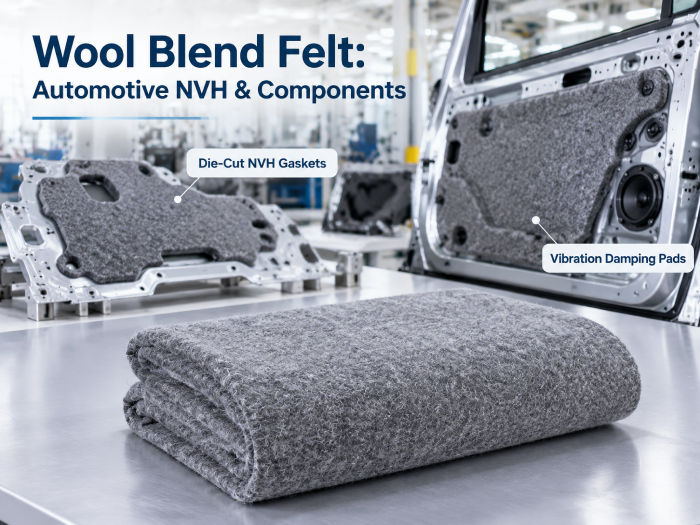
Automotive materials may need to be cut, die-cut, laminated, or processed in other ways according to the component design. In addition to meeting basic performance requirements, the material must be suitable for the customer's actual processing and assembly methods.
Therefore, buyers should define the technical requirements of the finished component before deciding whether wool blend needle punched felt is suitable for the project.
Which Automotive Components May Use Wool Blend Nonwoven Felt?
Wool blend needle punched felt can be considered as a potential material for selected automotive interior, acoustic, and thermal management components. However, it should not be regarded as a universal material suitable for every automotive component.
Automotive Interior Auxiliary Components
Some automotive interior projects use nonwoven materials as liners, covering layers, cushioning layers, or auxiliary structures.
For these applications, buyers may focus on material softness, thickness, surface characteristics, structural stability, and processing suitability.
Wool blend structures can be included in the material selection process. However, their suitability must be evaluated according to the component design and actual operating requirements.
Automotive Acoustic and Cushioning Components
Some automotive interior and equipment components require fiber materials for acoustic absorption or cushioning.
The fiber structure, thickness, and density of needle punched felt can influence its acoustic and mechanical performance. Whether wool blend felt is suitable for a particular acoustic component should be evaluated based on the available installation space, target acoustic performance, and actual test results.
The presence of wool alone does not prove that a material will provide better acoustic performance than other fiber materials.
Selected Thermal Management and Insulation Components
Some automotive component projects require materials to provide a degree of thermal insulation, lining, or auxiliary thermal protection.
Wool fibers have natural insulating characteristics, so wool blend needle punched felt can be considered as a potential option for selected thermal management material projects.
However, whether the material can meet specific automotive thermal protection requirements depends on fiber composition, material structure, operating temperature, exposure duration, installation location, and the design of the finished component.
If the material is intended for use near an engine compartment, exhaust system, or another high-temperature area, buyers must first clarify the actual temperature environment and project requirements before evaluating the material.
Ordinary wool blend felt should not automatically be treated as a high-temperature protection material. Its thermal insulation characteristics also do not make it an automotive fire suppression product or an EV battery thermal runaway protection product.
How Do Fiber Composition and Needle-Punched Structure Affect Automotive Wool Blend Felt?
Fiber composition is one of the first specifications buyers should confirm when sourcing wool blend needle punched felt.
Different fibers and blending ratios can affect softness, mechanical properties, dimensional stability, processing performance, and cost. Buyers should not evaluate a material based only on product names such as Wool Blend or Wool Felt.
Confirm the Wool Content and Blended Fibers
First, buyers should confirm which fibers are used in the material and the proportion of wool to other fibers.
If an automotive project has specific natural fiber content requirements, the target wool percentage and acceptable tolerance should be defined before sampling.
If the project focuses more on material strength, dimensional stability, or downstream processing, the characteristics of the other blended fibers should also be considered.
A higher wool content does not necessarily mean better performance in every application. The appropriate blending ratio should be determined according to the requirements of the finished component.
Confirm the Needle-Punched Material Structure
Needle punched felt is a nonwoven material formed through the mechanical entanglement of fibers.
During material development, fiber types, blending ratios, fiber distribution, GSM, and thickness all influence the final structure.
For automotive component projects, buyers should also confirm whether the material will be used as a single layer or laminated with other materials.
If lamination is required, the substrate, lamination method, and finished structure should be clarified in advance. This helps avoid performance differences between the initial material sample and the finished component.
Understand the Differences Between Flame Retardancy, Heat Resistance, and Thermal Insulation
This distinction is particularly important in automotive material sourcing.
Flame-retardant performance mainly concerns how a material behaves when exposed to flame.
Heat resistance concerns whether a material can maintain its required structure or performance under specified temperature and time conditions.
Thermal insulation concerns how a material affects heat transfer.
These three properties are not interchangeable.
If a customer requires both flame retardancy and thermal insulation, the buyer should provide separate technical specifications and testing requirements for each property. A material flame-retardant test report does not prove that the material has passed thermal insulation, heat resistance, or finished automotive component testing.
How Should Buyers Specify GSM, Thickness, and Dimensions for Automotive Wool Blend Felt?
Material specifications can affect component weight, space requirements, structure, and processing suitability.
Therefore, automotive material buyers should define their target specifications during the quotation stage and verify the actual parameters during sample approval.
GSM
GSM refers to the weight of the material per square meter.
GSM affects the material's weight per unit area and overall structure. However, a higher GSM does not automatically mean better thermal insulation, flame retardancy, or acoustic performance.
Buyers should determine the target GSM according to the component's weight limitations, installation space, and actual performance requirements.
Thickness
Thickness affects the space occupied by the material, its compression condition, and its suitability for installation.
If the material needs to be assembled with other components, buyers should provide the available space and target thickness instead of simply requesting a thicker material.
For components that may be compressed during use, the required thickness under actual operating conditions should also be confirmed.
Density and Structural Uniformity
Even when two materials have the same GSM, their thickness, firmness, and structural characteristics may differ because of variations in fiber composition and needle-punched structure.
Buyers should confirm GSM, thickness, and density during sample evaluation. Acceptable specification tolerances should also be defined for mass production.
For long-term automotive supply projects, consistency between approved samples and mass-produced materials is particularly important.
Width, Length, and Processing Dimensions
For materials supplied in rolls, buyers should confirm roll width, roll length, and packaging requirements.
For component processing, buyers should provide cutting dimensions, die-cutting drawings, and dimensional tolerances.
Confirming these parameters in advance helps suppliers evaluate whether the material is suitable for downstream processing and reduces dimensional problems during sampling and mass production.
What Material Testing Should Be Confirmed for Automotive Projects?
Automotive material testing requirements usually depend on the finished component, installation location, and customer technical specifications.
Buyers should provide the required testing standards and acceptance criteria at the early project stage rather than simply asking whether the material is flame retardant.
Material Flame-Retardant Testing
If a project requires flame-retardant performance, buyers should confirm the test standard, specimen thickness, material composition, and acceptance criteria.
Standards such as FMVSS 302 and DIN 75200 may appear in certain automotive material specifications. However, buyers should not assume that every wool blend automotive felt automatically complies with these standards.
JHC currently has a material-level flame-retardant test report. When using this report for a project, buyers should confirm whether the tested material composition, specifications, and test conditions match the material required for the current project.
A material flame-retardant test report is not the same as a finished automotive component test report or an automotive OEM certification.
VOC and Odor Testing
Some automotive interior projects may require testing for volatile organic compounds (VOC) and odor performance.
These requirements generally depend on the automotive manufacturer, component type, and target market.
If a customer specifies VOC or odor requirements, the test method, limits, specimen preparation, and reporting requirements should be confirmed in advance.
Without corresponding test results, it should not be claimed that wool blend needle punched felt already complies with a specific automotive VOC or odor standard.
Heat Resistance and Thermal Aging Tests
If the material will be used in a specific temperature environment, buyers should clarify the operating temperature, exposure duration, testing method, and acceptance criteria.
Depending on the project, additional evaluations may be required for dimensional changes, appearance, or other properties after thermal aging.
It is important to understand that material flame-retardant test results cannot replace heat resistance or thermal aging test results.
Arranging Third-Party Testing According to Customer Requirements
If the existing material flame-retardant report does not cover all project requirements, buyers can provide the specified testing standards and requirements so that the testing arrangements can be discussed with the supplier.
JHC can assist in contacting third-party testing institutions and arranging relevant material testing or other tests required by the project. The specific test items, testing institution, sample requirements, costs, and testing schedule need to be confirmed according to the actual project. Testing costs can be negotiated.
For projects requiring finished automotive component testing, the final component structure and specimen condition should be confirmed first. A raw material test report cannot be used as a substitute for finished-product testing.
How Can JHC Develop Custom Wool Blend Needle Punched Felt for Automotive Suppliers?
For automotive component suppliers, material development should start with the actual application and technical requirements rather than selecting a fixed specification first and trying to find an application for it.
JHC has experience in producing wool blend needle punched felt and has corresponding material specifications and physical samples. Fiber composition, GSM, thickness, and other material parameters can be discussed and customized according to customer project requirements.
The development process can follow these steps.
Step One: Confirm the Application Location and Main Function
Customers should provide the installation location, main function, and operating environment of the finished component.
For example, the project may focus on interior lining, acoustic absorption, cushioning, thermal insulation, or flame-retardant requirements.
Step Two: Confirm Material Specifications
Discuss the wool content, other blended fibers, GSM, thickness, density, color, and dimensions according to project requirements.
If the customer has existing material samples, drawings, or technical specifications, these can also be provided as references.
Step Three: Arrange Sample Evaluation
JHC has physical samples of wool blend needle punched felt that can be used for initial material evaluation.
During sample approval, buyers should check fiber composition, GSM, thickness, appearance, and structure. They should then determine whether further adjustments are needed according to the actual component requirements.
If the project has specific flame-retardant or other performance requirements, buyers should also confirm whether the existing material test report is applicable or whether additional testing is necessary.
Step Four: Confirm Testing and Technical Documents
After sample evaluation begins, the customer should clarify the required testing standards, test items, and report types.
If additional testing is needed, JHC can assist in arranging third-party testing according to project requirements. Testing costs and schedules can be discussed and confirmed before the arrangements are made.
Step Five: Confirm Mass Production Specifications and Quality Requirements
After sample approval, the mass production requirements should be clearly defined, including fiber composition, GSM, thickness, width, dimensional tolerances, packaging, and inspection requirements.
For automotive projects, buyers should also confirm whether material changes will require resampling or additional testing.
This helps reduce the risk of differences between approved samples and mass-produced materials.
What Information Should Automotive Component Buyers Include in an RFQ?
To help suppliers evaluate wool blend needle punched felt more accurately, automotive buyers are advised to include the following information in their RFQ.
RFQ Item | Information to Provide |
Final application | Automotive interior, acoustic component, thermal management component, or another specific part |
Installation location | Exact installation position, space limitations, and surrounding environment |
Main function | Thermal insulation, acoustic absorption, cushioning, flame retardancy, or other requirements |
Fiber composition | Required wool content and other blended fibers |
GSM | Target weight and acceptable tolerance |
Thickness | Target thickness and tolerance |
Density | Target density or structural requirements |
Dimensions | Roll width, sheet dimensions, or die-cutting drawings |
Processing method | Cutting, die cutting, lamination, or other processing requirements |
Testing requirements | Specified standards, test methods, and acceptance criteria |
Sample requirements | Sample dimensions, quantity, and approval method |
Order information | Estimated order quantity, delivery schedule, and packaging requirements |
Documentation | Material specifications, flame-retardant reports, or other test documents |
If the customer has not yet decided on the exact fiber blending ratio, they can first provide the component application, drawings, and performance requirements. The supplier can then evaluate a suitable material option based on the project needs.
Conclusion: Evaluate Automotive Wool Blend Needle Punched Felt Against Actual Component and Testing Requirements
Wool blend needle punched felt can be considered as a potential material for selected automotive interior, acoustic, and thermal management components. However, its suitability for a specific project must be evaluated based on fiber composition, material structure, GSM, thickness, operating environment, and testing requirements.
For automotive component manufacturers, selecting a supplier involves more than confirming whether the material can be customized. Buyers should also consider sample availability, specification consistency, and whether the required testing documents can be provided.
HuiZhou JinHaoCheng Nonwovens Co., Ltd.has experience in producing wool blend needle punched felt, along with corresponding material specifications and physical samples. The material parameters can be customized according to customer requirements. JHC currently has a material-level flame-retardant test report. If customers require additional testing, JHC can assist in arranging third-party testing according to the project requirements, with the specific testing arrangements and costs to be discussed separately.
For buyers developing automotive interior, acoustic, or selected thermal management components, providing the application location, material drawings, target specifications, and testing requirements during the quotation stage will help suppliers evaluate whether wool blend needle punched felt is suitable for the project.