Disaster Relief Blankets for Humanitarian Aid: What Bulk Buyers Need to Specify
For importers, humanitarian aid suppliers, and government procurement contractors responsible for sourcing relief supplies, one of the biggest challenges when purchasing emergency blankets in bulk is not simply finding a manufacturer. It is making sure the purchasing requirements are clearly defined.
Even when blankets are intended for disaster relief, different projects may have different requirements for fiber composition, wool content, GSM, thickness, dimensions, individual weight, and packaging. If a buyer only provides a product photo or a general size requirement, it may be difficult for the manufacturer to evaluate the actual material structure and provide an accurate quotation or production recommendation.
Before requesting a quotation for a bulk order, buyers should prepare the intended application, material specifications, finished dimensions, packaging requirements, order quantity, and delivery information. This helps the manufacturer assess whether the requested product can be produced and reduces the risk of specification differences between sample approval and mass production.
This guide explains the key specifications to confirm when sourcing disaster relief blankets and how to prepare a clear procurement request for a manufacturer.
What Are Disaster Relief Blankets?
Disaster relief blankets are warming blankets used in emergency response and humanitarian aid projects. They are commonly included in relief supplies to provide temporary warmth and basic living support for people affected by disasters.
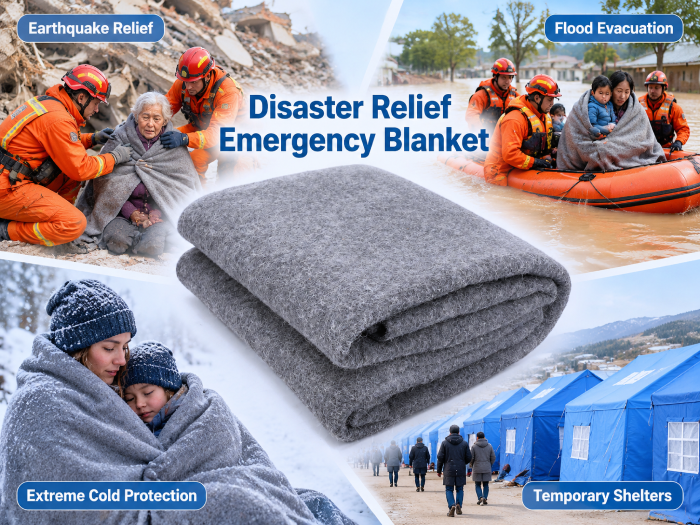
These blankets may be used in situations such as earthquakes, floods, cold-weather emergencies, refugee assistance, and temporary accommodation. Depending on the actual project requirements, they can be produced with different fiber compositions, GSM, thicknesses, dimensions, and packaging options.
Wool and wool-blend materials are among the material options that buyers may consider for emergency warming blankets. For products made with a needle-punched nonwoven structure, buyers can evaluate combinations of natural wool, polyester, flame-retardant polyester, or other functional fibers according to the intended application.
It is important to understand that a disaster relief blanket is not a medical device, and not every blanket automatically meets the same government or international organization procurement standards. Specific product requirements should be based on the project's technical documents, destination-market requirements, and acceptance criteria confirmed by the buyer.
Who Purchases Blankets for Humanitarian Aid?
Bulk procurement of humanitarian aid blankets is commonly associated with organizations and businesses responsible for relief supply distribution, government project implementation, and international aid procurement.
Humanitarian aid suppliers purchase blankets according to project requirements and provide them to the relevant relief programs. Government procurement contractors may need to identify suitable manufacturers based on tender documents, technical specifications, and delivery schedules.
Relief goods importers and wholesalers may also purchase emergency blankets in bulk for inventory, seasonal demand, or further distribution.
For these buyers, a manufacturer's ability to understand product specifications, support sample approval, maintain consistent specifications between production batches, and arrange packaging and delivery according to the order requirements can be more important than simply comparing product photos.
Common Procurement Scenarios
Different relief scenarios can influence the material, dimensions, weight, and packaging requirements of emergency blankets. Manufacturers need to understand how the blankets will be used before evaluating a suitable material and finished-product solution.
Earthquake Relief
After an earthquake, some residents may need temporary accommodation and essential living supplies. Emergency warming blankets can be included in relief packages to provide temporary warmth for people staying in temporary shelters.
When preparing an earthquake relief procurement request, buyers should specify the expected order quantity, blanket dimensions, material composition, packaging method, and delivery destination. If the order is associated with a specific relief project, the buyer should also provide the project's technical documents and acceptance requirements.
Flood Relief
Flood relief projects may involve temporary accommodation, transportation of relief supplies, and centralized distribution. For these orders, packaging methods, individual blanket weight, and outer carton dimensions may affect transportation, warehousing, and subsequent distribution.
Buyers should specify in advance whether each blanket needs individual packaging or whether multiple blankets will be packed together. They should also confirm whether the packaging needs printed product information, project identification, or other markings.
Refugee Assistance
Refugee assistance projects may require large quantities of emergency warming blankets for distribution to different locations.
These projects often require clearly defined product specifications and packaging requirements. Buyers should confirm the dimensions, material composition, color, edge finishing, and individual weight of each blanket. They should also specify whether all blankets must have the same specifications or whether different sizes are acceptable.
If the procurement documents specify fiber content, GSM, dimensions, or other acceptance criteria, buyers should provide those documents to the manufacturer instead of relying only on product photos when requesting a quotation.
Cold-Weather Emergency Supplies
Cold-weather emergency supplies generally require closer attention to fiber composition, thickness, weight, and the intended use of the finished blanket.
Buyers should not evaluate warmth only by increasing GSM. Fiber type, material structure, thickness, density, and finished dimensions can all influence the characteristics of the final product.
Therefore, buyers should clearly specify the required wool content, material GSM, thickness, and individual blanket weight. During sample approval, they should check whether the actual product meets the agreed requirements.
Temporary Accommodation
Temporary accommodation and emergency shelter projects may require a continuous supply of warming blankets. In addition to the product itself, buyers need to consider packaging, storage, transportation, and possible replenishment orders.
If the project involves long-term supply or staggered deliveries, buyers should provide the estimated total quantity, quantity per shipment, delivery schedule, and packaging requirements during the quotation stage. This allows the manufacturer to evaluate the order arrangement more accurately.
What Specifications Should Bulk Buyers Confirm?
When purchasing bulk emergency blankets, buyers should prepare a clear product specification sheet before requesting a quotation. The following details should be confirmed as early as possible.
Fiber Composition
Fiber composition is one of the basic factors affecting the material structure and characteristics of an emergency blanket.
For needle-punched nonwoven blankets, buyers can evaluate the use of natural wool, polyester, flame-retardant polyester, or other functional fibers according to the project requirements.
Different fiber combinations can affect the material's feel, structure, weight, and processing performance. Buyers should specify their preferred fiber types or provide a target product sample for the manufacturer to evaluate.
If the project has specific fiber composition requirements, these should be stated as clear percentages or technical specifications. Simply describing the product as a "wool blanket" or "wool blend blanket" is not sufficient.
Wool Content
If the procurement project requires wool material, the actual wool content must be clarified.
Wool content is not automatically defined by the word "wool" in a product name. A blanket described as a wool-blend blanket does not indicate the actual percentage of wool it contains.
Buyers should specify the required wool content and whether other fibers are permitted. If the project does not require a fixed percentage, buyers can provide the target product characteristics, a reference sample, or the procurement technical documents for the manufacturer to evaluate a suitable fiber combination.
Before mass production, the wool percentage and other fiber components should be confirmed through mutually approved material specifications and samples. This helps prevent differences between the procurement documents and the actual product.
GSM, Thickness, and Density
GSM, thickness, and density are three different specifications. Buyers should not provide only one of them.
GSM refers to the weight of material per square meter. It helps buyers understand the material's weight per unit area.
Thickness refers to the material's measured thickness. The measurement method and conditions should be clarified when precise requirements are involved.
Density refers to the mass per unit volume. For needle-punched materials, density is related to factors such as fiber composition, needle-punched structure, and the degree of material compaction.
Even when two materials have the same GSM, they may have different thicknesses and densities. Buyers should therefore confirm all three parameters according to the project requirements.
If the buyer has not determined the exact values, a reference sample, target finished-product weight, or intended application can be provided to help the manufacturer evaluate suitable material specifications.
Blanket Dimensions
Blanket dimensions are essential information for quotation and production confirmation.
Buyers should specify the finished blanket's length and width. They should also clarify whether the dimensions refer to the material before cutting or the final product after edge finishing.
If the project requires blankets in different sizes, each size and its corresponding quantity should be listed separately rather than providing only one total order quantity.
For blankets with special dimensions, buyers should also confirm the dimensional tolerances, whether edge finishing may affect the final size, and which measurement standard will be used during sample approval.
Weight per Blanket
The weight of an individual blanket is related to its GSM and finished area, but the final weight cannot be determined accurately from GSM alone.
In actual procurement, individual weight can also be affected by the finished dimensions, material structure, edge finishing, and other processing requirements.
If the project documents specify the weight of each blanket, buyers should state the required weight and acceptable tolerance. They should also clarify whether the specified weight includes individual packaging.
If no individual weight has been specified, buyers can provide the target dimensions and material specifications so that the manufacturer can calculate and confirm the weight based on the actual sample.
Color and Edge Finishing
Color and edge finishing are also important details to confirm before placing a bulk order.
Common color options may include natural color, grey, or customized colors according to project requirements. Buyers should specify whether a particular color reference, color standard, or batch-to-batch consistency requirement applies.
For edge finishing, buyers should clarify the required finished appearance and provide reference photos or samples where possible. Different edge finishing methods may affect the appearance, dimensions, and processing requirements of the finished blanket.
If the project has strict appearance requirements, it is advisable to approve a physical sample before mass production. This helps avoid discovering color or edge-finishing differences only after the bulk order has been completed.
Individual Packaging vs. Bulk Packaging
Packaging affects the storage, transportation, and distribution of emergency blankets. For large-scale relief procurement, packaging should be decided before production is completed, not after the blankets have been manufactured.
Individual packaging means that each blanket is packed separately. This makes individual products easier to store, identify, and distribute. If buyers need the packaging to display product names, specifications, barcodes, or project identification, they should provide these requirements during the quotation stage.
Bulk packaging means that multiple blankets are packed together. This option may be suitable for centralized transportation and storage, but buyers need to specify the quantity per package, outer packaging dimensions, and packaging material requirements.
If customized packaging is required, buyers should also clarify whether they need brand logos, labels, instruction documents, carton markings, or other packaging information.
The RFQ should clearly state whether individual or bulk packaging is required, the quantity per package, outer packaging requirements, label content, whether custom printing is needed, and whether a packaging sample must be approved.
What Should Be Included in a Disaster Relief Blanket RFQ?
A complete disaster relief blanket RFQ should include more than the product name and order quantity. To help the manufacturer understand the requirements accurately, buyers should organize the product, material, packaging, and order information in one document.
The following information should be included in the quotation request:
RFQ Item | Information Buyers Should Provide |
Final application | Earthquake relief, flood relief, refugee assistance, cold-weather supplies, or temporary accommodation |
Fiber composition | Natural wool, polyester, flame-retardant polyester, or other specified fibers |
Wool content | Required wool content or permitted blend ratio |
GSM | Target GSM or acceptable range |
Thickness | Target thickness and measurement requirements |
Density | Target density or reference sample |
Blanket size | Finished length and width |
Weight per blanket | Individual blanket weight and acceptable tolerance |
Color | Natural color, grey, or specified color |
Edge finishing | Required edge finishing or reference sample |
Packaging | Individual packaging, bulk packaging, or customized packaging |
Order quantity | Total quantity and quantity for each specification |
Delivery schedule | Target delivery date and staggered delivery plan |
Destination | Delivery country, city, or designated destination |
Testing and documents | Required tests, technical documents, and acceptance criteria |
Sample requirements | Sample quantity, specifications, and approval method |
If the procurement project is associated with a government tender or humanitarian aid organization, buyers should also provide the applicable technical specifications, acceptance documents, and destination-market requirements. The manufacturer needs to evaluate these documents individually. A project description such as "humanitarian aid" or "government project" is not enough to determine whether a product meets the required standards.
Before placing the order, both parties should confirm the final fiber composition, finished dimensions, individual weight, packaging method, acceptable tolerances, inspection requirements, and delivery arrangements in writing. The approved specifications should serve as the basis for sample acceptance and mass production.
OEM and Bulk Manufacturing Support
For bulk emergency blanket procurement, a manufacturer needs to understand not only the intended application but also the buyer's requirements for material evaluation, sample approval, and bulk order arrangements.
JHC can provide material and customization solutions for needle-punched wool emergency blankets. Material options include Natural Wool Fiber, Polyester, Flame-Retardant Polyester, and other functional fibers. Fiber ratios, GSM, thickness, density, width, and finished dimensions can be discussed and customized according to project requirements.
Regarding supply formats, roll materials or cut pieces can be evaluated according to the order requirements. Color, edge finishing, and packaging options such as Bulk Packaging, Individual Packaging, or Customized Packaging can also be discussed.
For buyers seeking OEM or ODM cooperation, it is advisable to provide the target product specifications, a reference sample, or procurement documents first. The manufacturer can then evaluate the material structure and processing requirements before confirming the product specifications through sample approval.
Established in 2005, HuiZhou JinHaoCheng Nonwovens Co., Ltd. has long been engaged in the development and production of needle-punched nonwoven materials and related products. For overseas buyers who require customized needle-punched materials, communicating directly with the manufacturer about fiber composition, GSM, thickness, dimensions, and packaging helps clarify product requirements before mass production.
Please note that order feasibility, minimum order quantity, sample arrangements, production lead time, and delivery schedules must be confirmed according to the actual product specifications, order quantity, and production schedule. For orders with specific government procurement or international project requirements, the relevant technical documents and acceptance standards must also be reviewed before any compliance commitments are made.
Conclusion: Provide Complete Specifications Before Placing a Bulk Order
When purchasing disaster relief blankets in bulk, the product name is only the starting point for a quotation. The information that actually affects material evaluation, pricing, and production confirmation includes fiber composition, wool content, GSM, thickness, density, finished dimensions, individual weight, color, edge finishing, and packaging method.
For humanitarian aid suppliers, government procurement contractors, and relief goods importers, the most effective approach is to prepare complete product specifications and order information before requesting a quotation. Buyers should also provide the necessary reference samples or technical documents to the manufacturer.
If some material parameters have not yet been finalized, buyers can first explain the intended application, target dimensions, expected weight, and order quantity, then discuss a suitable material solution with the manufacturer. Clear specification confirmation, sample evaluation, and written order approval can reduce misunderstandings during bulk procurement and make subsequent production and delivery arrangements easier to manage.