Cold Weather Relief Blankets: How Wool Blend Materials Support Emergency Warmth
When sourcing blankets for cold-weather emergency relief, buyers need to consider more than the appearance or basic specifications of the finished product. The fiber composition, wool content, material weight, thickness, blanket dimensions, and intended application all influence the final product design.
For humanitarian aid suppliers, government procurement contractors, and emergency relief product distributors, wool blend emergency blankets can be one material option worth evaluating. However, selecting the right material requires understanding the expected environment and the requirements of the finished blanket.
This guide explains how wool blend materials, GSM, thickness, blanket weight, and coverage requirements should be considered when developing cold weather relief blankets.
Why Are Thermal Blankets Needed in Cold-Weather Relief?
In cold-weather emergency situations, blankets are commonly used to provide an additional layer of warmth and comfort. They may be included in emergency supply packages for people affected by severe weather, displacement, or other emergency situations.
For bulk buyers, the challenge is not simply finding a warm blanket. The product must also match the intended application, distribution requirements, and practical conditions of use.
Different projects may have different priorities. Some buyers may focus on warmth and coverage, while others may place greater importance on portability, individual blanket weight, or storage efficiency.
Before selecting a material, buyers should clarify the intended environment, expected usage, required blanket dimensions, and any specific procurement requirements.
Natural Wool Fiber and Thermal Insulation
Natural wool fiber is commonly considered for products that require thermal comfort. Its fiber structure and natural properties make it a potential material option for blankets and other insulation-related products.
When wool is incorporated into a needle-punched nonwoven structure, it can be combined with other fibers to develop a material with different physical characteristics.
However, the actual performance of a finished blanket depends on more than the presence of wool. Fiber composition, wool content, material weight, thickness, density, and the construction of the finished product all need to be considered together.
Buyers should therefore avoid assuming that a higher wool percentage automatically guarantees better warmth in every application.
For projects with specific thermal performance requirements, the material and finished blanket should be evaluated according to the actual conditions of use.
Wool Blend Composition and Material Weight
The fiber blend is one of the important factors when developing a wool blend emergency blanket.
Depending on the project requirements, buyers may discuss natural wool fiber, polyester, flame-retardant polyester, and other functional fibers with the manufacturer.
Different fiber combinations can result in different material characteristics. The appropriate composition should be selected according to the intended application, required material properties, and target product specifications.
Wool content is another specification that should be clearly confirmed before production. Buyers should communicate the required wool percentage rather than simply requesting a wool blanket without defining the composition.
Material weight also needs to be considered alongside fiber composition. Two materials with different fiber blends or weights may not provide the same physical characteristics, even when their thickness appears similar.
For this reason, buyers should evaluate the overall material construction instead of using a single specification to determine suitability.
How GSM and Thickness Affect Blanket Construction
GSM (grams per square meter) and thickness are two important specifications when developing emergency blankets.
GSM indicates the weight of the material per unit area. Thickness describes the distance between the material's two surfaces. Both specifications help buyers and manufacturers define the material construction.
However, GSM and thickness are not interchangeable. Materials with the same GSM may have different thicknesses, while materials with similar thicknesses may have different weights and densities.
These differences can affect the physical structure, handling, and overall construction of the finished blanket.
When selecting a material for a cold-weather relief blanket, buyers should consider GSM and thickness together with fiber composition and density.
It is also important to understand that a specific GSM or thickness does not represent a guaranteed insulation level or a specific temperature rating. The actual thermal performance of a finished blanket must be evaluated under relevant application conditions.
For buyers who need to compare material specifications, our guide to GSM and thickness explains the relationship between these parameters in wool needle felt.
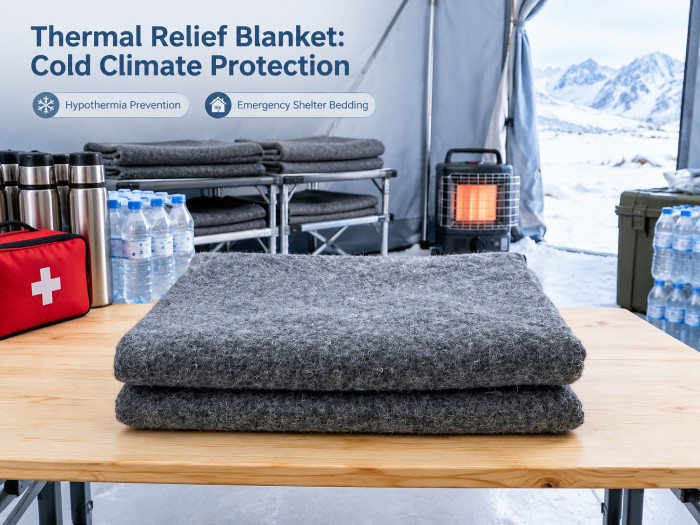
Blanket Weight, Portability and Coverage
Besides material composition, the weight and dimensions of the finished blanket are important considerations for emergency relief projects.
A heavier blanket may require more storage and transportation space, while a lighter blanket may be easier to distribute and carry. However, reducing weight should not be the only objective when selecting a material.
Buyers need to balance the required coverage area, material specifications, finished blanket weight, and practical distribution conditions.
Blanket dimensions should also match the intended use. A blanket designed for individual use may have different size requirements from one intended for shared or other emergency applications.
Before confirming production specifications, buyers should evaluate the relationship between material GSM, blanket dimensions, and the weight of each finished blanket.
This helps manufacturers understand the product requirements and propose a material construction for further evaluation.
What Information Should Buyers Provide to Manufacturers?
Clear product specifications help manufacturers evaluate material options and prepare suitable samples for review.
When sourcing cold weather emergency blankets, buyers should provide the following information as clearly as possible.
Specification | Information to Confirm |
Intended application | Individual emergency use, humanitarian aid, or other relief applications |
Environment | Expected climate and conditions of use |
Fiber composition | Natural wool, polyester, or other functional fibers |
Wool content | Required wool percentage or acceptable composition range |
GSM | Target material weight per square meter |
Thickness | Required material thickness |
Density | Target density, if specified |
Blanket dimensions | Required finished length and width |
Weight per blanket | Target weight of each finished blanket |
Portability | Storage, handling, and transportation requirements |
Coverage requirement | Required coverage area for the intended application |
Color and finishing | Preferred color and edge finishing requirements |
Sample requirements | Sample quantity and evaluation requirements |
Testing requirements | Any material or finished-product tests required for the project |
Providing these details allows the manufacturer to understand the project more accurately and discuss whether the proposed material construction is suitable for further sampling.
For buyers planning bulk procurement of disaster relief blankets, it is also important to confirm packaging, order quantity, and delivery requirements separately.
Why Is Sample Testing Important Before Bulk Orders?
Before placing a large order, buyers should evaluate samples rather than relying only on specification sheets or material descriptions.
A sample allows buyers to check the actual material structure, appearance, thickness, weight, flexibility, and handling characteristics.
For cold-weather relief projects, the evaluation should also consider whether the material and finished blanket meet the requirements of the intended application.
If a project has specific thermal performance or other testing requirements, buyers should define the relevant test methods and acceptance criteria before production.
Material-level test results should not automatically be treated as proof of the performance of the complete finished blanket. The finished product may have different dimensions, structures, and usage conditions.
Sample evaluation helps buyers and manufacturers confirm the material specifications and identify any adjustments needed before bulk production.
Conclusion: Match Blanket Materials to the Actual Cold-Weather Application
Selecting a suitable cold weather relief blanket requires more than choosing a high GSM or a high wool content. Fiber composition, wool percentage, material weight, thickness, density, blanket dimensions, and finished product weight should all be considered in relation to the intended application.
Wool blend needle-punched materials can be considered for emergency blanket development, but the final material construction should be evaluated against the actual requirements of each project.
At HuiZhou JinHaoCheng Nonwovens Co., Ltd., buyers can discuss wool blend needle-punched material options and customized specifications for their blanket projects. Fiber composition and material parameters can be discussed according to project requirements.
For bulk orders, we recommend confirming the material specifications and evaluating samples before proceeding with mass production.
A clear understanding of the application and product requirements helps buyers and manufacturers develop a more suitable material solution for cold-weather emergency blanket projects.