
Absorbing Water vs. Removing Grease: Why Cleaning Cloth Performance Is Not the Same
When sourcing a super absorbent cleaning cloth, buyers often focus on water absorption speed, absorption capacity, and fabric thickness. However, if the cloth is mainly intended for cleaning kitchen countertops, stovetops, dishes, or equipment surfaces, its water absorption performance alone cannot determine whether it is suitable for removing grease.
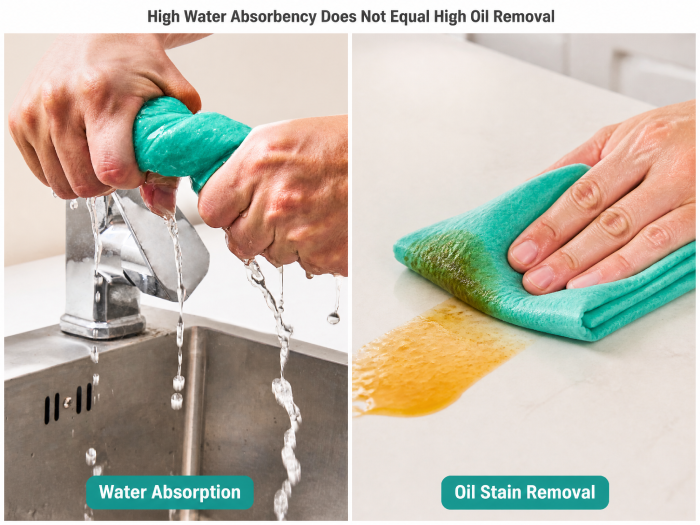
A cleaning cloth that absorbs water quickly does not necessarily remove grease effectively. Likewise, a cloth designed to wipe away grease does not always need to absorb large amounts of oil. Some products are intended to remove grease from a surface through wiping and the use of cleaning agents, rather than allowing large quantities of oil to enter the fabric.
For cleaning product importers, wholesalers, and brand buyers, the key is not simply to find a multipurpose cleaning cloth that claims to perform well in every task. Instead, buyers should identify the intended cleaning application first and then evaluate samples using the appropriate test methods.
Why Are Water Absorption and Grease Removal Different Cleaning Tasks?
In cleaning cloth procurement, several performance characteristics are often described together, but they do not represent the same function.
Water absorption refers to water entering the fibers or the spaces between fibers and being temporarily retained within the material. This performance is important when wiping up water spills, removing liquid residue, or cleaning wet surfaces.
Cleaning solution absorption refers to the ability of a cloth to take in a liquid containing cleaning agents. It is related to how liquid enters the material, but may also be affected by the cleaning solution's formulation, surface tension, and the material's wettability. Results from a plain-water test cannot fully represent how a cloth performs with a cleaning solution.
Surface grease removal refers to reducing oil or grease residue on a surface through contact, friction, wiping, and transfer. This process may involve the cleaning agent's ability to disperse or emulsify grease, as well as the cloth's surface structure and wiping method.
Removal of solid stains, such as dust, food particles, and other surface debris, involves different considerations. Contact between the cloth and the particles, friction, adhesion, and particle transfer can all affect the result.
Therefore, water absorption, cleaning solution absorption, grease removal, and solid stain removal should be evaluated separately. Good performance in one area does not automatically prove good performance in the others.
Cleaning task | Main performance being evaluated | What buyers should look at |
Water absorption | The ability to take in and retain water | Absorption speed, absorption capacity, and water retention after squeezing |
Cleaning solution absorption | The ability to take in a cleaning liquid | Wetting speed, absorption behavior, and liquid distribution |
Grease removal | The removal or transfer of grease from a surface | Surface residue after wiping, grease on the cloth, and cleaning agent conditions |
Solid stain removal | The removal of solid particles from a surface | Remaining particles, wiping marks, and particle attachment to the cloth |
For buyers, the first step is to define the product's main application rather than compare suppliers using only one water absorption figure.
What Does a Super Absorbent Cleaning Cloth Actually Need to Do?
A super absorbent cleaning cloth is generally designed to emphasize the absorption of water or another specified liquid. However, the term "super absorbent" does not represent an overall performance guarantee for every cleaning task.
The performance of an absorbent cleaning cloth may be affected by fiber type, fiber blend, GSM, thickness, density, pore structure, and surface treatment.
For example, hydrophilic fibers such as viscose and cotton generally have a greater affinity for water. Polyester and other hydrophobic fibers have a lower natural affinity for water, so water may be retained more in the spaces between fibers. However, the final performance still depends on the actual fiber blend and material structure. It should not be judged by fiber name alone.
The fiber network and internal pores of needle-punched nonwoven fabric can also affect how liquid enters and is retained. Materials with the same GSM may show different absorption performance if their fiber composition, thickness, or structure differs.
One point is particularly important: high water absorption does not mean high grease removal performance. Water absorption testing mainly examines how water enters the material, while kitchen grease removal also involves interactions between grease, cleaning agents, the cloth surface, and the surface being cleaned.
Therefore, if buyers are sourcing a kitchen cleaning cloth or dish cloth, they should also clarify whether it needs to handle greasy stovetops, dishes, range hood surfaces, or other areas exposed to kitchen grease.
Why Can a Cloth Absorb Water but Still Struggle with Kitchen Grease?
Water and oil differ in their wetting behavior, flow characteristics, and interactions with fiber surfaces. A material that is easily wetted by water is not necessarily easy to wet with or absorb oil.
Fiber Wettability Is Not the Same for Water and Oil
Fibers may have different wettability characteristics when exposed to different liquids. A material that allows water to enter its fiber network relatively easily may interact differently with grease.
Therefore, the speed at which a water droplet spreads across a cloth cannot be used to directly predict how well the cloth handles cooking oil, mixed grease, or oily kitchen residue.
A Porous Structure Does Not Guarantee Grease Removal
An open pore structure can provide space for liquid to enter a material, but pores alone cannot guarantee that grease will be effectively removed.
During wiping, grease may remain on the surface being cleaned, attach to the cloth surface, or be dispersed by a cleaning agent and transferred through the wiping action.
Buyers therefore need to distinguish between two questions: whether grease has been removed from the original surface, and whether the grease has been absorbed and retained inside the cloth. These are different performance considerations.
Detergent and Wiping Method Can Change the Result
Kitchen grease cleaning often involves more than direct contact between a cloth and oil. The type of cleaning agent, its concentration, the amount used, contact time, and number of wiping passes can all affect the result.
For example, grease may become easier to disperse and wipe away from a countertop or dish after a cleaning agent is applied. In this situation, the cleaning result comes from the combined effects of the cloth, cleaning agent, and wiping action. It should not be attributed entirely to the cloth's own oil absorption capacity.
If buyers test a sample only with water but intend to evaluate its performance in an actual kitchen grease cleaning application, the test conditions are incomplete.
Removing Grease Does Not Always Mean Absorbing Oil
This distinction is particularly important when understanding the positioning of different cleaning cloth products.
Some products are designed to wipe grease away from a surface rather than absorb large amounts of oil. After wiping, grease may remain on the cloth surface or be transferred away with the help of a cleaning agent.
Therefore, the product description "removes oil but does not absorb oil" is not necessarily contradictory. It may mean that the product is intended to remove surface grease through wiping rather than function as an industrial oil-absorbent material.
However, buyers should still ask suppliers to clarify the conditions behind this description, including the type of grease, whether a cleaning agent is used, the wiping method, and whether the cloth can be cleaned after use. A single product statement should not be interpreted as proof of the same performance under every grease-cleaning condition.
How Should Buyers Test Water Absorption Separately?
If the main purchasing requirement is water absorption, buyers should establish a separate absorption test record instead of combining water absorption and kitchen grease removal into one evaluation.
Confirm the Water Absorption Test Conditions
Before testing, confirm the sample dimensions, initial dry condition, starting weight, water temperature, contact method, and test duration.
If different suppliers use samples of different sizes, or one sample is fully immersed while another is tested through contact on only one side, the results are not directly comparable.
For supplier comparisons, use samples with the same dimensions and initial condition whenever possible, and apply the same test method.
Record Water Uptake and Absorption Speed Separately
Water absorption capacity and absorption speed are two different performance characteristics.
Absorption capacity refers to how much water a sample can take in under specified conditions. Absorption speed refers to how long it takes for water to enter or spread through the material.
Buyers can record absorption behavior within a defined period and compare samples under the same conditions. For products intended to handle larger liquid spills, absorption capacity may be more important. For cloths used to dry countertops quickly, initial absorption speed may also be a key consideration.
If buyers need to compare absorption per unit of material weight, they can record the dry sample weight and the weight after water absorption, then calculate the result using an agreed method. It is important to specify whether free water remaining on the sample surface is removed before weighing. Otherwise, different handling methods may produce significantly different results.
Check Liquid Retention After Absorption
After absorption, buyers should also consider how easily water is released when the cloth is squeezed.
For example, a cleaning cloth may need to be wrung out or squeezed during normal use. If a sample releases a large amount of water under light pressure, its practical performance may differ from what its static absorption capacity initially suggests.
Buyers can therefore include a squeezing or drainage observation in their evaluation. However, the squeezing method, pressure, or operating conditions should be standardized. Water retention results obtained under inconsistent conditions are not suitable for direct supplier comparisons.
Water absorption test item | Conditions to standardize | Suggested records |
Sample preparation | Dimensions and initial dry condition | Sample ID, dimensions, and dry weight |
Water contact method | Immersion, dripping, or one-sided contact | Contact method and water temperature |
Absorption speed | Defined observation period | Time required for water to enter or spread |
Absorption capacity | Same test duration and handling method | Weight before and after absorption |
Water retention | Standardized squeezing or drainage method | Weight after squeezing and amount of liquid released |
This test method helps answer how well a cloth absorbs water. It does not prove how effectively the cloth removes kitchen grease.
How Should Buyers Evaluate Grease Removal on a Cleaning Cloth?
Grease removal tests should be designed around the actual cleaning application. Buyers first need to identify the type of grease, the surface it is attached to, and whether the product will be used with a cleaning agent.
Define the Type of Grease and the Surface
Different types of grease may come from cooking oil, animal fats, cooking residues, or mixed stains that have adhered to a surface after heating. Their conditions and cleaning difficulty are not necessarily the same.
The test surface also affects the result. Glass, stainless steel, ceramic, and different coated surfaces may have different surface characteristics. A result obtained on one surface should not automatically be applied to every kitchen surface.
Buyers should select grease and test surfaces that closely match the intended application and record the specific conditions.
Decide Whether to Test With or Without Detergent
If the product is intended for dry wiping or wiping with water only, the test should follow those conditions.
If it is designed to be used with dishwashing liquid or another cleaning agent, the type, concentration, amount, and contact time of the cleaning agent should be specified.
It is useful to treat "water only" and "with a specified cleaning agent" as two separate test conditions. This helps buyers understand how the product performs under different usage methods instead of attributing all cleaning effects to the cloth itself.
Keep the Wiping Procedure Consistent
A grease removal test should standardize at least the sample dimensions, amount of grease, covered surface area, waiting time, number of wiping passes, wiping direction, and operating method.
If one sample is wiped once while another is wiped repeatedly, the final results cannot clearly demonstrate differences between the materials.
For more controlled sample comparisons, buyers can use a fixed load or another repeatable wiping device. If wiping is performed manually, the operator and wiping action should be kept as consistent as possible, and the number of wiping passes should be recorded.
Evaluate the Surface After Wiping
After testing, inspect the original surface for visible grease films, remaining residue, or wiping marks.
Buyers can also observe the condition of the cloth, including whether grease remains mainly on the surface, whether the cloth feels noticeably greasy, and whether it can be cleaned using the agreed washing method.
It is important to note that a surface that looks clean does not necessarily mean all grease has been removed. If the application requires strict control of residual grease, buyers should select a more suitable testing method based on the actual use requirements rather than relying only on visual inspection.
Grease removal test item | Conditions to define | Suggested records |
Grease type | Cooking oil, animal fat, or specified stain | Type and condition of grease |
Test surface | Stainless steel, glass, ceramic, or target surface | Surface material and condition before cleaning |
Cleaning agent | No cleaning agent or a specified product | Type, concentration, and amount |
Wiping conditions | Sample size, number of passes, direction, and method | Test procedure and operating records |
Cleaning result | Residue remaining after wiping | Photos, visual observations, and necessary test results |
Cloth condition | Grease condition on the cloth surface | Visible greasy residue and ease of cleaning |
Water absorption and grease removal tests should be recorded separately. If buyers need a multipurpose cleaning cloth for both water spills and kitchen grease, they should define separate performance requirements for each task instead of relying on one overall rating.
How Do Fiber Composition and Surface Structure Affect Different Cleaning Tasks?
Material selection affects cleaning cloth performance, but no single fiber or structure automatically performs best in every cleaning application.
Fiber Composition
Different fibers have different moisture absorption, wettability, and surface characteristics.
Hydrophilic fibers such as viscose and cotton are generally suitable for product designs where water absorption is important. Polyester and other synthetic fibers may offer different design options in terms of durability, structural stability, and cost. Actual performance still needs to be evaluated in relation to the fiber blend and finished material structure.
For grease removal, buyers should not judge performance only by names such as polyester, viscose, or bamboo fiber. They need to consider the material blend, surface characteristics, cleaning agent conditions, and actual sample performance.
Fiber Structure and Surface Characteristics
The spaces between fibers affect how liquid enters and is retained. However, wiping grease also requires consideration of how the cloth surface contacts the stain.
Fabric thickness, density, softness, surface texture, and structural stability may all affect the contact conditions and handling experience during wiping.
Therefore, it is not accurate to assume that larger pores always produce better grease removal, or that a rougher surface necessarily provides stronger cleaning performance. Material structure needs to be evaluated in relation to the specific surface and cleaning task.
Cleaning Agent Compatibility
For products mainly intended for kitchen grease removal, cleaning agents may be an important part of the overall cleaning system.
Buyers should confirm whether the product is intended to be used with water, dishwashing liquid, or another cleaning agent, and whether the cloth can be properly wetted, distribute the cleaning solution, and perform the required wiping task under those conditions.
If the cleaning agent formulation changes, previous test results may not be directly applicable. Therefore, buyers should keep the cleaning agent conditions consistent during sample evaluation whenever possible.
How Should Buyers Choose Between Absorbent and Grease-Removal Cleaning Cloths?
Buyers should not make decisions based only on product names or individual performance claims. Instead, product positioning should be determined by the target market and the main cleaning application.
Product positioning | Main cleaning task | Sample evaluation focus | What to confirm before purchasing |
Absorbent cleaning cloth | Absorbing water spills and liquid residue | Absorption speed, capacity, and water retention | Fiber blend, GSM, thickness, and test conditions |
Kitchen grease-removal cloth | Wiping grease from countertops, stovetops, and dishes | Wiping performance with specified grease and cleaning agent conditions | Grease type, surface material, cleaning agent, and wiping procedure |
Multipurpose cleaning cloth | Handling water, everyday stains, and some grease | Separate water absorption and grease removal evaluations | Main applications, performance priorities, and material blend |
Commercial cleaning cloth | Frequent surface wiping and daily cleaning | Cleaning performance, durability, and condition after washing | Usage frequency, cleaning environment, washing method, and specifications |
For example, a kitchen cleaning cloth intended for household use may need to handle water absorption, dish wiping, and countertop grease removal. A product designed for commercial kitchens may place greater emphasis on actual performance under specific grease conditions and frequent wiping.
For brand owners and wholesalers, product development should begin by identifying the performance characteristic that matters most in the target market. The material blend and structure can then be selected accordingly. If a product needs to provide both good water absorption and grease removal, both functions should be tested separately during sample evaluation.
How the Two Jinhaocheng Cleaning Cloth Products Are Positioned
Jinhaocheng's needle-punched nonwoven cleaning cloth product page emphasizes water absorption, everyday wet and dry wiping, cleaning solution distribution, and material options including polyester, viscose, bamboo fiber, and customized blends.
The German Cleaning Cloth product page, on the other hand, emphasizes removing grease without absorbing oil and mentions foaming and wiping performance when used with a cleaning agent.
These descriptions represent different product positioning. They do not mean that one product performs better than the other in every cleaning task. Buyers should request samples based on their intended applications and separately confirm water absorption, grease removal performance, and cleaning agent conditions.
What Should Buyers Confirm Before Placing a Bulk Order?
Before placing a bulk order, buyers should include product applications and performance requirements in their sample approval documents instead of simply writing "high absorbency" or "good cleaning performance" in an inquiry email.
First, define whether the product is mainly intended for water absorption, kitchen grease removal, dish wiping, or multipurpose cleaning. If it has several applications, list them in order of priority.
Second, provide the target material and specification requirements, including fiber composition, fiber ratio, GSM, thickness, dimensions, color, packaging, and expected usage conditions. If the material has not yet been determined, buyers can first provide the application and target performance requirements so the supplier can discuss suitable sample options.
Third, establish separate water absorption and grease removal test conditions. Water absorption testing should specify the sample condition, water contact method, duration, and weighing method. Grease removal testing should specify the grease, surface, cleaning agent, wiping passes, and evaluation criteria.
Fourth, keep sample photos, test records, and the final approved sample. Bulk orders should use the approved sample and written specifications as the basis for production and inspection whenever possible. This helps reduce the risk of unapproved changes in material composition or structure between samples and bulk production.
For HuiZhou JinHaoCheng Nonwovens Co., Ltd., the existing cleaning cloth product pages list needle-punched nonwoven cleaning cloths, German Cleaning Cloth, and other cleaning cloth products, together with material and specification customization information. Buyers can provide their intended applications, material preferences, target GSM, dimensions, packaging requirements, and estimated order quantities to discuss a suitable product solution.
When sending an inquiry, buyers are encouraged to provide the following information:
Purchasing information | Suggested details |
Target market | Household cleaning, kitchen products, commercial cleaning, or other markets |
Main application | Water absorption, grease removal, dish wiping, or multipurpose cleaning |
Target performance | Absorption speed, absorption capacity, grease removal performance, etc. |
Test conditions | Water or grease type, test surface, cleaning agent, and wiping method |
Material requirements | Polyester, viscose, bamboo fiber, or another blend |
Product specifications | GSM, thickness, dimensions, color, and packaging |
Purchasing plan | Sample quantity, estimated order volume, and annual demand |
If the product needs to handle both water and grease, make sure the two performance requirements are specified separately during sample approval. This allows the supplier to discuss material and structure based on the actual application instead of focusing only on one water absorption indicator.
Conclusion: Match the Cleaning Cloth to the Performance You Need
Water absorption and grease removal are two different cleaning functions. Water absorption mainly reflects how water enters and is retained within a material. Grease removal needs to be evaluated in relation to the type of grease, surface material, cleaning agent, and wiping conditions.
A super absorbent cleaning cloth is not necessarily suitable for every kitchen grease cleaning application. Likewise, a dish cloth that can wipe away surface grease does not necessarily need to absorb large amounts of oil.
For buyers, the more reliable approach is to define the intended application first, test water absorption and grease removal separately, and then confirm the fiber blend, material structure, and product specifications based on the sample results.
Do not simply ask a supplier, "Does this cloth absorb water?" or "Can this cloth remove grease?" More importantly, clarify the conditions under which the cloth is expected to perform, the liquid or stain involved, and the cleaning result required. Matching test conditions with purchasing requirements helps reduce product positioning errors before bulk orders.




