
Car Seat Foam Laminated Fabric: Backing Structures for Seat Covers, Cushions and Headrests
Automotive seat material development should not begin with a general request for foam laminated fabric. Seat cover backing, cushion surfaces, backrests, headrests, and armrests may all use foam-and-fabric composite materials, but they can have different installation positions, surface requirements, cushioning needs, and subsequent processing requirements.
For automotive seat manufacturers, the first step is to identify the role of the foam laminated fabric in the final seat structure. It may serve as a foam backing layer for upholstery fabric or as a flexible composite material for a specific seat component. However, it should not be treated as equivalent to a complete automotive seat cushion core.
Therefore, when sourcing Car Seat Foam Laminated Fabric, buyers should first identify the specific seat component, then select the foam type, fabric substrate, and lamination structure. Finally, the material should be evaluated through actual samples to confirm its suitability for subsequent processing and final assembly.
What Is the Difference Between Automotive Seat Cover Backing and Cushion Padding?
Automotive seat cover backing and cushion padding are often found in the same seat structure, but they are not the same material and should not be specified using the same purchasing criteria.
Seat Cover Backing generally refers to the foam or other backing layer attached to the back of upholstery fabric. It can be made by laminating fabric with foam and forms part of the seat cover material. The composite material can then undergo cutting, sewing, or other processing according to the seat design.
Seat Cushion Padding, on the other hand, generally refers to the filling material or foam structure inside the seat cushion that provides cushioning and support. It may be a separate foam component or part of a molded seat foam core. Its structure and function cannot simply be replaced by a layer of foam laminated fabric.
The main differences are shown below:
Comparison | Seat Cover Backing | Seat Cushion Padding |
Location | On the back of the upholstery fabric or within a composite fabric structure | Inside the seat cushion |
Basic structure | A composite of fabric and foam or other backing materials | Separate foam, filling materials, or another seat core structure |
Main function | Forms a composite layer of the seat cover and meets surface material and subsequent processing requirements | Provides the cushioning and support required inside the seat cushion |
Common processing | Cutting, sewing, quilting, or seat cover assembly | Molding, cutting, assembly, or integration with other seat components |
Purchasing priorities | Fabric type, foam thickness, lamination structure, surface condition, and processing compatibility | Foam type, density, hardness, resilience, and seat structure requirements |
Buyers should first confirm whether they need foam-backed upholstery fabric or cushion foam material used within the complete seat structure.
If the requirement is for fabric and foam to be laminated in advance, buyers should provide the seat cover structure, fabric type, and foam specifications. If they need the seat cushion core, they should clarify whether a separate foam or molded foam component is required. Foam laminated fabric should not be treated as a direct substitute.
How Should Foam Lamination Structures Be Selected for Different Automotive Seat Components?
Automotive seats usually consist of several different components. Seat covers, cushions, backrests, headrests, and armrests differ in shape, contact position, and manufacturing processes. Therefore, their material structures should be evaluated according to their actual applications.
Seat Component | Possible Role of Foam-Laminated Fabric | Key Points to Confirm |
Seat Cover | Forms a flexible foam backing layer behind the upholstery fabric | Fabric appearance, hand feel, foam thickness, sewing, and cutting requirements |
Seat Cushion | Used in the seat cover or a specified surface composite structure | Difference between the seat cover and internal cushion core, cushioning requirements, and material behavior under compression |
Seat Back / Backrest | Used as backing for backrest fabric or in a specified composite component | Curved-surface wrapping, material flexibility, thickness, and assembly method |
Headrest | Used in the headrest cover or a specific flexible backing layer | Component shape, covering method, sewing, and composite layer structure |
Armrest | Used in the outer layer or a specified internal composite material | Contact surface, thickness, softness, wrapping, and subsequent forming requirements |
These components do not necessarily all require foam laminated fabric. Whether a composite material is needed should be determined by the final seat design.
For example, seat cover backing requires attention to the overall condition of the laminated fabric and whether it can accommodate cutting and sewing. For seat cushions, buyers must distinguish the surface upholstery material from the internal load-bearing foam core instead of treating these two materials as interchangeable.
For backrests, headrests, and armrests, buyers should also provide the component shape, installation position, and subsequent covering method. For components involving curves, edging, or special forming requirements, a flat material sample alone may not be sufficient to determine final compatibility.
Therefore, when purchasing automotive seat foam laminated fabric, it is better to provide drawings, photographs, or existing material samples for each component rather than supplying only a photograph of the complete vehicle seat.
How Should Standard PU Foam and High Resilience PU Foam Be Evaluated?
PU foam is one of the materials that may be considered when developing flexible automotive seat composites. However, standard PU foam and high resilience PU foam should not be selected simply by comparing their names.
Different PU foam grades may vary in density, hardness, resilience, compression recovery, and processing compatibility. Their actual performance needs to be evaluated using technical specifications and physical samples.
Evaluation Item | Standard PU Foam | High Resilience PU Foam |
Material positioning | Conventional flexible polyurethane foam, with specific performance depending on the foam grade | Polyurethane foam designed with a focus on higher resilience characteristics |
Parameters to confirm | Density, hardness, thickness, resilience, and compression behavior | Density, hardness, resilience, compression set, and other relevant properties |
Selection basis | Material function and processing requirements of the specific seat component | Requirements for resilience, support, and actual use conditions of the specific component |
Sample evaluation | Check hand feel, thickness, lamination condition, and compatibility with subsequent processing | In addition to general checks, confirm relevant resilience and compression properties |
Purchasing considerations | Density alone cannot determine softness or hardness | The term high resilience does not automatically mean the foam is suitable for every seat component |
It is important to understand that foam density is not the same as hardness and cannot independently represent resilience or final seat comfort.
Density mainly describes the mass per unit volume, while hardness and resilience need to be evaluated using their respective test methods. Buyers should not provide only a density value and expect a supplier to determine whether the foam is suitable for automotive seats based on that figure alone.
For automotive seat projects, buyers should also confirm whether the final application involves requirements for heat resistance, odor, VOC, fogging, flame retardancy, compression set, or other automotive material properties. Different automotive manufacturers, vehicle models, and markets may apply different technical specifications and acceptance criteria. The parameters of one material should not be automatically applied to every project.
High resilience PU foam is also not necessarily the best choice for every seat component. The selection should be based on the specific component structure, material thickness, application requirements, and actual test results.
How Should Knitted Fabric, Warp Knitted Fabric, Mesh, and Synthetic Leather Be Selected?
Selecting foam laminated fabric involves more than choosing the right foam. Buyers also need to confirm the fabric or surface material to be laminated with it.
Different substrates may vary in textile structure, surface appearance, softness, stretch characteristics, and subsequent processing requirements. Even when the same PU foam is used, the final composite material may behave differently when combined with different substrates.
Substrate Type | Structural Characteristics | Considerations for Automotive Seat Material Development |
Knitted Fabric | Formed by interconnected yarn loops | Stretch, surface texture, softness, sewing, and covering requirements |
Warp Knitted Fabric | Formed through loop structures created by warp yarns | Fabric structural stability, stretch characteristics, surface condition, and processing compatibility |
Mesh Fabric | Features an open or perforated structure | Mesh pattern, ventilation requirements, surface appearance, and overall composite structure |
Synthetic Leather | Features a polymer surface layer and a corresponding substrate structure | Surface condition, flexibility, lamination compatibility, bending, and subsequent processing requirements |
Both knitted fabric and warp knitted fabric belong to knitted textile structures, but their specific constructions and properties are not identical. If buyers have already selected a fabric type, it is better to provide an actual fabric sample rather than only a general material name.
Mesh can be considered as a substrate for certain composite structures, but its open structure alone does not prove that it will provide better breathability or be more suitable for a particular seat component. Actual performance may also be affected by foam type, mesh opening size, lamination method, and the overall layer structure.
For synthetic leather, particular attention should be paid to lamination compatibility between the surface material and the foam. Different surface coatings, substrate structures, and processing conditions may affect bonding results. Therefore, the lamination method and subsequent processing requirements should be confirmed for the specific material.
When selecting a substrate, buyers should provide its composition, GSM, thickness, color, surface finish, and intended application. If the fabric has already been finalized, providing an actual sample is recommended so the supplier can evaluate its compatibility with the foam.
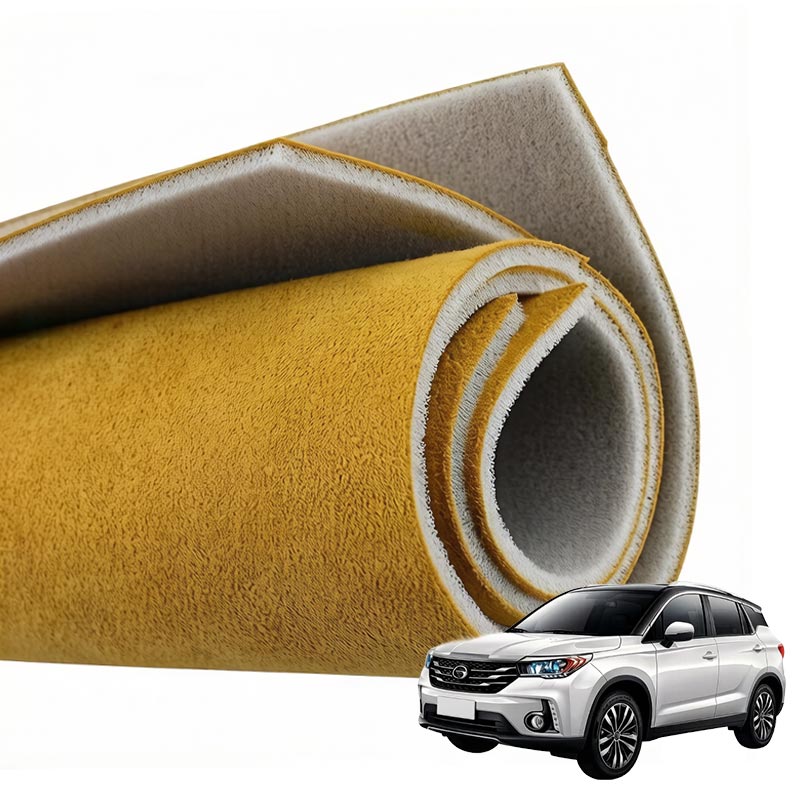
What Is the Difference Between Single-Sided Lamination and Fabric + Foam + Fabric Structures?
Foam laminated fabric can be developed with different layer configurations according to the final product structure. For automotive seat material development, common structures to consider include single-sided lamination and a three-layer composite consisting of fabric, foam, and fabric.
Single-Sided Lamination: Fabric + Foam
This structure consists of one fabric layer laminated to one foam layer. It can be used as a flexible composite backing layer for certain seat covers or specified seat components.
Buyers should confirm which side serves as the visible surface and whether the other side needs to contact another material or undergo further assembly. Foam thickness, fabric condition, and the overall dimensions after lamination should also be confirmed.
Double-Fabric Structure: Fabric + Foam + Fabric
In this structure, fabric is laminated to both sides of the foam, creating a three-layer composite material. It can be considered for composite material development where fabric layers are required on both sides.
However, a three-layer structure is not necessarily better than a single-sided structure and should not be assumed suitable for every automotive seat component. The two fabric layers may serve different purposes, so buyers should confirm the material type, GSM, color, and surface requirements of each side separately.
Comparison | Fabric + Foam | Fabric + Foam + Fabric |
Basic number of layers | Two layers | Three layers |
Fabric position | One side of the foam | Both sides of the foam |
Fabric specifications to confirm | Type and specifications of one fabric | Type and specifications of both fabric layers |
Structural focus | Lamination condition between the fabric and foam | Combination of both fabric layers with the foam core |
Purchasing priorities | Visible surface, foam thickness, and back-side application | Surface requirements on both sides, overall thickness, and subsequent processing |
Application evaluation | Confirm according to the specific component and installation structure | Confirm according to the need for fabric on both sides and the final product structure |
In addition to the number of layers, buyers should consider the overall thickness, softness, bending behavior, and subsequent cutting method of the laminated material.
If the material needs to undergo sewing, wrapping, or other forming processes, buyers are advised to provide actual component samples or structural drawings and evaluate the composite material through sample testing.
What Material Specifications and Subsequent Processing Requirements Should Be Confirmed for Automotive Seat Foam Laminated Fabric?
Purchasing specifications for automotive seat foam laminated fabric should not simply state "PU foam laminated fabric" or "automotive seat foam fabric."
To reduce differences in how suppliers interpret the requirements, buyers should provide as many of the following specifications as possible.
Specification Item | Information to Confirm | Purchasing Considerations |
Final seat application | Seat cover, cushion surface, backrest, headrest, or armrest | Identify the specific position of the material in the final seat |
Foam type | Standard PU foam, high resilience PU foam, or another specified material | If the grade has not been selected, provide the actual application and requirements |
Foam thickness | Target thickness and allowable tolerance | Distinguish the foam thickness from the total laminated thickness |
Foam density | Target density and testing basis | Clarify that the density refers to the foam itself, not the entire composite material |
Foam hardness and resilience | Target hardness, resilience requirements, and test methods | Do not use density alone as a substitute for hardness or resilience |
Fabric type | Knitted fabric, warp knitted fabric, mesh, synthetic leather, or another specified material | Provide actual fabric samples and material composition whenever possible |
Fabric GSM | GSM of each fabric layer | Clarify whether GSM refers to an individual fabric layer or the entire composite |
Lamination structure | Fabric + Foam or Fabric + Foam + Fabric | Specify the material and sequence of every layer |
Total laminated thickness | Finished thickness and tolerance after lamination | Confirm using actual samples and an agreed measurement method |
Subsequent processing | Cutting, sewing, quilting, wrapping, or other processing | Explain which operations the material must undergo |
Testing and acceptance requirements | Relevant automotive standards, test methods, and acceptance criteria | Provide applicable OEM or project specifications instead of simply stating "automotive standard compliant" |
Foam thickness, foam density, fabric GSM, and total laminated thickness are different specification items and should not be confused.
For example, fabric GSM should be clearly identified as the weight of an individual substrate layer or the unit area weight of the entire composite. Foam thickness should also be recorded separately from the total thickness of the finished laminated material.
In addition, if the automotive seat material needs to undergo cutting, sewing, quilting, wrapping, or forming, the supplier should understand the specific processing methods. A material that appears suitable in a flat sample does not necessarily mean it will meet requirements after actual production operations.
For projects with specific automotive performance requirements, buyers should provide the corresponding test methods, sample conditions, and acceptance criteria before sampling. Suppliers should not promise compliance with specific automotive brands or vehicle models without supporting tests and documentation.
What Information Should Automotive Seat Manufacturers Provide Before Requesting a Quotation?
If an automotive seat manufacturer wants a supplier to evaluate the feasibility of a foam laminated fabric structure, the following information should be provided when making an inquiry.
Inquiry Information | Details to Provide |
Final application | Specify whether the material is for a seat cover, cushion surface, backrest, headrest, or armrest |
Product photographs or drawings | Provide photographs, structural drawings, or existing material samples of the seat component |
Fabric information | Fabric type, fiber composition, GSM, thickness, color, and surface requirements |
Foam information | PU type, thickness, density, hardness, and resilience requirements |
Lamination structure | Single-sided lamination or a Fabric + Foam + Fabric structure |
Dimension requirements | Material width, length, total laminated thickness, and tolerances |
Subsequent processing | Whether cutting, sewing, quilting, wrapping, or other forming processes are required |
Performance requirements | Whether requirements involve flame retardancy, odor, VOC, heat resistance, compression set, or other properties |
Testing standards | Applicable automotive manufacturer specifications, test methods, and acceptance criteria |
Order quantity | Sample quantity, trial order quantity, and expected bulk order volume |
Delivery requirements | Packaging method, lead time, and shipping requirements |
If buyers have not yet selected a specific foam grade or lamination structure, they do not need to make assumptions before requesting a quotation. They can first provide the final seat component application, photographs, existing material samples, and known performance requirements. The supplier can then evaluate possible material combinations.
For foam lamination projects, JHC's confirmed experience includes laminating PU and EVA foam with different materials, involving flame lamination, adhesive lamination, and hot-melt lamination. Material combinations and processing arrangements need to be confirmed according to specific project requirements, and some projects also involve external processing. Therefore, whether a particular fabric, foam grade, and layer structure can be used for an automotive seat component still needs to be evaluated based on project information and actual samples. It should not be assumed based on the structure of another product.
If you are developing custom automotive foam laminated fabric for car seats, you can learn more about the relevant product range and provide the material requirements for your specific seat components.
If the actual requirement is for rigid support or structural backing at the rear of a seat, it should be distinguished from flexible foam laminated fabric and considered as rigid needle punched felt for automotive seat backing. These two materials serve different functions and should not be treated as the same product for purchasing comparisons.
Before submitting an inquiry, buyers can also refer to the foam laminated fabric specifications for automotive applications guide to organize information about foam, fabric, layer structure, thickness, and subsequent processing.
The key to automotive seat material purchasing is not to choose the most complicated composite structure or the one with the greatest number of layers. It is to ensure that the foam, fabric, and lamination method match the application, production process, and acceptance requirements of the specific seat component. By clarifying the component application, providing actual material samples, and confirming testing standards, manufacturers can move forward more effectively with material development and bulk purchasing.




