
Aquarium Filter Floss vs. Filter Pads: When Should Buyers Choose Rolls or Cut Sheets?
When purchasing aquarium filter media, buyers usually focus first on material type, thickness, GSM, and filtration applications. However, for aquarium filtration equipment manufacturers, filter media converters, brands, and wholesalers, another decision can directly affect downstream production and sales: should they purchase continuous rolls or pre-cut filter pads?
In the aquarium filtration market, aquarium filter floss and aquarium filter pad are both commonly used product terms. However, their meanings can vary among suppliers and sales channels. Some products are supplied in rolls for further slitting or cutting by downstream processors. Others are supplied as full sheets that buyers can process according to their required dimensions. Some are already cut to specified sizes and can move directly into assembly or packaging.
Buyers therefore need to distinguish between the material itself and its supply format. Rolls, full sheets, and pre-cut filter pads are not necessarily three different types of filtration material. They represent different supply and processing stages.
The right choice should not be based on unit price alone. Buyers should consider order quantity, downstream processing methods, equipment requirements, packaging, inventory management, and actual material utilization.
Why Does Supply Format Matter When Buying Aquarium Filter Media?
The same type of aquarium filter media can be supplied in different formats according to the buyer's production and sales requirements. For an upstream material supplier, rolls may be more suitable for further continuous processing. For downstream brands or aquarium filtration equipment manufacturers, pre-cut filter pads may be closer to the format required for their final products.
When buyers purchase rolls, they may also need to consider subsequent slitting, dimensional control, processing equipment, and semi-finished product inventory. When purchasing pre-cut filter pads, they need to confirm whether the pad dimensions match their product designs and whether the material can move directly into their packaging or assembly processes.
Supply format can also affect order management. For example, an aquarium filtration equipment manufacturer may need to feed material continuously into its equipment. A filter media brand may need to convert the material into different sizes before individual packaging. A wholesaler may be more concerned with inventory and distribution across different product specifications.
These purchasing situations are not the same. Buyers should first understand which processes the material must go through after delivery, then decide whether to purchase rolls, full sheets, or pre-cut filter pads.
What Is the Difference Between Filter Floss Rolls, Full Sheets, and Cut Filter Pads?
During purchasing discussions, it is important to clarify what each supply format actually means. This helps prevent misunderstandings between buyers and suppliers about the condition in which the material will be delivered.
Aquarium Filter Floss Roll: Continuous Material in Roll Form
An aquarium filter floss roll generally refers to aquarium filter media supplied in a continuous wound length. After delivery, buyers can feed, slit, or further process the material according to their production requirements.
This format is generally suitable for buyers with their own material processing capabilities, those requiring continuous material feeding, or manufacturers that need to produce different product sizes for different orders.
A roll does not necessarily mean that the material has already been processed into its final product form. Buyers may still need to convert it into the dimensions or shapes required for their applications.
Full Sheet: Individual Sheets of Material
Full sheets are supplied as individual pieces, but they are not necessarily cut to the final dimensions of the finished product.
This format may suit buyers who do not need continuous roll feeding but still want to determine dimensions or carry out further processing during downstream production.
For example, some converters may need to distribute full sheets to different production stations or arrange further processing according to multiple product specifications. Full sheets can reduce the need to handle entire rolls on the production floor, but their suitability still depends on sheet dimensions, handling requirements, and inventory management.
Aquarium Filter Pad: Pre-Cut Filter Sheets
In this article, an aquarium filter pad mainly refers to filter media that has already been cut to agreed dimensions.
This format is suitable for buyers who need material for direct assembly, sale as a matching filtration product, or packaging according to fixed specifications.
Compared with rolls, pre-cut filter pads reduce the need for buyers to slit or cut the material themselves. However, buyers must determine the product dimensions in advance. If product sizes change frequently, pre-cut inventory may require more detailed management.
It is important to note that a pre-cut filter pad does not necessarily mean that it is a complete filter or filtration component. It may still be only one layer of material within a finished product, depending on the product structure and equipment design.
When Should Buyers Choose Aquarium Filter Floss Rolls?
If buyers have their own downstream processing capabilities or their production processes require continuous material supply, rolls are often worth considering first.
Continuous Feeding or Further Slitting
For manufacturers that need to feed filter media continuously into processing equipment, rolls may integrate more easily with existing production workflows.
For example, a filter media converter can slit rolls into different product sizes according to order requirements before further packaging or assembly.
If a factory needs to produce aquarium filter pads in multiple sizes, purchasing rolls may also provide more flexibility when adjusting product specifications. However, suitability still depends on equipment capabilities, production cycles, and material utilization methods.
One Material Used for Multiple Product Sizes
Some brands and converters do not sell just one size of filter media. Different customers, filtration equipment, or sales channels may require different specifications.
In these situations, purchasing rolls and carrying out downstream slitting in-house may make it easier to manage raw materials and schedule production according to different orders.
However, if specification changes occur frequently, buyers should also consider leftover material from size changes, production setup time, and inventory management costs.
Buyers with Their Own Processing and Packaging Capabilities
If buyers have their own material slitting, packaging, and finished-product management capabilities, rolls can serve as the base material for further production.
This approach may suit buyers who want to control downstream processing, develop private-label products, or convert raw materials into different sales formats.
However, purchasing rolls also means that buyers must take responsibility for the related processing, labor, equipment, and packaging work. Whether this option is more suitable should be evaluated according to actual production conditions rather than assuming that rolls always have a lower purchasing cost.
When Are Full Sheets or Pre-Cut Aquarium Filter Pads More Suitable?
If buyers do not need to process entire rolls themselves, or if their downstream products use fixed-size filter media, full sheets and pre-cut filter pads may better match their actual requirements.
Direct Assembly in Fixed Specifications
For aquarium filtration equipment manufacturers whose product dimensions have already been established, pre-cut filter pads may reduce on-site cutting work if the material only needs to be installed in a fixed size.
Operators can retrieve the required specifications according to the production schedule and use them in the corresponding assembly process.
However, buyers still need to confirm dimensional tolerances, material condition, and actual installation requirements. Nominal dimensions alone are not enough to determine whether a pad is suitable.
Buyers Without Roll Processing Equipment
Some brands, wholesalers, and equipment manufacturers do not have complete roll slitting or processing facilities.
If buyers mainly handle product assembly, bundled sales, or distribution, purchasing full sheets or pre-cut filter pads may fit their existing business processes more easily.
This can reduce the need to handle entire rolls themselves. However, buyers should communicate different size requirements to the supplier in advance and evaluate how changes in finished-product dimensions may affect inventory.
Packaging and Selling Different Product Specifications
If filter media is sold as individual pads or supplied as replacement consumables for filtration equipment, pre-cut products may be closer to the final sales format.
For example, different packages may correspond to different dimensions, quantities, or product models. Buyers can evaluate whether they need the supplier to provide filter pads in specified sizes according to their sales channels and packaging requirements.
However, if there are many product specifications, buyers should also consider the minimum order quantity for each size, inventory turnover, and future replenishment arrangements.
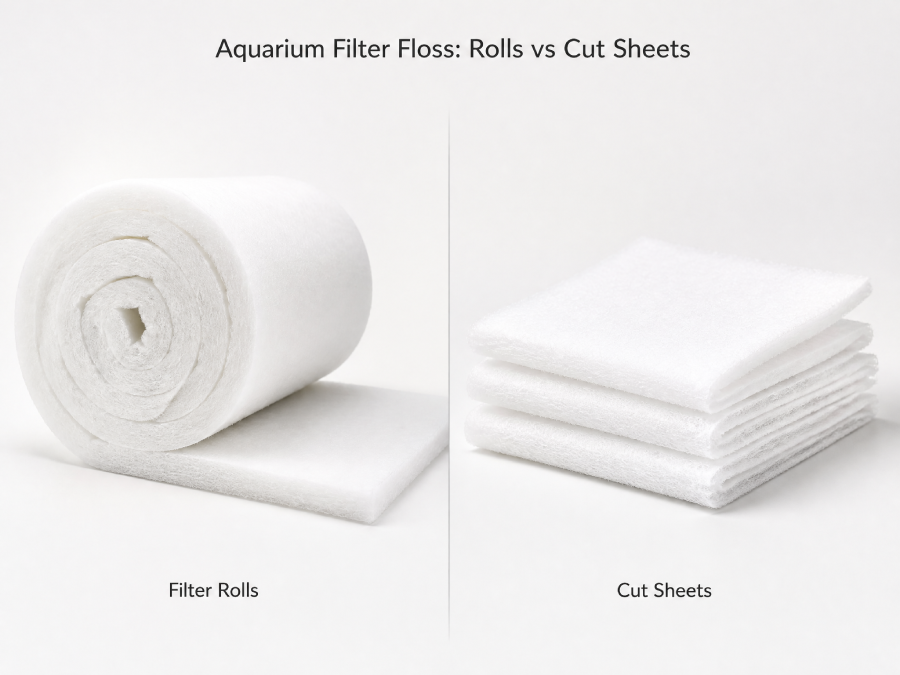
How Do Supply Formats Affect Downstream Processing, Packaging, and Inventory?
When choosing rolls or sheets, buyers should not consider only the condition in which the material arrives. They should evaluate the entire process after the material enters downstream production.
Downstream Processing Methods
Rolls generally require further feeding or slitting to produce different product sizes. For buyers with processing equipment, this format can provide more flexibility in production scheduling.
Full sheets can reduce the need to handle entire rolls on-site. However, if the dimensions or shapes need to be changed further, additional processing may still be required.
Pre-cut filter pads are more suitable for projects with established product dimensions and assembly methods, potentially reducing some downstream processing steps.
Buyers should therefore decide whether they want to retain control over downstream processing or prefer the supplier to deliver the material in specified dimensions.
Packaging and Transportation
The packaging methods for rolls, full sheets, and pre-cut filter pads may differ.
Rolls require consideration of roll protection, packaging units, and handling methods. Full sheets require suitable flat stacking, packaging protection, and batch identification. Pre-cut filter pads may need to be packaged separately according to product specifications or the number of pieces per package.
If buyers intend to distribute products directly to retailers or end customers, they should also consider whether product labels, package quantities, and sales specifications match the supplier's delivery format.
Packaging can also affect shipping space and on-site unpacking operations. However, without actual dimensions, packaging data, and transportation conditions, it is not appropriate to assume that one format will always reduce logistics costs.
Inventory Management
Rolls can be held as raw material inventory and processed according to incoming orders. Full sheets can be managed by material specification or production batch. Pre-cut filter pads may need to be managed separately according to different dimensions, product models, and package quantities.
If buyers have a limited number of product specifications and stable orders, pre-cut pads may be easier to manage as fixed SKUs.
If product specifications are numerous and orders change frequently, rolls may provide greater flexibility for downstream processing. However, buyers will also need to manage slit semi-finished products and leftover material.
The inventory management method should therefore match the company's product range, order frequency, and warehouse procedures.
Material Utilization and Overall Purchasing Cost
Rolls are not necessarily cheaper than sheets, and sheets are not necessarily more convenient than rolls.
Rolls may reduce certain purchasing limitations when different sizes are required, but downstream processing can involve labor, equipment usage, and slitting waste. Pre-cut filter pads may reduce some on-site processing work, but changing demand across different sizes can also result in specification mismatches or excess inventory.
Buyers should evaluate purchasing quantity, cutting waste, labor costs, processing equipment, packaging, inventory turnover, and whether leftover material can be reused.
The real comparison should not be limited to the price per kilogram or per pad. It should consider the overall cost from material purchasing through to the final product or sales stage.
What Should Buyers Consider Before Choosing Rolls or Cut Sheets?
Before deciding on a supply format, buyers should first clarify the final application and downstream processing workflow.
First, explain the type of aquarium filtration product in which the material will be used. For example, is it continuous filter media for automatic filtration equipment, replacement filter media inside a filtration unit, or filter pads that will be packaged and sold individually?
Second, confirm how the material will be processed after delivery. Will buyers need to feed, slit, or carry out other processing themselves? If they do not have the necessary equipment, would they prefer the supplier to provide pre-cut sheets?
Next, determine the required delivery format. Do buyers need continuous rolls, full sheets that have not yet been cut to final dimensions, or filter pads already cut to specified sizes? If different products require different formats, this should also be communicated in advance.
Then, confirm the dimensions and packaging requirements related to the supply format. For rolls, provide the relevant information required for actual use and equipment installation. For sheets, specify individual sheet dimensions, permitted tolerances, package quantities, and product identification requirements. Specific equipment dimensions and installation compatibility should be checked separately according to the equipment model rather than inferred from the supply format alone.
Finally, explain the basic material requirements, including fiber type, GSM, thickness, color, material structure, and relevant requirements for aquarium filtration applications. For polyester aquarium filter floss projects, buyers should also confirm whether the material meets the applicable requirements for water contact, cleaning, and actual use.
This article focuses on supply format selection rather than a complete technical RFQ. Buyers who need to organize material specifications, equipment information, sample requirements, and other purchasing details can refer to a dedicated aquarium filter media RFQ guide.
Can Aquarium Filter Media Be Supplied in Both Roll and Pad Formats?
Where material specifications, production conditions, and supplier processing capabilities allow, the same type of aquarium filter media may be evaluated for delivery in different formats.
For example, a project may start with roll material that the buyer slits into multiple product sizes. Alternatively, if the finished product dimensions have already been established, buyers may consider having the supplier provide pre-cut filter pads directly.
However, this does not mean that every product can switch between supply formats without changing any requirements. Rolls and sheets may involve different processing, packaging, and acceptance requirements. If buyers change from rolls to pre-cut sheets, they should reconfirm individual sheet dimensions, quantities, packaging, and permitted tolerances. If they change from sheets to rolls, downstream equipment and processing workflows should be reassessed.
For long-term purchasing projects, buyers are advised to confirm the material itself through samples before deciding on the supply format. The final approved material specifications, delivery condition, dimensional requirements, and packaging methods should be recorded in the order or product specification document.
If a project involves both raw material processing and finished-product sales, buyers can also evaluate rolls and pre-cut products separately for different sales channels rather than forcing one supply format to meet every requirement.
How to Choose the Right Supply Format for Your Aquarium Filter Media Project
Buyers can begin by evaluating their own business models.
If a company has downstream processing capabilities, requires continuous feeding, or wants to produce multiple product sizes from the same material, an aquarium filter floss roll may be more suitable as a raw material purchasing format.
If a company mainly handles assembly, bundled sales, or distribution and does not need to process entire rolls, full sheets or pre-cut aquarium filter pads may be worth considering.
If buyers are still developing a new product and have not finalized its dimensions, they should first clarify the material application and downstream processes before discussing samples and different supply formats with the supplier. It is better not to commit to a specific delivery format too early when product dimensions and production workflows are still uncertain.
For overseas buyers seeking customized aquarium filter media, HuiZhou JinHaoCheng Nonwovens Co., Ltd. can discuss the specifications of polyester hot-air filter media and other nonwoven filtration materials, roll or sheet supply formats, and related customization requirements according to each project. The company also provides OEM/ODM manufacturing services. Established in 2005, the company operates multiple automated nonwoven production lines with an annual production capacity of approximately 10,000 tons. Material supply options can be discussed based on customer applications, samples, and production requirements. Specific product structures, supply formats, and bulk specifications must be confirmed according to each project's requirements.
Conclusion: Choose the Supply Format That Fits Your Downstream Process
There is no single answer to whether aquarium filter media should be purchased in rolls or as filter pads that applies to every buyer.
If buyers have downstream processing capabilities, require continuous feeding, or produce multiple product sizes, rolls may better fit their production workflows. If buyers mainly handle assembly, bundled sales, or distribution and have already established their product dimensions, full sheets or pre-cut filter pads may be more suitable.
Buyers should consider downstream processing, equipment conditions, packaging, inventory management, order quantities, labor, and material utilization rather than simply assuming that rolls are always cheaper or sheets are always more convenient.
Ultimately, the right supply format should make the entire process—from supplier delivery to downstream production or sales—more efficient while reducing unnecessary processing and inventory management burdens.




