
Self-Adhesive vs. Non-Adhesive Anti-Condensation Felt: Understanding the Backing Structure
When sourcing anti-condensation felt for metal roofing, buyers need to confirm more than the material, GSM, and thickness. One easily overlooked detail is whether the back of the felt has a self-adhesive backing.
Two products may use similar polyester needle-punched felt as their base material, but different backing constructions can affect how the material is fixed, processed, and inspected during sample approval.
For metal roofing sheet manufacturers, choosing the right construction should not depend only on the product name or unit price. More importantly, buyers need to understand how the felt will be attached to the metal sheet and whether the selected construction is compatible with the existing production process.
This article explains the differences between the two backing structures, including their material construction, fixing methods, production compatibility, and sample inspection requirements, helping buyers determine which option better suits their projects.
What Are the Basic Components of Anti-Condensation Felt?
Anti-condensation felt can generally be understood in two parts: the base felt layer and the backing construction added according to the product design.
The base felt layer forms the main fibrous structure of the material. Some products use PET needle-punched nonwoven felt, in which interlocked fibers create a material with a certain thickness and porous structure.
The backing construction is designed according to the installation or processing requirements. It may include a self-adhesive backing, a non-adhesive felt structure, or another specified composite construction.
Therefore, buyers should not simply specify "PET anti-condensation felt" or "anti-condensation felt" when placing an order. They should also clarify whether an adhesive layer is required and how the finished material will be fixed in the final application.
It is important to understand that non-adhesive does not necessarily mean a single-layer PET needle-punched felt. A product may contain another film or composite layer without having a self-adhesive backing. The actual construction should be confirmed through the product cross-section and technical specifications.
What Is the Role of the PET Needle-Punched Felt Layer in Both Structures?
For anti-condensation felt made with PET needle-punched nonwoven material, the base felt layer may be shared by both backing structures.
After PET fibers are formed into a web and needle-punched, they create a nonwoven material with a certain thickness and porous structure. This provides the basic fibrous construction of the anti-condensation product. Its basis weight, thickness, fiber composition, and web structure all influence the characteristics of the finished material.
Self-adhesive and non-adhesive products do not necessarily require different base fibers. Their main difference is whether a self-adhesive layer is added and how the adhesive or other composite layers are combined with the base felt.
When comparing the two products, buyers should confirm the base felt specifications separately from the backing construction.
For example, two products both specified at 100 g/m² should not automatically be considered identical in overall construction, thickness, or processing performance.
If the product includes an adhesive layer, buyers should also confirm whether the stated GSM refers to the base felt alone or the complete adhesive-backed product. The same clarification is needed for thickness, including the measurement object and method.
What Components Make Up a Self-Adhesive Backing Structure?
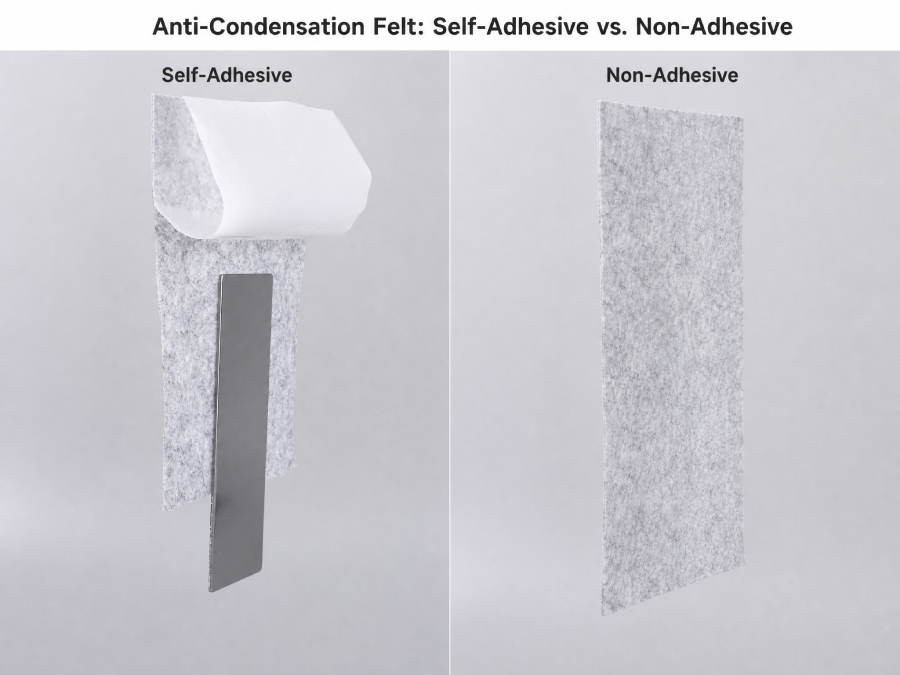
Self-adhesive anti-condensation felt is made by adding a suitable adhesive layer to the back of the base felt. This allows the material to bond to a metal surface when the substrate and processing conditions are compatible.
Depending on the product design, a self-adhesive construction may include the following components:
The base PET needle-punched felt layer provides the required fibrous material structure.
The adhesive layer is designed to create a bond with the target substrate under suitable conditions.
A protective release liner may be included in the product design to protect the adhesive surface during storage and transportation. It is removed before application according to the product requirements.
Not all self-adhesive products use exactly the same adhesive or protective layer design. Buyers should therefore not judge the complete construction based only on the term "Self-Adhesive."
For metal roofing applications, compatibility between the adhesive and the target metal surface is particularly important. Steel sheets may have different coatings, surface treatments, and cleanliness conditions, all of which can affect actual bonding performance.
Buyers should therefore confirm the adhesive type, compatible metal surfaces, processing temperature, bonding requirements, and whether a protective release liner is needed.
The key to a self-adhesive construction is not simply whether it can stick, but whether the adhesive is compatible with the actual metal substrate and processing conditions.
How Should Non-Adhesive Anti-Condensation Felt Be Fixed?
Non-adhesive anti-condensation felt refers to a construction without a pre-applied self-adhesive backing.
This does not mean that the material does not need to be fixed, nor does it mean that it can simply be placed on a metal roof and used without any additional arrangement.
If the product has no self-adhesive backing, buyers must first define the actual fixing method required for the project. This may depend on the metal roofing structure, processing equipment, composite design, or on-site installation plan.
Without a confirmed product design and customer process, it should not be assumed that non-adhesive felt can be installed using a particular glue, mechanical fastener, or other fixing method.
For metal roofing manufacturers, the most important questions are whether the felt will be fixed during metal sheet production or during subsequent installation, and whether the customer's existing equipment can perform the required bonding or fixing operation.
If the customer has not yet determined a fixing method, it is advisable to provide the metal sheet structure, processing method, and existing material samples before discussing a suitable product construction with the supplier.
Non-adhesive felt without a clearly defined fixing method should not enter bulk purchasing based only on its base material specifications.
Is a Self-Adhesive Structure Suitable for Continuous Metal Roofing Production?
For metal roofing manufacturers using continuous roll-forming production, self-adhesive anti-condensation felt can be evaluated as a possible material construction. However, its self-adhesive feature alone does not prove that it is suitable for every existing production line.
During actual production, the felt needs to match the metal sheet surface, material feeding method, bonding position, and processing conditions.
Buyers should pay particular attention to the following points:
Can the felt be unwound and fed consistently according to the production line requirements?
Does the felt width match the effective bonding area of the metal roofing sheet?
Can the adhesive form the required bond on the actual metal surface?
Do noticeable shifting, wrinkles, edge lifting, or local delamination occur during processing?
After production, handling, and subsequent processing, does the adhesive-to-felt bond remain within the agreed acceptance requirements?
If a non-adhesive construction is used, buyers need to confirm whether the production line has the required fixing or lamination process. The fact that the base felt can be unwound normally does not mean that the complete product can automatically be used in continuous production.
Therefore, continuous metal roofing projects should be validated using actual samples under representative production conditions. A simple hand-applied adhesion test is not enough to establish production-line compatibility.
How Do the Two Backing Structures Affect Purchasing and Processing?
The main differences between self-adhesive and non-adhesive anti-condensation felt relate to the backing construction, fixing method, and processing conditions that need to be verified.
Comparison | Self-Adhesive Anti-Condensation Felt | Non-Adhesive Anti-Condensation Felt |
Base material | PET needle-punched felt or another specified felt material | PET needle-punched felt or another specified felt material |
Backing construction | Includes a self-adhesive layer; some designs also include a protective release liner | No pre-applied self-adhesive backing; other specified composite layers may still be present |
Fixing method | Bonds to a compatible substrate through the adhesive backing | Depends on the customer's specified fixing, lamination, or installation method |
Main purchasing considerations | Adhesive type, metal surface, bonding requirements, and protective layer | Base felt, specified backing construction, and actual fixing method |
Processing validation | Unwinding, feeding, bonding, and bonding stability | Unwinding, feeding, and compatibility with the customer's specified fixing process |
Sample inspection | Check the adhesive construction, bonding performance, and processing compatibility | Check whether the construction matches the specification and whether the fixing and application method are feasible |
It is important to note that a non-adhesive construction does not automatically mean lower cost, slower installation, or faster installation. The actual purchasing cost also depends on the felt specifications, additional fixing materials, processing steps, labor, and equipment requirements.
Similarly, a self-adhesive structure is not suitable for every metal sheet. If the adhesive is incompatible with the metal surface, the product may fail to meet the required bonding performance even when its GSM and thickness meet the specified values.
Buyers should therefore compare the complete product construction and application process rather than comparing only the base felt price.
What Backing Details Should Buyers Confirm Before Purchasing?
Before requesting a quotation, buyers should list the base felt and backing construction separately to avoid suppliers making different assumptions about the required product.
First, confirm the base felt specifications.
Specify the fiber material, base felt GSM, thickness, color, width, and roll length. If the project has requirements for GSM or thickness tolerances, these should also be stated in advance.
Next, confirm the backing construction.
For a self-adhesive product, specify whether an adhesive backing is required, the compatible substrate, whether a protective release liner is needed, and the relevant bonding requirements.
For a non-adhesive product, provide the required backing construction and explain how the material will ultimately be fixed or laminated. Simply writing "Non-Adhesive" without explaining the actual application method is not sufficient.
Third, clarify how the finished product specifications are calculated.
For products with adhesive or composite layers, confirm whether the GSM and thickness in the technical documents refer to the base felt or the complete finished product. Otherwise, specifications from different suppliers may not be directly comparable.
Finally, confirm the processing conditions.
If the product will be used in continuous metal roofing production, provide information about the metal sheet surface, manufacturing method, required material width, and sample validation conditions. If it will be used for on-site installation, explain the installation structure and fixing requirements.
For projects with specific technical requirements, it is advisable to use construction drawings, samples, and agreed acceptance criteria as the basis for quotation and order confirmation.
How Can Samples Be Used to Confirm the Final Product Construction?
Sample approval should involve more than checking the product color, hand feel, and appearance. Buyers should also verify whether the backing construction matches the agreed requirements.
For self-adhesive anti-condensation felt, check whether the base felt, adhesive layer, and protective release liner match the confirmed specifications. After removing the protective liner, apply the sample to the target metal surface and observe whether the bonding is even and whether noticeable local separation or edge lifting occurs.
For non-adhesive anti-condensation felt, first confirm that the sample does not have a pre-applied self-adhesive backing. If the product includes another film or composite layer, check whether its material and construction match the agreed specifications.
The sample should then be tested using the fixing or lamination method already specified by the customer. If the fixing method has not yet been determined, the sample can only be used to confirm the base material and construction. It should not be treated as completed application validation.
For continuous metal roofing production projects, samples should be tested under representative production conditions whenever possible. Observe unwinding, feeding, alignment, bonding, and subsequent processing performance.
After sample approval, retain the approved sample and its corresponding specification documents. For self-adhesive products, record the adhesive construction and bonding acceptance requirements. For non-adhesive products, record the complete backing construction and the fixing method confirmed by the customer.
This helps reduce specification misunderstandings and construction differences during subsequent bulk production.
Conclusion: Confirm the Fixing Method Before Choosing the Backing Structure
The main difference between self-adhesive and non-adhesive anti-condensation felt is not necessarily the base felt material. It is whether a self-adhesive backing is included and how the finished material will be attached to the metal roofing system.
If a metal roofing manufacturer wants the material to bond to a compatible metal surface through an adhesive layer, a self-adhesive construction can be evaluated first. However, compatibility between the adhesive, actual substrate, and processing conditions must be verified.
If the customer already has a clearly defined fixing or lamination method, a construction without self-adhesive backing can also be evaluated. The fixing method, product construction, and sample acceptance requirements must be confirmed before purchasing.
For anti-condensation felt purchasing, the most important step is not simply choosing "Self-Adhesive" or "Non-Adhesive." It is making sure that the base felt, backing construction, processing method, and final application are compatible.
HuiZhou JinHaoCheng Nonwovens Co., Ltd. can discuss PET needle-punched felt specifications, including GSM, thickness, width, roll length, and suitable adhesive configurations according to project requirements. For projects requiring different backing constructions, buyers are advised to provide the target metal sheet information, construction requirements, and existing samples first so that the product solution and its technical feasibility can be evaluated.




