
How Can Self-Adhesive Felt Help Reduce Buzz, Squeak and Rattle in Automotive Interiors?
Minor noises inside a vehicle do not always come from the engine, tires, or body structure. Sometimes, they are caused by contact between two interior components. For example, slight friction between a plastic trim panel and a metal bracket, contact between a clip and its mounting surface, or movement between a wiring harness and nearby components may produce Buzz, Squeak and Rattle (BSR) noises.
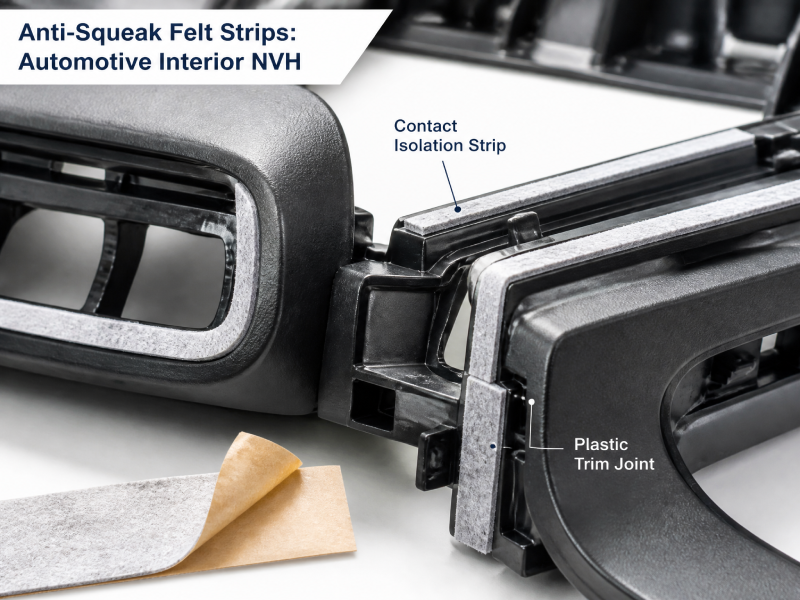
For these localized contact problems, self-adhesive polyester felt can be considered as a flexible contact isolation material. When an adhesive-backed felt strip or pad is installed at the contact point between two components, it can create a soft intermediate layer under suitable conditions, helping reduce direct contact between hard surfaces and providing localized cushioning.
However, self-adhesive felt cannot solve every automotive noise problem. It should not be treated as a complete replacement for dedicated sound insulation materials, vibration-damping materials, or structural support components. Buyers need to identify the actual source of the noise first, then select the felt according to the contact position, assembly clearance, compression condition, adhesive compatibility, and automotive project requirements.
Where Do Rattles and Other Interior Noises Usually Come From?
Automotive interior noises should be investigated by identifying the specific contact points between components rather than simply assuming that the vehicle needs more sound insulation.
When a vehicle is moving, vibrating, or experiencing slight movement between interior components, two adjacent parts may come into repeated contact. If the contact surfaces are hard or there is relative movement between the components, friction, impact, or intermittent vibration noise may occur.
Common potential contact areas include plastic interior trim panels against metal body structures, door trim strips against supporting structures, clips or brackets against mounting surfaces, and connection points between dashboard components, center consoles, and other interior parts.
Wiring harnesses, connectors, and surrounding plastic components may also be potential sources of noise. If a wiring harness is not sufficiently secured, or if there is movement space between a connector and nearby components, vehicle vibration may cause repeated contact with surrounding structures.
Different noise sources require different solutions. If the problem comes from localized friction or slight impact between two hard surfaces, adding a flexible contact layer may be worth evaluating. However, if the noise comes from structural resonance, significant vibration, loose mechanical connections, or other system-level problems, adding a layer of self-adhesive felt alone may not solve the issue.
Therefore, before selecting automotive anti-rattle felt, buyers and component engineers should identify where the noise occurs, what materials the two contacting components are made of, and whether relative movement takes place during vehicle operation.
How Does Self-Adhesive Felt Create Cushioning and Contact Isolation Between Two Components?
The basic function of self-adhesive felt is to add a flexible material layer between two components that might otherwise come into direct contact.
A typical construction consists of needle-punched nonwoven felt, a pressure-sensitive adhesive layer, and a protective release liner. During installation, the release liner is removed and the felt is applied to the selected position. After assembly, the other component contacts the felt surface, creating a new contact interface.
Compared with a loose cushioning pad, an adhesive-backed construction can help keep the felt in a defined position and reduce the possibility of movement during assembly. This can be useful for components with clearly defined contact points, repeated assembly requirements, or a need for consistent installation positioning.
Under suitable localized contact conditions, felt may provide three functions.
First, contact isolation. The felt layer separates two hard surfaces and reduces the possibility of direct contact.
Second, localized cushioning. Flexible felt may compress under pressure, providing a certain degree of cushioning at the contact point.
Third, reduced direct friction. When the felt surface and installation method are suitable for the actual movement conditions, it may reduce direct friction between two hard components.
However, localized contact isolation should be distinguished from a complete vibration-damping or sound-insulation system. Ordinary self-adhesive felt should not be promoted as a material that can eliminate all vehicle noises. It also cannot automatically replace dedicated vibration-damping pads, acoustic insulation structures, sealing components, or load-bearing supports.
If the problem comes from significant structural vibration, loose connections, continuous impact, or complex acoustic resonance, the root cause should be identified first. Other material or structural solutions may be necessary.
Which Contact Areas Between Plastic and Metal Components Can Use Self-Adhesive Felt?
Localized contact between plastic and metal components is one of the typical situations where self-adhesive felt may be evaluated in automotive interiors.
For example, a plastic door panel may come into contact with the internal metal structure of a vehicle door. Interior trim strips, mounting brackets, and metal fixing components may also experience localized friction. If a dashboard or another interior component has slight impact or friction at a particular edge or connection point, an additional felt layer may also be considered according to the actual structure.
When selecting an installation position, the first step is to identify where the two components make contact and whether this contact occurs when the vehicle is stationary, during assembly, or while the vehicle is operating.
If there are only a few fixed contact points, localized felt pads may be more suitable than covering a large area. If the contact area is continuous and narrow, such as along a trim panel edge or a long connection line, narrow self-adhesive felt strips may be worth considering.
It is also necessary to determine which component should carry the felt. The adhesive side should be attached to a surface suitable for bonding and should not interfere with subsequent assembly. The opposite side becomes the actual contact surface.
Adhesive compatibility cannot be determined simply by classifying a substrate as plastic or metal. Different plastic materials, metal surface treatments, contamination conditions, and coating finishes may affect bonding performance. The actual substrate and surface condition need to be evaluated.
How Should Felt Strip Installation Positions Be Determined Around Trim Panels, Clips, and Wiring Harnesses?
Anti-rattle felt strips are generally suitable for narrow areas that require a continuous flexible contact layer, while self-adhesive felt pads may be considered for small, localized contact points.
For interior trim panels and decorative strips, first determine whether the noise comes from contact between the panel edge and an adjacent structure. If localized friction is confirmed, the installation area can be determined according to the length and width of the contact zone.
For clips and brackets, check whether the felt will interfere with normal clip positioning, insertion depth, or fixing strength. Felt should not cover an effective connection point simply to add cushioning.
For wiring harnesses and connectors, buyers need to understand the range of movement during vehicle operation and determine whether the felt is suitable for the actual contact location. If the felt is used for wrapping or localized isolation, it must not interfere with connector fixing, wiring layout, or subsequent maintenance.
The installation position should not be determined only from a static photograph. Two components may appear not to touch when they are separated, but relative movement may occur after assembly or under vibration.
A more reliable approach is to determine the installation area using actual component drawings, photographs of the contact points, or physical samples. The felt strip width, length, shape, and application direction can then be evaluated.
If custom die-cut felt pads are required, the product shape, dimensions, tolerances, and processing feasibility should be confirmed first. For projects where the contact position has not yet been finalized, rolls or strips can be evaluated initially. Pre-cut or die-cut supply can be considered after the actual sample confirms the required shape.
How Do Thickness, Density, and Compression Affect Anti-Rattle Performance?
When selecting adhesive backed polyester felt, thickness and density alone cannot determine whether the material is suitable. For localized automotive interior applications, buyers also need to consider how the felt compresses under pressure and how much installation clearance is actually available between two components.
Thickness determines how much space the felt occupies before compression. If the felt is too thick, it may affect trim panel positioning, clip assembly, cover closure, or the fit between adjacent components. If it is too thin, it may not provide the intended separation layer at the contact point.
Density affects how compact the felt structure is and how it behaves under pressure. Felt materials with different densities may show different softness and compression characteristics, even when their initial thicknesses are similar.
In addition, GSM, thickness, and density are not interchangeable specifications. GSM refers to the mass per unit area, thickness describes the material's physical dimension, and density represents mass per unit volume. Buyers cannot simply provide one GSM value and expect a supplier to determine whether the material is suitable for a narrow contact area.
For automotive interiors, the actual clearance after assembly deserves particular attention. When felt is compressed between two components, it may change the contact pressure and assembly condition. Therefore, buyers should not only measure the thickness of an uncompressed sample but also check the space occupied after compression under conditions close to the actual assembly environment.
The final specification should be determined by considering the contact area, contact pressure, assembly clearance, component movement, and sample validation results. A thicker or softer felt is not automatically more effective at reducing noise.
How Can the Adhesive Be Made Compatible with Automotive Plastic, Metal, and Coated Surfaces?
For self adhesive felt material, adhesive compatibility with the target substrate directly affects whether the felt strip can remain securely attached at the intended position.
Automotive interiors involve different substrates and surface treatments, including various plastics, coated metals, bare metals, laminated materials, and textured decorative panels. Even when two surfaces are both classified as plastic or metal, their bonding conditions may differ.
Therefore, when requesting a quotation, buyers should not simply state that they need self-adhesive felt. They should also identify the actual surface to which the felt will be applied and describe its surface condition.
For plastic components, buyers should confirm the specific material type, surface texture, coating, and whether any release agents or other residues may affect adhesion. For metal components, buyers should specify whether the surface is bare metal, painted, plated, or treated in another way, and whether oil or processing residues may be present.
The project should also define adhesive requirements, including initial adhesion, long-term bonding, the risk of edge lifting, operating conditions, and whether adhesive residue or surface changes are acceptable during removal.
JHC's self-adhesive felt product page specifies a construction consisting of a pressure-sensitive adhesive (PSA) layer and a kraft paper release liner. It also indicates that adhesive type and bonding strength can be evaluated according to the application, substrate, and operating conditions. This does not mean that one adhesive construction is automatically suitable for every automotive plastic, metal, or coated surface.
Buyers should provide the actual substrate sample or surface information so that the supplier can evaluate the adhesive solution according to the project requirements. For interior components with strict appearance requirements or sensitive finishes, bonding and removal should be checked using actual samples.
How Can Samples Be Used to Verify Felt Strip Installation Positions and Contact Performance?
Before bulk purchasing, samples should be evaluated using actual automotive interior components or materials with the same surface treatment. Testing adhesive performance on an ordinary metal plate alone cannot fully represent the assembly and operating conditions of the final automotive component.
First, confirm the basic sample specifications, including felt construction, fiber type, GSM, thickness, density, color, adhesive construction, and release liner. If the buyer already uses an existing material, the original sample can also be provided for comparison.
Next, install the sample at the actual contact position. Check whether the felt strip or pad covers the intended area and whether it interferes with clips, screws, trim panel edges, connectors, or other assembly structures.
Then check the clearance and compression condition after assembly. Confirm whether the felt is too thick, whether it affects component positioning, and whether it remains in the intended position under the actual contact pressure.
For contact areas where relative movement may occur during vehicle operation, simulation or vibration testing should be carried out according to the actual operating conditions or project requirements. Check whether the felt develops edge lifting, position movement, surface wear, or fiber shedding. A static adhesion test alone cannot replace validation under dynamic operating conditions.
If the project has requirements for the surface after removal, adhesive residue, coating changes, and other appearance issues should also be checked. Buyers should not assume that every adhesive will leave no residue without actual testing.
After sample approval, the confirmed sample and specification records should be retained by both parties. The agreed felt construction, thickness, GSM, adhesive, release liner, dimensions, and acceptance requirements should be clearly documented. Subsequent bulk production should follow the approved sample and specifications.
What Additional Material Requirements Should Be Confirmed for Automotive Self-Adhesive Felt Projects?
Ordinary polyester self-adhesive felt can be considered as a candidate material for certain localized automotive interior contact positions. However, a product name containing “automotive” or “anti-rattle” does not mean that the material automatically meets all automotive OEM requirements.
Automotive projects may have different requirements depending on the vehicle, component, installation position, and customer specifications. In addition to basic felt construction and adhesive performance, requirements may involve flame resistance, VOC, odor, abrasion resistance, temperature performance, aging behavior, and dimensional stability.
These requirements are not necessarily the same for every project. Buyers should first confirm the material specifications provided by the customer or OEM, then determine which items require testing or supporting reports.
In particular, ordinary polyester self-adhesive felt does not automatically have automotive flame-retardant certification. Similarly, the fact that a factory holds a particular management system certification does not prove that a specific product has passed the flame resistance, VOC, or odor tests required by an automotive customer.
If a project requires flame resistance, the applicable test method, material construction, thickness, and actual test sample should be confirmed. If the project has VOC or odor requirements, the testing standard, sample condition, and acceptance criteria should also be clarified.
For automotive interior components intended for long-term use, temperature changes, aging, continuous contact, and wear may also need to be evaluated according to customer requirements. If the material, adhesive, or thickness changes, buyers should confirm whether the original test results remain applicable.
HuiZhou JinHaoCheng Nonwovens Co., Ltd.offers self-adhesive felt with a composite construction consisting of needle-punched nonwoven felt, pressure-sensitive adhesive, and a release liner. Material weight, thickness, density, dimensions, adhesive, and supply format can be discussed according to project requirements. For automotive projects, whether a specific product meets OEM requirements for flame resistance, VOC, odor, heat resistance, or aging must still be independently verified against the customer's specifications and the relevant samples.
When requesting a quotation, buyers are advised to provide component photographs, contact position drawings, target substrate information, assembly clearance, operating conditions, expected annual quantity, and customer material specifications. The more clearly these details are defined, the easier it is for the supplier to evaluate the suitable felt construction, adhesive solution, and sample validation process.
For automotive interior BSR projects, the correct starting point is not simply asking whether a supplier has automotive self-adhesive felt. Buyers should first identify where the noise occurs, how the two components make contact, and what specific localized contact problem the felt is expected to address. Only after these conditions are clear can thickness, density, adhesive, and die-cut dimensions be meaningfully selected.




