How SAP Nonwoven Materials Work in Disposable Hygiene Absorbent Cores
In disposable hygiene products such as baby diapers, adult incontinence products, disposable underpads, and pet training pads, absorbent materials need to do more than simply take in liquid. Liquid must first pass through the product's surface layer, enter the absorbent area, and then be distributed and retained while minimizing the risk of liquid being released again.
This is one of the key differences between disposable hygiene products and reusable absorbent products. Disposable products commonly use SAP (Super Absorbent Polymer) to help store liquid within the absorbent core, while washable underpads rely more on hydrophilic fibers and the fiber structure of needle punched absorbent felt to absorb and retain liquid.
For hygiene product manufacturers, understanding the role of SAP materials in an absorbent core and how they work with the topsheet, acquisition and distribution layer, and backsheet helps determine a suitable material structure during product development. Material selection should not be based only on a product name or GSM.
Why Do Disposable Hygiene Products Use SAP Absorbent Materials?
Disposable hygiene products need to manage a certain amount of liquid within a limited product thickness and available space. In baby diapers and adult incontinence products, for example, the material must not only receive liquid but also retain it inside the product and reduce the risk of liquid being released again or leaking outward.
Conventional hydrophilic fibers can absorb and transfer liquid through the spaces between fibers, but their liquid storage mechanism is different from that of SAP. SAP, or super absorbent polymer, is a polymer material that absorbs liquid and swells when it comes into contact with water, urine, or other compatible liquids, forming a gel-like structure.
Within an absorbent core, SAP mainly provides liquid storage and retention. It can be combined with materials such as fluff pulp or incorporated into specially designed composite absorbent structures.
This material combination allows product developers to balance absorbency, product thickness, liquid distribution, and end-use requirements.
It is important to understand that SAP absorbent material is not the same as a complete diaper absorbent core. A complete absorbent core also needs to consider the fiber carrier, liquid transfer pathways, material fixation, and overall structure. SAP is only one important component of the absorbent system.
How Does SAP Absorb Liquid and Form a Gel?
The main characteristic of SAP is its ability to absorb liquid and swell after contact. Common SAP materials used in hygiene products are cross-linked absorbent polymers. Their specific chemical composition and performance depend on the formulation and product grade.
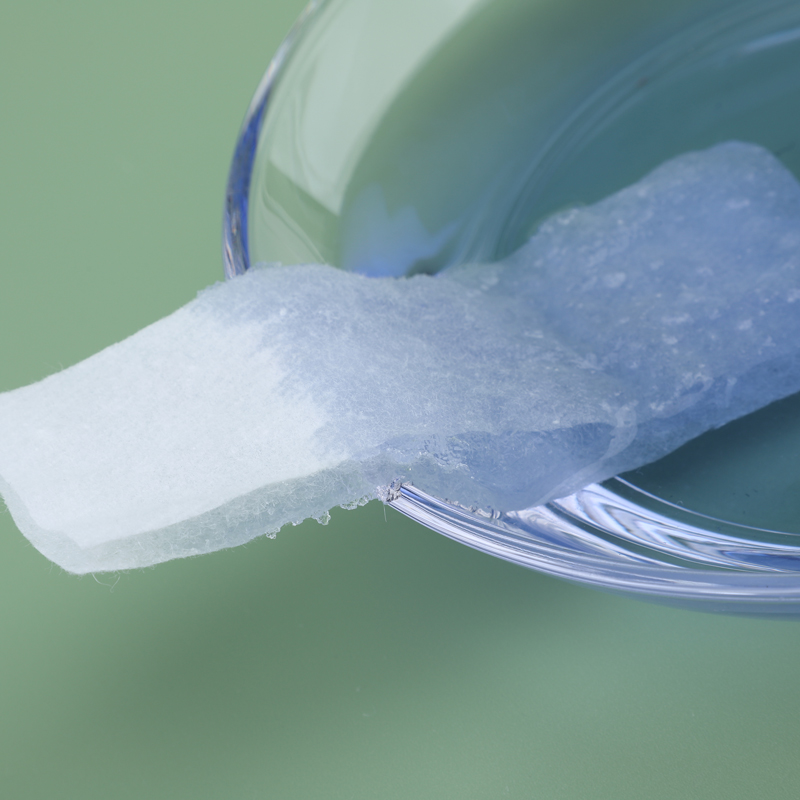
When urine or another compatible liquid enters an absorbent area containing SAP, the polymer particles absorb the liquid, gradually swell, and form a gel. The liquid is then stored within the swollen polymer network rather than remaining only in the spaces between ordinary fibers.
This process can be understood in three stages.
Liquid Contact
Liquid passes through the product's topsheet and acquisition structure before reaching the absorbent core where SAP is located. Whether the liquid can reach this area efficiently depends on factors such as topsheet hydrophilicity, the structure of the acquisition layer, and the pore structure of the absorbent core.
Absorption and Swelling
After coming into contact with liquid, SAP absorbs it and the polymer particles gradually swell. Different SAP grades, liquid types, and test conditions can affect the actual absorption performance.
Gel Formation and Liquid Retention
After absorbing liquid, SAP forms a gel-like structure that helps retain liquid within the absorbent area. The final liquid retention performance depends not only on the SAP itself but also on particle distribution, the supporting fiber structure, absorbent core design, and external pressure.
Therefore, buyers should not evaluate SAP only by its theoretical absorption capacity. They should also understand how the material performs in terms of liquid uptake, distribution, and retention under actual use conditions. Different test liquids, test methods, and applied pressures may produce different results. Any performance data supplied by a manufacturer should be evaluated together with the corresponding test conditions.
SAP Nonwoven Materials vs. Conventional Hydrophilic Fiber Layers
Both SAP absorbent materials and conventional hydrophilic fiber layers may be used in disposable hygiene products, but they do not perform exactly the same functions.
Conventional hydrophilic fiber layers mainly receive, transfer, and temporarily retain liquid through the fiber surfaces and pores within the fiber network. SAP, on the other hand, absorbs liquid and swells to form a gel, providing an important liquid storage function.
Comparison | SAP Absorbent Materials | Conventional Hydrophilic Fiber Layers |
Main material | Super absorbent polymer, sometimes combined with a fiber carrier or other materials | Hydrophilic fibers or nonwoven fabrics treated to improve hydrophilicity |
Main function | Absorbs liquid, swells to form a gel, and stores liquid | Receives liquid, transfers liquid, and helps distribute it |
Liquid retention mechanism | Mainly through the swollen polymer gel structure | Mainly through the fiber network and capillary action |
Common structural position | Absorbent core or SAP-containing composite absorbent layer | Acquisition layer beneath the topsheet or fiber carrier within the absorbent core |
Key selection factors | SAP type, content, distribution, fixation method, and absorption performance | Fiber composition, hydrophilicity, pore structure, GSM, and thickness |
It is important to note that SAP nonwoven material is not a universal structural term for every hygiene product absorbent core. It may refer to a nonwoven composite containing SAP or a SAP structure that uses nonwoven material as a carrier or support layer. Before purchasing, buyers need to confirm whether SAP is already integrated into the material, how it is fixed, and whether the supplied product is a single-layer material, composite roll, or another form.
Ordinary needle punched absorbent felt should also not be treated as equivalent to SAP material. Needle punched absorbent felt mainly relies on hydrophilic fibers and the fiber network to absorb and retain liquid. It can be developed for reusable absorbent products according to specific requirements. Buyers evaluating this type of material can refer to needle punched absorbent felt for reusable products.
If the purchasing requirement is SAP absorbent material for disposable hygiene products, buyers need to confirm the polymer composition and composite structure rather than judging suitability based only on the absorption performance of conventional absorbent felt.
How Does the SAP Absorbent Layer Work with Other Layers?
SAP absorbent materials do not normally perform the entire liquid management function of a hygiene product on their own. They need to work with other functional layers to allow liquid to enter the absorbent core and be retained inside the product.
The exact construction varies between brands and product types, but disposable hygiene products generally need to consider the following functional layers.
Top Sheet
The topsheet is the first material that comes into contact with liquid and is also an important layer that touches the user's skin. It needs to allow liquid to pass through while meeting product-specific requirements for softness, skin contact, and liquid transfer.
The topsheet normally does not provide the main liquid storage function. If liquid cannot pass through it efficiently, liquid may remain on the product surface and affect the subsequent absorption process.
Acquisition and Distribution Layer (ADL)
The acquisition and distribution layer is located between the topsheet and the absorbent core. Its main function is to receive liquid that passes through the topsheet and distribute it over a larger area.
If liquid enters only one small area of the absorbent core, that local area may reach saturation more quickly while other areas remain underused. The ADL helps distribute liquid and improve the utilization of the absorbent core.
For thin absorbent structures containing a relatively high proportion of SAP, liquid acquisition and distribution are particularly important. Gel formation takes time, so SAP alone cannot solve every issue related to rapid liquid intake and distribution.
Absorbent Core
The absorbent core is the main part of the product responsible for liquid storage. Conventional or commonly used absorbent core structures may combine SAP with fiber materials such as fluff pulp or use pre-formed composite absorbent materials.
SAP absorbs liquid and forms a gel, while fiber materials can help transfer liquid, support the absorbent structure, and influence SAP distribution and utilization.
The specific material combination depends on the product design, whether it is a baby diaper, adult incontinence product, disposable underpad, or pet training pad. One material structure cannot be assumed to suit every application.
Back Sheet
The backsheet usually provides a liquid barrier to reduce leakage through the back of the product. Depending on the product design, it may use a waterproof film or a composite structure combining film and nonwoven fabric.
The backsheet and absorbent core have different functions: the absorbent core stores liquid, while the backsheet helps prevent liquid from leaking outward. The presence of SAP in the absorbent core does not mean that the complete product automatically has adequate leakage protection.
Therefore, hygiene product manufacturers need to consider the compatibility of the topsheet, acquisition layer, absorbent core, and backsheet during product development, rather than focusing only on increasing the GSM or SAP content of one material.
How Do SAP Content, GSM and Thickness Affect Material Development?
When sourcing SAP nonwoven materials or SAP-containing composite absorbent materials, SAP content, material GSM, thickness, and structure are all important technical specifications. However, none of these parameters alone can determine the performance of the final product.
SAP Content
SAP content affects the proportion of polymer in the absorbent material, but a higher SAP content does not necessarily mean a better finished product.
If SAP is distributed unevenly or the absorbent core lacks suitable liquid transfer pathways, locally swollen gel may affect the movement of liquid into other areas. Material development needs to balance SAP storage capacity, fiber support, and liquid transfer.
Buyers should clarify how SAP content is calculated. For example, is it expressed as a percentage of the total dry composite material weight, or is another calculation method used? Different suppliers may use different definitions, so figures without a clear calculation basis should not be compared directly.
GSM
GSM refers to the weight of material per unit area. For SAP-containing composite materials, buyers need to confirm whether the quoted GSM refers to the total weight of the composite material or only to one of its carrier layers.
If the total material weight is known but the weight proportions of SAP and the fiber carrier are not, it can be difficult to understand the actual material structure.
Thickness
Thickness affects the space occupied by the material in the finished product, its compression state, and compatibility with other layers. Materials with the same GSM may have different thicknesses because of differences in structure, density, and compression.
Buyers should specify the thickness measurement method and test conditions, especially whether the material is measured in its natural state or under a defined pressure.
Material Structure
Material structure affects SAP fixation, liquid entry pathways, and the stability of the material after absorption.
For SAP-containing nonwoven composites, buyers need to confirm how SAP is distributed and fixed, and whether the material may experience particle migration, localized accumulation, or separation between composite layers.
Therefore, material development should not compare only SAP content, GSM, and thickness. Material structure, sample testing, and the actual conditions of the finished product should also be considered.
What Should Hygiene Product Manufacturers Specify When Sourcing SAP Nonwoven Materials?
For manufacturers of baby diapers, adult incontinence products, disposable underpads, and pet training pads, providing complete application details and technical requirements during the inquiry stage can reduce misunderstandings about the required material structure.
Buyers should prepare the following information in advance.
Purchasing Information | Details to Confirm |
Final Application | Baby diapers, adult incontinence products, disposable underpads, or pet training pads |
Material Type | SAP polymer, SAP composite nonwoven, SAP carrier material, or another absorbent layer |
SAP Content | SAP content and its calculation basis |
Carrier Material | Composition of the fiber carrier or support material |
Material Structure | Single layer, composite layer, sandwich structure, or another construction |
GSM | Total GSM and the weight requirements of individual functional layers |
Thickness | Required thickness and measurement conditions |
Width and Roll Length | Roll width, length, and slitting requirements |
Liquid Performance | Target liquid intake speed, absorption capacity, absorption under pressure, rewet, and other required indicators, together with test methods |
Processing Requirements | Compatibility with hygiene product production lines, cutting, and lamination requirements |
Order Quantity | Sample requirements, trial production quantity, and estimated bulk order volume |
Quality Requirements | Inspection items, acceptance criteria, and batch consistency requirements |
Liquid performance is particularly important and requires clearly defined test conditions. Buyers should specify the test liquid, single or repeated liquid application, testing time, applied pressure, and the indicators to be evaluated.
For example, liquid intake speed, free absorbency, absorption under pressure, and rewet are different evaluation parameters. One test result cannot replace all of them. When suppliers provide test data, they should also identify the test method and sample structure.
Before placing a bulk order, buyers are advised to confirm material samples and conduct trial production and validation within the target hygiene product structure. Test results from an individual material do not necessarily represent the performance of the finished product.
How Can Nonwoven Material Suppliers Support Hygiene Product Development?
For hygiene product manufacturers, the value of a material supplier is not limited to providing a roll of nonwoven fabric. A capable supplier should also understand the functional position of the material in the finished product and be able to discuss suitable material specifications based on the actual construction.
HuiZhou JinHaoCheng Nonwovens Co., Ltd.publicly lists needle punched nonwoven, absorbent materials, thermal bonded wadding, laminated nonwoven materials, and related nonwoven processing categories. Its manufacturing capabilities include needle punching, thermal bonded wadding production, and lamination. The company also offers material specification discussions and customization according to customer requirements.
For disposable hygiene product projects, buyers can first clarify the target product, the functional position of the material in the finished construction, the target GSM, thickness, width, structure, and expected liquid performance. These details can then be discussed with the material supplier to evaluate a suitable material solution.
If the purchasing requirement is SAP needle punched nonwoven for disposable hygiene products, buyers should further confirm whether SAP is already integrated into the material, how the polymer is fixed, the fiber carrier structure, the supplied material format, and the available test documentation. The ability to manufacture needle punched nonwoven or conventional absorbent felt does not automatically demonstrate that a supplier has SAP addition, fixation, or composite processing capabilities.
Before requesting a formal quotation, buyers should ask the supplier to clarify the actual scope of supply. Is the supplier providing SAP raw material, SAP-containing composite nonwoven, a semi-finished absorbent core, or another functional layer material? Different supply scopes require different equipment, processes, and quality acceptance requirements.
If a project involves skin contact, baby care, or medical care applications, buyers should also confirm the applicable material safety, regulatory, and testing requirements according to the target market and finished product. General nonwoven fabric certifications alone should not be interpreted as proof that the final SAP-containing hygiene product meets all applicable requirements.
Conclusion: Match the SAP Material Structure to the Final Product
In disposable hygiene absorbent cores, SAP mainly absorbs liquid and forms a gel, helping the product store and retain liquid. However, the performance of a complete absorbent core is also influenced by the fiber carrier, SAP distribution, acquisition layer, topsheet, backsheet, and overall material structure.
For manufacturers of baby diapers, adult incontinence products, disposable underpads, and pet training pads, selecting SAP nonwoven materials should involve more than checking SAP content or material GSM. Buyers also need to confirm the material structure, liquid transfer pathways, SAP fixation method, thickness, processing compatibility, and actual test conditions.
Before bulk purchasing, first clarify the functional position of the material in the finished product. Then confirm its suitability through sample evaluation and testing within the complete product structure. This helps reduce the risk of material incompatibility with the production line and supports more consistent manufacturing.