
Pipe Insulation Felt Roll Specifications: GSM, Mesh, Adhesive and Roll Dimensions
When purchasing self-adhesive reinforced pipe felt rolls, providing only a GSM value, thickness, or roll width is usually not enough for a supplier to understand the exact product requirements.
This material is not a single-layer needle-punched felt roll. It is a composite product consisting of a needle-punched felt base, a reinforcing mesh structure combined with adhesive, and a release liner. Each component has its own specifications. Therefore, base felt GSM, finished product GSM, base felt thickness, and finished product thickness must be confirmed separately.
For example, two pipe felt rolls may use needle-punched felt with the same GSM but have different finished weights and thicknesses because of differences in the reinforcing mesh, adhesive, and composite structure. If buyers do not clarify which specifications they are referring to, misunderstandings may occur between quotation, sample approval, and bulk production.
Therefore, before ordering a pipe insulation felt roll, buyers should understand the actual product structure and confirm the felt base, reinforcement, adhesive, release liner, and finished roll dimensions one by one. This helps suppliers understand the requirements more accurately and reduces specification misunderstandings before bulk production.
Why Do Pipe Insulation Felt Rolls Need Application-Based Specifications?
The specifications of self-adhesive reinforced pipe felt rolls cannot be determined in the same way as ordinary needle-punched felt because the finished product contains multiple material layers.
The needle-punched felt forms the base layer. The reinforcing mesh combined with adhesive provides the reinforced structure, while the release liner protects the adhesive surface. Buyers need to confirm these components separately rather than specifying only one GSM or thickness value for the finished product.
Requirements may also vary between projects. Some buyers focus more on the GSM and thickness of the felt base. Others need to confirm the reinforcing mesh structure, while some need to evaluate the adhesive and release liner according to the actual pipe surface and installation method.
Before requesting a quotation, buyers should clarify three key points.
First, confirm the application. Will the material be used for pipe wrapping, or for another pipe-related protective or auxiliary application? The intended use can affect the required material structure and specifications.
Second, confirm the installation method. Will the material be wrapped continuously along the pipe, or cut into sections for installation? Will overlapping be required? These details can affect the required roll width and length.
Finally, clarify the product being purchased. Buyers need a finished roll with reinforcement, adhesive, and a release liner, rather than a roll of ordinary needle-punched felt. This should be stated clearly when requesting a quotation to avoid receiving a quotation based on the wrong product structure.
Felt Base Material and Fiber Composition
The needle-punched felt base is the foundation of a self-adhesive reinforced pipe felt roll. Its fiber composition and material specifications influence the overall structure and application suitability of the finished product.
Buyers should first confirm the base material. Depending on the order requirements, the product may use polyester fiber, PP, rPET, or other customized materials. Different fiber compositions should not be treated as interchangeable based on product names alone. Even at the same GSM, their material structures and actual characteristics may differ.
Next, buyers should clarify whether the specified GSM and thickness refer to the needle-punched felt base. For a multi-layer composite product, the specifications of the base felt are not the same as those of the finished product.
If buyers already have a reference material, they can provide a sample together with the specification requirements. The supplier can then check the base material's color, surface appearance, thickness, and material characteristics to reduce misunderstandings caused by written descriptions alone.
If no reference sample is available, buyers can first provide the intended application, material requirements, and target specifications, then discuss a suitable needle-punched felt base with the supplier.
For bulk purchasing, it is recommended to list the fiber composition, base felt GSM, and base felt thickness as separate items in the specification sheet rather than using only a general product name.
GSM and Thickness: Base Felt vs. Finished Roll
GSM and thickness are two of the most common sources of specification misunderstandings when purchasing needle-punched felt. For self-adhesive reinforced pipe felt rolls, buyers must clarify whether these values refer to the needle-punched felt base or the finished composite product.
Base Felt GSM refers to the weight per unit area of the needle-punched felt base. It should not automatically be treated as the total GSM of the finished product, which also includes the reinforcing mesh and adhesive structure.
Finished Product GSM refers to the weight per unit area of the product after the composite structure has been completed. Buyers who need to control the total weight of the finished material should specify this value separately.
For example, a buyer may require a needle-punched felt base with a particular GSM and also request reinforcing mesh and adhesive. If it is not clear whether the GSM refers to the base felt or the finished product, the buyer and supplier may use different calculation standards.
Thickness needs to be distinguished in the same way.
Base Felt Thickness refers to the thickness of the needle-punched felt base.
Finished Product Thickness refers to the thickness of the finished product after reinforcement and adhesive have been added.
These two values should not be used interchangeably. For projects where the overall thickness after pipe wrapping is important, finished product thickness is particularly relevant. If the buyer is mainly concerned with the base material, the base felt thickness should be specified separately.
Needle-punched felt is a flexible material, and the measuring pressure and method may affect the thickness reading. Therefore, both parties should also agree on the thickness measurement method and acceptable tolerance.
Buyers are advised to specify the following four items separately when requesting a quotation:
Base Felt GSM: The weight per unit area of the felt base.
Finished Product GSM: The total weight per unit area of the finished product.
Base Felt Thickness: The thickness of the needle-punched felt base.
Finished Product Thickness: The thickness of the finished composite product.
JHC's pipe felt samples can be used to distinguish and check the specifications of the base felt and finished product. During sample approval, buyers should record these four parameters separately to avoid specification misunderstandings in future bulk orders.
Mesh Material and Reinforcement Requirements
The reinforcing mesh is an important structural component of self-adhesive reinforced pipe felt rolls. When requesting a quotation, buyers should not simply write "mesh reinforced." They should also understand the actual position of the mesh within the finished product.
JHC's self-adhesive reinforced pipe felt roll uses a needle-punched felt base, with a reinforcing mesh structure combined with adhesive positioned between the felt base and the kraft paper release liner.
Therefore, this product should not be understood simply as ordinary needle-punched felt with a separate layer of mesh fabric added to its surface. Its overall structure needs to be considered together with the adhesive and release liner.
When confirming specifications, buyers should first clarify whether reinforcing mesh is required and whether the requested product needs to match the structure of the reference sample.
If buyers have a specified mesh structure or reference sample, they can provide photographs, samples, or technical requirements so the supplier can check the details.
In addition, the reinforcement structure should be considered together with the flexibility of the finished material, roll converting requirements, and the actual installation method. The presence of mesh alone does not establish a specific tear strength or other performance value that has not been verified.
For bulk purchasing, it is recommended to list the reinforcing mesh as a separate structural requirement in the specification sheet and confirm the final product structure through sample approval.
Adhesive Type and Bonding Requirements
Self-adhesive reinforced pipe felt rolls have an adhesive backing. When requesting a quotation, buyers need to clarify whether the product requires a self-adhesive structure and what bonding requirements apply to the intended surface.
The adhesive affects the installation method and must be evaluated according to the target surface. Different pipe surfaces may have different materials and surface conditions, so buyers should not assume that the same adhesive is suitable for every type of pipe.
Buyers should explain in advance which surface the material will be applied to, such as a metal pipe, a coated surface, or another substrate. If actual samples or photographs of the installation site are available, these can also be provided.
In addition, buyers should describe any special requirements related to adhesion, installation convenience, or the intended service environment.
If a project has specific requirements for bonding strength, temperature resistance, or long-term adhesion stability, these should be raised during the quotation stage. The relevant verification method should then be confirmed according to the actual product and project requirements.
For this type of multi-layer composite roll, buyers are advised to inspect the felt base, reinforcing mesh, and adhesive structure together during sample approval rather than focusing only on the visible needle-punched felt surface.
Kraft Paper Release Liner Specifications
The kraft paper release liner is an important component of self-adhesive reinforced pipe felt rolls. Its main purpose is to protect the adhesive surface and prevent contamination or premature adhesion before storage, transportation, and installation.
JHC's current self-adhesive reinforced pipe felt roll uses a kraft paper release liner. For projects requiring other release liner materials, alternatives can also be discussed according to customer requirements.
Buyers should first clarify whether kraft paper is required. If another release liner material is preferred, this should be specified during the quotation stage rather than after sample approval or bulk production.
Next, buyers should confirm whether the release liner is compatible with the actual adhesive structure. For projects involving continuous pipe wrapping or section cutting, the protective function of the release liner during storage, handling, and installation should also be considered.
If buyers have specific peeling requirements, such as needing the release liner to be easier to remove during installation, these should be explained in advance and checked through sample approval.
Although the release liner is not the felt base that ultimately contacts the pipe, it directly affects the protection and installation process of the self-adhesive roll. It should therefore be confirmed as a separate specification item.
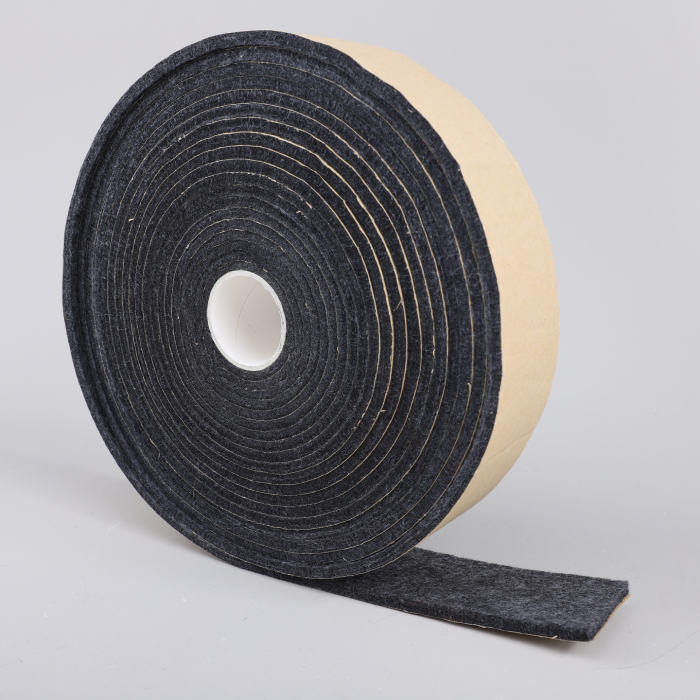
Roll Width, Length and Winding Requirements
Roll width and length can affect purchasing quantities, on-site installation, material utilization, and transportation arrangements.
The width of a pipe felt roll should be determined according to the actual pipe dimensions, wrapping method, and installation requirements. If buyers plan to cut the material on-site, they should specify the required finished width rather than providing only an approximate range.
The length of each roll should be determined according to the length of the pipe sections, the installation method, the required joints or overlaps, and on-site handling conditions.
For continuous wrapping projects, buyers should also explain whether they require a specific winding direction, core size, or other packaging requirements.
The winding condition is also worth confirming in advance. For example, buyers may have requirements for neat roll edges, tight winding, or additional protection during transportation. These details can be confirmed according to the actual order and packaging arrangement.
JHC can discuss customized roll widths and lengths according to customer requirements. The specific available size combinations need to be confirmed based on the material structure, order requirements, and factory production arrangements. Buyers can provide the target roll width, length per roll, and estimated order quantity when requesting a quotation so the sales team can check the requirements further.
Therefore, buyers are advised to confirm the following items separately when requesting a quotation:
Finished roll width.
Length per roll.
Core specifications, if required.
Winding direction and roll condition, if required.
Weight per roll or handling limits, if required.
Packaging method and transportation protection requirements.
Do not automatically treat the roll width or length of other ordinary needle-punched felt products as fixed specifications for self-adhesive reinforced pipe felt.
Pipe Diameter and Installation Method
Pipe diameter is an important factor when determining the specifications of pipe felt rolls.
The same roll width may require different cutting lengths and overlap arrangements for pipes with different diameters and wrapping methods. Therefore, buyers should not provide only the pipe length while ignoring the actual outside diameter and installation method.
First, provide the actual outside diameter range of the target pipes rather than only the nominal pipe size. The nominal diameter is not necessarily the same as the actual outside diameter. Providing measured dimensions or technical drawings whenever possible will help improve accuracy.
Second, explain how the material will be installed. Will it be wrapped along the pipe axis or wound around the pipe circumference? Is continuous overlapping required? Will the material need to be cut around elbows, tees, valves, or other irregular sections?
If the product needs to cover multiple pipe diameters, buyers should clarify the required material width or cutting method for each diameter range. This helps prevent one specification from being applied to all pipes without proper consideration.
Buyers should also confirm whether additional overlap width needs to be reserved during installation and where the adhesive will be applied.
For pipes with special structures, it is recommended to provide pipe photographs, outside diameter measurements, installation drawings, or samples of the existing wrapping material. This helps the supplier understand the actual installation requirements instead of estimating dimensions based only on the product name.
Sample Approval Before Bulk Production
Before bulk production, sample approval should cover the material structure, specification definitions, and suitability for the intended installation. It should not focus only on color and hand feel.
First, confirm the needle-punched felt base. Check the fiber composition, base felt GSM, base felt thickness, color, and surface appearance to ensure they match the purchasing specifications.
Next, confirm the reinforcing mesh structure. Check whether the mesh is positioned as agreed and whether the overall structure matches the approved sample.
Third, confirm the adhesive and release liner. Check whether the product has the agreed self-adhesive structure, whether the release liner meets the requirements, and whether adhesive protection and peeling meet the installation needs.
Fourth, confirm the finished product specifications. Measure the GSM and thickness of both the base felt and finished product separately, and check whether the finished roll width and length meet the agreed requirements.
Fifth, check the actual installation suitability. Apply the sample to the target pipe or an appropriate real surface and check whether the material can be wrapped, bonded, and installed as expected.
If a project has specific requirements for adhesion, temperature resistance, or other performance characteristics, the relevant verification requirements should be clarified at the sample stage. The product should not be considered suitable for every intended condition based only on its appearance and hand feel.
After sample approval, both parties should keep the approved sample and specification sheet as references for bulk production. If the needle-punched felt base, reinforcing mesh, adhesive, or release liner is changed later, the parties should reconfirm whether the change affects the finished structure and specifications.
For buyers, the purpose of sample approval is to ensure that the material composition, layer structure, dimensions, and installation method of the final product meet the requirements agreed by both parties.
A Practical Specification Checklist for Buyers
To make the quotation process more efficient, buyers are advised to prepare a complete specification sheet before requesting a quotation for self-adhesive reinforced pipe felt rolls.
Purchasing Item | Information to Confirm |
Felt Material | Polyester, PP, rPET, or other specified fiber material |
Base Felt GSM | GSM of the needle-punched felt base |
Finished Product GSM | Total GSM of the finished composite product |
Base Felt Thickness | Thickness of the needle-punched felt base |
Finished Product Thickness | Thickness of the finished composite product |
Reinforcement | Whether reinforcing mesh is required and the reference structure |
Adhesive | Whether adhesive backing is required, target bonding surface, and special requirements |
Release Liner | Kraft paper or another customer-specified release liner material |
Roll Width | Finished roll width |
Roll Length | Length per roll |
Winding | Core, winding direction, and roll condition requirements, if any |
Pipe Diameter | Actual outside diameter range of the target pipes |
Installation Method | Axial wrapping, circumferential wrapping, overlapping, or another installation method |
Application | Pipe wrapping, auxiliary noise control, or another clearly defined application |
Testing Requirements | Adhesion, dimensional, or other performance tests required by the project |
Sample Approval | Sample quantity, approval method, and acceptance requirements |
Order Quantity | Trial order quantity and estimated bulk demand |
Packaging | Individual roll packaging, cartons, pallets, and transportation protection |
If buyers cannot provide all technical parameters at the beginning, they can first provide existing samples, pipe outside diameters, installation photographs, and the intended application. The supplier can then help identify which specifications need to be defined and which items can be discussed through sample development.
For self-adhesive reinforced pipe felt rolls, the most important step is to define the needle-punched felt base, reinforcing mesh, adhesive, release liner, and finished roll dimensions separately.
HuiZhou JinHaoCheng Nonwovens Co., Ltd. can discuss the needle-punched felt base, material GSM, thickness, reinforcement structure, roll dimensions, and composite options with buyers according to the actual product structure and order requirements. Customized roll widths, lengths per roll, and special material requirements need to be confirmed according to the order details and factory production arrangements.
Before placing a bulk order, clearly defining every material layer and finished product specification, followed by quotation, sample approval, and bulk production, can reduce communication errors caused by different interpretations of specifications and help establish consistent purchasing standards for long-term orders.




