
Needle-Punched vs. Thermally Bonded Aquarium Filter Media: How to Choose
When sourcing filter fleece for aquariums or nonwoven materials for aquarium filtration equipment, choosing the right manufacturing process is an important part of product development. Both needle-punched nonwoven materials and thermally bonded filter cotton can be used in specific aquarium filtration applications. However, their forming processes differ, and the suitability of the finished material must be evaluated against the target product's structure, filtration requirements, and actual operating conditions.
For aquarium equipment manufacturers, filtration product OEMs, importers, and wholesalers, the key question is not which process is universally better, but which material best matches their product design and purchasing requirements.
This guide focuses on the purchasing suitability of needle-punched and thermally bonded materials, sample comparison, filtration performance evaluation, and batch specification confirmation to help buyers establish a clearer material selection process.
Why Should Aquarium Filter Media Not Be Selected by Manufacturing Process Name Alone?
When purchasing nonwoven aquarium filter media, the manufacturing process can help buyers understand how a material is formed, but it does not directly determine the finished product's filtration performance.
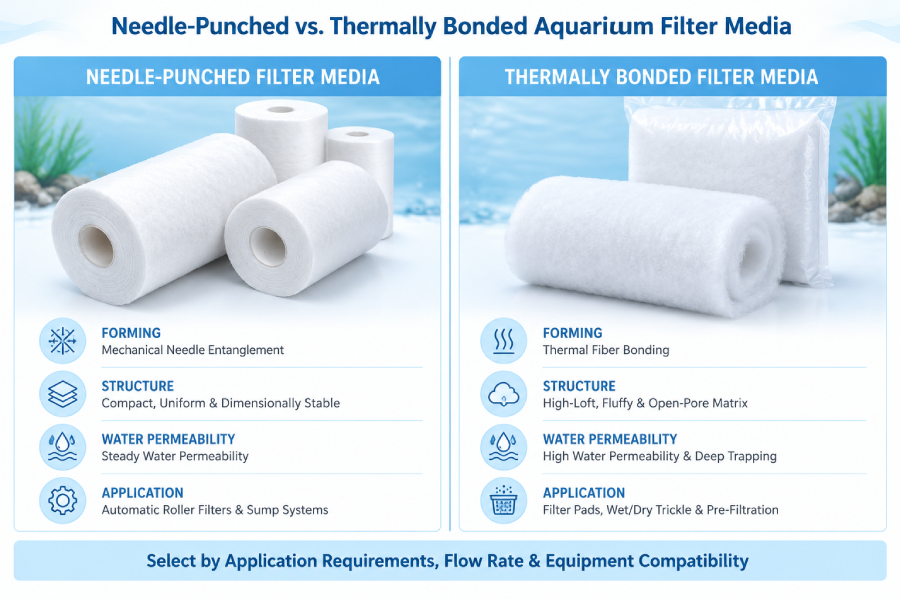
Needle-punched nonwoven materials are formed by mechanically entangling fibers, while thermally bonded filter cotton uses appropriate heat treatment to bond fibers that are suitable for thermal bonding. The two processes create material structures differently, but actual performance also depends on the specific material design and manufacturing conditions.
For example, one aquarium filtration product may require the material to maintain a stable shape during continuous operation. Another may place greater emphasis on water permeability under specified conditions, particle retention, or compatibility with other components. The priorities can differ between applications.
Therefore, buyers should not simply ask suppliers whether they offer needle-punched or thermally bonded filter cotton. They should first define the function of the material in the finished product, then select a suitable process and verify the samples against the relevant requirements.
What Are the Structural Differences Between Needle-Punched and Thermally Bonded Processes?
How Does the Needle-Punching Process Form Nonwoven Filter Media?
The needle-punching process uses barbed needles to repeatedly penetrate a fiber web, mechanically entangling the fibers to form a nonwoven material with a defined thickness and overall structure.
For aquarium filter media, the resulting fiber structure can be designed according to the specific product requirements. Buyers can evaluate whether the material's thickness, structural stability, water permeability, and particle retention meet the intended application requirements.
However, needle-punching alone does not guarantee a particular filtration performance. Even materials described as needle-punched may perform differently because of variations in their specific structures and manufacturing parameters.
Purchasing decisions should therefore be based on actual samples and target product requirements rather than the process name alone.
How Does the Thermally Bonded Process Form Filter Cotton?
The thermally bonded process uses heat to soften or melt suitable bonding fibers and create bonds between fibers under appropriate processing conditions.
This process can be used to manufacture aquarium filter cotton and related nonwoven filtration materials. The resulting structure and performance depend on the fiber system, processing conditions, and specific product design.
Buyers should confirm whether the supplier's samples meet the target product requirements for thickness, structural stability, water permeability, and particle retention. Material names and surface appearance alone are not sufficient to determine suitability.
Thermal bonding does not automatically mean that a material has lower water flow resistance, a longer service life, or better filtration performance. These characteristics must be verified for the specific product and operating conditions.
How Should Buyers Compare Samples Made by the Two Processes?
When comparing needle-punched and thermally bonded aquarium filter media, buyers should first define the finished product's requirements and then select the appropriate evaluation criteria. Sample results are meaningful only when the testing conditions are sufficiently comparable.
Thickness and Structural Stability
First, confirm whether the sample thickness meets the product design requirements. Then evaluate whether the material maintains its required shape under the specified operating conditions.
If the material must fit into a particular filter component, buyers should also check how it fits with that component. If the product will be compressed, secured, or continuously fed through equipment, these actual conditions should be included in the sample evaluation.
Similar thickness does not necessarily mean that two materials have the same internal structure, nor does it establish which process is more suitable for the target product.
Density and Material Consistency
Buyers can record the sample's GSM, thickness, and relevant density data to check whether the material meets the agreed specifications and whether noticeable variations occur across different areas of the sample.
However, GSM or density alone cannot determine filtration performance. When comparing materials made by different processes, buyers should use clearly defined specifications and evaluate the results alongside water permeability and particle retention tests.
For ongoing bulk supply, buyers should also confirm that the supplier can consistently manufacture material to the approved specifications, rather than merely provide one initial sample that meets the requirements.
Water Permeability
Water permeability is an important consideration when selecting aquarium filter media, but faster water flow should not automatically be equated with better filtration.
If the material must operate under specified water supply conditions, buyers should define the test method, water supply conditions, sample dimensions, and material state during testing. The results should then be recorded for comparison.
When comparing needle-punched and thermally bonded samples, keep the testing conditions as consistent as possible. Otherwise, differences in results may be caused by variations in test conditions rather than by the manufacturing process itself.
Particle Retention Performance
If the target product must retain specific types or ranges of particles, buyers should define the target particles, testing conditions, and evaluation method according to the actual application requirements.
Particle retention cannot be determined reliably from material thickness, apparent surface compactness, or visual appearance alone. Even if two materials look similar, they cannot automatically be assumed to provide the same filtration performance.
If particle retention is a defined product requirement, include the relevant test method and acceptance criteria in the purchasing specification and verify them during sample evaluation.
Why Are Appearance, GSM, and Thickness Not Enough to Determine Filtration Performance?
Appearance, GSM, and thickness are relatively easy to measure and compare during purchasing, but they describe only some of a material's characteristics. They do not fully represent filtration performance.
Materials manufactured by different processes may have different internal fiber structures even when their GSM and thickness are similar. Water permeability and particle retention must also be evaluated in relation to the specific material design and testing conditions.
Likewise, a material that looks more compact does not necessarily provide better filtration in every application. A more open-looking material cannot be assumed to have better water permeability or particle retention based on appearance alone.
A more reliable approach is to define the actual product requirements first and then establish corresponding sample evaluation criteria. Appearance, GSM, and thickness can be used to verify basic specifications, while structural stability, water permeability, and particle retention should be assessed through appropriate testing.
This approach helps buyers avoid making purchasing decisions based solely on product images, process names, or individual parameters. It also makes it easier to compare samples from different suppliers against the same criteria.
What Additional Requirements Must Be Verified for Automatic Roller Filters?
When the material is intended for an automatic aquarium roller filter, buyers must verify not only the material structure and filtration performance but also the roll's compatibility with the equipment.
Provide relevant information such as the equipment model, roll width, roll length, core dimensions, and maximum outer diameter. Confirm the roll installation method and the material feed path as well.
During sample evaluation, check whether the roll can be installed correctly and whether the material feeds through the equipment as intended. Testing should follow the equipment manufacturer's operating instructions and use the agreed operating conditions.
Material process selection and equipment compatibility are two separate considerations. Even if a needle-punched or thermally bonded material meets the filtration requirements in an individual test, this does not guarantee that its roll dimensions, installation method, or feeding behavior will suit a particular machine.
For continuous roll applications, buyers should verify material performance and equipment compatibility separately rather than proceeding to mass production after completing only one of these checks.
For projects involving automatic roller filtration equipment, buyers can also review our needle-punched PET aquarium roller filter fleece rolls and confirm the required roll specifications against their equipment requirements.
How Should Buyers Explain Process Requirements, Testing Conditions, and the Operating Environment to Suppliers?
To help suppliers provide more suitable samples, buyers should explain the target product, operating environment, and key performance requirements during the inquiry stage rather than providing only a material name and estimated order quantity.
First, describe the type of aquarium filtration product in which the material will be used and the function it must perform in the finished product. For example, clarify whether the material is intended for continuous roller filtration, a fixed filter assembly, or use in combination with other materials.
Next, define the key evaluation criteria, including thickness, structural stability, water permeability, and particle retention. If specific acceptance requirements apply, provide the test methods, testing conditions, and pass criteria in advance.
If the buyer is already using a particular material, an existing sample, technical documentation, or relevant test records can help the supplier understand the differences between the current material and the target product requirements.
If the final process has not yet been selected, buyers can ask the supplier to assess both needle-punched and thermally bonded options against the project requirements and provide samples for comparison where feasible. The supplier can help confirm material specifications and manufacturing feasibility, but the final selection should still be based on actual testing against the target product requirements.
As a Chinese nonwoven materials manufacturer, HuiZhou JinHaoCheng Nonwovens Co., Ltd. can discuss needle-punched nonwoven materials, thermally bonded materials, and related customized specifications according to project requirements, with OEM/ODM support and bulk supply. For overseas buyers developing aquarium filtration materials, defining the application, testing requirements, and target specifications in advance helps improve consistency between sample evaluation and subsequent bulk purchasing.
How Can Sample Test Results Be Converted into Bulk Purchasing Specifications?
After sample testing is completed, buyers should convert the confirmed results into clear written specifications. This helps prevent mass production from relying solely on sample photographs, verbal descriptions, or manufacturing process names.
The purchasing specification should identify the manufacturing process, material grade, and agreed basic parameters, together with applicable technical requirements such as thickness, GSM, and dimensions.
For functional requirements such as water permeability and particle retention, record the agreed test methods, testing conditions, and acceptance criteria. If the product is intended for an automatic aquarium roller filter, also document the equipment model, roll dimensions, installation requirements, and feeding verification results.
During sample approval, buyers should retain the approved sample identification or relevant records so that subsequent production batches can be checked against the same reference. If the product design, operating environment, or key specifications change, the relevant requirements should be reassessed rather than assuming that the original sample results remain applicable.
For ongoing purchasing projects, clear written specifications help buyers and suppliers follow the same standards for production, inspection, and batch acceptance. They also reduce the risk of judging product conformity solely by process names or visual appearance.
Conclusion: Choose the Appropriate Process Through Application Requirements and Sample Testing
Needle-punching and thermal bonding are two different nonwoven manufacturing processes, but neither can be considered universally better for aquarium filtration products based on its process name alone.
Buyers should start with the actual application requirements, compare sample thickness, density, structural stability, water permeability, and particle retention, and evaluate the results under consistent testing conditions. For continuous roll applications such as automatic aquarium roller filters, roll installation and material feed compatibility should be verified separately.
After sample approval, document the confirmed process, material specifications, testing conditions, and acceptance requirements in the bulk order specification. This process helps aquarium equipment manufacturers, filtration product OEMs, importers, and wholesalers compare material options more systematically and reduce risks caused by unclear purchasing specifications.




