
How Should Buyers Evaluate Needle Punched Felt for Carpet and Floor Underlay?
For carpet manufacturers, flooring brands, carpet underlay wholesalers, and flooring material importers, sourcing carpet underlay felt involves more than checking the material name or thickness. The more important question is:
Is this needle punched felt suitable for installation beneath my carpet or flooring system, and can it meet the actual use, installation, and maintenance requirements?
Depending on its material structure and product design, needle punched felt may be used in certain carpet underlays, separation layers, auxiliary padding layers, or other components within a flooring system. However, these applications are not identical. Requirements for carpet underlay may not apply to every hard flooring system, and a material used for covering or separation may not be suitable for long-term compression or concentrated loads.
For bulk purchasing, buyers should first understand the structure of the complete flooring system. They can then evaluate how the material works with the carpet, flooring surface, subfloor, and installation method.
This guide explains how overseas buyers can evaluate the suitability of carpet padding felt and floor underlay felt, and what they should confirm before requesting a quotation or placing a bulk order.
Why Is the Term “Carpet Underlay” Not Enough to Determine Whether Needle Punched Felt Is Suitable?
When sourcing carpet underlay, buyers may ask suppliers:
“Do you offer needle punched felt for carpets?”
“Do you have felt suitable for installation beneath flooring?”
These questions are useful starting points, but they do not provide enough information to determine whether a material is suitable for the final flooring structure.
Different needle punched felt products may vary in fiber composition, fiber structure, density, thickness, and finishing methods. These differences can affect compression behavior, shape retention, dimensional stability, and compatibility with other materials during actual use.
More importantly, “carpet underlay” is not a universal application covering every type of flooring system.
For example, a material may be designed for use beneath a particular carpet system, while another flooring system may require a more stable subfloor, a dedicated underlay, or a composite structure with specific functions. Even if both materials are installed beneath a floor covering, this does not mean they can use the same felt.
Buyers should therefore identify the installation position, intended function, flooring structure, and operating conditions before deciding whether needle punched felt is worth considering.
What Is the Difference Between Carpet Underlay, a Separation Layer, and Flooring Backing?
Before evaluating needle punched felt, buyers should distinguish between the different roles a material may perform within a flooring system.
Carpet Underlay
Carpet underlay is installed between the carpet and the structure beneath it. Depending on the system design, it may serve as an auxiliary padding layer or perform another specified function.
Buyers should confirm whether the underlay is compatible with the carpet type and installation method rather than judging its suitability solely by softness or thickness.
Separation Layer
Some flooring structures require a layer of material to separate different components.
The evaluation criteria depend on the specific purpose of this layer. For example, the material may need to cover a defined area, remain in position, or meet particular contact and installation requirements.
If the material is intended only for separation, buyers should not automatically assume that it also provides cushioning, waterproofing, sound insulation, or load-bearing performance.
Backing or Auxiliary Layer in a Flooring System
Some flooring products may incorporate felt as a backing or internal auxiliary layer. In these cases, buyers need to determine whether the felt is part of the product itself and how it relates to the surface layer, subfloor, and installation system.
A backing layer is not necessarily the same product as a separate underlay installed beneath a carpet. Buyers should not treat these two applications as interchangeable.
Carpet Underlay and Waterproof Flooring Underlay Are Not the Same
If a project requires waterproofing or moisture protection, buyers must clarify whether the requirement applies to the floor covering, subfloor, underlay, or complete flooring system.
Ordinary needle punched felt should not be considered waterproof simply because of its material name. If the design requires a waterproof or moisture-control barrier, a dedicated membrane, composite structure, or another suitable solution may need to be evaluated.
When requesting a quotation, buyers should distinguish clearly between carpet underlay felt and waterproof flooring underlay to avoid purchasing a material that does not meet the intended functional requirements.
How Should Buyers Evaluate Compression and Load Conditions in a Flooring System?
The suitability of needle punched felt for carpet or flooring cannot be determined solely by how soft it feels in the hand. Buyers also need to understand the types of pressure the material will experience after installation and whether it must remain stable under specific conditions.
Identify the Sources of Pressure During Use
Different flooring systems may experience different pressure conditions.
For example, residential carpet, commercial carpet, and certain hard flooring systems may have different patterns of use, furniture placement, foot traffic, and localized loading.
Buyers should explain the intended environment and whether the material will be exposed to sustained compression, repeated foot traffic, or concentrated loads.
This information helps suppliers understand the application requirements. However, the application description alone does not prove that a particular needle punched felt meets the required performance standards.
Distinguish Auxiliary Underlay from a Load-Bearing Structure
If needle punched felt is intended as an auxiliary layer beneath carpet, its suitability should be evaluated according to the function required by that system.
If a flooring system requires a subfloor or underlay to provide defined structural support, compression control, or another technical function, the material must be selected according to the relevant design requirements and verified through appropriate testing.
The thickness or density of needle punched felt alone does not establish that it can replace a dedicated load-bearing subfloor, structural board, or other engineered component.
Do Not Use Initial Hand Feel as Proof of Long-Term Performance
The softness of a material before installation does not fully represent how it will behave under pressure within a flooring system.
If the project has specific requirements for compression, thickness changes, or shape retention during use, buyers should define the relevant acceptance criteria and confirm suitable test methods with the supplier.
The final decision should be based on the requirements of the actual flooring system rather than hand feel or a single specification.
How Should Needle Punched Felt Work with Carpet, Flooring Materials, and the Subfloor?
Needle punched felt generally needs to work together with carpet, flooring surfaces, or the subfloor as part of a complete flooring system. Therefore, inspecting the felt alone is not enough to confirm its suitability.
Compatibility with the Carpet Surface
If needle punched felt will be installed beneath a carpet, buyers should confirm whether the underlay is suitable for the carpet type and installation method.
Factors to consider may include whether the underlay remains in its intended position after installation, how it contacts the carpet backing, and whether the complete structure meets the requirements of the installation system.
Buyers should not assume that a felt is suitable for every carpet product simply because of its appearance, thickness, or softness.
Compatibility with Hard Flooring Materials
If needle punched felt is intended for use beneath a hard flooring system, buyers should first confirm whether that flooring system permits this type of underlay.
Some flooring products may specify requirements for underlay compression behavior, dimensional stability, joints, installation methods, or subfloor conditions. These requirements should be checked against the flooring manufacturer's installation instructions and the project specifications.
Until compatibility has been confirmed, buyers should not assume that needle punched felt suitable for one carpet system can also be used beneath a different flooring system.
Compatibility with the Subfloor
Subfloor conditions can also affect installation and performance.
Buyers should explain the subfloor type, installation method, and any surface conditions that require special consideration. If the project specifies requirements for flatness, moisture, or other subfloor characteristics, these should be confirmed according to the project specifications rather than assuming that the felt will resolve subfloor problems.
If the underlay needs to be laminated or installed in combination with other materials, buyers should also define the function of each layer and the joining method, then validate the complete structure through sample testing.
Why Are Dimensional Stability, Joints, and Installation Methods Important?
Even when a material has the expected basic structure, unsuitable dimensions, joints, or installation methods can still affect installation and the final result.
Confirm Roll Dimensions or Cut Sizes
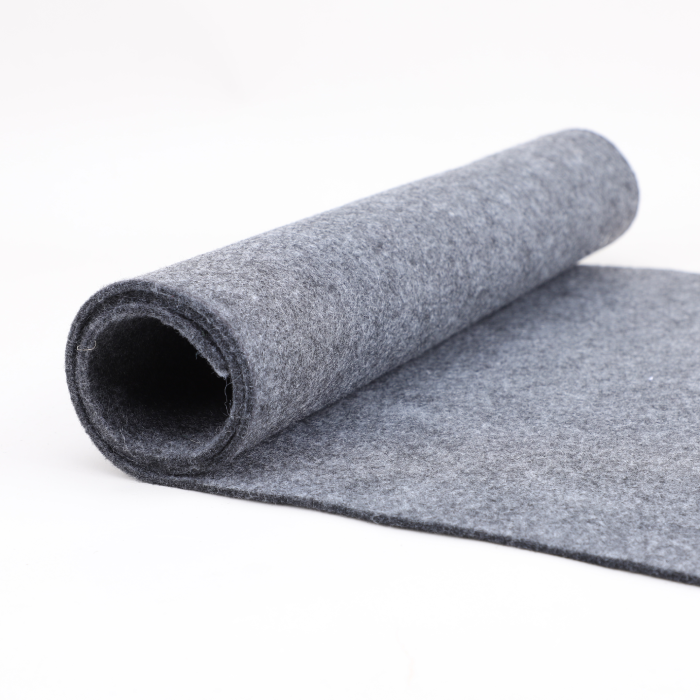
If needle punched felt is supplied in rolls, buyers should confirm whether the roll width, length, and laying method are suitable for the project.
If the material needs to be supplied as sheets or custom-shaped pieces, buyers should confirm the cutting dimensions, edge condition, and allowable dimensional tolerances.
For large flooring areas, buyers should also consider how separate sheets or rolls will be joined. The overall installation should not be judged solely by inspecting a single sample piece.
Confirm Joint and Edge Treatment
Different flooring systems may have different requirements for joints, edges, and material connections.
Buyers should clarify whether the material will be laid directly, cut and joined, fixed in place, or installed together with other layers. If joints or edges could affect subsequent installation, these areas should be checked during sample validation.
Buyers should not assume that every needle punched felt product can be joined or fixed in the same way without verification.
Confirm the Installation Sequence
Material suitability also depends on the installation sequence.
For example, an underlay may need to be installed before the carpet is laid, while in another product it may form part of the composite flooring itself. Different installation sequences can create different handling requirements.
Buyers should therefore provide the installation method or relevant instructions so that the supplier understands the material's position within the actual system, rather than describing the application only as “under flooring.”
What Conditions Should Buyers Confirm in Moisture-Prone Environments?
Moisture-related issues in flooring projects must be evaluated according to the actual environment and the complete flooring structure.
Buyers should first determine whether moisture may come from the subfloor, the surrounding environment, or cleaning and use. They should also confirm whether the flooring system specifies moisture-control or waterproofing measures.
Identify the Source of Moisture
Moisture sources can vary between projects. They may include residual moisture in the subfloor, ambient humidity, or water exposure during use.
Buyers should describe the actual environmental conditions and confirm any requirements for subfloor moisture, separation layers, and installation conditions in the flooring manufacturer's instructions or project specifications.
Not every moisture problem is caused by the underlay material, and adding a layer of needle punched felt should not be assumed to solve moisture-related issues.
Clarify Whether a Waterproof or Moisture-Control Barrier Is Required
If the project requires a barrier against liquid water or a defined level of water vapor control, buyers should specify the required function and applicable standards.
Ordinary needle punched felt should not automatically be treated as a waterproof or moisture-control barrier. If the design requires a dedicated barrier layer, other materials or a validated composite structure may need to be considered.
If composite materials are used, their structure, joining method, and conditions of use should also be checked against the flooring system requirements.
Do Not Promise Acoustic, Thermal, or Moisture Performance Without Supporting Data
The actual performance of needle punched felt depends on its structure, installation method, and the complete flooring system.
If a project has specific requirements for sound absorption, thermal insulation, or moisture control, buyers should define the relevant performance criteria and verify them through appropriate testing or system-level evaluation.
These functions should not be assumed solely from the material category, thickness, or a general product description from the supplier.
How Should Buyers Validate Samples in the Actual Flooring Structure?
Needle punched felt may appear suitable on its own, but that does not guarantee that it will meet requirements after installation in the actual flooring system.
Before bulk purchasing, buyers can follow the steps below to evaluate the material.
Step 1: Confirm the flooring system.
Identify whether the material will be used as carpet underlay, a separation layer, backing, or another auxiliary layer. Explain the carpet or flooring surface, subfloor, and installation method.
Step 2: Describe the operating conditions.
Provide information about the intended environment, sources of pressure, expected loads, moisture conditions, and any specific requirements for compression or dimensional stability.
Step 3: Confirm adjacent materials and installation methods.
Explain which materials the needle punched felt will contact and whether it needs to be cut, joined, fixed, or laminated. Provide relevant drawings, product specifications, or reference samples.
Step 4: Test the sample in a representative structure.
Whenever possible, install the sample in a flooring structure that closely represents the actual project. Check the laying process, joints, edges, dimensions, and overall compatibility.
If the project specifies compression, dimensional stability, moisture-control, or other performance requirements, select appropriate test methods according to the relevant specifications. A simple installation check should not be used as a substitute for all required performance testing.
Step 5: Confirm the bulk purchasing criteria.
After the sample is approved, record the confirmed material specifications, dimensional tolerances, installation requirements, and applicable acceptance criteria as references for subsequent bulk orders.
This process helps buyers determine whether needle punched felt is suitable for the intended flooring system instead of making a decision based only on the material name or an isolated sample.
What Information Should Buyers Provide Before Requesting a Quote?
Carpet manufacturers, flooring brands, and importers can prepare the following information to help suppliers recommend suitable materials more accurately.
Flooring system type: Carpet system, hard flooring system, or another floor construction.
Installation position: Carpet underlay, separation layer, backing, or another auxiliary layer.
Material function: Explain what the material needs to do and which functions are essential.
Adjacent materials: Provide information about the carpet, flooring surface, subfloor, and other relevant materials.
Load and compression conditions: Describe the operating environment, sources of pressure, and any specific requirements for compression or dimensional stability.
Moisture conditions: Explain whether there is a risk of subfloor moisture or other water exposure and whether the project requires a dedicated moisture-control or waterproof layer.
Installation method: Specify whether the material will be installed in rolls, joined as sheets, fixed in place, or laminated with other materials.
Existing specifications or samples: If a reference material is already available, provide its GSM, thickness, dimensions, photographs, or a physical sample.
Testing and acceptance requirements: If the project specifies compression, dimensional stability, moisture-related, or other test standards, state them clearly during the inquiry.
Purchasing plan: Provide the estimated order quantity, required delivery time, preferred supply format (rolls or cut pieces), and whether repeat orders are expected.
Even if buyers have not finalized every technical specification, they can still provide the flooring structure, application details, and existing samples. This information is more useful to a supplier than an inquiry that simply states, “We need needle punched felt for carpet underlay.”
How Can Buyers Move from Sample Validation to Bulk Purchasing?
Once the installation position, operating conditions, and basic performance requirements have been clarified, buyers can confirm the detailed specifications, supply format, and bulk acceptance requirements.
For customized materials, the application, specifications, dimensional tolerances, processing methods, sample approval, and bulk quality criteria should be considered together rather than comparing thickness or unit price alone.
For ongoing purchasing programs, buyers should also evaluate whether the supplier has suitable nonwoven manufacturing, customization, processing, and quality-control capabilities.
HuiZhou JinHaoCheng Nonwovens Co., Ltd. manufactures needle punched nonwovens, needle punched felt, and various composite nonwoven materials. For carpet and flooring-related projects, buyers can provide details of the flooring structure, existing material samples, installation method, and performance requirements to discuss potential material and processing solutions.
It is important to note that a supplier's ability to manufacture needle punched felt or composite materials does not mean that every product is suitable for every flooring system. The final selection should still be based on the design requirements of the intended system, sample validation results, and any necessary performance testing.
Conclusion: Confirm the Flooring System Before Selecting the Underlay Material
When sourcing carpet underlay felt or floor underlay felt, the most important step is not to find a universal specification for every type of flooring. Buyers should first confirm the material's installation position, intended function, load conditions, adjacent materials, and installation method within the complete flooring system.
Carpet underlay, separation layers, backing materials, and waterproof flooring underlays are not interchangeable product concepts. The suitability of needle punched felt should be evaluated according to the specific flooring structure and project requirements rather than determined solely by the material name, thickness, or hand feel.
For overseas buyers, a more practical purchasing process is:
Flooring System Confirmation → Installation Position and Function Definition → Load, Moisture, and Installation Requirements → Sample Validation → Bulk Specifications and Acceptance Criteria → Purchasing
This process can help reduce risks associated with unclear applications, system incompatibility, or incomplete purchasing specifications. It also helps suppliers understand project requirements more accurately.
If you are sourcing needle punched felt for a carpet or flooring system, start by explaining the actual flooring structure, installation position, and operating conditions. Then determine the appropriate specifications and purchasing solution.




