
How Should Furniture Manufacturers Evaluate Felt for Sofa Padding and Upholstery?
For sofa manufacturers, upholstered furniture producers, furniture material wholesalers, and furniture brand purchasing teams, sourcing sofa padding felt involves more than checking the material’s thickness or softness. The real question is:
Is this needle punched felt suitable for the specific furniture component, and will it work with the existing materials and manufacturing processes?
In sofa and upholstered furniture production, needle punched felt may be used as a lining, separation layer, frame protection layer, bottom covering, or another auxiliary material component, depending on the product design. However, each position serves a different purpose. Buyers should not assume that a material is suitable simply because it is described as “furniture felt” or “upholstery padding material.”
For bulk purchasing, several factors can affect production suitability, including how well the material fits the intended position, whether it can be processed according to the component’s shape, how it interacts with adjacent materials, and whether its specifications remain consistent across production batches.
This guide explains how furniture buyers can evaluate furniture upholstery felt based on its intended application and what information to confirm before requesting a quotation from a needle punched felt manufacturer.
Why Is the Material Name Alone Not Enough When Buying Sofa Felt?
When purchasing needle punched felt for sofas, buyers may begin with questions such as:
“Do you supply needle punched felt for furniture?”
“Can you recommend felt suitable for sofas?”
These questions are useful starting points, but they do not provide enough information for a supplier to determine whether a specific material is appropriate.
Materials described as needle punched felt can differ in fiber composition, fiber structure, GSM, thickness, density, and finishing methods. These differences can affect how the material behaves during processing and use.
More importantly, the requirements may vary considerably depending on whether the felt is used as an internal separation layer, a frame protection layer, or a bottom covering.
For example, one component may need to fit around an irregular frame, while another may require consistent coverage, a specific fixing method, or clean edges after cutting. If buyers only describe the application as “for sofas,” the supplier may not have enough information to identify the most relevant material requirements.
A more practical purchasing approach is to identify the installation position, intended function, adjacent materials, and processing method before discussing the exact specifications.
What Functions Can Needle Punched Felt Perform in Sofas and Upholstered Furniture?
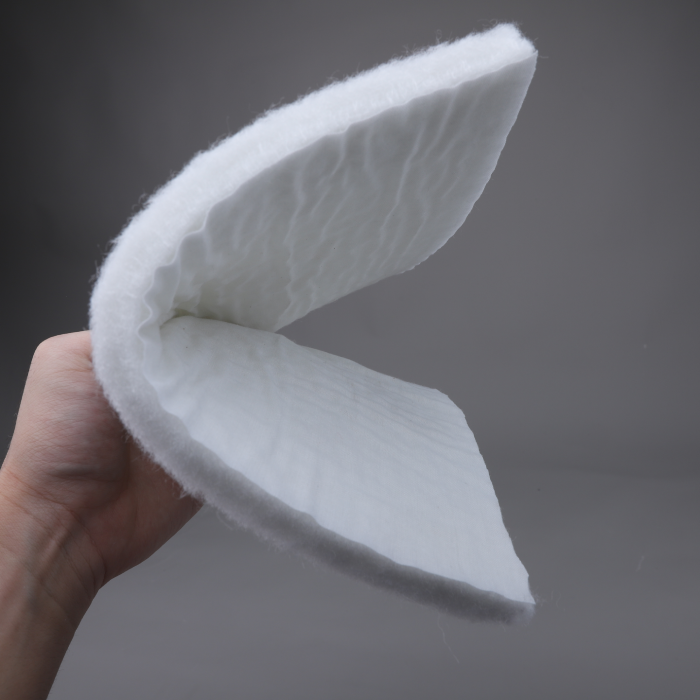
Needle punched felt is a nonwoven material formed by mechanically entangling fibers through a needle punching process. Its fiber composition, structure, and processing methods can be adjusted for different applications, making it a potential material for certain furniture components.
However, needle punched felt is not a universal replacement for every sofa filling material or load-bearing component. Its suitability must be evaluated according to the actual function of the component.
As an Inner Lining or Separation Layer
Some furniture designs require a layer of material to separate or cover different components.
For these applications, buyers should check whether the needle punched felt is suitable for the intended installation position, can be laid according to the component’s shape, and remains in the required position during assembly without unwanted wrinkles, shifting, or edge problems.
If the material needs to cover a relatively large area, buyers should also confirm whether its dimensions and cutting method are suitable for the production process.
As an Auxiliary Cushioning or Padding Layer
Some furniture designs may require an additional padding layer between adjacent materials.
In this situation, buyers should not assume that needle punched felt will provide the required cushioning simply because it feels soft or has a certain thickness.
It is important to clarify whether the felt serves only as an auxiliary padding layer or must meet specific compression, recovery, or support requirements. If the furniture design relies on foam, springs, or other dedicated components for its primary support, needle punched felt should not automatically be treated as a replacement for those components.
As a Frame Protection Layer
In some sofa constructions, material may be used to cover parts of the frame or help reduce direct contact between different components.
For these applications, buyers should evaluate how well the felt fits the frame’s contours, how it will be fixed in place, the condition of the cut edges, and the result after assembly.
If the material needs to be folded, wrapped, or secured around the frame, sample testing should check for unwanted wrinkles, stretching, shifting, or damage during installation.
As a Bottom Covering or Backing Layer
The underside and certain rear sections of sofas and other upholstered furniture may require a covering or backing material.
For these positions, buyers should confirm the required coverage, dimensional stability, edge finishing, fixing method, and whether the felt needs to be laminated with another material.
A bottom covering and an internal cushioning layer serve different purposes, so the same evaluation criteria should not automatically be applied to both.
How Should Buyers Evaluate Felt According to Its Installation Position?
For furniture manufacturers, the most practical way to evaluate needle punched felt is to begin with the function of the component rather than selecting a general specification first.
Define the Evaluation Criteria Based on the Component’s Function
If the material is mainly used for covering or separation, buyers can prioritize its laying, cutting, and fixing performance.
If it needs to fit around a frame or an irregular surface, buyers should examine its fit, behavior when bent, and tendency to shift during assembly.
If it sits between other soft materials, buyers should confirm whether the surface contact, layer alignment, and fixing method meet the furniture design requirements.
If the material must provide a defined cushioning or compression function, buyers should specify the required performance and verify it through appropriate testing. Hand feel alone is not sufficient, and an auxiliary padding function should not be confused with a load-bearing function.
Do Not Treat Different Furniture Components as the Same Application
A sofa may contain outer upholstery fabric, foam, a frame, spring or other support components, inner linings, and bottom coverings. These components perform different functions and therefore have different material requirements.
Furniture buyers should identify exactly where the needle punched felt will be installed before explaining the application to the supplier.
This approach helps prevent recommendations based on the wrong application and may reduce repeated adjustments during sample testing.
What Should Buyers Confirm When Felt Contacts Foam, Upholstery Fabric, Frames, or Other Materials?
Needle punched felt is often one component of a complete furniture structure rather than a finished product used on its own. Therefore, a material that meets its individual requirements may not necessarily perform as expected when combined with adjacent components.
Compatibility with Foam or Other Soft Materials
If the felt will be placed next to foam, fiber filling, or other soft materials, buyers should confirm whether the layers can maintain their intended positions and shapes during assembly.
For example, thickness, surface characteristics, and flexibility may affect how the material is laid and secured. If the design involves bonding, sewing, or another joining process, buyers should also verify that the material is suitable for that method.
The performance of the assembled structure should not be assumed based only on the appearance or hand feel of an individual layer.
Compatibility with Frames or Other Rigid Components
If the felt is used for frame protection or local covering, buyers should confirm that it can be cut to the required contours and remain in position after fixing.
For components with corners, curves, or irregular shapes, buyers can provide drawings or physical samples to help the supplier understand the actual geometry and installation method.
If the material will experience tension, folding, or repeated contact during fixing, these conditions should be included in sample validation rather than checking the material only when it is laid flat.
Is Lamination with Another Material Necessary?
Some furniture components may require needle punched felt to be laminated with upholstery fabric, film, or another functional material to meet specific structural or processing requirements.
The need for lamination should be determined by the furniture design and intended application, not simply by adding more material layers.
Before confirming a lamination solution, buyers should explain the function of each layer, the intended bonding method, and the subsequent processing steps. Samples should then be checked to confirm whether the combined structure is suitable for production.
What Requirements Do Cutting, Sewing, Bonding, and Lamination Create?
For furniture manufacturers, material purchasing involves more than evaluating the material itself. Buyers must also consider whether it can be processed efficiently on the production line.
Cutting and Custom-Shaped Processing
If the needle punched felt needs to be cut into a specific shape, buyers should confirm whether the cutting dimensions, contours, edge condition, and allowable tolerances meet the component design requirements.
For furniture components manufactured repeatedly in large quantities, buyers should also check whether the cut material is likely to deform or shift during handling, positioning, and assembly.
If custom-sized or shaped pieces are required, refer to the needle punched felt cutting and customization guidefor information on providing dimensions, drawings, and other processing details.
Sewing or Mechanical Fixing
If the felt needs to be sewn, stapled, or secured using another method, buyers should explain the actual fixing process to the supplier.
During sample evaluation, check whether the fixing positions meet the design requirements, whether the material develops unwanted tearing or deformation during processing, and whether the edges interfere with subsequent assembly.
Different needle punched felt structures may respond differently to processing methods, so suitability should be confirmed using the actual material.
Bonding or Lamination
If the felt needs to be bonded or laminated with another material, buyers should provide the intended joining method and final operating conditions in advance.
During sample validation, check whether the combined material meets the component’s fit, assembly, and appearance requirements. Also look for delamination, lifting, or other problems that could interfere with subsequent production.
Bond strength and other lamination performance requirements should be verified using methods appropriate to the project. They should not be assumed from the material name alone.
How Should Buyers Evaluate Dimensional Stability and Batch-to-Batch Consistency?
For furniture factories that manufacture sofas and upholstered furniture continuously, purchasing risks do not arise only when the first batch is unsuitable. Problems can also occur when later batches differ from the approved sample.
Confirm Key Dimensions and Allowable Tolerances
Before bulk purchasing, buyers should identify the parameters that need to be controlled for the intended application, such as GSM, thickness, width, cut dimensions, or other measurements directly related to assembly.
Not every parameter requires the same level of control. Buyers should prioritize the measurements that affect installation, coverage, or processing and then agree on the applicable specifications and allowable tolerances with the supplier.
Check Material Consistency Across Production Batches
If the furniture factory needs to purchase the same needle punched felt repeatedly, it is advisable to retain an approved sample and document the specifications that the bulk material must follow.
For repeat orders, buyers can check whether appearance, dimensions, thickness, and other processing-related characteristics remain consistent with the approved sample.
If the material will undergo further cutting, sewing, or lamination, buyers should also verify that the bulk material maintains consistent processing behavior.
Connect Quality Requirements to the Actual Application
Not every furniture felt product requires the same tests. Testing should be determined by the material’s intended function within the furniture structure.
For example, if the project focuses on dimensions and assembly, dimensional tolerances and assembly fit should be prioritized. If the project has specific compression performance or fire-safety requirements, these should be identified and evaluated separately.
This approach makes quality control more relevant to the product design instead of adding a long list of tests that may have little connection to the actual application.
Why Should Samples Be Tested in the Actual Furniture Structure?
Needle punched felt may appear suitable on its own, but that does not guarantee that it will meet requirements once installed inside a sofa.
Actual performance may also be affected by adjacent materials, fixing methods, component shapes, processing methods, and assembly sequences.
Before bulk purchasing, furniture manufacturers should ideally validate the material using the following process.
Step 1: Confirm the installation position.
Identify whether the material will be used as a lining, separation layer, auxiliary padding layer, frame protection layer, or bottom covering, and explain the main function of the component.
Step 2: Provide information about the actual structure.
Give the supplier component drawings, existing samples, photographs, or details of adjacent materials so that the supplier can understand the felt’s position within the complete furniture structure.
Step 3: Confirm the material and processing solution.
Discuss the fiber material, GSM, thickness, dimensions, cutting method, and whether sewing, bonding, or lamination is required.
Step 4: Test samples at the component level.
Whenever possible, install the sample in the actual furniture structure and check its fit, fixing, edges, assembly, and appearance. If the material performs a defined functional role, carry out the relevant tests according to the project requirements.
Step 5: Confirm the bulk purchasing criteria.
After the sample is approved, document the confirmed specifications, allowable tolerances, processing requirements, and necessary acceptance criteria as references for subsequent production batches.
This validation process provides a more reliable basis for determining whether the material is suitable for actual furniture manufacturing than simply touching the sample or comparing quotations.
What Information Should Buyers Provide Before Requesting a Quote from a Needle Punched Felt Supplier?
Furniture manufacturers can prepare the following information to help suppliers recommend materials and provide more accurate quotations.
Furniture type: Sofa, lounge chair, upholstered bed, office chair, or another type of upholstered furniture.
Installation position: Inner lining, separation layer, auxiliary padding, frame protection, bottom covering, or another component.
Component function: Explain what the material needs to do and which performance requirements are essential.
Adjacent materials: Identify whether the felt will contact foam, upholstery fabric, a frame, or other components.
Processing method: Explain whether the material requires cutting, custom shaping, sewing, fixing, bonding, or lamination.
Existing specifications or reference samples: If a material is already in use, provide its GSM, thickness, dimensions, photographs, or a physical sample when available.
Quality and testing requirements: If the project specifies dimensional tolerances, compression performance, fire-safety standards, or other acceptance conditions, explain the requirements in advance.
Purchasing plan: Provide the estimated order quantity, required delivery time, preferred supply format (rolls or cut pieces), and whether repeat orders are expected.
Buyers do not need to know every technical specification before starting an inquiry. Providing a clear description of the component, photographs, and processing requirements is generally more useful than simply stating, “We need needle punched felt for sofas.”
How Can Buyers Move from Component Evaluation to Bulk Purchasing?
Once the installation position and basic requirements are clear, buyers can determine the detailed specifications and confirm the sample and bulk-order requirements with the supplier.
If customized material is needed, buyers should consider the component application, material specifications, processing methods, allowable tolerances, sample approval, and bulk acceptance criteria together instead of comparing only GSM or unit price.
For furniture factories that purchase materials over the long term, it is also important to evaluate whether the supplier has suitable nonwoven manufacturing, customization, processing, and quality-control capabilities.
HuiZhou JinHaoCheng Nonwovens Co., Ltd. manufactures needle punched nonwovens, needle punched felt, and various composite nonwoven materials. For furniture-related purchasing projects, buyers can provide component drawings, existing samples, or application details to discuss potential material structures and processing solutions.
If a project has specific fire-safety, compression, or other performance requirements, buyers should identify the applicable standards during the inquiry and verify compliance through appropriate samples and testing. Suitability should not be determined solely from a general material category or a supplier’s broad product description.
Conclusion: Confirm the Function of the Furniture Component Before Selecting the Felt Specifications
For sofa and upholstered furniture manufacturers, evaluating sofa padding felt or furniture upholstery felt should begin with the intended installation position, the function the material needs to perform, and how it will interact with adjacent materials and production processes—not with a single specification intended for every furniture application.
Inner linings, separation layers, auxiliary padding, frame protection layers, and bottom coverings serve different purposes. They should therefore be evaluated using criteria relevant to their individual functions.
For purchasing teams, a more practical process is:
Installation Position → Component Function → Adjacent Materials and Processing Requirements → Sample Validation → Bulk Specification Confirmation → Purchasing
This approach can help reduce purchasing risks associated with unclear applications, processing incompatibility, or insufficient specification confirmation. It can also help suppliers understand furniture manufacturers’ requirements more accurately.
If you are sourcing needle punched felt for sofas or upholstered furniture, start by explaining the actual component, installation method, and processing requirements. Then determine the appropriate specifications and purchasing solution.




