
Why Is Mesh Reinforcement Used in Felt Pipe Wrap? Tear Resistance and Material Stability
Self-adhesive needle-punched felt pipe wrap needs to do more than remain flexible during production, transportation, and installation. It must also withstand the mechanical forces involved in unrolling, cutting, slitting, handling, and wrapping. If the material is too soft or experiences localized tension during converting, problems such as edge tearing, deformation, or structural instability may occur.
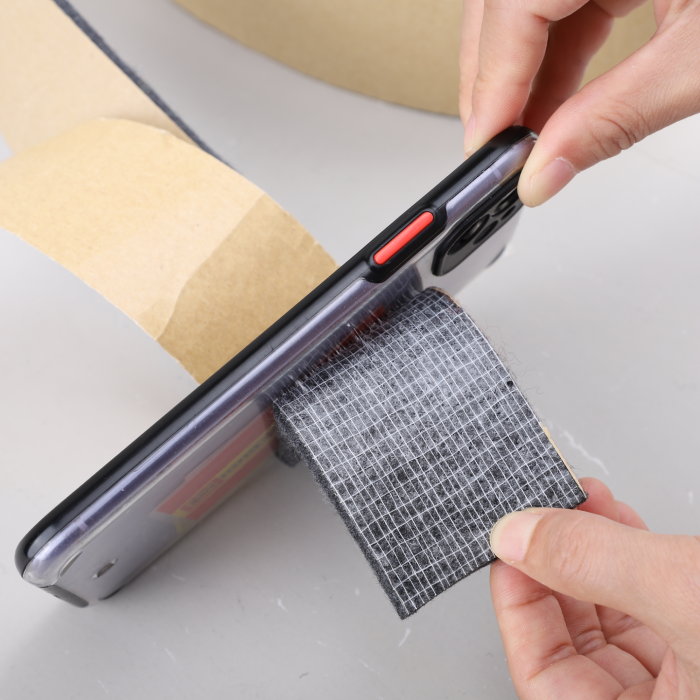
Adding reinforcing mesh to a needle-punched felt composite is one structural design option worth evaluating. In a suitable composite construction, the mesh layer can provide additional support and help distribute some external forces, potentially improving the material's structural integrity during processing and use.
However, reinforcing mesh does not make a material completely tear-proof. Nor does adding a mesh layer automatically guarantee a specific level of tensile strength or dimensional stability. Actual performance depends on the mesh material, mesh structure, bonding method, felt substrate properties, and final application conditions.
For buyers sourcing mesh reinforced felt, the key is not simply to confirm whether the product contains a mesh layer. They also need to understand where the mesh is positioned, how it is combined with the needle-punched felt, and whether the material remains stable after slitting, cutting, and pipe wrapping.
What Is Mesh-Reinforced Needle-Punched Felt?
Mesh-reinforced needle-punched felt is a composite material structure made by combining a needle-punched felt substrate with a mesh reinforcement material.
Ordinary needle-punched felt is formed through the mechanical entanglement of fibers. Depending on the fiber type, GSM, thickness, and needling structure, the material can offer different levels of flexibility, bulk, and structural stability.
When a product requires additional structural support, a mesh reinforcement layer can be considered as part of the needle-punched felt construction. The mesh becomes one component of the composite structure and works together with the felt substrate.
For self-adhesive pipe wrap materials, the complete construction may also include pressure-sensitive adhesive and release paper. Buyers should therefore distinguish the functions of each layer: needle-punched felt serves as the main fibrous substrate, reinforcing mesh provides additional structural support, the adhesive helps secure the material, and the release paper protects the adhesive surface.
The number of layers, mesh position, and composite method may vary between products. The mesh may be embedded within the felt or positioned at a specific point in the composite structure. The actual design must be confirmed according to the product construction and manufacturing requirements. Buyers should not assume that all reinforced felt products use the same layer arrangement.
For pipe wrapping applications, the main purpose of reinforcing mesh is to help flexible roll materials withstand mechanical forces during converting, handling, and installation, rather than turning needle-punched felt into a rigid board.
What Role Does the Reinforcing Mesh Layer Play in a Composite Structure?
The main value of a mesh layer is that it adds another structural support component to flexible felt. It does not simply make the material thicker. Instead, the mesh participates in the overall load-bearing behavior of the composite structure.
In a suitable construction, the mesh may help distribute localized tension. When a roll is pulled, stretched, or subjected to external forces at a particular point, the reinforcement layer can participate in bearing some of the load and may help reduce localized stress concentration.
The mesh may also help the material maintain its overall form during unrolling, movement, and processing. For products that need to be slit or cut from larger rolls, this additional structural support may influence edge integrity and shape retention after converting.
For pipe wrap materials, flexibility and structural stability need to be considered together. The material must bend around the pipe while remaining sufficiently intact during normal handling and installation, without easily developing noticeable tears or deformation.
Therefore, the purchasing value of a reinforced nonwoven felt roll is not simply the addition of another material layer. It is the ability of the reinforcement and felt substrate to work together to meet roll converting and end-use installation requirements.
It is important to note that the actual contribution of the mesh depends on its material, mesh structure, orientation, position, and bonding condition with the felt substrate. Knowing only that a product contains mesh is not enough to determine its structural performance.
How Can Reinforcing Mesh Help Improve Tear Resistance?
For flexible needle-punched felt rolls, tearing may occur at roll edges, cut sections, localized stress points, or areas pulled during installation.
When external force is applied, the fiber structure may begin to separate locally. If the force continues to increase, the tear may extend further through the material structure.
In a suitable composite construction, reinforcing mesh can participate in distributing some of the tensile force and provide additional support to the felt substrate. This combined structure may help reduce localized stress concentration in certain areas and limit the risk of further tear propagation.
However, mesh reinforced felt does not mean tear-proof felt. A mesh layer cannot guarantee that the material will never tear under every load direction or operating condition.
Tear resistance is also affected by the mesh material, mesh opening size, mesh orientation, bonding between the mesh and felt, substrate thickness, and overall composite construction. If the interlayer bonding is unstable, the mesh may not provide its intended support. Local delamination or separation between the mesh and felt may also occur.
For this reason, buyers should not simply ask suppliers for a product described as having "reinforcing mesh." They should explain the actual handling and installation conditions the material needs to withstand. For example, will the roll be unrolled frequently? Will the material be pulled after cutting? Does installation require wrapping around pipe elbows? Could the finished material experience localized pulling during handling?
If a project has specific tear resistance requirements, comparisons should be made using mutually agreed test methods and samples. Buyers should not judge performance solely by whether a mesh layer is present.
How Does Reinforcing Mesh Affect Dimensional Stability During Slitting and Cutting?
For reinforced adhesive felt that requires further converting, the material must meet not only its final application requirements but also the demands of downstream processing.
During roll slitting, the material passes through feeding, tensioning, and cutting processes. If the roll stretches, shifts, or wrinkles easily during processing, the specified slit width and edge condition may be affected.
In a suitable construction, reinforcing mesh can provide additional support to the felt substrate and help maintain overall material integrity under tension. However, whether it improves feeding and slitting stability still needs to be verified according to the actual converting equipment, mesh structure, and material flexibility.
During cutting, buyers should pay attention to the structural condition around the cut edges. Narrow strips, long strips, and irregularly shaped parts may be more likely to reveal structural problems along the edges.
If the mesh is not securely bonded to the felt substrate, cutting may result in exposed mesh, edge separation, or localized delamination. Therefore, inspection should cover not only the flatness of the material surface but also the condition of the cut edges and the interfaces between layers.
For buyers with continuous production requirements, it is advisable to conduct sample converting trials using actual processing equipment or conditions close to the intended production process. Check material feeding, slit width, edge integrity, and deformation.
Mesh reinforcement can be considered as one structural approach to improving roll converting suitability, but it cannot replace verification of material compatibility with the converting equipment.
Why Should Reinforced Structures Be Considered for Pipe Wrap Materials?
Pipe wrap materials usually undergo several operations during installation, including unrolling, cutting, bending, wrapping, and securing. Unlike flat materials, pipe wrap must also accommodate different pipe diameters, elbows, and connection points.
If the material is too flexible, installers may find it easier to cause localized deformation when pulling or adjusting its position. Long rolls may also experience additional mechanical stress through repeated unrolling and movement.
For these applications, mesh backed nonwoven felt can be considered as a structural option worth evaluating. Reinforcing mesh may help the material maintain its integrity during handling and wrapping, reducing the risk of tearing caused by localized stress.
At curved sections of a pipe, the material needs to bend and follow the pipe's shape. Buyers should confirm whether the reinforcement layer affects flexibility and surface conformity. If the mesh structure is too rigid or does not match the flexibility of the felt substrate, the material may not conform easily to the pipe surface.
For self-adhesive pipe wrap materials, the relationship between the reinforcement layer and the adhesive construction also needs to be considered. After bending and securing, the adhesive layer should make contact with the target surface as intended by the product design. The reinforcement structure should not prevent the material from conforming to the surface or cause unnecessary delamination or edge lifting during installation.
Therefore, when selecting reinforced pipe wrap materials, buyers need to evaluate two aspects together: whether the roll has sufficient structural integrity during handling and converting, and whether it can still provide the required flexibility and surface conformity on the actual pipe.
What Is the Difference Between Mesh-Reinforced Needle-Punched Felt and Ordinary Needle-Punched Felt?
The main difference between ordinary needle-punched felt and mesh-reinforced needle-punched felt is their material construction, rather than simply a difference in thickness or weight.
Ordinary needle-punched felt mainly relies on the mechanical entanglement of fibers to form the material structure. Its flexibility, thickness, strength, and structural stability depend on the fiber type, GSM, needling structure, and production conditions.
Mesh-reinforced needle-punched felt adds a mesh reinforcement layer to the felt substrate, giving the composite construction an additional support component. Its design purpose is generally to improve structural integrity under specific loading conditions and enhance suitability for certain converting processes.
Comparison | Ordinary Needle-Punched Felt | Mesh-Reinforced Needle-Punched Felt |
Basic construction | Mainly formed by an entangled fiber structure | Composite structure consisting of a needle-punched felt substrate and mesh reinforcement |
Flexibility | Depends on fiber type, thickness, and density | Depends on the compatibility of the felt substrate and mesh structure |
Tear resistance | Depends on the substrate structure and loading direction | The reinforcement layer may distribute some external force; actual performance requires testing |
Converting stability | Needs to be evaluated according to the roll and converting equipment | May provide additional support, but converting trials are still required |
Pipe wrapping | Can be used in pipe wrap projects where its performance is suitable | Can be evaluated for projects with greater emphasis on roll structural integrity |
Purchasing considerations | Fiber type, GSM, thickness, and flexibility | In addition to substrate specifications, the mesh and composite construction must be confirmed |
This does not mean that the mesh-reinforced version is better than ordinary needle-punched felt for every application.
If the material is only required for light protection, simple wrapping, or applications with limited structural support requirements, ordinary needle-punched felt may already meet the project's needs. If the roll needs frequent handling, further slitting, or may be pulled during installation, buyers can evaluate whether a reinforced construction offers practical value.
The final choice should be based on loading conditions, converting methods, installation environments, and cost requirements.
How Should Buyers Confirm the Mesh Material and Reinforcement Structure?
When purchasing mesh reinforced felt, buyers should not simply tell the supplier that they need needle-punched felt with mesh. To help the supplier evaluate the material construction accurately, buyers need to explain the intended function of the mesh and the processing and installation steps the finished product will undergo.
First, confirm the mesh material type. Different mesh materials may have different flexibility, strength, temperature resistance, and bonding characteristics with the felt substrate. The specific choice should be based on the product construction and operating environment. Buyers should not assume that a particular fiber or plastic mesh will be used without confirmation.
Second, confirm the mesh position and construction. Buyers can provide a product cross-section drawing to show whether the mesh is located inside the felt, on its surface, or between other composite layers. If the product also includes adhesive and release paper, the position of each layer should be indicated.
Third, confirm how the mesh is bonded to the felt substrate. Interlayer bonding stability can affect the material's performance during slitting, bending, and installation. For pipe wrap rolls intended for long-term use, buyers should pay attention to possible separation between the mesh and felt, localized wrinkling, or interlayer delamination.
Fourth, explain the final converting method. Will the material be supplied in full rolls, or does it need to be slit to a specified width? Will it be installed through continuous wrapping or cut into fixed lengths? Does it need to undergo die cutting, bending, or other processing? These details can influence the choice of material construction.
Finally, provide the application environment. Pipe diameter, operating temperature, installation space, humidity, and the target pipe surface may all affect the suitability of the material.
For custom projects, buyers are advised to provide product photos, cross-section drawings, existing samples, required roll dimensions, and installation instructions. This allows the supplier to evaluate the reinforcement structure according to actual requirements instead of recommending a product based only on its material name.
How Should Mesh-Reinforced Felt Samples Be Inspected Before Bulk Production?
Sample approval is an important step in determining whether a mesh-reinforced construction is suitable for a project. Buyers should not only check whether the material surface is flat. They should also evaluate the material through the intended converting process and actual pipe wrapping method.
Check the overall construction
First, confirm that the needle-punched felt substrate, mesh layer, adhesive, and release paper match the structure agreed upon by both parties. Check whether the mesh shows noticeable displacement, exposure, wrinkles, or localized gaps.
Check the interlayer bonding condition
Observe whether there is any obvious separation between the mesh and the felt substrate. For composite materials, interlayer bonding can be checked according to the agreed material construction and test method. A fixed peel strength should not be inferred from a simple manual pulling test.
Check the cut edges
Use the sample for actual slitting or cutting and observe whether the edges are neat and whether the mesh shows abnormal exposure, separation, or fraying. Different cutting methods may produce different results, so the test conditions should be as close as possible to the buyer's actual converting process.
Check bending and wrapping performance
Bend or wrap the material around a pipe with the actual application diameter. Check whether it conforms to the pipe shape and whether noticeable wrinkling, delamination, edge lifting, or localized tearing occurs.
Check the self-adhesive construction
If the product has an adhesive backing, conduct a bonding test on the target pipe surface. Confirm whether edge lifting, localized detachment, or other installation-related problems occur after the material is applied.
Confirm bulk acceptance criteria
After sample approval, both parties should define the inspection items for bulk production. These may include material construction, mesh position, roll width, thickness, appearance, interlayer bonding, and packaging condition. For properties such as tear resistance and dimensional stability, acceptance requirements should only be established after the test methods have been agreed upon by both parties.
For mesh-reinforced self-adhesive needle-punched felt pipe wrap, what buyers really need to confirm is not simply whether mesh has been added, but whether the material can remain stable under their own converting and installation conditions after reinforcement.
HuiZhou JinHaoCheng Nonwovens Co., Ltd. can discuss customization options with buyers according to their needle-punched felt and composite material requirements. However, the specific mesh material, layer construction, composite method, and performance specifications must be confirmed against the actual product and validated through sample testing. Until these details are established, no particular mesh structure, tear resistance level, or converting performance should be treated as a universal standard for all products.




