
Should Buyers Check Smoke, Toxicity, and Flaming Droplets When Sourcing Flame Retardant Felt?
When sourcing flame retardant felt, buyers usually begin by checking whether the material meets the flammability testing requirements specified for their project. However, for products used in interior building applications, industrial equipment, transportation, or other environments with defined fire-safety requirements, confirming a flame-retardant rating may not be enough to address every purchasing requirement.
During a fire, a material's combustion behavior may involve several different factors, including smoke production, the toxicity of combustion products, and the formation of flaming droplets. These indicators address different aspects of fire behavior and cannot all be evaluated based on a single flame-retardant classification.
Overseas buyers should therefore confirm the intended application and applicable requirements before deciding whether smoke production, smoke toxicity, and flaming droplets need to be assessed separately. Not every type of flame retardant felt requires all these tests. The actual requirements depend on the end use, target market, and project specifications.
Why May a Flame-Retardant Rating Alone Be Insufficient?
A flammability test result describes how a specific specimen performs under defined test conditions. Different test methods, however, evaluate different aspects of material performance.
For example, a material may meet the requirements of a particular small-scale flammability test. This does not automatically demonstrate that it also meets requirements for low smoke, smoke toxicity, or flaming droplets. If buyers only confirm that a supplier has provided a flame-retardant test report without checking the other indicators required by the project, important compliance requirements may be overlooked.
For interior building materials and other products subject to specific reaction-to-fire classification requirements, the purchasing specification may cover not only combustion behavior but also classifications related to smoke production and flaming droplets. Projects with separate smoke-toxicity requirements may require additional confirmation of the applicable test method and acceptance criteria.
The key distinction is that flame-retardant performance is not the same as a complete fire-safety assessment. The former concerns a material's combustion behavior under specified test conditions. The latter may also involve smoke, combustion products, flaming droplets, and the conditions in which the finished product will be used.
Buyers should not assume that descriptions such as “Flame Retardant,” “Fire Resistant,” or “Low Smoke” prove that a material meets every relevant requirement. A more reliable approach is to identify the performance evidence required by the project and check the scope of the available test reports individually.
What Is the Difference Between Smoke Production, Smoke Toxicity, and Flaming Droplets?
These three indicators may all be relevant to fire safety, but they do not measure the same thing. Buyers should understand their different purposes and avoid treating evidence for one indicator as proof of another.
Indicator | What It Evaluates | What Buyers Should Confirm |
Smoke production | The amount or rate of smoke produced by a material under specified fire-test conditions and the applicable smoke classification | Whether the project specifies a smoke classification or limit, and whether the report includes the relevant test and result |
Smoke toxicity | Harmful constituents in combustion smoke or related toxicity indicators, depending on the applicable test method | Whether a specific toxicity test is required, which method applies, and what limits or evaluation criteria must be met |
Flaming droplets | Whether the material produces droplets or particles that continue to burn under the specified test conditions, and how this behavior is classified | Whether the project specifies requirements for flaming droplets and whether the report covers the relevant specimen and classification |
Smoke Production: Is There a Defined Low-Smoke Requirement?
Smoke-production testing evaluates a material's smoke behavior under specified fire-test conditions. For projects subject to defined reaction-to-fire classification requirements, buyers may need to confirm the applicable smoke classification.
For example, the relevant classification system in EN 13501-1 includes additional smoke classifications such as s1, s2, and s3. These classifications should be interpreted in the context of the applicable product category, test method, and project requirements. A single letter or rating should not be used on its own to determine whether a material is suitable for every application.
If buyers require a low-smoke material, they should specify the applicable standard, classification, or limit in the inquiry. The phrase “Low Smoke” in a product name or marketing document is not a substitute for supporting test evidence.
Smoke Toxicity: Does Low Smoke Mean Low Toxicity?
Low smoke and low smoke toxicity are not the same thing.
Smoke-production indicators primarily evaluate characteristics such as the amount or rate of smoke generated. Smoke toxicity concerns harmful constituents in combustion products and the applicable methods for evaluating their toxicity. These indicators address different questions and cannot replace one another.
Therefore, even if a material has been tested for smoke production, buyers should not conclude that it meets a specific smoke-toxicity requirement without the relevant supporting evidence.
If the project specifies smoke toxicity, buyers should confirm the applicable test method, specimen conditions, evaluation indicators, and acceptance limits. They should also ask the supplier whether the available reports actually cover these requirements.
Terms such as “low smoke,” “non-toxic,” or “no harmful gases” should not be treated as verified performance claims without appropriate evidence. The specific claim must be supported by applicable testing and results.
Flaming Droplets: Can the Material Produce Burning Droplets When Exposed to Fire?
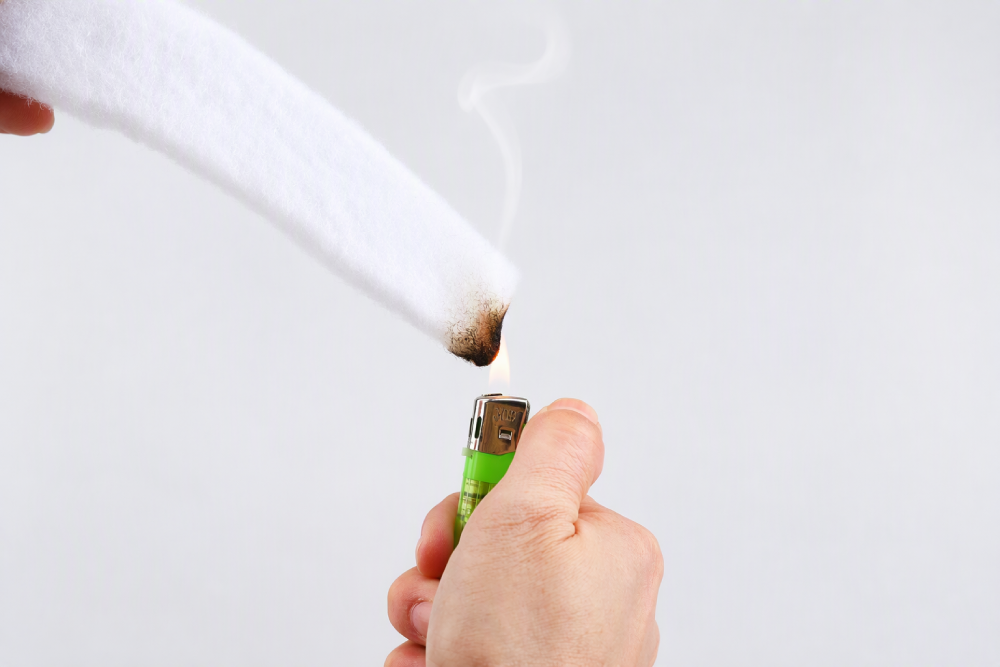
Flaming-droplet evaluation concerns whether a material produces droplets or particles that continue to burn when exposed to fire, as well as the relevant behavior defined by the applicable test method.
In some building-product reaction-to-fire classification systems, EN 13501-1 uses additional classifications such as d0, d1, and d2 to describe relevant behavior. Buyers should interpret these classifications according to the applicable standard and classification rules rather than applying them directly to other test systems or every type of felt.
For materials used in certain interior building applications, equipment assemblies, or composite products, buyers should confirm whether flaming-droplet requirements apply and whether the test specimen represents a single layer of felt or the final composite construction.
The absence of obvious flaming droplets does not automatically prove compliance with all flame-retardant, smoke, or toxicity requirements. These performance aspects should be verified separately according to the project specifications.
Which Applications Require Particular Attention to These Three Indicators?
Whether smoke production, smoke toxicity, and flaming droplets need to be assessed depends on the intended use of the finished product and its applicable requirements, not simply on whether the material is described as flame retardant felt.
Application | Indicators That May Need Attention | Information to Confirm Before Purchasing |
Interior building materials, wall coverings, or ceiling-related materials | Applicable reaction-to-fire classification, smoke production, and flaming-droplet requirements | Product category, target market, installation method, and required classification |
Transportation products or other products with defined fire-safety specifications | Specified combustion performance and other additional indicators required by the project | OEM or project specifications, final installation location, and test specimen |
Materials or components inside industrial equipment | Flame-retardant requirements specified for the equipment or product, plus any explicitly required fire-related indicators | Equipment purpose, material location, and customer-specified test methods |
Composite, laminated, or multilayer materials | Test requirements applicable to the actual material construction | Whether the test covers a single layer or the finished composite, including adhesives, backing, and layer structure |
General industrial applications without defined low-smoke, toxicity, or flaming-droplet requirements | Performance verification appropriate to the actual use | Operating environment, customer specifications, and applicable acceptance requirements |
This table helps buyers identify potential areas for verification. It does not mean that every application requires all three types of testing.
For example, a building project may specify a reaction-to-fire classification that includes additional classifications for smoke production and flaming droplets. Whether separate smoke-toxicity testing is required must still be determined from the applicable requirements. Industrial equipment projects may also have different internal material specifications, so the term “industrial use” alone does not mean that every indicator is mandatory.
If buyers are unsure which requirements apply, they should first consult the product design team, customer, or compliance personnel to identify the relevant standards and performance requirements. Those requirements can then be communicated to the material supplier.
How Should Buyers Include These Requirements in a Request for Quotation?
To reduce repeated clarification during quotation, sampling, and bulk production, buyers should include the applicable fire-safety requirements in their request for quotation (RFQ) rather than simply stating that flame retardant felt is required.
First, define the end use and target market.
Explain whether the material will be used in interior building applications, industrial equipment, transportation products, or another application. Provide the target sales market and relevant customer specifications. This information helps determine which test system applies and whether smoke, toxicity, or flaming droplets need to be considered.
Second, list the required indicators separately.
If the project requires a smoke-production classification, specify the relevant standard, classification, or limit. If it has a separate smoke-toxicity requirement, state the required test method and acceptance criteria. If flaming droplets must be controlled, identify the corresponding test standard and required classification.
Avoid using terms such as “Low Smoke,” “Non-Toxic,” or “No Flaming Droplets” without explaining how the requirements will be verified. Without supporting test criteria, buyers and suppliers may interpret the same description differently.
Third, confirm the test specimen and material construction.
Specify whether testing should cover a single layer of needle-punched felt, a surface-treated material, or the finished composite containing adhesives, backing, or other layers. Test results for a single layer do not automatically demonstrate that the complete composite product meets every requirement.
Fourth, confirm the report scope and acceptance criteria.
Check the material name, specimen construction, thickness, and other relevant specifications in the report against the proposed purchase. Confirm that the test method, results, and classification correspond to the project requirements.
Fifth, define sample approval and bulk-production requirements.
Confirm during the sampling stage which test documents must be provided and whether changes to the material specifications or construction require the existing results to be reassessed. For long-term OEM projects, consistency between the approved sample and bulk-production material is also important.
Defining these details in advance helps suppliers understand the project requirements and reduces the risk of repeated sampling or purchasing delays caused by a mismatch in testing scope.
What Should Buyers Check When Reviewing Test Reports?
After receiving a supplier's test reports, buyers can use the following checklist to determine whether the documents cover the requirements of the project.
Review Item | Questions to Confirm |
Test standard | Does the standard and its version match the project requirements? |
Scope of indicators | Does the report actually cover the required smoke-production, smoke-toxicity, or flaming-droplet indicators? |
Specimen information | Do the material name, thickness, construction, and other specifications match the material being purchased? |
Test results | Do the reported values, ratings, or classifications meet the project requirements? |
Composite construction | Was the test performed on a single layer of material or the actual composite construction being purchased? |
Document completeness | Is there enough information to identify the report issuer, test method, specimen, and results? |
One point deserves particular attention: a single flame-retardant test report does not necessarily include results for smoke production, smoke toxicity, and flaming droplets. Buyers should check what was actually tested rather than relying on words such as “Fire,” “Flame Retardant,” or similar terms in the report title.
If a report covers only one flammability test but does not provide data for smoke or toxicity indicators required by the project, buyers should ask whether the supplier has additional documentation or what verification is needed to address the missing requirements.
If a supplier cannot provide a particular test result, buyers should not immediately conclude that the material is non-compliant. A more appropriate approach is to confirm whether the test is a mandatory or contractually specified requirement, then determine whether additional testing, a different material solution, or a revised purchasing specification is necessary.
What Should Buyers Confirm with the Supplier Before Bulk Ordering?
For customized flame-retardant needle-punched nonwoven projects, buyers should confirm before bulk production that the material specifications, testing requirements, and document scope are consistent.
Item to Confirm | Details to Define |
End application | Material installation location, final product use, and target market |
Material specifications | Fiber composition, basis weight, thickness, construction, and relevant surface treatments |
Flame-retardant requirements | Specified test standard, classification, or acceptance criteria |
Smoke requirements | Whether smoke-production testing is required and the applicable classification or limit |
Toxicity requirements | Whether separate smoke-toxicity testing is required, including the applicable method and limits |
Flaming-droplet requirements | Whether flaming-droplet verification is required and the corresponding classification or standard |
Test specimen | Single-layer felt, treated material, or the final composite construction |
Documents and samples | Required reports, sample approval process, and reassessment requirements following specification changes |
As a manufacturer focused on nonwoven research, development, and production, HuiZhou JinHaoCheng Nonwovens Co., Ltd. can discuss specifications for flame-retardant needle-punched nonwovens and related customized materials, including fiber composition, basis weight, thickness, and construction, according to project needs.
For projects with specific fire-safety requirements, buyers are encouraged to provide the intended application, applicable standards, and required indicators at the inquiry stage. This allows the supplier to discuss the material-development direction and the relevance of existing documentation before bulk production, rather than discovering missing testing requirements at a later stage.
Conclusion: Confirm the Full Fire-Safety Requirements for the Intended Application
When sourcing flame retardant felt, smoke production, smoke toxicity, and flaming droplets should be treated as separate performance considerations. Whether they need to be verified individually depends on the finished product's intended use, target market, applicable standards, and customer specifications.
A smoke-production classification does not automatically prove compliance with smoke-toxicity requirements. Likewise, a single flame-retardant test result does not automatically cover flaming droplets or every performance aspect of a finished composite product. Buyers should identify the indicators required by their project and check the test methods, specimen construction, report results, and acceptance criteria individually.
Before bulk ordering, including the relevant requirements in the technical specification or RFQ and confirming that the test reports match the actual material being purchased can reduce misunderstandings. It also helps prevent a result for one test from being mistaken for complete evidence of fire-safety compliance.




