
Aquarium Filter Floss for Sump vs. Canister Filters: What Needs to Match?
When purchasing aquarium filter media, many buyers initially focus on material type, GSM, thickness, and filtration performance. However, for sump filters and canister filters, these material specifications alone cannot determine whether a product is suitable for a particular filtration system.
Even if two filter materials are both made primarily from polyester fibers, this does not mean they can be used interchangeably in all filtration equipment. Different systems may have different internal spaces, support structures, installation methods, and water flow paths. If the material dimensions are unsuitable, the filter floss is not properly secured, or noticeable gaps remain around its edges, water may not pass through the material as intended.
For aquarium equipment manufacturers, filtration media buyers, and OEM customers, selecting aquarium filter floss requires more than confirming material specifications. Buyers also need to understand how the target equipment is designed to accommodate and use the filter material. This article explains the practical differences between sump and canister filters, the installation conditions buyers should check, and how sample testing can help reduce risks before bulk purchasing.
Why Can't Sump and Canister Filters Always Use the Same Filter Floss Specifications?
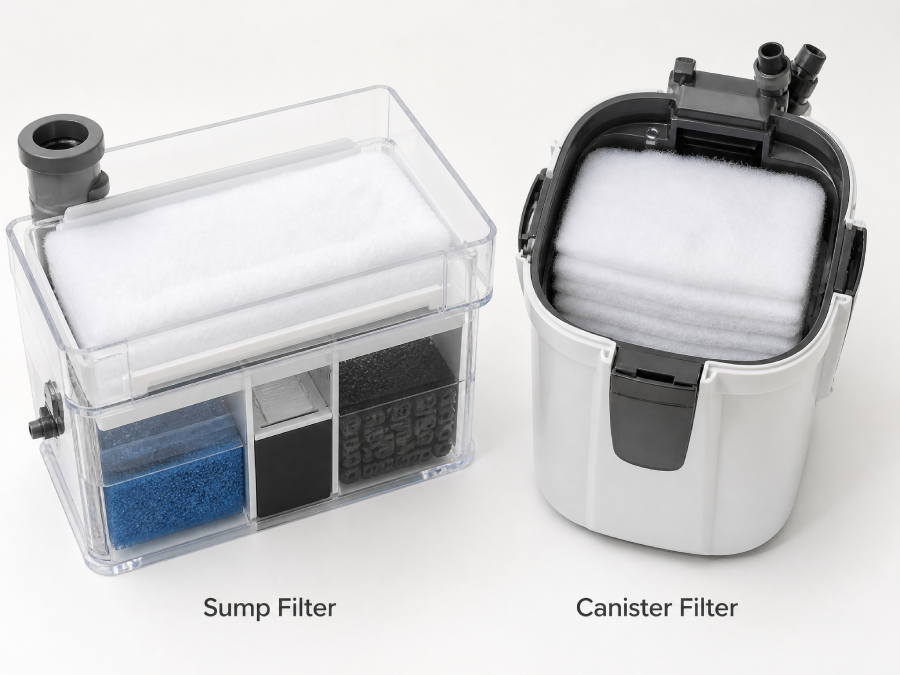
Both sump filters and canister filters can use filter floss for mechanical filtration, but their internal structures and material installation methods are not necessarily the same.
Sump filters generally use filter chambers or compartments to hold different filtration materials. Filter floss may be placed on a designated support structure or laid across a specific filtration area, depending on the equipment design. Buyers should pay attention to the material coverage area, support method, edge positioning, and ease of replacement.
Canister filters usually have an enclosed housing with multiple filter baskets or media compartments. Filter floss needs to fit into the designated position and may be used together with other filtration materials. Its cut dimensions, thickness, layering arrangement, and ease of removal can all affect installation.
Therefore, even if the material composition is the same, one type of polyester aquarium filter floss may not automatically fit both types of filtration equipment.
Comparison | Sump Filter | Canister Filter |
Main installation space | Filter chamber or separate compartment | Filter basket or media compartment inside an enclosed housing |
Material placement | Laid flat, positioned, or secured according to the system design | Cut to size and placed inside a filter basket or designated area |
Dimensions to check | Coverage area, chamber width, and chamber length | Basket length, width, internal height, and cut dimensions |
Support and positioning | Support plates, chamber structure, or other securing designs | Basket edges, layered media structure, or internal supports |
Routine maintenance | Ease of removal, cleaning, or replacement | Ease of opening the housing, removing the baskets, and reinstalling the material |
These are common installation considerations, not universal designs for every sump or canister filter. Actual requirements should be confirmed against the equipment model, structural drawings, and physical installation conditions.
What Installation Conditions Should Buyers Check When Using Filter Floss in Sump Filters?
The filtration compartments in sump systems are often relatively accessible. However, simply being able to place filter floss inside a chamber does not mean the material is properly matched to the equipment.
First, confirm the actual chamber dimensions and material coverage area.
Buyers should check the usable length, width, and available height of the filter installation area. It is important to distinguish between the external dimensions of the chamber and the actual internal space available for the filter material.
If the material is too small, uncovered areas may remain around the edges. If it is too large, it may need to be folded or compressed to fit into the chamber. Either situation may change the intended water flow path.
For a cut-to-size aquarium filter pad, buyers should also confirm that the cut material can remain securely positioned and cover the required filtration area.
Second, check whether the filter floss has adequate support.
Different sump systems may use filter support plates, mesh panels, or other structures. If the filter floss is placed directly on a support surface, buyers should confirm that the structure can hold the material without excessive sagging, curling, or shifting under water flow.
If the equipment is designed to keep the filter material flat, sample testing should confirm whether it can maintain its intended shape after installation. Its appearance in a dry condition alone is not enough to establish suitability.
Third, check for noticeable gaps around the material edges.
If there are large gaps between the filter floss and the inner walls of the chamber, some water may pass through these openings instead of flowing through the filter material.
This is commonly referred to as water bypass. It is not the same issue as the filtration capability of the material itself. Even if the filter floss meets the purchasing specifications, insufficient coverage of the intended filtration area may affect the actual water flow path.
Buyers should therefore check how the material fits against the chamber edges and whether the equipment design requires edge sealing or specific water channels.
Fourth, confirm whether the material is easy to remove and replace.
Filter floss in sump systems usually needs to be inspected, cleaned, or replaced according to its actual operating condition. If the material is oversized, gets stuck in the chamber, or requires other components to be removed before it can be taken out, routine maintenance may become more difficult.
For equipment brands, installation convenience also affects the end user's experience. Sample evaluation should include not only whether the material can be installed, but also whether it can be removed and repositioned through the normal maintenance process.
What Structural Conditions Matter More When Using Filter Floss in Canister Filters?
Canister filters have relatively enclosed internal spaces, and filter floss usually needs to fit into a filter basket or media compartment. In addition to material dimensions, buyers should pay attention to the internal structure and assembly method.
First, confirm the usable dimensions of the filter basket or media compartment.
Buyers should measure the actual space where the filter floss will be placed, rather than relying only on the external dimensions of the canister filter.
Check the basket's internal length, width, available height, and whether the filter floss will prevent the basket from being properly reinstalled.
If cut sheets are used, it is advisable to prepare samples based on the actual basket dimensions before confirming the final cutting size. Canister filters from different brands and models may have different internal designs, so dimensions should not be assumed to be interchangeable simply because the equipment belongs to the same category.
Second, confirm whether the material thickness matches the available internal space.
If the filter floss is too thick, it may need to be excessively compressed to fit inside the basket. If it is too thin, it may not cover the designated area securely according to the equipment design.
However, this does not mean that thicker material is always better or that thinner material is always more suitable for canister filters. Actual suitability depends on the basket structure, material resilience, available installation space, and equipment operating conditions.
Buyers should record both the material thickness before compression and its actual condition after installation. This helps prevent decisions based solely on a single thickness measurement supplied by the manufacturer.
Third, check the layering arrangement and material stability.
Some canister filters place different filtration materials in separate baskets, while others require multiple layers of material inside the same compartment.
If the filter floss needs to be positioned above or below other media, buyers should check whether it is likely to slide, curl, or become noticeably deformed.
If the equipment does not have a dedicated securing structure, testing should also confirm whether the material can remain in its intended position during assembly and operation. The material should not be excessively compressed just to make the basket close properly, as this may change its original structural condition.
Fourth, confirm whether removal and maintenance are affected.
Canister filters need to be opened for maintenance, and their baskets must be removed before the filter material can be accessed. If the filter floss is cut inaccurately, it may become stuck, deformed, or difficult to remove in one piece.
For filter floss designed to be replaced regularly, buyers should include the removal process in sample evaluation rather than checking only whether the material can be installed the first time.
Why Can Gaps Around Filter Floss Affect the Actual Water Flow Path?
The fit between filter floss and the equipment affects not only whether the material can be installed, but also where the water actually flows.
Under the intended installation conditions, water should follow the flow path designed by the equipment manufacturer and pass through the filtration material. However, if the filter floss is incorrectly sized, its edges are not positioned properly, or the material shifts during operation, water may follow a different path.
Water may bypass the material through gaps around its edges.
When noticeable gaps exist between the filter floss and the chamber or basket, some water may take the path of lower resistance instead of passing through the filter material as intended. This can make the actual operating condition different from the equipment's original design expectations.
The material may shift or curl in certain areas.
If the filter floss does not have adequate support or the installation space is unsuitable, it may move, curl at the edges, or become locally deformed during operation. This may change how the material contacts the equipment and could create additional water flow paths.
The material may be excessively compressed.
If the filter floss is too thick and must be forced into the media compartment, its internal structure may change. The degree of compression, material resilience, and available internal space should all be checked through actual sample testing. Suitability should not be determined solely by measuring the material's thickness outside the equipment.
It is important to understand that gaps around the material do not necessarily cause significant filtration problems in every system. Whether water bypass occurs and how much it matters depend on the equipment structure, operating conditions, material condition, and actual installation method.
Buyers should also avoid declaring filter floss defective simply because a visible gap can be seen. A more reliable approach is to install the material in the target equipment, observe its water flow path and operating condition, and then decide whether the dimensions or installation method need adjustment.
How Can Buyers Conduct Sample Compatibility Tests for Sump and Canister Filters?
For equipment manufacturers and filtration media buyers, sample testing should ideally use the actual equipment or a test setup that accurately represents the target equipment structure. Comparing only the appearance, GSM, or thickness of materials on a table cannot fully establish whether they are suitable for a particular filtration system.
Step 1: Conduct an actual installation test.
Install the sample in the filter chamber, basket, or media compartment according to the equipment's normal operating method.
Check whether the material can be installed smoothly, whether excessive folding or compression is required, whether its edges cover the designated area, and whether installation affects the normal closing of baskets, covers, or other components.
Record the sample's cut dimensions, thickness, installation position, and securing method. If the material needs to be cut, retain the cut sample for future comparison.
Step 2: Check water flow under normal operating conditions.
Start the equipment according to the operating conditions recommended by the equipment manufacturer and observe whether water passes through the filtration material as intended.
Pay particular attention to noticeable bypass around the material edges, movement of the material, curling, sagging, and any abnormal conditions related to sample installation.
When comparing samples from different suppliers, use the same equipment, installation position, and comparable operating conditions whenever possible. Results from tests conducted under different conditions should not be compared directly.
Step 3: Observe performance as debris gradually accumulates.
A new sample may operate normally immediately after installation, but this does not guarantee that it will maintain the same condition after being used for a period of time.
As fish waste, uneaten food, and other suspended debris accumulate, the surface and internal condition of the filter floss may change. Under the intended equipment conditions, buyers should observe whether the material develops noticeable deformation, localized blockage, movement, or changes in the water flow path.
The purpose is not to establish one testing duration for every filtration system. Instead, buyers should create repeatable observation conditions based on the target application and record the testing time and material condition.
Step 4: Simulate routine maintenance operations.
Testing personnel should remove the filter floss according to the equipment's normal maintenance procedure. Check whether it can be removed easily, whether it is likely to tear or become deformed, and whether it can be returned to its intended position after reinstallation.
If the product is designed to be cleaned and reused, this requirement must also be verified using the actual cleaning method. The material should not be considered suitable for repeated washing or long-term reuse simply because it still looks intact.
For equipment brands, this step also helps identify whether the material dimensions and structure are suitable for the end user's routine operation.
Step 5: Keep testing records and approved samples.
Buyers should record the equipment brand and model, sample material, GSM, thickness, cut dimensions, installation method, operating conditions, observations after debris accumulation, and maintenance results.
Samples that pass testing should be retained and labeled with identification numbers. They can then serve as references for future specification confirmation and supplier communication.
How Should Compatibility Test Results Be Converted into Final Purchasing Specifications?
After sample testing, buyers should not simply reply by email that the sample is "suitable for use." A more reliable approach is to convert the verified conditions into clear purchasing specifications.
For sump systems, the specification document can record the usable chamber dimensions, filter floss coverage area, material thickness, support method, edge fit requirements, and maintenance conditions.
For canister filters, buyers should focus on the internal basket dimensions, cut dimensions of the filter floss, layering arrangement, thickness requirements, compression condition, and removal requirements.
For both types of equipment, record the material type, GSM, thickness, sample identification number, and testing conditions. If some parameters are still under evaluation, they should be clearly marked as pending confirmation rather than treated as approved specifications.
If the equipment structure, basket dimensions, chamber design, or material specifications change, the original sample testing results should not automatically be considered valid for the new design. Compatibility testing may need to be repeated.
For long-term purchasing projects, buyers should confirm the final approved sample and specification version with the supplier. This helps reduce communication problems caused by different interpretations of dimensions, changes in installation methods, or material adjustments in repeat orders.
As a nonwoven material manufacturer, HuiZhou JinHaoCheng Nonwovens Co., Ltd. was established in 2005 and has long been engaged in nonwoven material R&D and production. The company operates multiple automated production lines and provides OEM/ODM customized manufacturing services. For aquarium filtration material projects, polyester filtration material GSM, thickness, dimensions, and supply options can be discussed according to the customer's equipment structure, reference samples, and application requirements. For different applications, including sump and canister filters, the final material specifications should still be confirmed through actual installation and operating tests with the target equipment.
Conclusion: Filter Floss Suitability Cannot Be Determined by Material Specifications Alone
Although both sump and canister filters can use polyester filter floss, their internal installation spaces, support structures, securing methods, and maintenance procedures may differ. Therefore, buyers should not assume that one material specification will work for every filtration system.
When selecting aquarium filter media, buyers should check not only the material type, GSM, and thickness, but also the actual installation dimensions, edge fit, material stability, and water flow path during operation.
For equipment manufacturers, importers, and OEM customers, the most reliable approach is to conduct sample installation, operating observation, debris accumulation testing, and maintenance evaluation using the target equipment. The conditions that pass testing can then be included in the final purchasing specifications.
Confirm the equipment structure first, verify material compatibility through testing, and then finalize the bulk purchasing parameters. This process helps both buyers and suppliers determine more clearly whether the product meets the requirements of its intended application.




