How Much Water Can Anti-Condensation Felt Hold Before It Drips?
When purchasing anti-condensation felt, buyers often want to know how much water the material can absorb per square meter and how long it takes to dry. These factors can help assess whether the material is suitable for a metal roofing project.
However, there is no single water-holding capacity or drying time that applies to every product and environment. Performance depends on the test method, material structure, humidity, temperature, airflow, and the rate at which condensation forms.
For metal roofing manufacturers, steel-structure contractors, and overseas building-material buyers, the key is not simply to look for a high water-absorption figure, but to understand how that figure was measured, what it represents, and whether it can help assess performance in a real roofing application.
Is There a Fixed Water-Holding Capacity for Every Anti-Condensation Felt?
No. Different anti-condensation felt products may produce different results under different test conditions. Before comparing figures, buyers should understand what each measurement actually represents.
Measurement | What It Means | What Buyers Should Know |
Water absorption capacity | The amount of water a material can absorb under specified test conditions | The test method and endpoint must be clearly defined |
Water absorption by mass (g/g) | The mass of absorbed water relative to the dry mass of the material | This helps compare absorption relative to material weight, but does not directly indicate absorption per square meter |
Water absorption per square meter (g/m²) | The amount of water absorbed by a specified area of material | The sample area, test conditions, and calculation method should be consistent |
Water absorption rate | How quickly the material absorbs water during a specified period | A material that absorbs water quickly does not necessarily have a higher total absorption capacity |
Drying time | The time required for the material to release moisture and reach a defined drying endpoint under specified conditions | Temperature, relative humidity, airflow, initial moisture content, and the drying endpoint can all affect the result |
It is also important to distinguish GSM (grams per square meter) from water absorption capacity. GSM describes the mass of the material per unit area. It does not indicate how much water the felt can absorb.
A higher GSM does not automatically mean that a product has a proportionally higher water absorption capacity. Buyers should evaluate the actual absorption data and test conditions rather than relying on material weight alone.
How Should Buyers Read Water Absorption Test Data?
Water absorption figures are meaningful only when buyers understand how they were obtained. Different test methods may produce different results, even when the samples appear similar.
Test Information | What Buyers Should Check |
Sample specifications | Confirm the product model, material structure, GSM, thickness, and sample dimensions |
Water contact method | Determine whether the sample was fully immersed, sprayed, exposed to dripping water, or tested through one-sided contact |
Test duration | Check how long the sample was exposed to water before the result was recorded |
Temperature | Confirm the temperature during the test |
Pressure and contact conditions | Check whether pressure was applied and how the water contacted the sample |
Calculation method | Confirm how the absorbed water was measured and whether the result is expressed by mass or by area |
Repeat tests | Ask whether the result was repeated and whether the measurements were consistent |
Units | Confirm that the results use the same units before comparing different products |
For example, a sample tested by full immersion may produce a different result from one exposed to condensation droplets on a single surface. These methods do not necessarily represent the same conditions as those found beneath a metal roof.
Buyers should therefore ask suppliers to explain the test method and compare samples under the same conditions whenever possible. Different water-contact methods may produce different results, so a higher figure alone does not prove that one product will perform better in an actual roofing application.
Why Doesn't High Water Absorption Capacity Guarantee Drip-Free Performance?
A high water absorption capacity does not automatically mean that a roof will remain free of dripping. Several factors can affect performance.
The rate of condensation may exceed the material's ability to manage moisture.
If condensation forms faster than the felt can absorb and redistribute the moisture, water may accumulate on the material's surface or exceed its available absorption capacity.
The material may not have enough time to dry.
Anti-condensation felt needs suitable conditions to release absorbed moisture. If condensation repeatedly forms before the material has dried sufficiently, moisture can accumulate over time.
Laboratory results may differ from actual roofing conditions.
A laboratory test uses defined conditions, while a real roof may experience changing temperatures, humidity levels, airflow, and condensation rates. A test result should not be treated as a guarantee of performance under every environmental condition.
Material performance is not the same as the performance of the entire roofing system.
Roof design, installation, ventilation, and environmental conditions can all influence moisture behavior. The absorption data of the felt should therefore be considered alongside the conditions in which it will be used.
Anti-condensation felt can temporarily absorb condensation and release moisture when conditions allow. It should not be regarded as a permanent water-storage material or as a guarantee against dripping in every situation.
Therefore, when evaluating anti-condensation felt, buyers should consider absorption data, actual environmental conditions, and drying conditions together rather than selecting a product solely because it has the highest stated absorption capacity.
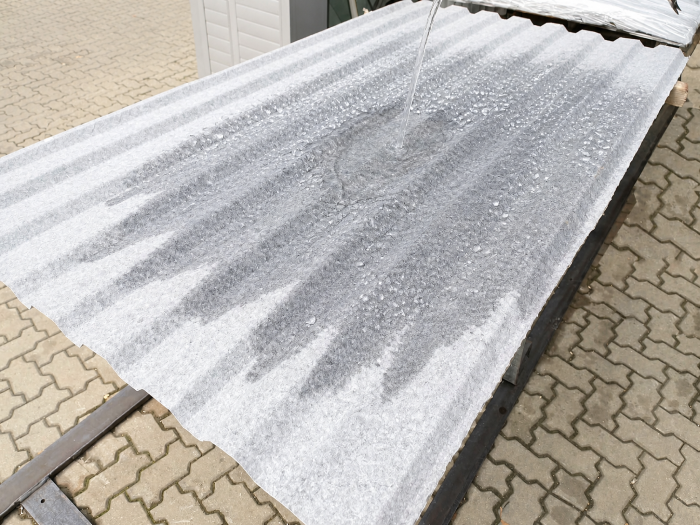
What Determines the Drying Time of Condensation Fleece?
The condensation fleece drying time depends on both the material and the conditions in which it dries. A drying-time figure is useful only when the test conditions and the definition of “dry” are clearly stated.
Factor | How It Can Affect Drying |
Relative humidity | Higher relative humidity may slow moisture release into the surrounding air |
Temperature | Temperature affects evaporation and can change the rate at which moisture leaves the material |
Airflow | Air movement can help carry moisture away from the material surface |
Initial moisture content | A sample containing more water at the beginning of a drying test may require more time to reach the specified endpoint |
Material structure and thickness | Fiber structure, material thickness, and other product characteristics may influence moisture retention and release |
Installation and operating conditions | Conditions beneath a metal roof may differ from controlled laboratory conditions |
Drying endpoint | Different definitions of “dry” can produce different drying-time results |
For example, a sample dried under controlled conditions with good airflow may reach the specified endpoint sooner than a sample in a humid, poorly ventilated environment. This does not necessarily mean that the two samples have different material quality; the drying conditions themselves may explain the difference.
When reviewing condensation fleece drying time, buyers should ask how much water was present at the beginning of the test, what environmental conditions were used, and how the end of the drying period was determined.
Without this information, drying-time figures from different suppliers may not be directly comparable.
How Can Buyers Compare Water Absorption and Drying Test Results?
When comparing anti-condensation felt products, buyers should review the complete test basis instead of comparing a single number. The following table can be used to organize supplier information.
Comparison Item | Information to Record |
Product model | The exact product or specification being tested |
Material structure | The material composition and relevant structural characteristics |
GSM | The mass per square meter of the material |
Sample area and thickness | The dimensions and thickness of the test sample |
Test method | The procedure used to measure water absorption |
Temperature | The temperature during the absorption test |
Relative humidity | The humidity during the test, where applicable |
Water-contact conditions | How water was applied to or contacted the sample |
Test duration | The time allowed for water absorption |
Absorption result and unit | The measured result, with its unit clearly stated |
Drying conditions | The temperature, humidity, airflow, and other relevant conditions during drying |
Drying endpoint | The criterion used to determine when drying was complete |
Drying time | The time required to reach the specified endpoint |
Repeat results | Whether repeated tests produced consistent results |
Relevance to the actual roof | Whether the test conditions reasonably represent the intended application |
Further validation | Whether additional testing is needed before bulk purchasing |
This comparison helps buyers identify whether supplier data is genuinely comparable. If two suppliers use different sample dimensions, water-contact methods, or drying conditions, their results should not be treated as directly equivalent without further evaluation.
When absorption and drying performance may affect project outcomes, buyers should identify the performance requirements that need to be verified and determine how the test results will be assessed against those requirements.
What Should Buyers Ask Suppliers to Validate Before Bulk Purchasing?
Before placing a bulk order, buyers should confirm the basis of the reported performance data and determine whether the product is suitable for the intended roofing application.
First, ask the supplier to clarify the test method, measurement units, and conditions used to obtain the water absorption figures. This helps prevent misunderstandings about what the numbers actually represent.
Second, confirm the drying conditions and the endpoint used to determine drying time. A drying-time figure without this information may be difficult to interpret or compare.
Third, check whether the tested sample represents the product that will be supplied in bulk. Product specifications, material structure, and relevant production requirements should be confirmed before order approval.
Fourth, assess whether the test conditions are representative of the intended application. If the project environment differs significantly from the laboratory conditions, additional validation may be necessary.
Finally, agree on the performance requirements and acceptance criteria before production whenever these characteristics are important to the project. Clear requirements make it easier for both the buyer and supplier to understand what needs to be verified.
When Should a Roofing Project Require Further Validation?
Further validation may be necessary when a project has specific moisture-management requirements or when standard test results cannot adequately represent the intended operating conditions.
This is particularly relevant when the roof is exposed to persistently high humidity, condensation occurs repeatedly, or the project requires defined absorption and drying performance.
Additional evaluation may also be appropriate when the actual installation conditions differ from the supplier's test environment, or when buyers need to verify consistency across bulk production.
In these situations, buyers should not rely on a single absorption figure or drying-time estimate. The test method, environmental conditions, product specifications, and project requirements should be reviewed together to determine whether further testing is needed.
Conclusion
There is no single water absorption capacity or drying time that can predict when every type of anti-condensation felt will begin to drip. The result depends on how the material is tested, how much moisture it receives, and whether the surrounding conditions allow it to dry.
For buyers evaluating anti-condensation felt absorption capacity, the practical approach is to confirm how the data was measured, compare products under consistent conditions, understand the drying-test criteria, and validate the results against the intended roofing application.
A clearly defined test basis provides a more reliable foundation for supplier comparison and bulk purchasing decisions than a high absorption figure alone.