
Anti-Condensation Felt for Corrugated Steel Roofing: Profile Fit and Material Compatibility
Self-adhesive PET anti-condensation felt can be considered for corrugated steel roofing and trapezoidal metal roofing sheets. However, the fact that a product is described as corrugated or profiled metal roofing does not automatically mean that the felt will fit every panel profile.
Different roofing sheets may have different crest heights, pitch distances, valley widths, side angles, and effective coverage widths. These structural differences can affect the actual coverage area, cutting dimensions, bonding contact, and subsequent production methods of the felt.
For roofing panel manufacturers, steel structure contractors, and building material buyers, the key question is not simply whether the material can stick to a piece of metal. It is whether the material can be properly matched to the actual roof profile and production requirements.
Before placing a bulk order, buyers should confirm the roof panel cross-section, required coverage area, metal surface condition, and actual processing method. The fit should then be checked using a sample of the corresponding roofing sheet.
What Is the Difference Between Corrugated Steel Roofing and Trapezoidal Metal Roofing?
Corrugated steel roofing and trapezoidal metal roofing are both types of profiled metal sheets, but their cross-sectional shapes are different.
Corrugated steel roofing typically has a series of continuous curved waves, consisting of repeated crests, valleys, and connecting sections. Trapezoidal metal roofing usually has a more angular profile, with relatively flat sections, inclined sidewalls, and regularly shaped raised sections.
There are also metal roofing sheets with different profile heights, pitch distances, reinforcing ribs, or special structural designs. Even when two products are both described as corrugated roofing, their actual cross-sectional dimensions may be very different.
For anti-condensation felt for corrugated steel roofing, buyers should not select a material based only on the roofing sheet's product name.
Roofing sheet type | Typical profile features | What buyers should check |
Corrugated steel roofing | Continuous curved crests and valleys | Crest height, pitch distance, curved profile, and actual contact areas |
Trapezoidal metal roofing | Flat sections, inclined sides, and trapezoidal raised sections | Side angle, top width, bottom width, and groove dimensions |
Metal roofing with reinforcing ribs | Additional small ribs or grooves within the main profile | Whether the local structures affect material coverage and continuous contact |
Special profiled metal sheets | Different cross-sections designed for specific projects | Actual cross-sectional drawings or physical samples are required for evaluation |
If buyers provide only the product name of the roofing sheet, the supplier may not have enough information to determine which areas the felt needs to cover.
When requesting a quotation, buyers should therefore provide a cross-sectional drawing, product photographs, or a physical roofing sheet sample. For roofing sheets with established production models, it is also helpful to provide the profile dimensions and drawing revision to avoid using different panel versions during sample approval.
Why Does the Roof Panel Profile Affect Anti-Condensation Felt Fit?
Self-adhesive PET anti-condensation felt generally consists of needle-punched PET nonwoven material with a self-adhesive backing. It is designed to be applied to the inner surface of compatible metal roofing sheets.
However, the cross-section of a metal roofing sheet is not necessarily flat. When the material needs to cover a surface with continuous raised and recessed sections, its actual fit depends on both the profile geometry and the structure of the material itself.
First, the crests and valleys have different heights. The material needs to accommodate the actual profile and cover the required areas. The evaluation should not be based only on the flat width of the roofing sheet.
Second, inclined and curved sections affect how the material contacts the metal surface. Different profiles may result in different local contact conditions. Therefore, the bonding performance observed on a flat sample cannot automatically represent the result on an inclined or curved section.
Third, some roofing sheets have reinforcing ribs, edge structures, or overlapping sections. Whether these areas need to be covered should be determined by the panel design and actual application requirements.
Buyers should distinguish between two different things: the material can stick to a metal surface and the material can cover the required areas of a profiled roofing sheet as intended.
For example, a flat metal sheet may be suitable for an initial bonding check, but it cannot fully represent the fit of the material on a roofing sheet with multiple crests and valleys.
When evaluating self-adhesive PET roofing felt, buyers should therefore use the actual roofing profile as the basis for assessment rather than relying only on the fact that the material has a self-adhesive backing.
Where Should Self-Adhesive PET Anti-Condensation Felt Be Applied on a Roofing Sheet?
For metal roofing applications, anti-condensation felt is generally considered for application to the side of the roofing sheet facing the building interior, which is the inner surface of the metal panel.
However, the actual coverage area needs to be determined according to the roofing sheet design and project requirements.
Some buyers may want the material to cover most of the inner surface of the roofing sheet. Other projects may require coverage only in designated areas, depending on the panel profile, production method, and application design.
Without clearly defined project requirements, buyers should not automatically assume that the felt must cover every crest, valley, sidewall, and edge.
The following details should be confirmed first.
Confirm the required coverage area
Buyers should clarify whether the material needs to cover the entire specified inner surface or only selected flat or local areas. Different coverage requirements will directly affect the required material width and cutting plan.
Confirm the panel orientation and profile direction
The orientation of the roofing sheet during production, transportation, and installation may affect material processing and application arrangements. The actual production or installation condition should be used as the reference.
Confirm whether certain structural areas need to remain uncovered
For example, some edges, overlapping sections, fixing structures, or other processed areas may need to be left clear according to the roofing sheet design. Increasing the coverage area should not take priority over these structural requirements.
Confirm the contact between the adhesive backing and the metal surface
The material needs to contact the metal in the areas specified by the design. If there are differences in coating, surface treatment, or other local conditions, these areas should be checked separately during sample evaluation.
The application position should therefore be determined by the roofing profile and product design together, rather than by cutting the felt according to the total width of the metal sheet alone.
What Should Buyers Check on the Crests, Valleys, and Flat Sections?
Different areas of corrugated or trapezoidal metal roofing have different geometries. Their material fit should therefore be checked separately.
Crest areas
The crest is the raised section of the roofing profile. Buyers should confirm whether the material needs to cover the top of the crest and whether it can follow the actual curve or top profile as required.
If the crest is narrow or has a pronounced change in profile, the material's performance on a flat surface should not be used to predict its fit on the crest.
Valley areas
The valley is the recessed section of the roofing profile. Buyers should confirm whether the material needs to extend to the bottom of the valley and whether it can reach the required position according to the design.
For roofing sheets with deep valleys or different valley widths, the actual coverage area deserves particular attention. Without physical sample verification, suppliers should not promise that the material will fully fit every recessed section.
Inclined or curved sections
The connecting areas between crests and valleys may be inclined surfaces or continuous curves. Different profile shapes can affect how the material contacts the metal surface.
If these areas need to be covered, buyers should check the actual roofing sheet sample for local lifting, wrinkles, insufficient coverage, or other conditions that do not meet the project requirements.
Flat sections
Flat sections are generally easier to use for an initial bonding check. However, successful bonding on a flat section does not mean that the entire profiled surface has been properly matched.
Buyers can use flat areas for basic inspection while also checking the crests, valleys, and connecting sections. This helps avoid making a decision based on only one part of the roofing sheet.
Roofing sheet area | What to check | What should not be assumed |
Crest | Top width, curve or profile shape, and actual coverage | The material will automatically cover every crest completely |
Valley | Recess depth, bottom width, and whether the material reaches the required position | The material will automatically fit every deep groove |
Inclined or curved section | Contact condition, local lifting, wrinkles, and coverage continuity | Flat-surface bonding results represent the performance on inclined surfaces |
Flat section | Bonding contact, material position, and surface condition | A flat-surface test can replace verification of the complete profile |
The final objective is to confirm whether the material meets the project's requirements for positioning, fit, and processing within the intended coverage area, rather than assuming that every roofing profile can use exactly the same application method.
How Should Buyers Determine the Felt Width and Cutting Dimensions?
Material width is an important detail that can easily be overlooked when purchasing felt for profiled metal roofing.
The overall width of a roofing sheet, its developed width, and its effective coverage width after installation are not necessarily the same. For metal sheets with crests and valleys, the actual coverage requirement may also differ from the flat projected width of the panel.
If buyers determine the felt width using only the nominal roofing sheet width, the material may not correspond accurately to the required coverage area.
The following points should be considered.
First, confirm how the roofing sheet width is defined
Buyers should distinguish between the overall width, effective coverage width, and relevant dimensions used during production. For products with side-lap structures, it is particularly important to clarify which dimension the felt width should correspond to.
Then, confirm the required material coverage area
If the material needs to cover the entire specified inner surface of the roofing sheet, its dimensions should be determined according to the actual profile and coverage requirements.
If only selected areas need to be covered, the starting and ending positions should be clearly defined. This helps avoid unnecessary cutting caused by excessive material width or insufficient coverage caused by a narrow roll.
Confirm whether the material will be applied continuously or cut into sections
Some production arrangements may use continuous rolls, while others may require the material to be cut according to the roofing sheet length or designated areas.
For continuous coverage, buyers need to consider material width, roll direction, and the processing conditions of the production equipment. For sectional application, the dimensions, positions, and joint arrangements of each piece should be confirmed.
Consider the edges and overlapping areas
If the roofing sheet has side laps, folded edges, or special structural sections, buyers should clarify whether these areas are included in the felt coverage area.
It should not be assumed that the material needs to cover every metal edge or that all overlapping areas are suitable for direct application.
For customized orders, buyers are advised to mark the required coverage area on the same drawing as the roofing sheet cross-section. The material width, cutting dimensions, and roll specifications can then be confirmed with the supplier.
This is more reliable than providing only one nominal roofing sheet width.
Do Roofing Sheet Coatings and Surface Conditions Affect Adhesion?
Yes. Whether self-adhesive anti-condensation felt can achieve the required bonding condition depends not only on the adhesive backing, but also on the metal substrate and its surface condition.
Different roofing sheets may have galvanized surfaces, painted coatings, or other surface treatments. Even when two products use steel as the base material, their coatings and surface treatment processes may differ.
Therefore, buyers should not assume that all steel sheets, aluminum sheets, or pre-painted metal sheets provide the same bonding conditions.
The following information should be checked.
Metal substrate and surface coating
Buyers should identify the metal substrate and confirm whether the surface has a galvanized layer, paint coating, or other treatment. If the specific coating type or product model is available, it should also be provided.
Oil, dust, or other surface residues
Oil, dust, processing residues, and other contaminants on the metal surface may affect contact between the adhesive layer and the substrate.
Sample evaluation should therefore use a surface condition that is as close as possible to the actual production or installation condition, rather than relying only on an ideally cleaned sample.
Local differences in the roofing sheet surface
If different areas of the same roofing sheet have different surface treatments or local coating variations, buyers should identify the areas where the anti-condensation felt needs to bond.
Confirm the applicable bonding conditions
For a specific project, bonding compatibility should be evaluated according to the actual metal surface, adhesive type, application temperature, and processing method. Where necessary, the material supplier and roofing sheet manufacturer should jointly confirm the sample evaluation requirements.
It is important to understand that initial bonding performance does not automatically prove long-term bonding stability. Specific bonding requirements should be determined according to the project application and actual verification conditions.
The adhesive function of anti-condensation felt is also different from the waterproofing performance of the metal roofing sheet itself. Applying felt to the inner surface of a roofing sheet does not mean that it can replace the roof panel's laps, fasteners, or other waterproofing structures.
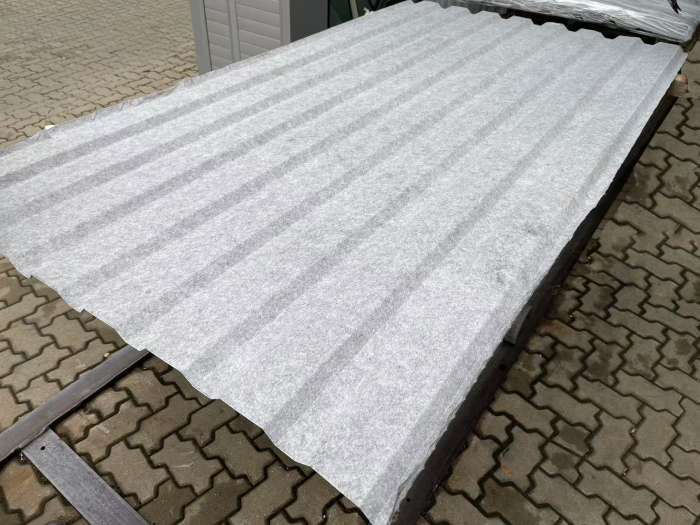
How Can Buyers Verify the Fit Using Actual Roofing Sheet Samples?
For corrugated steel and trapezoidal metal roofing, buyers are advised to verify the fit using actual roofing sheet samples before confirming bulk specifications.
Testing only on a flat metal sheet cannot adequately represent the actual fit on a profiled surface.
A practical approach is to prepare a representative section of the roofing sheet and retain the surface coating and profile structure used in the actual project wherever possible.
Sample evaluation can follow these steps.
Step 1: Confirm that the roofing sheet sample matches the drawing
Check the profile shape, crest height, pitch distance, valley width, and surface condition. If the sample is not the same model as the final production roofing sheet, the differences should be clearly identified.
Step 2: Confirm the felt material structure
Check whether the PET material structure, self-adhesive backing, GSM, thickness, and width of the sample match the intended purchasing requirements.
If the supplier provides a sample with a different material structure or specification, its test results should not automatically be applied to another product.
Step 3: Apply the material according to the intended coverage plan
Determine the material starting position, coverage area, and cutting dimensions based on the roofing sheet drawing. Apply the material using the method planned for the project rather than testing only the easiest flat area.
Step 4: Inspect each profile section separately
Check the crests, valleys, inclined surfaces, and connecting areas. Observe whether the material reaches the intended coverage positions and whether there is any unacceptable lifting, wrinkling, shifting, or local lack of contact.
Step 5: Check the bonding condition between the material and metal surface
Inspect the bonding condition on the specified metal surface according to the project requirements. For projects with defined bonding requirements, the inspection method and acceptance criteria should be agreed upon in advance rather than judged by touch alone.
Step 6: Confirm whether the intended production method is feasible
If the material will be laminated during continuous roll forming, further verification should be carried out under the actual equipment and process conditions. A manually applied sample is useful for preliminary inspection, but it does not automatically represent the result of continuous production.
Buyers should keep sample photographs, roofing sheet drawings, material specifications, and evaluation records as reference documents for subsequent production and repeat orders.
What Dimensions and Production Conditions Should Be Confirmed Before Bulk Production?
For roofing sheet manufacturers, anti-condensation felt may need to work together with the metal sheet processing process, rather than simply being applied manually to a finished roofing panel.
In this case, material width, roll direction, application position, and production equipment conditions may all affect the actual application.
Before bulk production, buyers should confirm the following information.
Item to confirm | Information to provide or check | Purpose |
Roofing sheet model | Product model, cross-sectional drawing, and drawing revision | Ensure the material is developed for the correct panel profile |
Profile dimensions | Crest height, pitch distance, valley width, and other relevant dimensions | Evaluate the coverage area and fit requirements |
Roofing sheet width | Overall width, effective coverage width, and relevant dimension definitions | Determine material width and cutting method |
Surface condition | Metal substrate, coating type, and surface cleanliness | Evaluate adhesive compatibility |
Material specification | PET material structure, GSM, thickness, and width | Fix the sample and bulk production specifications |
Adhesive structure | Self-adhesive backing and corresponding bonding requirements | Confirm whether the material structure meets project needs |
Production method | Manual application, pre-lamination, or continuous roll forming | Evaluate the actual processing conditions |
Equipment conditions | Relevant equipment requirements and processing limitations | Confirm whether the material is suitable for the production process |
Sample results | Application photographs, inspection records, and approval results | Establish a reference for bulk production and repeat orders |
If continuous roll-forming production is planned, buyers should explain at which production stage the material will be introduced and what requirements the equipment has for roll width, running direction, and material condition.
If the felt will be applied to finished roofing sheets, the application method, panel surface condition, and material cutting requirements should be confirmed instead.
These two production arrangements do not have exactly the same verification priorities. The same sample evaluation result should not automatically be used to represent both methods.
For long-term purchasing projects, buyers should also keep the approved roofing sheet drawing revision, material specifications, samples, and acceptance requirements. If the roofing sheet model, surface coating, or production process changes later, the original compatibility assessment should be reviewed again.
Frequently Asked Questions
Can self-adhesive PET anti-condensation felt be used on all corrugated steel roofing sheets?
This cannot be assumed.
Different corrugated steel roofing sheets may have different crest heights, pitch distances, valley shapes, and surface coatings. Material suitability needs to be evaluated according to the actual profile, bonding surface, coverage requirements, and production method.
Can the same anti-condensation felt be used for corrugated steel and trapezoidal roofing sheets?
The same material type may be suitable for both applications, but this does not mean that the same width, cutting dimensions, and application plan can be used directly.
The actual profile and project requirements of each roofing sheet should be checked separately.
Does anti-condensation felt need to cover every crest and valley?
Not necessarily.
The required coverage area depends on the roofing sheet design, material application requirements, and production arrangement. Buyers should define the intended coverage area before determining the material width and cutting method.
If the material bonds well to a flat metal sheet, does that mean it is suitable for corrugated roofing?
No.
A flat metal sheet can provide an initial check of the bonding condition between the material and metal surface. It cannot fully represent the actual fit on the crests, valleys, and inclined sections of a profiled roofing sheet.
The material should be verified using a sample of the corresponding roofing sheet model.
Can self-adhesive PET anti-condensation felt be applied directly to pre-painted steel sheets?
This cannot be determined from the term pre-painted steel alone.
Different coatings, surface treatments, and cleanliness conditions may affect adhesive compatibility. Buyers are advised to provide an actual sheet sample and confirm the surface conditions and bonding requirements before deciding whether the material is suitable.
Do continuous roll-forming production and manual application require the same sample verification?
Not completely.
Manual application can provide an initial check of material coverage and surface bonding. Continuous roll-forming production also requires consideration of the actual equipment, material running direction, and processing conditions. Further production verification may be necessary.
What should buyers provide when requesting a quotation?
Buyers should ideally provide the roofing sheet cross-sectional drawing, panel model, surface coating information, required coverage area, material width requirements, and planned application or production method.
If an actual roofing sheet sample is available, it should also be provided. Information that reflects real production conditions helps the supplier evaluate material specifications and propose an appropriate sample verification plan.
Conclusion: Confirm the Roofing Sheet Profile Before Selecting the Anti-Condensation Felt
Corrugated steel roofing and trapezoidal metal roofing can be considered for self-adhesive PET anti-condensation felt applications. However, one material specification should not be assumed to fit every roofing profile.
Buyers should first check the crests, valleys, inclined sections, and effective coverage width of the roofing sheet. They should define the required material coverage area and then evaluate bonding and fit according to the metal substrate, surface coating, and actual processing method.
For roofing sheet manufacturers, material width, roll specifications, production equipment conditions, and sample evaluation results should also be confirmed before bulk production. A successful application on a flat metal sheet alone is not sufficient to approve a production solution.
Founded in 2005, HuiZhou JinHaoCheng Nonwovens Co., Ltd. has more than 20 years of experience in nonwoven material research, development, and manufacturing. The company has manufacturing capabilities in needle-punched nonwoven materials and related laminating processes. Customized requirements for self-adhesive PET anti-condensation felt, including GSM, thickness, width, roll length, and related specifications, can be discussed according to individual project requirements. The specific material structure and processing solution still need to be confirmed against the product requirements.
If you are sourcing self-adhesive PET anti-condensation felt, it is recommended to provide the roofing sheet cross-sectional drawing, actual panel sample, required coverage area, and production method when making an inquiry. Confirming the material dimensions and fit requirements using the actual roofing profile is more reliable than selecting a product based only on the roofing sheet name or material GSM.




