
Why Dense Needle Punched Felt Can Feel Different at the Same GSM
When sourcing dense needle punched felt, importers, wholesalers, product manufacturers, and industrial buyers may notice that two materials with the same GSM can feel very different. One may feel firmer and more compact, while the other may feel softer, looser, or more flexible.
Why does this happen if both materials have the same stated weight per square meter?
The answer is that GSM is only one part of a material’s specification. Fiber composition, fiber fineness, fiber web structure, needle punching, consolidation, and finishing can all affect the final feel and structure of needle punched felt.
For buyers, the important question is not simply which sample feels denser. It is how to understand these differences, compare samples fairly, and establish clear acceptance criteria that can be maintained during bulk production.
This guide explains the main factors that influence the feel of needle punched felt and provides practical advice for evaluating samples and improving consistency between orders.
1. Why Can Needle Punched Felt with the Same GSM Feel Different?
GSM stands for grams per square meter. It describes the weight of a material per unit of area, but it does not directly describe its thickness, density, firmness, or surface feel.
Two needle punched felt samples can have the same GSM while differing in their internal fiber structure.
For example, one sample may have a relatively open fiber structure and feel soft or fluffy. Another may have a more consolidated structure and feel firmer or more compact.
These differences do not necessarily mean that one sample is better than the other. The more suitable material depends on the requirements of the finished product.
When comparing high density felt or other technical felt materials, buyers should therefore consider more than the weight shown on the specification sheet.
GSM is a useful starting point, but it should not be treated as a complete description of the material.
2. How Do Fiber Composition and Fiber Fineness Affect Hand Feel?
The fibers used in needle punched felt are one factor that can influence the finished material’s characteristics.
Different fiber types can have different levels of flexibility, resilience, stiffness, and surface characteristics. Fiber fineness can also affect how the fibers interact and how the material feels when handled.
As a result, two materials with the same GSM may feel different even when their overall weight is similar.
However, fiber composition and fineness are not the only factors that determine hand feel. The final structure also depends on how the fibers are distributed and consolidated during production, as well as any finishing treatments applied afterward.
For buyers, this means that simply requesting the same GSM does not guarantee that different suppliers will provide materials with identical hand feel.
When a specific feel is important to the final product, communicate your requirements to the supplier and evaluate them against physical samples rather than relying on GSM alone.
3. How Does Fiber Web Structure Affect the Compactness of Needle Punched Felt?
Before needle punched felt becomes a finished material, the fibers form a web that serves as the basis for the final structure.
The distribution and arrangement of fibers within this web can affect the appearance, thickness, and feel of the finished felt.
If the fiber distribution differs between two materials, the samples may feel different even when their GSM is similar.
For example, a material with a relatively open structure may feel softer or loftier, while a more consolidated structure may feel firmer.
The overall appearance and hand feel can provide useful initial information, but they cannot reveal every detail of the internal structure. Touch alone is not enough to determine whether the fibers are evenly distributed throughout the material.
For procurement purposes, buyers should consider both the physical sample and the relevant specifications. If structural uniformity is important to the application, it should be included in the supplier’s sample evaluation and quality requirements.
4. How Do Needle Punching and Consolidation Affect Material Firmness?
Needle punching mechanically entangles fibers to form a more stable nonwoven structure.
The degree of fiber entanglement and consolidation can influence the compactness, thickness, flexibility, and surface characteristics of needle punched felt.
Consequently, materials with the same GSM may have different levels of firmness because their fiber structures and consolidation conditions are not identical.
However, a firmer material is not automatically better.
A product that requires a soft, flexible structure may not benefit from excessive consolidation. Another application may require a more compact material to meet its handling or processing requirements.
The correct structure depends on the intended use of the finished product.
When requesting samples, buyers should explain whether they need a soft, flexible, firm, or compact material. This helps the supplier understand the target characteristics more clearly and reduces the risk of approving a sample that does not suit the final application.
5. How Can Finishing Treatments Change the Feel of Needle Punched Felt?
The final feel of needle punched felt can also be affected by finishing and additional processing.
Depending on the product requirements, finishing may include calendering, heat treatment, lamination, coating, or other surface treatments.
These processes can change the surface appearance, firmness, thickness, or overall structure of the finished material.
For example, two samples made from similar fibers and with the same GSM may feel different if they have undergone different finishing treatments.
This is particularly important when buyers compare samples from different suppliers. A difference in hand feel does not necessarily mean that the fiber composition or GSM is different; the finishing method may also contribute to the result.
If your finished product requires a particular surface appearance or level of firmness, make sure the approved sample reflects the intended finishing conditions.
The relevant processing and finishing requirements should also be recorded so that they can be referenced during repeat orders.
6. Why Is Hand Feel Not an Accurate Measurement of Material Density?
Hand feel is useful for an initial comparison, but it is subjective. Different people may describe the same material differently, using terms such as soft, firm, compact, stiff, or dense.
More importantly, these descriptions are not precise measurements of density.
In technical terms, density relates to mass per unit volume. GSM, by contrast, refers to mass per unit area. Thickness and density are related to the material’s structure, but they are not interchangeable specifications.
A material that feels firmer is not necessarily denser by a measurable amount. Likewise, a material that feels softer is not automatically less dense.
If your application requires a specific density, buyers should agree with the supplier on the measurement method and acceptance range rather than relying on touch alone.
If the requirement is mainly about hand feel, use a clearly identified reference sample and written descriptions to help standardize the evaluation.
This distinction is important when purchasing technical felt for applications where material consistency matters.
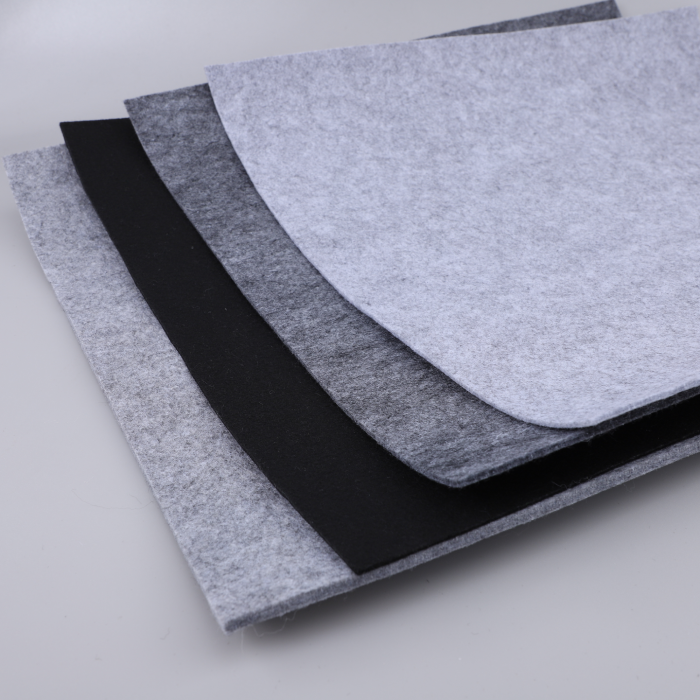
7. How Should Buyers Compare Needle Punched Felt Samples from Different Suppliers?
When comparing samples, buyers should establish a consistent basis for evaluation instead of judging each material independently.
Start by confirming the available information for each sample, including GSM, fiber composition, thickness, surface treatment, and other relevant specifications.
Then compare the samples under consistent inspection conditions.
Pay attention to the following aspects:
Hand feel: Does the material match the required softness, firmness, or compactness?
Thickness: Does the measured thickness meet the intended requirement when tested under an agreed method?
Surface appearance: Is the surface consistent with the approved appearance and texture?
Structure and uniformity: Are there visible differences in thickness, surface texture, or fiber distribution?
Downstream processing: Can the material be cut, laminated, die-cut, sewn, or processed as required for the finished product?
Application performance: Does the sample meet the actual requirements of the final product?
A sample that feels more compact is not necessarily the most suitable option. It must also meet the relevant specifications and processing requirements.
For fair supplier comparisons, record the results for each sample rather than relying only on memory or informal descriptions.
8. How Can Buyers Establish Repeatable Acceptance Criteria for Bulk Orders?
Approving one sample is only the beginning of quality control. For repeat purchasing, the more important task is ensuring that future production batches remain consistent with the agreed requirements.
A practical approach is to establish a documented reference standard before placing a bulk order.
First, approve a reference sample.
Keep a clearly identified sample that both the buyer and supplier agree represents the required material characteristics.
Second, record the key specifications.
Depending on the product, these may include GSM, thickness, fiber composition, width, surface appearance, finishing method, and any other essential requirements.
Third, define the inspection method.
If thickness, density, or another measurable property is important, agree on how it will be measured and what tolerance is acceptable. If hand feel is important, describe the target characteristics and compare production samples with the approved reference.
Fourth, maintain batch records.
Identify the approved sample and the relevant specifications so that future orders can be compared against the same standard.
Fifth, agree on how changes will be handled.
If the fiber composition, finishing treatment, or another important production condition needs to change, establish a process for communicating and approving that change.
These steps help both parties evaluate whether a new batch meets the agreed requirements. They also reduce misunderstandings caused by subjective descriptions such as “slightly harder” or “more compact.”
9. What Information Should Buyers Provide When Requesting Needle Punched Felt?
If you need a specific level of compactness or hand feel, providing only the product name and GSM may not give the supplier enough information to understand your requirements.
When requesting a quotation or sample, provide as many of the following details as possible:
Target GSM: The required weight per square meter.
Fiber composition: The preferred fiber type or blend, if known.
Target hand feel: Whether the material should feel soft, flexible, firm, or compact.
Thickness and tolerance: The required thickness and acceptable variation, where applicable.
Surface requirements: Any expectations regarding texture, appearance, or uniformity.
Processing requirements: Whether the material will be cut, die-cut, laminated, sewn, heat-pressed, or processed in another way.
Final application: How the material will be used and what characteristics are most important.
Sample and acceptance criteria: An existing sample, product drawing, or written description that can serve as a reference.
If you do not know the exact density or the appropriate production parameters, you can begin by providing the intended application and an existing sample. The supplier can then discuss possible material options with you.
The objective is to establish a shared understanding of the required material before bulk production begins.
10. Compare Material Structure, Not Just GSM
When purchasing needle punched felt, GSM is an important specification, but it does not guarantee identical hand feel or compactness across different suppliers.
Fiber composition, fiber fineness, fiber web structure, needle punching, consolidation, and finishing can all contribute to differences between samples.
For overseas importers, wholesalers, and product manufacturers, a more reliable purchasing approach is to compare the complete material requirements, approve a reference sample, and document the acceptance criteria before placing repeat orders.
HuiZhou JinHaoCheng Nonwovens Co., Ltd. has experience in nonwoven material manufacturing and can discuss material and processing requirements for different product applications. When evaluating a customized needle punched felt project, buyers should communicate the required GSM, fiber composition, hand feel, thickness, finishing, and intended application as clearly as possible.
The key takeaway is simple: two needle punched felt materials can have the same GSM without having the same structure or feel.
Rather than selecting a material based on hand feel alone, buyers should combine sample comparison with measurable specifications and documented acceptance standards. This creates a clearer basis for supplier evaluation and helps maintain consistency across bulk orders.




