
Recycled PET Felt Roll vs. Sheet: Which Format Is Better for Your Production?
When purchasing recycled PET felt, overseas buyers need to decide whether to order it in rolls or sheets, in addition to confirming the material specifications. This choice affects not only the delivery format but also downstream cutting, production scheduling, labor requirements, material utilization, and inventory management.
For manufacturers with automatic cutting equipment and continuous processing requirements, rolls are often easier to integrate into the production line. For factories that use fixed-size materials directly, manufacture finished components, or lack cutting equipment, sheets may be more convenient. However, this does not mean that rolls are always better for large orders or sheets are always better for small orders. The key consideration is how the factory processes the material and which operations are required after delivery.
Why Should Buyers Look Beyond Unit Price When Choosing Recycled PET Felt Rolls or Sheets?
The difference between Recycled PET Felt Roll and Recycled PET Felt Sheet is not simply a matter of packaging. Rolls are supplied as continuous material that buyers can cut according to their production needs. Sheets are pre-cut to specified dimensions, making them easier to handle and use in subsequent assembly or processing.
Comparing only the price per square meter or kilogram may not reveal which purchasing format is more suitable for a factory. Rolls may require additional cutting equipment, operators, and production time. Sheets can reduce some on-site processing work, but pre-cut dimensions, packaging, and processing services may also affect the purchase price.
For example, a furniture liner manufacturer with automatic feeding and cutting equipment may be able to purchase rolls and cut the material according to different product dimensions. Another factory that only needs protective pads in fixed sizes and has no separate cutting operation may find sheets easier to incorporate into its assembly process.
Therefore, buyers should understand their production workflow before comparing quotations. The real comparison should consider the total cost of material purchasing, downstream processing, labor, waste, and storage rather than looking at the price of rolls or sheets alone.
Which Production Processes Are Better Suited to Recycled PET Felt Rolls?
If a factory needs to process material continuously or cut the same material into multiple sizes, Recycled PET Felt Roll is usually worth considering first. Rolls can be used with feeding equipment, automatic cutting machines, or continuous production lines, reducing repeated loading and material changes.
For products manufactured regularly with relatively stable specifications, rolls also allow factories to manage cutting dimensions and material usage according to their production plans. For example, a furniture component manufacturer may need to cut liners or protective layers in different widths from the same roll of recycled PET felt. Using rolls allows the factory to adjust its cutting layout to actual requirements rather than relying entirely on predetermined sheet sizes.
Rolls can also suit factories that want to manage their own cutting plans. If product dimensions vary between orders, the factory can arrange cutting according to each order rather than purchasing separately pre-cut materials for every size. However, this flexibility depends on whether the factory has the appropriate equipment, personnel, and production management capabilities.
Before purchasing rolls, buyers should therefore confirm the required material width, roll length, equipment compatibility, and in-house cutting capabilities. If the rolls cannot be handled by existing equipment, or on-site cutting would significantly increase labor and material waste, pre-cut sheets should also be evaluated.
Which Production Processes Are Better Suited to Recycled PET Felt Sheets?
If the finished product requires materials in fixed dimensions, or the material needs to proceed directly to assembly, packaging, or another processing stage after delivery, Recycled PET Felt Sheet may be a better fit for the production requirements.
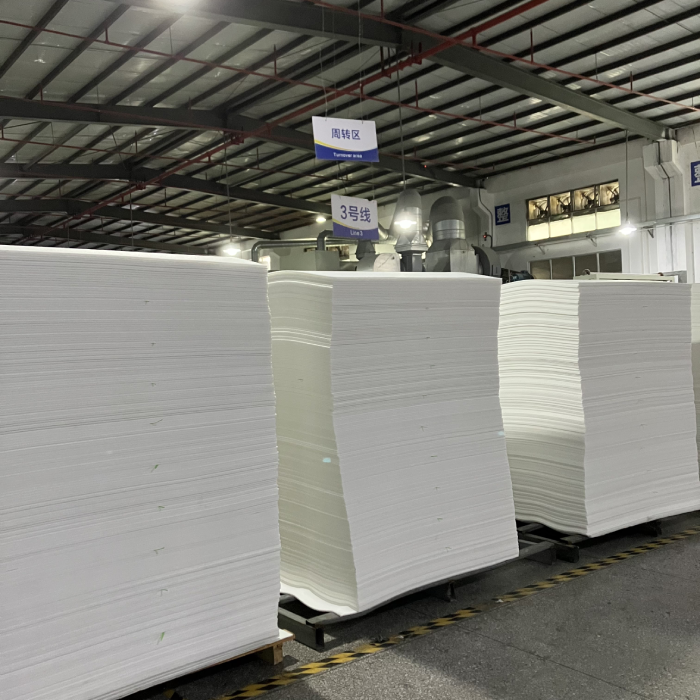
Sheets are generally supplied in specified length and width dimensions. Factories can take and use them by batch without first unrolling, measuring, and cutting a full roll. For fixed-size pads, liners, separators, or other finished components, pre-cut sheets can simplify some on-site operations.
For factories without automatic cutting equipment, sheets may also reduce equipment investment and the need to schedule cutting operators. In particular, when continuous feeding is unnecessary and product dimensions remain relatively stable, pre-cut sheets can move more directly into the next production stage.
However, buyers should still confirm dimensional tolerances, edge conditions, packaging, and actual application requirements before purchasing sheets. If the finished product comes in many sizes or its design changes frequently, ordering separate sheet dimensions may increase inventory management complexity.
Therefore, sheets are generally worth considering for production processes that require standardized dimensions, less on-site cutting, or direct assembly. Their suitability should ultimately be assessed against actual size variations, order frequency, and processing methods.
How Should Buyers Choose Between Rolls and Sheets for Automatic Cutting, CNC, and Die Cutting?
If a factory already uses automatic cutting equipment, rolls can often be integrated with continuous feeding processes. The equipment can cut according to preset dimensions, allowing the factory to plan material usage around the product layout. Actual results, however, depend on the equipment's supported material width and thickness, feeding method, and cutting precision. Buyers should confirm that the equipment is suitable for the intended recycled PET felt before ordering.
For CNC or die-cutting processes, the choice between rolls and sheets depends on the equipment configuration and processing method. Some production lines can feed rolls directly for continuous cutting, while other processes require the material to be prepared as sheets before positioning, punching, or further processing. The use of CNC or die cutting alone does not determine which purchasing format is more suitable.
If the factory frequently changes product dimensions, rolls may provide greater flexibility in material layout, but buyers should also consider changeover, feeding, and offcut handling. If the product shape and dimensions remain fixed over time, pre-cut sheets may simplify loading and positioning.
Buyers should therefore explain their actual processing workflow to the supplier, including the equipment type, how the material is loaded, the required finished dimensions, and whether the material will undergo bonding, lamination, or assembly after cutting. This allows both formats to be evaluated against the real production requirements rather than being selected based solely on the name of the processing equipment.
How Do Order Volume and Production Quantity Affect the Choice?
For continuous, repetitive production with relatively large order volumes, rolls may help standardize feeding and cutting processes, especially when the factory already has suitable equipment. Buyers can purchase material according to the production plan and arrange cutting based on actual usage. However, if production batches change frequently, rolls may also require additional changeovers, slitting, and inventory management.
For small production runs, trial production, or fixed-size components, sheets may be easier to count, store, and issue by batch. If each order requires only a limited amount of material and the factory does not want to arrange a separate cutting operation for a small quantity, pre-cut sheets may better suit its workflow.
Nevertheless, order volume alone does not determine the purchasing format. A small-volume buyer with cutting equipment may still benefit from rolls if several orders can share the same material roll. A large-volume buyer manufacturing fixed-size components for direct assembly may prefer sheets.
A more reliable decision considers order quantity, the frequency of dimension changes, equipment availability, labor requirements, and material waste together. Buyers should evaluate the actual production process rather than automatically following the rule that large orders require rolls and small orders require sheets.
How Can Buyers Compare the Total Cost of Rolls and Sheets?
When comparing Recycled PET Felt Roll and Recycled PET Felt Sheet, buyers should evaluate purchasing costs together with downstream processing costs. Even when both formats use the same raw material, differences in cutting, packaging, and production arrangements can lead to different overall costs.
For rolls, in addition to the material quotation, buyers should consider the labor, equipment usage, production time, and offcut waste associated with in-house cutting. If the cutting layout makes efficient use of the material and the equipment operates consistently, rolls may suit the existing workflow. However, if additional equipment or significant labor is required, those costs should also be included in the comparison.
For sheets, buyers should confirm whether the quotation includes pre-cutting, custom dimensions, special packaging, and any other agreed services. Sheets can reduce some on-site operations, but if the product comes in many sizes, the factory may need to manage separate inventories for different dimensions. Minimum quantities and the risk of leftover stock for each size should also be considered.
For a fair comparison, buyers can request separate quotations for rolls and sheets and confirm whether the material specifications, actual dimensions, quantities, packaging, and delivery terms are equivalent. They can then combine those figures with their own processing costs and material utilization rates to determine which format better meets the project's total cost objectives.
What Should Buyers Confirm When Requesting a Quote from a Recycled PET Felt Supplier?
To help a supplier evaluate both roll and sheet options accurately, buyers should explain the finished product, how the material will be processed, and the condition in which they want the material delivered.
For rolls, buyers should provide the target width, required roll length, estimated order quantity, and information about whether their existing equipment can handle continuous rolls. For sheets, they should specify the length and width of each sheet, dimensional tolerances, quantity, and any special shape or edge requirements.
Regardless of the format, buyers should describe the final application, material requirements, downstream processing method, and packaging needs. If the product requires CNC cutting, die cutting, bonding, lamination, or assembly, these details should also be included in the inquiry so that the supplier can assess whether the proposed delivery format suits the next production stage.
If buyers have not yet decided on the final format, they can ask the supplier to evaluate both rolls and sheets and provide corresponding quotations. For projects still under development, product drawings, existing samples, or the dimensions of the final component can help the supplier understand the actual requirements.
When comparing quotations, the most important point is to ensure that both options use equivalent material specifications and order quantities, while clearly identifying which processing steps will be completed by the supplier and which will be handled by the buyer. This avoids directly comparing the price of uncut roll material with the price of pre-cut sheets and drawing an inaccurate purchasing conclusion.
How Can HuiZhou JinHaoCheng Nonwovens Co., Ltd. Support Custom Requirements?
For overseas manufacturers, importers, and wholesalers that need a stable material supply and customized specifications, working with a supplier experienced in needle punched nonwoven production can help clarify material requirements and downstream processing needs at the inquiry stage.
HuiZhou JinHaoCheng Nonwovens Co., Ltd. has been manufacturing nonwoven materials since 2005 and has experience customizing needle punched nonwoven and felt products. Depending on project requirements, buyers can discuss material specifications, roll dimensions, and relevant processing needs with the company. For OEM or ODM projects, buyers can provide the product application, required dimensions, processing method, and estimated order quantity so that an appropriate material solution can be evaluated.
If the project has not yet determined whether rolls or sheets are more suitable, buyers can explain their existing production workflow and provide product drawings or samples during the inquiry. This gives the supplier a clearer basis for discussing feasible delivery formats and helping buyers coordinate material purchasing with downstream production.
Conclusion
The decision to purchase Recycled PET Felt Roll or Recycled PET Felt Sheet should not be based solely on unit price, order volume, or a supplier's standard delivery format. Rolls are generally suitable for factories that need continuous feeding, in-house cutting, or flexible material layout. Sheets are generally suitable for production processes that require fixed dimensions, less on-site cutting, or direct assembly.
If a factory already has automatic cutting, CNC, or die-cutting equipment, buyers should first confirm the equipment's feeding method and processing requirements before deciding which format can be integrated more easily into the existing workflow. If the factory lacks cutting equipment, or the product has fixed dimensions and requires direct assembly, pre-cut sheets are worth evaluating.
The final purchasing decision should take into account the production workflow, dimensional variations, order frequency, labor requirements, material waste, packaging, and inventory management. When requesting a quotation from a Recycled PET Felt Supplier, clearly explaining the final application and processing method is generally more useful than simply asking which format is cheaper.




