
How Should Buyers Specify Nonwoven Geotextile for Road Base Separation?
For road contractors, geosynthetic importers, distributors, and project procurement teams, sourcing geotextile fabric for soil separation involves more than choosing a product by its GSM or material name. The real challenge is translating the engineering requirements of a road project into specifications that suppliers can quote against, document, and deliver for inspection.
In road construction, geotextile may be placed between the existing subgrade soil and the aggregate base or subbase to help reduce the risk of the two layers mixing during construction and service. However, geotextile is not automatically required for every road project. Its suitability and performance requirements should be determined by the engineering design, site soil conditions, construction methods, and applicable technical specifications.
Buyers should therefore avoid asking a supplier only whether a particular GSM is available. Instead, they should first establish the intended function, the required material properties, and the documents that will be used to verify the delivered product.
This guide explains how to translate road base separation requirements into clear, purchasable, and verifiable material specifications, helping overseas buyers reduce misunderstandings before requesting quotations, approving samples, or placing bulk orders.
What Does Geotextile for Road Base Separation Need to Do?
Road structures typically include a subgrade, an aggregate base or subbase, and upper pavement layers. The exact structure varies according to the road design, ground conditions, and traffic requirements.
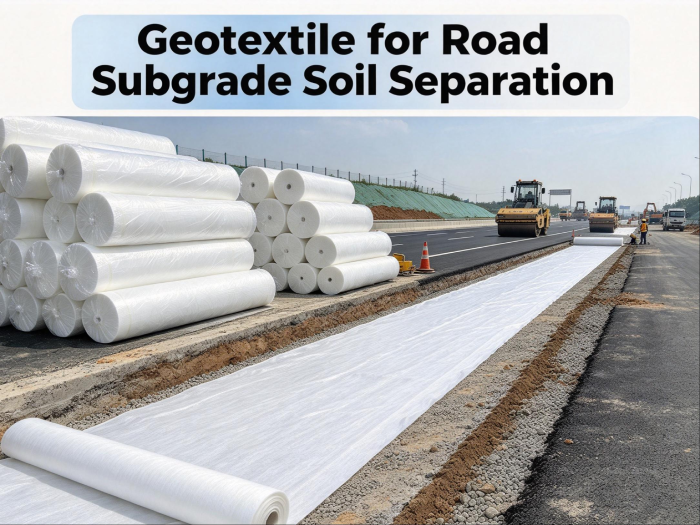
When geotextile is specified between the subgrade and the aggregate base or subbase, its primary function is to provide separation and help reduce the mixing of adjacent materials during construction and service.
If subgrade soil mixes with the aggregate, the aggregate layer may lose some of its intended gradation and structural integrity, potentially affecting long-term pavement performance. Construction activities, including aggregate placement, equipment movement, and compaction, can also expose the separation material to mechanical stresses.
However, buyers should distinguish between several engineering functions.
Soil separation focuses on reducing the mixing of adjacent soil and aggregate layers.
Filtration and drainage concern the movement of water through a material while controlling soil particle migration under the specified conditions.
Reinforcement or stabilization involves a geosynthetic performing a defined role in the structural response of the road system.
These functions may overlap in some projects, but not every geotextile provides the same performance. The material name alone cannot establish whether it meets the design requirements.
Buyers should therefore confirm whether the project requires separation only or also specifies filtration, drainage, reinforcement, or other functions. This distinction helps prevent suppliers from quoting materials that do not match the actual engineering requirements.
Why Should Buyers Not Specify Geotextile by GSM or Material Name Alone?
GSM, or grams per square meter, is a common specification for nonwoven geotextile. However, GSM alone cannot establish whether a material is suitable for a particular road base separation project.
Two geotextiles with the same GSM may differ in fiber material, fiber structure, thickness, manufacturing process, and other physical properties.
For road construction procurement, the important question is whether the material meets the performance requirements defined for the project, rather than whether it has a higher GSM.
For example, a higher GSM does not automatically demonstrate that a material has sufficient tensile, tear, puncture, or other mechanical properties for a specific construction environment. Likewise, greater thickness alone does not prove that the material meets the project's separation requirements.
Buyers should avoid specifying materials in the following ways:
Providing only a GSM value without explaining the intended application;
Requesting needle-punched nonwoven geotextile without identifying its required function;
Assuming that a higher GSM is always more suitable for road construction;
Comparing supplier quotations before confirming that the quoted materials meet equivalent technical requirements.
A more practical approach is to identify the performance requirements in the engineering documents first, then ask suppliers to quote against the same specifications. This makes quotations more comparable and reduces the risk of comparing prices for materials that are not technically equivalent.
What Information Should Buyers Extract from Engineering Documents Before Requesting a Quote?
If a project already has engineering drawings, technical specifications, or material procurement documents, buyers should first identify the information relevant to the geotextile.
Geotextile Placement
Confirm where the geotextile will be installed, such as between the existing subgrade and the aggregate subbase, or at another location specified in the design.
The placement location affects the material's intended function and the technical requirements that need to be checked.
Specified Material Function
Determine whether the project requires soil separation only or also includes filtration, drainage, reinforcement, or other functions. If the design specifies a material type or performance criteria, these requirements should form the basis of the inquiry.
Applicable Engineering Standards
Different countries, regions, project owners, and road projects may use different design standards, construction specifications, and material acceptance requirements.
Buyers should confirm the applicable standard, edition, and relevant clauses rather than automatically applying specifications from another project.
Required Material Properties
If the engineering documents specify unit weight, tensile strength, tear resistance, puncture resistance, apparent opening size, water permeability, or other properties, record the exact requirements, units, and associated test methods.
Not every project requires every property listed above, and the acceptance limits are not necessarily the same across all projects. The required tests and criteria should be based on the project documents.
Drawings and Material Schedules
If the drawings, material schedule, and technical specifications describe the geotextile differently, buyers should clarify the discrepancy with the project designer or responsible technical reviewer before ordering. This helps prevent suppliers from interpreting the requirements differently.
For overseas project procurement, organizing these documents in advance is often more efficient than repeatedly asking whether a particular GSM is available.
How Do Site Soil Conditions and Construction Loads Affect Material Requirements?
Geotextile for road base separation should not be selected independently of the actual construction conditions. Site soil and construction loads can affect the performance requirements specified by the engineering design, so buyers should provide relevant information whenever possible.
Site Soil Conditions
The soil type, particle composition, moisture condition, and bearing capacity may influence whether a separation layer is required and which material properties need to be considered.
For example, fine-grained soils that are susceptible to disturbance may present different engineering challenges from more stable ground conditions.
If available, buyers can provide geotechnical investigation reports, soil classification information, or relevant test results for review by the supplier or project engineer.
However, a general description such as “soft soil,” “clay,” or “sand” is not enough to establish that a particular GSM of geotextile will be suitable. The material specification still needs to correspond to the engineering requirements.
Construction Equipment and Site Operations
After the geotextile is installed, it may be exposed to mechanical stresses during aggregate placement, spreading, equipment movement, and compaction.
Procurement teams should therefore consider the construction survivability requirements defined by the project and identify whether the site presents a higher risk of mechanical damage.
Equipment type, working methods, aggregate conditions, and installation procedures can all affect construction. Buyers should share known site conditions with the project engineer or supplier so the relevant material requirements can be reviewed.
Loads and Road Service Conditions
Traffic loads, pavement structure design, and equipment loads during construction may all affect the requirements for the subgrade and separation system.
However, geotextile should not be treated as a stand-alone solution for every bearing-capacity or subgrade-stability problem. Its separation function is different from the overall structural design of the road.
If the project also requires reinforcement, improved load support, or deformation control, buyers should confirm whether the design specifies a reinforcement geosynthetic, composite structure, or other engineering measure. Increasing the geotextile GSM should not be used as a substitute for engineering design.
How Can Buyers Turn Engineering Requirements into Verifiable Material Specifications?
Once the application, design documents, and site conditions are understood, buyers can organize the information into a specification that suppliers can use for quotations and production.
A clear purchasing specification should include the following information.
Material Type and Intended Application
Identify the product as needle-punched nonwoven geotextile and specify its intended use between the road subgrade and aggregate base or at another location defined by the project.
If the engineering documents define a specific material category, use the terminology in those documents to avoid different interpretations among suppliers.
Required Technical Properties
List each performance property required by the engineering documents, including the specified value, unit, test method, and applicable standard.
If a requirement has not yet been established, do not insert an unverified value. Ask the project technical representative to confirm it or clearly mark it as pending confirmation.
Product Dimensions and Supply Format
Confirm the roll width, roll length, supply format, packaging, and other purchasing requirements based on the construction plan.
These details help suppliers prepare quotations and production plans, but they do not replace the required engineering performance criteria.
Documentation and Evidence Requirements
If the project requires a technical data sheet, test report, declaration of conformity, or other documentation, state this in the inquiry.
Buyers should also check whether the documents correspond to the quoted product type, specification, and test methods. A test report for one product should not automatically be treated as evidence that every other specification meets the project requirements.
Permitted Specification Tolerances
If the design or purchasing documents define tolerances for dimensions, unit weight, or other properties, include them in the purchasing specification and confirm them with the supplier before placing the order.
This approach turns a general product description into a specification that can be used for document review, sample approval, and incoming material inspection.
How Can Buyers Keep Samples, Delivered Materials, and Acceptance Documents Consistent?
A key part of engineering material procurement is not simply finding a sample that appears suitable. The approved sample, quoted specification, bulk production material, and final delivery documents should all correspond to one another.
During sample approval, buyers should record the sample's product type, specification, relevant performance information, and approval date. If testing is conducted, retain the test conditions and results rather than relying on visual memory alone.
Before bulk purchasing, confirm that the final order requirements match the documents that have already been reviewed and approved.
When the goods arrive, buyers can check product labels, roll dimensions, batch information, accompanying documents, and other acceptance items required by the project.
If the project requires sampling or third-party testing for specific properties, clarify the test methods, sampling requirements, and acceptance responsibilities in advance. The required tests and acceptance limits should follow the contract, engineering standards, and project acceptance documents.
One important distinction is that receiving technical documents from a supplier does not automatically mean the material has passed project acceptance. Similarly, two visually similar samples do not necessarily have identical critical performance properties.
By linking the purchasing specification, sample approval, batch documentation, and acceptance criteria, buyers can more reliably verify whether the delivered material meets the order requirements.
What Should Buyers Prepare When Requesting a Quote from a Supplier?
To help a supplier evaluate geotextile for road base separation more accurately, buyers should provide as much of the following information as possible.
Project Application: Explain whether the geotextile will separate the road subgrade from the aggregate base or be installed at another position in the road structure.
Design Documents: Provide relevant drawings, material specifications, engineering material schedules, or the project owner's procurement requirements.
Site Soil Conditions: Share available soil classification information, geotechnical investigation data, or relevant test results.
Construction Conditions: Describe the known aggregate type, installation method, construction equipment, and other conditions that may affect material use.
Performance Requirements: List the specified technical properties, test methods, applicable standards, and acceptance criteria.
Order Quantity and Dimensions: Provide the estimated quantity, roll width, roll length, packaging requirements, delivery destination, and expected purchasing schedule.
Documentation Requirements: Specify whether technical data sheets, test reports, sample approval, or other project documents are required.
If the exact technical parameters have not yet been finalized, buyers can begin by sharing the available design documents and project background. The supplier can then help clarify the available product information. However, engineering performance requirements that remain undefined should be confirmed by the project designer or responsible technical reviewer rather than replaced by general supplier assumptions.
For overseas buyers making repeat purchases, standardizing technical specifications and acceptance documentation in advance can also reduce communication differences between suppliers and production batches.
HuiZhou JinHaoCheng Nonwovens Co., Ltd.manufactures needle-punched nonwoven and related materials and offers customization services. For road construction inquiries, buyers can provide the project application, design documents, and specific technical requirements to discuss suitable material specifications and available product documentation.
Conclusion: Translate Engineering Design into Purchasing Requirements Before Comparing Quotations
Purchasing geotextile for road base separation should not begin with an isolated GSM value. It should begin with the engineering design, site soil conditions, and construction requirements.
Buyers should first establish the intended separation function, then extract the required material type, performance properties, test methods, and acceptance criteria from the engineering documents. These requirements should be incorporated into the inquiry and purchase order.
Technical document review, sample approval, and incoming material checks can then help confirm that the supplied material matches the approved specification.
This purchasing process helps overseas project buyers compare supplier quotations more clearly and reduces the risk of procurement discrepancies caused by different interpretations of the requirements.
If you are sourcing geotextile fabric for soil separation, prepare the road design documents, available site soil information, and material acceptance requirements before discussing specific product specifications with a supplier. This provides a clearer basis for turning engineering needs into purchasing requirements that can be verified.




