
What Should Overseas Buyers Test Before Approving a Floor Protection Roll Sample?
For overseas importers, wholesalers, and distributors sourcing Floor Protection Roll from China, the key question after receiving a supplier sample is not simply, “Does this sample look good?” It is whether the sample has actually met the purchasing requirements and is suitable to be approved for a bulk order.
Many purchasing problems do not occur because a sample is obviously defective. Instead, the sample may look and feel acceptable, but once it is used in an actual construction environment, buyers may discover differences in liquid absorption, water resistance, tear resistance, slip resistance, surface protection, or ease of installation. If these issues are only discovered after the bulk shipment arrives, returns, replacements, and reorders can create additional time and cost.
Therefore, floor protection roll sample evaluation should not be limited to a visual inspection. The real purpose of sample testing is to conduct a small-scale pre-purchase validation, using the sample to confirm whether the product is suitable for the target application, meets the requirements already discussed, and is worth moving to the next stage of bulk purchasing.
Why Doesn't a Good-Looking Sample Automatically Mean It Is Ready for Bulk Ordering?
A supplier sample is normally provided so that the buyer can evaluate whether the product meets basic requirements. However, receiving a sample does not mean that the purchasing decision has already been completed.
Floor Protection Roll is a material designed for actual use. It may be installed on floors or other surfaces that need protection and exposed to water, paint, dust, friction, foot traffic, and moving tools during construction, renovation, or daily work. Therefore, simply checking the sample's color, softness, or appearance cannot fully determine whether it is suitable for the actual application.
In addition, overseas buyers normally receive only a small number of sample rolls, while a bulk order may involve hundreds of rolls or even a full container. The main purpose of the sample stage is not to prove the supplier's mass-production capability, but to determine whether the product itself is worth moving to the next purchasing stage.
Therefore, buyers should treat sample testing as a product approval decision point. If the sample already shows clear problems in actual use, there is little reason to move directly to a bulk order.
First Confirm Whether the Sample Matches the Purchasing Requirements
Before starting practical testing, buyers should first confirm that the sample they received is actually the product they discussed and intended to purchase.
For example, if the buyer previously requested a specific GSM, thickness, width, roll length, material structure, color, or backing method, these basic details should be checked against the received sample. If the sample itself differs from the quotation or previously confirmed specifications, even good test performance should not be used as the final basis for bulk purchasing.
This step is particularly important for overseas buyers because different Floor Protection Roll products may look similar while having different material structures and performance characteristics. If a supplier provides another standard product simply because it is more convenient for sampling, the buyer may actually be testing a different product from the one intended for bulk production.
Therefore, before starting floor protection roll quality testing, buyers should confirm the sample's product model, key specifications, and purchasing requirements. This ensures that the subsequent test results have practical value.
Then Verify the Sample's Protective Performance Under Real-World Conditions
After confirming the specifications, the next step is to simulate the product's actual future use as closely as possible instead of simply examining the sample on an office desk.
If the product is mainly intended for renovation or construction sites, the buyer can place the sample on the target floor and observe whether it is easy to install, whether it moves easily, whether the edges tend to curl, and whether the surface changes noticeably after foot traffic or tools pass over it. This provides a more direct indication of whether the material is suitable for the intended construction environment.
The focus of testing should also reflect the actual application. If the product is mainly used during painting work, the buyer should pay more attention to how it performs when exposed to paint or other liquids. If it is intended for areas with heavy foot traffic, surface protection, wear resistance, and slip resistance may deserve greater attention.
These checks do not need to become complicated laboratory tests. For sample evaluation, the most useful approach is to use a limited amount of material to simulate the real application and observe whether any problems appear that could affect final use.
Why Should Water, Paint, and Common Construction Contaminants Be Tested at the Sample Stage?
Floor Protection Roll is frequently used in renovation, painting, and construction environments, making water, paint, and other construction contaminants representative real-world conditions.
If the product is intended to absorb liquids, buyers can observe how the material responds when liquid is applied, including absorption speed, spreading behavior, and whether noticeable liquid remains on the surface. If the product relies on a PE or other laminated structure for water resistance, buyers should focus on whether liquid penetrates the material and how the laminated structure performs during actual use.
Paint is another useful condition to evaluate during the sample stage. Depending on the intended application, buyers can expose the sample to commonly used construction paint and observe whether the liquid penetrates, spreads into the protected surface underneath, or affects the material's continued usability.
The purpose of these tests is not to claim that a product is “completely waterproof” or “completely stain-proof” under every condition. Instead, the goal is to determine whether its performance meets the basic requirements of the buyer's actual market and construction environment.
For overseas wholesalers and distributors, this step is particularly important because they may ultimately supply a category of customers rather than a single project. If the product performs poorly under typical application conditions, future bulk purchases may result in more customer complaints.
How Should Buyers Check the Sample's Surface, Tear Resistance, and Ease of Handling?
In addition to liquid-related tests, buyers should observe the material's physical performance during normal handling and installation.
First, inspect whether the surface is uniform and whether there are obvious local variations in thickness, surface defects, or other abnormalities that could affect use. For protective materials that may remain installed for an extended period, surface condition can directly affect the user's experience during construction.
Next, buyers can observe whether the material is easy to tear or damage during normal installation, movement, cutting, and handling. The purpose is not simply to pursue the highest possible tear strength as an isolated specification, but to determine whether the product can withstand the handling conditions of the intended application.
Slip resistance should also be evaluated on the actual floor surface whenever possible. Different flooring materials, construction environments, and backing structures can produce different friction characteristics. Therefore, sample testing should ideally reproduce the actual use conditions rather than relying on a single idealized surface.
These simple practical checks can reveal issues that are difficult to identify from product photos, specification sheets, or supplier descriptions alone.
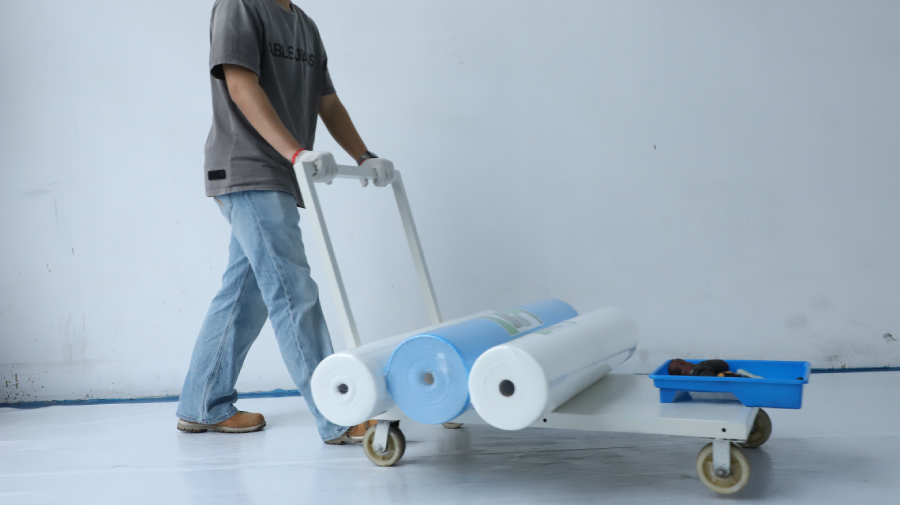
What Should Be Tested Separately When the Floor Protection Roll Has Adhesive or a Laminated Structure?
If the purchased Floor Protection Roll includes an adhesive backing, PE film, or another laminated structure, sample evaluation should not focus only on the surface material.
For adhesive-backed products, buyers should pay particular attention to how the product interacts with the target floor, including whether it is easy to install, whether it remains stable after application, and whether noticeable residue or other unwanted effects remain after removal. Sensitive surfaces such as hardwood flooring should be tested carefully before a formal bulk order is approved.
For PE-laminated products, buyers should focus on whether the laminated structure meets the requirements of the actual application. Practical bending, installation, and normal construction handling can help identify obvious separation or other abnormalities in the laminated layers.
The purpose is not to require buyers to perform professional laboratory-level material analysis themselves. Instead, the goal is to identify structural problems that could cause issues during actual construction before committing to a large purchase.
If the product will be used on different types of flooring or in different construction environments, sample testing should ideally cover the major intended markets rather than drawing a conclusion from only one ideal application.
How Can Buyers Decide Whether the Sample Test Is Sufficient to Support a Bulk Order?
After completing the sample testing, buyers should not simply classify the sample as “pass” or “fail.” Instead, they should determine whether several key questions have been answered.
First, does the sample match the purchasing specifications that have already been confirmed? Second, does it perform adequately under the intended real-world conditions? Third, did the testing reveal any issue that could affect bulk use, sales, or customer complaints?
If the sample meets the requirements but some aspects remain uncertain, buyers should clarify them with the supplier before approving the bulk order rather than leaving the unresolved issue until production is completed.
For higher-risk large-volume purchases, buyers can record the sample test results, including sample photos, key specifications, actual testing conditions, and any issues identified. This creates a clear reference when communicating with the supplier later and helps define what product standard was originally approved.
It is important to understand that sample testing is not intended to eliminate every possible product risk. Its purpose is to identify the most important problems at a relatively low cost before committing to a large purchase. For overseas buyers, this is one of the main values of the sample stage.
If the Sample Fails a Test, Should the Buyer Request a Revised Sample or Change Suppliers?
A problem found during sample testing does not automatically mean that the supplier is unsuitable. The key is to determine whether the issue resulted from a misunderstanding of the product specifications, a sample that was not produced according to the requirements, or a product that cannot actually meet the intended application.
If the issue is simply that the GSM, width, thickness, color, packaging, or another specification does not match the purchasing requirements, the buyer can first ask the supplier to reconfirm and adjust the sample. If the basic material structure is suitable but a particular performance requirement needs improvement, the buyer can also discuss whether the material, lamination method, or production conditions can be adjusted.
However, if the supplier cannot explain the difference between the sample and the purchasing requirements, or if the product itself cannot meet the buyer's core application needs, continuing to spend significant time on revisions may not be worthwhile. In this situation, the buyer can reassess whether the supplier is genuinely suitable for the product project.
Therefore, sample testing also helps buyers distinguish between problems that can be solved through specification adjustments and problems that the supplier itself may not be able to resolve.
How Does HuiZhou JinHaoCheng Nonwovens Co., Ltd. Support Floor Protection Roll Sample Evaluation?
For overseas Floor Protection Roll projects, HuiZhou JinHaoCheng Nonwovens Co., Ltd. has more than 20 years of nonwoven manufacturing experience and provides needle-punched nonwoven and related customized products, including OEM/ODM production.
At the sample stage, product conditions such as GSM, thickness, width, roll length, color, backing, laminated structure, and packaging can be confirmed according to the customer's purchasing requirements before the sample is evaluated against the intended application.
For overseas importers, wholesalers, and distributors, defining product requirements and actual use conditions as early as possible makes subsequent bulk-order communication easier. For customers with long-term purchasing plans, the approved sample and confirmed product specifications can also serve as important references for future orders.
Therefore, for overseas buyers looking for a needle punched nonwoven felt manufacturer or Floor Protection Roll supplier, sample evaluation is not only a way to test the product itself. It is also an important step toward establishing a clear purchasing standard for future orders.
Conclusion: Sample Approval Is Not About “Looking Good,” but About Confirming the Product Is Suitable for the Actual Purchase
For overseas buyers, receiving a Floor Protection Roll sample should not lead directly to a bulk order based only on appearance and price.
A more practical approach is to first confirm that the sample matches the purchasing requirements, then evaluate its protective performance under real-world conditions, with particular attention to liquids, paint, friction, tearing, slip resistance, and laminated structures that are relevant to the actual application.
The main purpose of sample testing is not to conduct complicated laboratory certification. It is to verify at relatively low cost, before committing to a large purchase, whether the product is genuinely suitable for the target market and application environment.
Once a Floor Protection Roll sample has passed both specification confirmation and practical application evaluation, the buyer has a stronger basis for deciding whether to move to the next stage of bulk purchasing. This changes the decision from “the supplier says the product works” to “the buyer has personally verified that the product is suitable for the intended purchase,” helping reduce the actual risk of the first bulk order.




