Keeping Floor Protection in Place on Busy Construction Corridors and Stairs
In commercial renovations, hotel refurbishments, and construction projects, corridors and stairs are often the areas where floor protection is most likely to shift. Frequent foot traffic, tool carts, and material handling can gradually move protective coverings out of position, open seams, create wrinkles, or cause edges to curl upward.
For construction contractors and floor protection buyers, reducing these problems is not simply a matter of choosing a thicker or heavier material. Installation direction, seam placement, stair geometry, floor conditions, and the compatibility between the backing and the substrate can all affect how securely a protective runner stays in place during use.
This guide explains how to plan the installation and positioning of floor protection on construction corridors and stairs, along with the conditions buyers should confirm before placing an order.
1. Why Does Floor Protection Shift on Construction Corridors?
Corridors are often long, have a relatively consistent direction of traffic, and experience repeated footfall. If the protective covering has wrinkles, poorly positioned seams, or inadequately finished edges, repeated walking and cart movement can gradually cause sections to shift.
For example, a runner in the middle of a corridor may gradually move sideways under repeated traffic. Seams between adjacent rolls may begin to open, while areas near walls, doorways, or corners may develop raised edges because of uneven cutting.
Before installation, check that the floor is clean, dry, and free from loose particles. Then determine the roll direction and seam positions. Do not lay the material directly over dust, grit, or other contaminants that may interfere with proper contact.
For long corridors, plan a continuous main installation route first, then deal with doorways, corners, and other areas that require cutting. This can reduce the local problems caused by improvised joins and irregularly cut pieces.
2. How Should Roll Direction and Seams Be Planned in Corridors?
For long corridors, laying the material along the main length of the corridor is often a practical starting point. This can help create a more continuous covered area and make it easier to check whether the runner has shifted.
However, the final installation direction should depend on the roll width, corridor dimensions, doorway positions, and the intended fixing method. Roll direction alone cannot guarantee that the material will stay in place.
Seam placement is equally important. Adjacent rolls should be joined or secured according to the product instructions and site conditions. Avoid seams with obvious height differences, loose edges, or openings that could catch on footwear or cart wheels.
If tape or another supplementary fixing method is required, first confirm its compatibility with both the floor surface and the protective runner's backing. This is particularly important for wood flooring, coated surfaces, and other substrates that are sensitive to adhesive residue or surface damage. Do not assume that every type of tape is suitable for every floor.
Pay particular attention to both sides of the corridor, doorways, and corners. Cut edges should lie flat and should not leave loose sections that can easily be caught by a shoe tip or a trolley wheel.
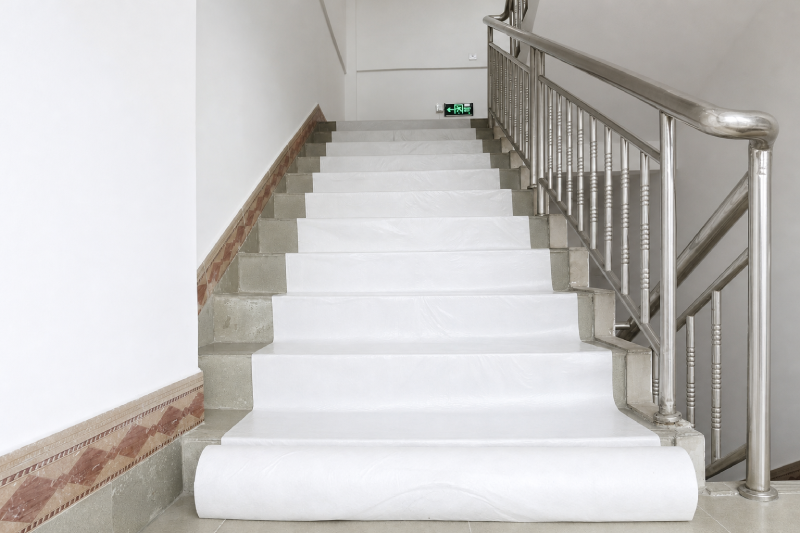
3. How Can Floor Protection Be Installed More Securely on Stair Treads and Risers?
Stairs differ from flat corridors. Each step has a horizontal tread and a vertical riser, creating changes in direction and multiple edges that the protective covering must accommodate.
If one long piece of material is simply laid over the stairs, the front edge of a tread may remain loose, while the riser may not be adequately covered. Repeated use of the stairs can pull at these areas or create wrinkles.
Before installation, check the width and depth of each tread and the height of each riser. Cut the material according to the actual dimensions. The method used to cover the treads and risers should follow the product design, installation instructions, and site conditions. Avoid leaving unsupported, curled, or easily lifted edges at the front of each step.
The material should fit the corresponding surface of each step. Pay particular attention to corners, tread nosings, and the top and bottom entrances to the staircase. If the product is not specifically designed for stair applications, do not assume that its weight alone will keep it securely in place on every step.
For construction stairs that will experience prolonged, frequent traffic, confirm whether the temporary protection solution is appropriate for the site conditions. Floor protection should not replace professional anti-slip measures or a compliant access-route design where these are required.
4. Why Does Self-Adhesive Backing Perform Differently on Different Floors?
Self-adhesive floor protection can help the material adhere to a floor, but the actual performance of the backing depends on the substrate. The same product may behave differently on different surfaces.
Floor cleanliness is one of the first conditions to check. Dust, grit, oil, and cleaning-product residue can interfere with contact between the backing and the floor, resulting in inadequate adhesion in certain areas.
Floor dryness is also important. Moisture or residual dampness may affect the adhesion of some backing materials. Before installation, confirm that the floor is suitable for application according to the product instructions.
Surface texture and coatings should not be overlooked. Smooth, rough, textured, or specially coated floors may have different compatibility requirements. Some surfaces may also be sensitive to adhesive materials, creating a risk of residue, coating damage, or other surface changes.
For this reason, buyers should not simply ask whether a product has a self-adhesive backing. They should provide details of the intended floor surface and carry out a small-area trial before full installation. During the trial, check whether the material adheres properly, whether the edges lift easily, and whether removal leaves residue or damages the surface.
If the floor type is unclear or the supplier cannot confirm compatibility between the backing and the intended substrate, do not assume that the self-adhesive construction is suitable for the entire project.
5. What Should Be Checked After Installation?
Completing the installation does not guarantee that the protective covering will remain in place throughout use. On construction corridors and stairs, inspect the covering before opening the area to traffic and check it periodically according to the frequency of use.
First, inspect the edges, especially along corridor walls, at doorways and corners, and at the front edges of stair treads. Look for visible lifting, loose sections, or areas that are not lying flat.
Next, check the seams. Adjacent rolls should not have openings that can catch on footwear or cart wheels, nor should they form obvious folds or raised transitions.
Then inspect the surface for wrinkles. If folds, overlapping sections, or shifted material are found, correct the problem before continuing to use the covering. Simply pressing a wrinkle flat without investigating its cause may not prevent it from returning.
If the material repeatedly shifts within a short period, check for floor contamination, backing incompatibility, an unsuitable fixing method, or a product that is not appropriate for the traffic conditions. Do not rely solely on adding more fixing materials.
It is particularly important to understand that more secure fixing does not mean the product has certified anti-slip performance. Even if a protective runner is difficult to move, that does not prove that its surface cannot be slippery. If a project has specific anti-slip requirements, request relevant test data from the supplier and confirm that the test method, conditions, and results are applicable to the intended use.
6. What Should Buyers Confirm Before Purchasing a Blue Heavy-Duty Floor Protection Runner?
For high-traffic areas such as corridors and stairs, buyers should first define the intended application rather than judge suitability by colour or the term “heavy-duty” alone.
When requesting a quotation, explain whether the project involves commercial renovation, construction work, or hotel refurbishment. Provide information about the corridor and stair substrates, expected duration of use, traffic conditions, and the specific areas that need protection.
If a self-adhesive product is planned, clarify whether the floor has a coating, whether adhesive residue is a concern, and whether a small-area trial is required before installation. For stairs, specify whether both the treads and risers need to be covered and what fixing method will be used on site.
If the project has specific anti-slip requirements, state them separately and request supporting test documentation from the supplier. Do not treat descriptions such as “anti-shift,” “self-adhesive,” or “heavy-duty” as proof of anti-slip certification.
Buyers can also ask the supplier to confirm the roll construction, backing type, available customization options, and packaging. Sample testing can then help establish whether the material is suitable for the actual installation environment.
For importers, wholesalers, and private-label brands that require a consistent supply, working with a factory experienced in needle-punched nonwoven production and customization can make it easier to discuss material construction, specifications, and future supply requirements. HuiZhou JinHaoCheng Nonwovens Co., Ltd. provides manufacturing and customization services for needle-punched nonwovens and related composite materials. Whether a specific product is suitable for a particular corridor or stair project should still be confirmed through product documentation, sample evaluation, and the site's requirements.
Conclusion: Reducing Movement Requires Both a Suitable Installation Plan and Product Compatibility
When using floor protection on construction corridors and stairs, reducing movement, curling, and wrinkles requires attention to roll direction, seam placement, tread and riser coverage, edge inspections, and compatibility between self-adhesive backing and the floor substrate.
Buyers looking for a blue heavy duty floor protection runner should specify the intended floor surface, traffic conditions, stair configuration, and fixing requirements when requesting a quotation. They should also use samples to confirm whether the product is suitable for the intended application.
In high-traffic areas, choosing an appropriate protective material is only the first step. Proper installation, regular inspection, and independent verification of anti-slip performance where required can help reduce the risk of shifting and raised edges during construction.