
Which Fire Test Should You Choose for Flame Retardant Industrial Felt?
For overseas buyers sourcing flame retardant felt, needle punched flame retardant nonwoven, or industrial insulation felt, different fire-test standards such as UL 94, FMVSS 302, DIN 4102, and EN 13501-1 often appear in RFQs.
The real challenge is not simply knowing the names of these standards, but determining: which fire test should your product actually require from the supplier?
Automotive interiors, industrial equipment, electrical insulation components, building interiors, and thermal insulation materials face different fire risks, so the applicable test methods can also be completely different. The test subjects, procedures, and classification systems are not the same. A rating such as “V-0,” “B1,” or “A2” should not automatically be treated as equivalent to another rating.
For buyers, a more appropriate process is to determine the final product application first, identify the applicable fire-test standard, and then require the supplier to provide the corresponding test report.
Why Should You Not Simply Ask Suppliers to “Meet a Flame Retardant Standard”?
“Flame Retardant” or “Fireproof” may sound clear during purchasing discussions, but these terms alone are not specific enough for a material supplier to determine the exact testing requirement.
For example, one industrial equipment manufacturer may purchase flame retardant material for use inside electrical equipment, while an automotive component manufacturer may purchase felt for vehicle interiors. Both may search for Flame Retardant Felt, but the final testing requirements may be completely different.
More importantly, the same needle punched nonwoven can be developed into different functional materials by changing the fiber system, thickness, density, composite structure, and final application. Therefore, the product name “flame retardant felt” alone cannot determine which standard should be used.
Buyers also need to confirm where the material will ultimately be installed.
If the material is installed inside a vehicle occupant compartment, the key requirement may be automotive interior flammability. If the material is part of a building wall or ceiling system, building-product reaction-to-fire classification may be required. If the material is used inside certain electrical equipment, the project may specify a particular flammability test for polymeric materials or equipment components.
Therefore, instead of simply writing:
“Need flame retardant felt.”
a more useful RFQ should also specify:
Final application
Material location
Target market
Required fire test
Required classification or limit
Material thickness and construction
This gives the supplier enough information to determine the appropriate material and testing approach.
When Should Industrial Equipment Projects Consider UL 94?
UL 94 is widely used in industrial equipment and electrical product purchasing, but buyers should first understand its scope.
UL Solutions describes UL 94 as a standard for evaluating the burning characteristics of specified polymeric materials under controlled laboratory conditions. Its classifications include HB, V-0, V-1, V-2, 5VA, and 5VB.
This means that if the purchased material is used for electrical equipment, electronic product housings, structural components, or insulation-related parts made from polymeric materials, UL 94 may form part of the project requirements.
However, this does not mean that every product described as “Flame Retardant Felt” should simply be specified as “UL 94 V-0.”
For needle punched felt, buyers should first confirm whether the material itself falls within the required test scope and whether the final product structure corresponds to the test sample. If the felt is only one layer of a composite material inside equipment, the final product may also contain other materials, adhesives, or supporting structures.
Therefore, buyers should not simply interpret:
UL 94 V-0 = the highest flame retardant grade for all industrial felt
and use that assumption in an RFQ.
UL Solutions also explains that UL 94 is a small-scale flammability test for polymeric materials and is not a general fire classification for building walls, floor coverings, or other building applications.
For industrial equipment purchasing, the more appropriate question is:
“Does my final product require the relevant polymeric material or component to be tested according to UL 94?”
rather than:
“Does your felt have UL 94?”
These two questions are very different in actual purchasing.
Why Is FMVSS 302 Commonly Considered for Automotive Interiors?
If flame retardant felt is used in automotive interiors, buyers should first determine whether the project requires FMVSS 302 or an OEM-specific automotive flammability test.
The formal title of FMVSS 302 is Flammability of Interior Materials. NHTSA information indicates that the standard addresses the burning characteristics of relevant materials used in the occupant compartment of motor vehicles. Its scope includes materials used in seats, headliners, interior trim panels, floor coverings, sun visors, and other specified interior applications.
This is particularly important for automotive needle punched nonwoven materials.
For example, one Polyester Needle Punched Felt may be used for general trunk decoration, while another may be used as a flame retardant material within an automotive interior structure.
Although the two materials may have similar appearance and basic specifications, a specific flammability requirement may apply to the final automotive project.
FMVSS 302 is also part of the vehicle regulatory framework. It is not a general flame-retardant rating that can be applied to every nonwoven material independently of its final automotive application. NHTSA also explains that compliance responsibilities are associated with the vehicle manufacturer's certification framework.
Therefore, automotive Tier 1 or Tier 2 buyers should preferably provide the OEM or project-specific testing requirements during the RFQ stage rather than simply telling a supplier that they need “Automotive Flame Retardant Felt.”
For automotive projects, the final installation location, whether the material is used alone or as part of a composite, and the OEM's testing specification can all affect the required validation method.
Why Do Building and Insulation Materials Involve DIN 4102 or EN 13501-1?
When flame retardant felt is used for building walls, ceilings, acoustic structures, decorative materials, or building insulation systems, the purchasing logic differs from automotive interiors and industrial equipment.
DIN 4102-1 is a German standard for the fire behavior of building materials. Its classification system includes categories such as A1, A2, B1, B2, and B3. DIN Media currently lists DIN 4102-1:1998-05 as a current standard.
EN 13501-1 is part of the European classification system for the reaction to fire of construction products. Relevant materials can be classified as A1, A2, B, C, D, E, or F, with additional classifications that may address smoke production and flaming droplets or particles.
Therefore, if you are purchasing acoustic felt, wall felt, ceiling material, or building insulation, you should not assume that a supplier's “UL 94 V-0” report automatically means that the material meets the relevant EN 13501-1 building classification.
Likewise, a material with a DIN 4102 B1 classification should not automatically be treated as having an equivalent EN 13501-1 classification.
The actual fire classification of a building product can also depend on its final application, installation method, substrate, and product structure. EN 13501-1 information likewise considers construction products in relation to their intended end use.
This is particularly important for buyers.
If you are purchasing a roll of needle punched acoustic felt and the supplier simply tells you that it has “good flame retardant performance,” that statement cannot replace the formal classification report required by a building project.
The correct approach is to first confirm:
Required building classification
Applicable test method
End-use application
Installation substrate
Product thickness
Composite structure
Then ask the supplier to provide samples and test documentation according to the applicable system.
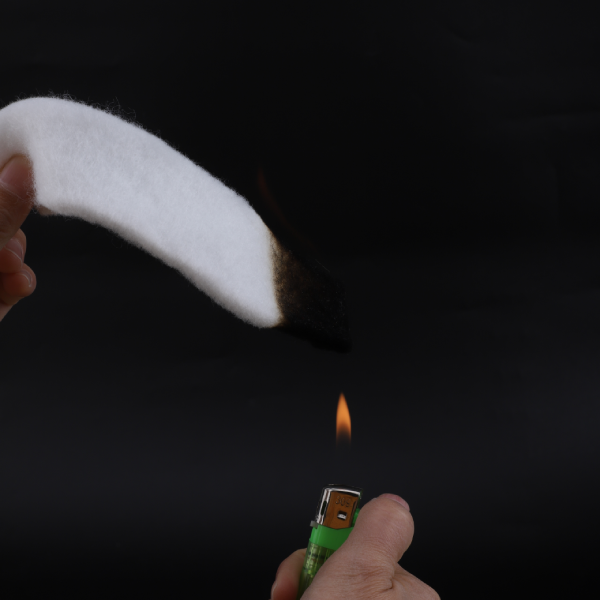
Why Are UL 94, FMVSS 302, DIN 4102 and EN 13501-1 Ratings Not Directly Equivalent?
This is one of the most common mistakes when purchasing flame retardant materials.
Although all of these standards are related to fire behavior, they evaluate burning characteristics under different conditions, for different material systems, or for different end-use applications.
UL 94 is a small-scale flammability testing system for polymeric materials; FMVSS 302 addresses relevant interior materials in motor vehicle occupant compartments; DIN 4102-1 is a German fire behavior classification system for building materials; and EN 13501-1 is a European reaction-to-fire classification system for construction products.
Therefore, buyers should not create simple assumptions such as:
UL 94 V-0 = FMVSS 302 compliant
or:
DIN 4102 B1 = EN 13501-1 B
These classifications cannot be converted into one-to-one equivalents simply based on their names.
For example, EN 13501-1 classifications may also include additional classifications for smoke production and flaming droplets or particles, while UL 94 classifications are based on specific small-scale flame test procedures.
Therefore, when a customer says:
“We need flame retardant felt.”
a professional supplier should continue by asking:
“Which test standard and classification does your project require?”
rather than immediately quoting a so-called “universal flame retardant grade.”
This is also an important point for overseas buyers comparing Chinese suppliers. If a supplier only says that its material has “excellent flame retardant performance” but cannot identify the relevant project testing standard, that information has limited value for formal material validation.
How Should Buyers Include Fire-Test Requirements in an RFQ?
For flame retardant industrial felt purchasing, an RFQ should ideally specify more than just the product name and GSM.
A more complete RFQ should state the final application and target market.
For example:
Final application: Automotive interior / Industrial equipment / Building interior / Electrical insulation
Target market: USA / EU / Germany / Other
Required fire test: UL 94 / FMVSS 302 / DIN 4102 / EN 13501-1 / OEM-specific test
Required classification: Project-specific rating
Material structure: Needle punched felt / Laminated felt / Composite felt
Thickness and GSM: Required range
Test sample condition: Single material or final composite
For automotive projects, buyers should also provide the specific OEM or Tier 1 requirements.
For building projects, it is preferable to provide the required building fire classification and final installation method.
For industrial equipment and electrical applications, buyers should confirm whether the test applies to an individual polymeric component, insulation structure, or complete product assembly.
This helps suppliers evaluate the material system before quoting instead of first offering a standard needle punched felt and discovering later that the testing requirement is incompatible.
For bulk purchasing, buyers should also confirm that the test report corresponds to the actual material specification, including:
Fiber composition
GSM
Thickness
Color
Surface treatment
Backing or lamination
Sample identification
If these parameters change significantly, buyers should reconfirm whether the original test results remain applicable to the production material.
For flame retardant materials, passing a test once and consistently producing material that meets the same requirements are two different things. Supplier quality control and batch consistency should therefore also be part of the purchasing evaluation.
How Can JHC Support Flame Retardant Felt Projects?
For industrial, automotive, and other OEM applications, HuiZhou JinHaoCheng Nonwoven Co., Ltd. provides needle punched flame retardant nonwoven, flame retardant felt, and related customized materials, with support for different fiber systems, GSM, thicknesses, widths, colors, and further composite processing.
For projects with specific fire-test requirements, buyers can provide the final application, target market, required test standard, and required classification during the RFQ stage rather than simply specifying “Flame Retardant Felt.”
This helps the supplier develop materials according to the actual project requirements and confirm the material structure and testing direction during the sampling stage.
For long-term OEM projects, initial test results are not the only consideration. Production stability during mass production is also important. Maintaining consistent GSM, thickness, width, fiber composition, and processing conditions can reduce the risk of performance differences between the approved sample and bulk production.
Therefore, when selecting a Needle Punched Felt Manufacturer, buyers should consider not only price and basic specifications, but also whether the supplier can understand project-specific testing requirements and maintain consistent bulk production according to the approved sample.
Conclusion
When purchasing flame retardant industrial felt, the most important question is not “Which flame retardant standard is the highest?” but:
“Which fire test standard should my final product require?”
UL 94, FMVSS 302, DIN 4102-1, and EN 13501-1 serve different material systems, applications, and evaluation approaches. Their classifications should not simply be treated as one-to-one equivalents. UL 94 is mainly used to evaluate the flammability of specified polymeric materials; FMVSS 302 addresses interior materials in motor vehicle occupant compartments; while DIN 4102-1 and EN 13501-1 primarily classify the fire behavior or reaction to fire of building materials and construction products.
Therefore, overseas buyers should first determine the final application, target market, installation location, and project requirements before specifying the required test method and classification to the supplier.
For flame retardant needle punched nonwoven, matching the correct fire-test standard to the final application is more important than simply pursuing a higher-looking flame retardant rating.




