How to Choose Air Filter Media by Airflow, Particle Loading and Pressure Drop
For importers, filtration equipment manufacturers, engineering purchasing teams, and industrial buyers sourcing Air Filter Media, one of the most common mistakes is starting with the question:
“Which filter material is the best?”
However, for an actual air filtration system, there is usually no single “best filter media” that is suitable for every equipment type and operating condition.
The same filter media may perform differently under different airflow rates, particle concentrations, particle characteristics, and filtration stages.
Therefore, the real question for buyers is not:
“Which material should I buy?”
but:
“Which air filter media is suitable for my filtration system?”
In particular, buyers should consider:
Airflow
Particle Loading
Pressure Drop
Filter Life
and:
Filtration Stage
These factors together determine whether a particular filter media is suitable for a specific system.
Therefore, for importers and long-term purchasing customers, Air Filter Media should not be selected only by product name. It should be selected according to the actual filtration conditions.
What Is Air Filter Media?
Air Filter Media is the material used in an air filtration system to capture or retain particles in the air.
Depending on the specific system and filtration method, filter media may use different fibers, membrane materials, paper-based materials, or other functional material structures.
Different materials are not simply different names.
They may perform differently in terms of:
Air Permeability
Particle Capture
Pressure Drop
Dust Loading
Mechanical Stability
Therefore, for buyers, Air Filter Media is not a single product. It is a category of functional materials that need to be selected according to system requirements.
This is why simply telling a supplier:
“Need air filter media.”
is usually not enough for a formal inquiry.
Why Is Airflow One of the First Parameters to Confirm When Choosing Air Filter Media?
Airflow is an important condition in filtration system design.
A filtration system needs to process a certain volume of air. Therefore, the filter media must not only provide the required filtration capability, but also allow air to pass through according to the system design.
If the resistance of the filter media is too high, it may affect the overall airflow of the system.
Therefore, when selecting Air Filter Media, buyers should provide the actual:
Airflow Rate
or the volume of air that the system needs to process.
At the same time, the effective filtration area should also be considered because the same airflow rate can create different requirements depending on the available filter area.
Therefore, instead of directly requesting a particular material, buyers should first tell the supplier:
How much air needs to pass through the media?
Why Does Particle Loading Affect Filter Media Selection?
In addition to airflow, buyers also need to understand:
Particle Loading
This refers to the particle burden entering the filtration system.
Different systems can have very different dust concentrations and particle characteristics.
If the concentration of particles in the air is low, the filter media may experience a relatively limited particle load.
If the system continuously handles air with high dust concentrations, particles may accumulate on and within the filter media more quickly.
As particle accumulation increases, filtration resistance can also change.
Therefore, when choosing Air Filter Media, buyers should not only consider:
Initial Filter Performance
They should also consider:
How will the media perform as particle loading increases?
For long-term filtration systems, Particle Loading is therefore an important purchasing consideration.
Why Should Pressure Drop Not Be Evaluated Separately from Filtration Efficiency?
Many buyers naturally focus on:
Filtration Efficiency
when selecting filter media.
However, if they only pursue filtration efficiency while ignoring:
Pressure Drop
another problem may arise.
A filtration system needs to capture particles while still maintaining appropriate airflow.
If the filter media creates excessive resistance to airflow, the system may require greater fan load to maintain the required air volume.
Therefore, practical Air Filter Media Selection usually requires a reasonable balance between:
Particle Capture
and:
Airflow Resistance
For buyers, the better question is not:
“What is the lowest pressure drop?”
Nor is it:
“What is the highest efficiency?”
The more useful question is:
“What balance does my filtration system require?”
Why Is Filter Life an Important Factor When Purchasing Air Filter Media?
If filter media needs to be replaced frequently, even a lower unit price may lead to increasing long-term purchasing costs.
Therefore, Filter Life should be considered when evaluating materials for long-term purchasing.
Filter Life is not determined by the filter media name alone.
It is generally related to:
Particle Loading
Airflow
Pressure Drop
Dust Characteristics
and:
Cleaning Method
As particles gradually accumulate in the filter media, airflow resistance may increase. When the operating resistance reaches a level that the system cannot accept, the media may need to be replaced or maintenance may be required.
Therefore, for long-term purchasing projects, buyers should consider more than:
Price per Piece
They should also consider:
Purchase Cost + Replacement Frequency + Operating Requirements
Does Filtration Stage Affect Air Filter Media Selection?
Yes.
An air filtration system may contain different filtration stages.
Each stage may perform a different function.
For example, some systems may first reduce the burden of larger particles, while later filtration stages handle finer particle control.
Therefore, when choosing Air Filter Media, buyers need to understand where the product is located within the overall system.
They should clarify whether the media is intended for:
Pre-Filtration
Primary Filtration
Final Filtration
Different filtration stages have different design objectives. Therefore, the same filter media selection standard should not automatically be applied to every stage.
For buyers, one of the most useful pieces of information is:
Where will this media be installed in the filtration system?
Why Should Airflow and Filter Area Be Considered Together?
Providing Airflow alone does not fully describe the filtration conditions.
The same airflow rate can produce different air velocities through the media depending on the effective filtration area.
Air velocity can then affect airflow resistance and the overall operating performance of the filtration system.
Therefore, when sending a formal inquiry, buyers should ideally provide:
Airflow Rate
and:
Effective Filter Area
If these parameters are not directly available, buyers can provide the dimensions of the existing filter, equipment model, or system design information.
This makes it easier for the manufacturer to determine the appropriate material direction.
Why Is Particle Size More Important Than Simply Saying “High Filtration”?
Buyers often say:
“Need high filtration.”
But this does not identify what actually needs to be filtered.
Particle size, concentration, and characteristics can vary significantly between applications.
Therefore, when selecting Air Filter Media, more useful information includes:
Target Particle Size
Particle Concentration
Particle Characteristics
rather than simply:
High Filtration Efficiency
For industrial systems, dust may consist of relatively large particles or much finer particles, while different particle loading conditions can also affect system operation.
Therefore, Filter Media Selection should begin with actual particle characteristics rather than a vague “high efficiency” requirement.
Why Can Moisture and Gas Conditions Also Affect Filter Media Selection?
In addition to particles, the air or gas conditions within the filtration system also need to be considered.
For example:
Humidity
Oil Mist
Corrosive Components
Temperature
These conditions may influence the long-term operating environment of the filter media.
Therefore, for industrial purchasing projects, suppliers need to know more than:
“What are you filtering?”
They also need to understand:
What is in the gas stream?
For industrial applications, providing complete gas-stream information can be more valuable than providing only the product name.
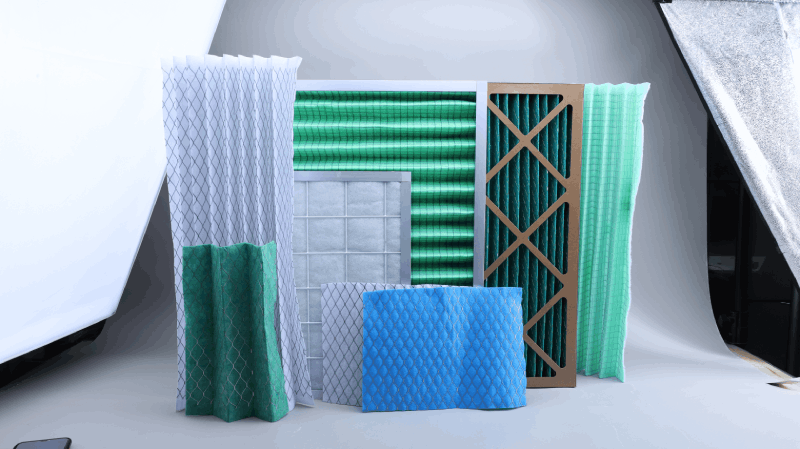
How Can Buyers Create a Simple Air Filter Media Selection Sheet?
Before sending a formal inquiry, buyers can organize the system conditions into a simple purchasing specification.
Item | Information to Confirm |
Application | Final filtration application |
Filtration Stage | Pre / Primary / Final |
Airflow | Actual airflow rate |
Filter Area | Effective filtration area |
Particle Size | Target particle range |
Particle Loading | Particle concentration or loading |
Pressure Drop | Acceptable operating resistance |
Filter Life | Target service period |
Gas Condition | Humidity, oil mist, temperature, corrosive components, etc. |
Filter Format | Filter Roll / Sheet / Cartridge / Other |
The value of this information is simple:
The supplier no longer needs to guess what the buyer means by “Need air filter media.”
Instead, the manufacturer can select a material direction according to the actual operating conditions.
Why Should Air Filter Media Not Be Selected by GSM or Thickness Alone?
GSM and Thickness are both important material parameters, but they cannot independently determine whether a filter media is suitable for a specific air filtration system.
For example, even if two materials have the same thickness, they may perform differently in terms of:
Fiber Structure
Air Permeability
Particle Capture
and:
Pressure Drop
Similarly, a higher GSM does not automatically mean that the material is more suitable for a particular filtration system.
Therefore, if a buyer simply tells the supplier:
“I need 500 GSM filter media.”
the supplier is still missing several important pieces of information.
A more complete purchasing approach is:
Application + Airflow + Particle Loading + Pressure Drop + Filter Life + Filtration Stage
and then determine:
Material + GSM + Thickness
In other words, material specifications should serve the filtration system requirements, rather than the material specifications determining the application.
When Should Buyers Consider Needle Punched Felt for Air Filter Media Selection?
Not every Air Filter Media application needs to use needle punched felt.
The final filter media form should be determined according to the filtration system and actual application conditions.
If a project requires a nonwoven material with a certain thickness, mechanical stability, and adjustable structure, Needle Punched Nonwoven can be one possible material direction.
However, its suitability still needs to be evaluated together with:
Airflow
Particle Loading
Pressure Drop
Filter Life
and the specific filtration structure.
Therefore, buyers should not assume that because a certain Needle Punched Felt is widely used in industrial filtration, it is automatically suitable for every air filtration project.
Your website already has a dedicated page covering Needle Punched Felt for Industrial Filtration, including its three-dimensional fiber structure, air permeability, dust capture, and industrial filtration applications. Therefore, this article does not repeat those topics.
Why Should Filter Media Selection Start with System Requirements Instead of the Material Name?
A professional purchasing process should be:
Application
↓
Filtration Stage
↓
Airflow
↓
Particle Characteristics
↓
Particle Loading
↓
Pressure Drop
↓
Filter Life
↓
Material Selection
↓
Specification
This approach is more practical than:
Material Name → GSM → Price
because the real goal is to solve the requirements of the entire filtration system rather than simply purchase one material.
For long-term purchasing customers, this approach also makes it easier to compare products from different suppliers.
As long as different suppliers quote based on the same system requirements, product comparisons become more meaningful.
How Does Jinhaocheng Support Customized Nonwoven Filter Media?
HUIZHOU JINHAOCHENG NONWOVENS CO., LTD. has more than 20 years of nonwoven manufacturing experience, a production facility of approximately 26,000 m², and 15 automated needle punching production lines, with capabilities covering needle punched materials, thermal bonded materials, meltblown materials, composite processing, and downstream processing.
As a professional nonwoven manufacturer China, Jinhaocheng can develop different nonwoven material specifications according to project requirements.
For filtration projects, customers can provide:
Application
Airflow Requirement
Particle Characteristics
Filter Stage
Required Thickness
GSM
and other product specifications.
After the actual operating conditions are confirmed, the appropriate material system and product specifications can then be determined, helping buyers avoid purchasing based only on one standard material.
When Purchasing Air Filter Media, the Goal Is Not to Find the “Strongest” Material but the Material That Matches the System
For buyers, the key principle in selecting Air Filter Media is not:
“Which filter media is the best?”
It is:
“Which filter media matches my filtration system?”
First confirm:
Airflow
Then confirm:
Particle Loading
Then consider:
Pressure Drop
At the same time, evaluate:
Filter Life
Finally, determine the material direction according to:
Filtration Stage
This helps prevent buyers from selecting a filter media that is not suitable for the actual system simply because of its filtration efficiency, GSM, Thickness, or purchase price.
Conclusion: Air Filter Media Selection Should Start with Operating Conditions, Not the Product Name
When purchasing Air Filter Media, buyers need to confirm a complete set of system conditions.
Airflow determines how much air the media needs to handle.
Particle Loading reflects the particle burden the media must manage.
Pressure Drop affects the operating resistance as air passes through the filtration system.
Filter Life is related to replacement frequency and long-term operation.
Filtration Stage determines what role the media performs within the overall filtration system.
Therefore, a more practical purchasing formula is:
Application → Airflow → Particle Loading → Pressure Drop → Filter Life → Filtration Stage → Media Selection
rather than:
Material Name → GSM → Price
For importers, wholesalers, filtration equipment manufacturers, and long-term purchasing customers, defining the system requirements first and then selecting Air Filter Media makes it easier to obtain material that genuinely fits the project.
If you are looking for a China manufacturer that can develop custom nonwoven filter media, Jinhaocheng can provide customized nonwoven material development support according to your airflow requirements, filtration stage, particle characteristics, and material specifications.