
What Should Buyers Consider About PE Film Thickness When Purchasing Waterproof Floor Protection Roll?
For overseas importers, wholesalers, distributors, and building material brands, PE film is an important part of the waterproof laminated structure when purchasing waterproof floor protection roll.
However, during an actual RFQ, many buyers simply tell suppliers that they need “PE laminated” or “waterproof backing” without further confirming the specification of the PE film itself. This can result in different suppliers offering products that are all described as Waterproof Floor Protection Roll but have different laminated structures.
Therefore, the key purchasing question is not simply to request a “thicker PE film.” Buyers should determine whether the PE film thickness matches the product’s waterproofing requirements, base material structure, application method, and cost target, while also ensuring that the supplier’s final production matches the confirmed specification.
Why Should PE Film Thickness Not Simply Be Understood as “Thicker Is Better”?
In Waterproof Floor Protection Roll, PE film primarily provides a liquid barrier. Therefore, some buyers naturally assume that the thicker the PE film, the better the product’s waterproof performance must be.
This understanding is incomplete.
PE film thickness is certainly an important specification that can affect the performance of a laminated product, but final waterproof performance is not determined by film thickness alone. Film integrity, lamination condition, base material structure, manufacturing process, and actual application conditions can all affect the final liquid barrier performance.
For buyers, a more reasonable approach is to first clarify what problem the product needs to solve. For example, a product mainly used to protect against water droplets, paint, and construction contamination during ordinary renovation may have different PE film requirements from a project involving a higher risk of prolonged liquid exposure.
Therefore, an RFQ should not simply say “thicker PE film.” It is more important to explain the actual application environment and waterproofing requirements so that the supplier can determine an appropriate PE film specification based on the complete product structure.
What Is the Difference Between PE Film Thickness and the Overall Thickness of Floor Protection Roll?
These are two specifications that are easily confused during purchasing.
The overall thickness of Floor Protection Roll refers to the thickness of the complete product structure, which may include the needle-punched nonwoven base material as well as the PE film or other laminated layers. PE film thickness, on the other hand, refers only to the PE film layer within that structure.
For example, two Floor Protection Roll products with a similar overall thickness may have different PE film specifications because their nonwoven GSM, fiber structure, or compression condition is different.
Conversely, even if two products use a similar PE film thickness, their final products may still have different flexibility, absorption, cushioning performance, and handling characteristics if their nonwoven base material, needle-punching density, or overall laminated structure is different.
Therefore, buyers should not treat “Floor Protection Roll thickness” and “PE film thickness” as the same specification.
Your existing website content already discusses the relationship between overall Floor Protection Roll thickness and GSM, so this page should avoid repeating the overall thickness selection topic. Instead, it should focus specifically on confirming PE film thickness as an independent specification within the laminated structure.
How Can PE Film Thickness Affect the Practical Performance of Waterproof Floor Protection Roll?
The most direct function of PE film in Floor Protection Roll is to provide a liquid barrier, so PE film thickness should first be considered in relation to the product’s waterproofing requirement.
During actual construction, the material may come into contact with water, paint, or other construction liquids. In addition to whether liquid can penetrate the film layer, the material must maintain its laminated structure during handling, cutting, unfolding, and installation. If the PE film specification does not match the intended application, it may affect the overall protective performance.
At the same time, a thicker PE film is not automatically the best choice for every project. Increasing the film layer can also affect the product structure, weight, cost, and processing conditions. For overseas renovation projects requiring large-area installation, buyers also need to consider whether the product remains practical to handle, unfold, and cut.
Therefore, PE film thickness should be treated as one part of the overall product structure rather than as an isolated number to maximize.
A reasonable purchasing requirement should be that the PE film provides the required liquid barrier performance without unnecessary material increases that could negatively affect product handling efficiency or purchasing cost.
Why Should Buyers Not Compare Supplier Quotations Based Only on the Description “PE Laminated”?
When requesting quotations from several suppliers, buyers may easily see product descriptions such as:
“PE laminated felt”
“Waterproof floor protection”
“PE backed nonwoven”
These descriptions may look very similar, but they do not necessarily mean that the suppliers are offering exactly the same product.
Different suppliers may use different nonwoven base materials, GSM levels, PE film specifications, and lamination processes. If buyers compare only the product name and price per roll, it becomes difficult to determine whether the quotations are genuinely comparable.
For example, Supplier A and Supplier B may both quote a PE laminated Floor Protection Roll, but if their base material structures, PE film thicknesses, and roll specifications are different, simply comparing the “price per roll” does not provide a meaningful purchasing comparison.
Therefore, when purchasing waterproof floor protection roll, buyers should include PE film thickness as a clearly defined product specification instead of using only a general description such as “PE laminated.”
This can help prevent suppliers from quoting based on their own standard product specifications, which may later result in differences between the sample, bulk order, and buyer’s original expectations.
How Should Buyers Specify PE Film Thickness in an RFQ?
If the buyer has already determined the required PE film thickness, it should be clearly stated in the RFQ. The buyer should also clarify that this refers to the PE film layer within the final product structure, not the overall thickness of the Floor Protection Roll.
For example, an RFQ can specify:
Product: Waterproof Floor Protection Roll
Base Material: Needle Punched Nonwoven
GSM: Confirmed requirement
Overall Thickness: Confirmed requirement
PE Film: Laminated
PE Film Thickness: Buyer requirement
Width: Confirmed requirement
Roll Length: Confirmed requirement
Waterproof Requirement: Application specific
This specification format is much clearer than simply writing “waterproof PE felt.”
If the buyer has not yet determined the appropriate PE film thickness, it is also not advisable to copy a specification from another supplier without considering the application. Different base material structures, application environments, and waterproofing requirements may require different product configurations.
In this situation, buyers can explain the actual application, protected surface, expected liquid exposure, and operating environment in the RFQ, allowing the manufacturer to recommend a suitable specification and provide a sample.
Why Should PE Film Thickness Be Confirmed Together With the Nonwoven Base Material?
A Waterproof Floor Protection Roll is not made from PE film alone.
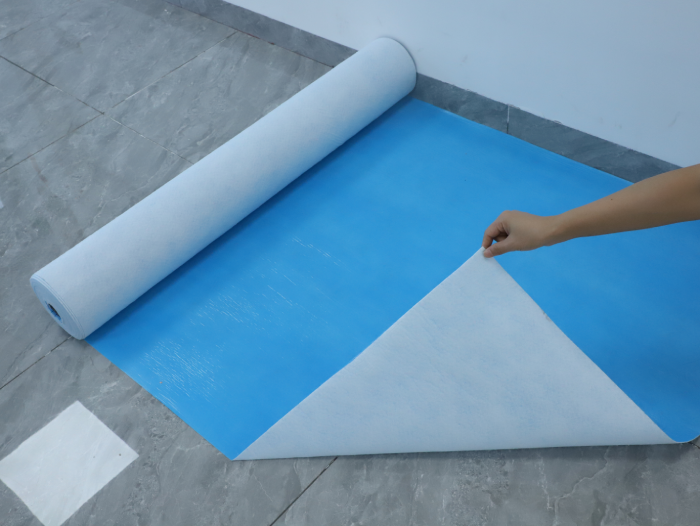
For PE laminated needle-punched nonwoven products, the material generally combines a nonwoven base with a PE film to form a laminated structure. The nonwoven base may provide functions such as absorption, cushioning, flexibility, and surface protection, while the PE film primarily provides the liquid barrier.
Therefore, asking a supplier only about PE film thickness does not provide a complete understanding of the product structure.
For example, the same PE film specification combined with nonwoven materials having different GSM levels, fiber compositions, or needle-punched structures can result in differences in product weight, flexibility, absorption, and surface performance.
Existing comprehensive material specification content on the website also emphasizes that GSM, thickness, fiber structure, needle-punching density, and backing structure should be considered as part of a complete product structure rather than selected entirely as independent parameters.
For buyers, a more practical RFQ logic is:
Application → Required Performance → Nonwoven Base → PE Film → Overall Product Specification
rather than:
PE Film Thickness → Price
This makes it easier for the supplier to develop a product configuration that is actually suitable for the intended application.
How Can Buyers Confirm That the Supplier's Actual PE Film Specification Matches the Quotation?
Once the PE film thickness has been determined, the next step is not simply to rely on the supplier’s quotation. The specification should also be included in the sample and bulk-order confirmation documents.
First, buyers should confirm that the sample provided by the supplier corresponds to the agreed product structure. This is especially important when comparing quotations from multiple suppliers, because buyers should not determine PE film consistency only by looking at the appearance of the product.
After sample approval, the confirmed PE film thickness, GSM, overall thickness, width, roll length, and laminated structure can be recorded as the product specification. This gives both the buyer and supplier a clear reference during bulk production.
For long-term purchasing, buyers also need to consider whether the specification remains stable between production batches. Existing content on the website already discusses supplier bulk-production verification and long-term batch consistency separately, so this article does not repeat those quality management processes. Instead, the focus here is that PE film thickness should be clearly recorded as part of the original product specification.
For buyers, this is more effective than waiting until bulk production and then asking whether the PE film is “the same as last time.”
If Buyers Do Not Know What PE Film Thickness to Choose, How Should They Confirm It With the Supplier?
Many overseas buyers making their first purchase of Waterproof Floor Protection Roll do not know which PE film thickness is appropriate for their application.
In this situation, the least advisable approach is simply to ask the supplier for the “thickest PE film.” The supplier needs to understand the final application before determining whether a particular product structure is appropriate.
Buyers can provide several basic details, including the type of floor being protected, the construction environment, expected application period, possible liquid exposure, whether large-area continuous installation is required, and requirements for product weight, flexibility, and cost.
For example, a product used for ordinary residential renovation may have different protection requirements from a product intended for a commercial construction site with longer-term use. The corresponding PE laminated structure may therefore not need to use exactly the same specification.
If the buyer already has an existing supplier’s product or sample, they can also provide product photos, a specification sheet, or a physical sample so that the manufacturer can evaluate the existing product structure and confirm a suitable alternative.
This approach is more effective than simply saying “PE film should be thicker,” because the ultimate purchasing objective is to obtain a waterproof floor protection roll that meets the actual application requirements, rather than simply obtaining a larger PE film thickness number.
How Does HuiZhou JinHaoCheng Nonwovens Co., Ltd. Support Waterproof Floor Protection Roll Specification Customization?
For overseas importers, wholesalers, and distributors, Waterproof Floor Protection Roll specifications often need to be adjusted according to the market and final application rather than using one standard product for every customer.
HuiZhou JinHaoCheng Nonwovens Co., Ltd. specializes in manufacturing needle-punched nonwoven and composite nonwoven products and can provide OEM/ODM solutions with different GSM levels, thicknesses, widths, roll lengths, and PE laminated structures according to customer application requirements.
During the inquiry stage, buyers can provide their target market, protected surface, application environment, estimated purchasing quantity, existing product specifications, or physical samples. Based on this information, the manufacturer can further evaluate the nonwoven base, PE film structure, and final Floor Protection Roll specifications.
For customers with long-term purchasing plans, recording PE film thickness and other key product parameters in the confirmed specification in advance can also help maintain consistency during sample approval, bulk production, and repeat orders.
Conclusion
When purchasing waterproof floor protection roll, PE film thickness is an important material specification that should be clearly confirmed, but it should not simply be understood as “thicker is better.”
Buyers should first distinguish between PE film thickness and the overall thickness of the Floor Protection Roll. They should then determine an appropriate specification based on liquid barrier requirements, the nonwoven base material, product structure, application environment, and cost target.
During the RFQ, sample approval, and bulk-order confirmation stages, PE film thickness should be recorded as a clear product parameter rather than relying only on vague descriptions such as “PE laminated” or “waterproof backing.”
For overseas buyers, the real objective is not to purchase the thickest PE film available. It is to find a waterproof floor protection roll with a PE film specification that matches the nonwoven base and actual application requirements and can be consistently manufactured according to the confirmed specification.




