
How Can Importers Calculate the True Landed Cost per Square Metre of Nonwoven Rolls?
For overseas buyers importing nonwoven rolls from China, the supplier's quotation is only one part of the total purchasing cost.
Different suppliers may quote in USD/kg, USD/m², USD/roll, or provide a total FOB price for a full container. Comparing these figures directly can easily lead to the wrong conclusion. For purchasing decisions, a more practical indicator is the actual Landed Cost after the product has been imported and all relevant costs have been allocated to each square metre of material.
Therefore, the real question for buyers is not simply "Which supplier offers the lowest price?" but:
Under different quotation units, packaging methods, and transportation costs, which quotation results in the lower actual landed cost per square metre?
Why Should Buyers Not Compare Nonwoven Suppliers by Unit Price Alone?
Nonwoven rolls are not always quoted using the same pricing unit.
One supplier may quote US$2.00/kg, another may quote US$0.45/m², while another may provide a price per roll.
If buyers only compare the numbers themselves, these three quotations cannot actually be compared directly.
For a weight-based quotation, buyers also need to know the actual GSM. For a quotation per roll, they need to know the roll width and roll length. For a quotation per square metre, they need to confirm whether the actual material specifications are exactly the same.
Therefore, before comparing suppliers, the first step is not to select the lowest quotation, but to convert all quotations to the same pricing basis.
For nonwoven products sold or ultimately used by area, Cost per m² is often a practical basis for comparing different quotations.
This allows:
Supplier A: US$/kg
Supplier B: US$/m²
Supplier C: US$/roll
to be converted into the same cost unit before comparison.
Step One: Convert Different Quotation Units into Cost per Square Metre
If a supplier quotes by kilogram, the buyer needs to calculate the cost based on the material's GSM.
The basic calculation is:
Cost per m² = Price per kg × GSM ÷ 1000
For example, if a nonwoven material is 200 GSM and the supplier quotes US$2.20/kg, the theoretical material cost is approximately:
US$2.20 × 200 ÷ 1000 = US$0.44/m²
If another supplier quotes US$0.42/m², the second supplier appears to offer a lower price.
However, this is still not the final purchasing conclusion because the two suppliers may have different packaging, transportation costs, trade terms, and other import-related expenses.
If a supplier quotes per roll, the buyer first needs to calculate the actual coverage area of each roll:
Roll Area = Roll Width × Roll Length
Then:
Cost per m² = Price per Roll ÷ Area per Roll
Only after completing this step can product quotations from different suppliers be meaningfully compared.
Step Two: Why Can Roll Packaging Change the Actual Purchasing Cost?
For overseas importers, packaging does more than affect product appearance and storage.
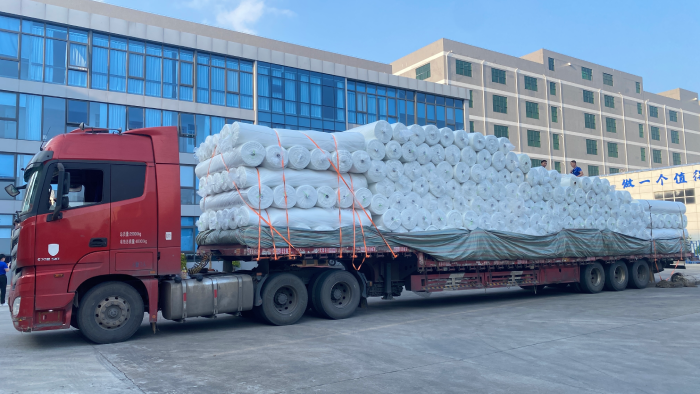
The packaging method of nonwoven rolls can affect the external dimensions of each roll, pallet usage, handling requirements, and transportation space utilization, which can ultimately affect logistics costs.
For example, if one packaging method reduces unnecessary external space while another creates a significantly larger packaging volume, the final logistics cost may be different even when the two suppliers offer similar prices per square metre.
However, buyers should not simply ask suppliers to maximize container loading.
Excessive compression should also be evaluated according to the material structure, appearance, thickness, and intended application requirements.
Therefore, during the RFQ stage, buyers should confirm:
Net weight per roll, area per roll, roll dimensions, package dimensions, and the packaging method for the full shipment.
These figures are more useful for cost calculation than simply asking, "How many rolls can fit into one 40HQ?"
Step Three: How Should International Freight Be Allocated per Square Metre?
International freight should not simply be added to the price of one individual roll. It should be allocated according to the actual purchasing quantity of the entire shipment.
For example, if a shipment contains 100,000 m² of material and the relevant international freight cost is US$4,000:
Freight Cost per m² = US$4,000 ÷ 100,000 m² = US$0.04/m²
If another shipment has a lower product price but its packaging and transportation conditions result in a freight cost of US$0.07/m², the original lower product quotation may not result in a lower final cost.
Therefore, when comparing suppliers, buyers should compare:
Product Cost + Allocated Freight Cost
within the same cost-per-square-metre framework.
It is important to note that the specific loading quantity of a 40HQ container should be calculated according to the actual product specifications and packaging method. Buyers should not directly apply container-loading data from another type of nonwoven roll.
Step Four: Which Import Costs Should Be Included in the True Landed Cost?
The true landed cost should not simply be:
FOB Price + Ocean Freight
Depending on the actual trade terms and import regulations of the destination country, buyers may also need to consider insurance, import duties, destination charges, customs clearance-related costs, and other expenses directly associated with bringing the goods into the local market.
Therefore, a more complete cost framework can be understood as:
Landed Cost = Product Cost + International Freight + Insurance + Import Duties + Destination Charges + Other Direct Import Costs
The final figure can then be divided by the actual purchased quantity in square metres:
Landed Cost per m² = Total Landed Cost ÷ Total Purchased Area
It is important to note that actual costs can vary depending on the destination country, product HS Code, trade terms, and import arrangements. Buyers should therefore not use one fixed percentage to estimate import costs for every nonwoven product.
For formal purchasing, it is better to confirm applicable duties, taxes, and port charges based on the specific destination country and actual commercial terms.
Step Five: Why Does a Lower FOB Price Not Necessarily Mean a Lower Landed Cost?
This is a common issue in overseas purchasing.
Suppose Supplier A offers a lower quotation, but its price per kilogram corresponds to a higher GSM, or its roll packaging takes up more transportation space. Supplier B may have a slightly higher FOB price, but its product specifications, packaging, and transportation efficiency may be better suited to the buyer's requirements.
If buyers compare only FOB prices, they can easily overlook the costs that come afterward.
What buyers should actually compare is:
Supplier Price → Product Area → Packaging → Freight Allocation → Import Costs → Landed Cost per m²
This is why overseas wholesalers and importers should not use only the first price shown on a supplier quotation as the basis for a purchasing decision, especially for full-container or repeat orders.
When purchasing volumes are large or orders are repeated regularly, even a difference of a few cents per square metre can create a significant difference in total purchasing cost over time.
What Data Should Buyers Request from a Nonwoven Supplier?
If you are preparing to import nonwoven rolls from China, it is recommended to ask suppliers to provide the data needed for cost calculation during the RFQ stage.
First, confirm the product:
GSM, width, roll length, area per roll, and weight per roll.
Then confirm:
Packaging method, package dimensions, palletization method, and total shipment weight.
Finally, confirm:
Trade terms, expected shipping method, transportation costs, and the loading plan that the supplier can provide.
If your goal is to calculate the actual landed cost per square metre, the final calculation should be organized into one consistent cost table:
Product Cost / m²
Packaging Cost / m²
Freight / m²
Insurance / m²
Import Duties / m²
Destination Charges / m²
Total Landed Cost / m²
This provides a much more useful basis for supplier comparison than simply comparing US$/kg or US$/roll.
How Can JHC Support Overseas Roll Buyers?
For overseas customers purchasing nonwoven materials on a long-term basis, a supplier should provide not only a product quotation but also clear product specifications and production information to support order and logistics planning.
HuiZhou JinHaoCheng Nonwovens Co., Ltd. has more than 20 years of nonwoven manufacturing experience and provides products including needle punched nonwoven, composite nonwoven, absorbent materials, filtration materials, and floor protection materials according to different application requirements, with OEM/ODM customization available.
For roll-material purchasing projects, we can provide relevant product and shipping data based on the actual GSM, width, roll length, packaging method, and order quantity, helping overseas importers compare product costs and logistics costs more accurately during the quotation stage rather than focusing only on the headline unit price.
Conclusion: Overseas Buyers Should Compare Landed Cost, Not Just the Lowest Quotation
For overseas buyers importing nonwoven rolls from China, the most useful figure is not the lowest number shown on a supplier quotation, but the Landed Cost per m² after all relevant costs have been converted and allocated.
Different suppliers may use different quotation units, while packaging methods and transportation conditions may also vary. Therefore, buyers should first convert kg, roll, and m² quotations to a common basis, and then include international freight, insurance, import duties, and destination-related costs in the calculation.
A lower FOB price does not necessarily mean a lower final purchasing cost.
Only by putting product price, actual purchased area, packaging, transportation, and import-related expenses into the same cost model can overseas importers compare different Chinese nonwoven suppliers more accurately and establish a more reliable cost benchmark for long-term purchasing.




