
How Should Buyers Specify Absorbent Felt for Liquid Filter Components?
For liquid filtration equipment manufacturers and filter cartridge OEMs, each material layer in a filter may serve a different purpose. Some layers are designed to retain particles, others help guide liquid flow, while certain layers may need to absorb or temporarily hold liquid.
If your filter design requires an absorbent material layer, the most important purchasing question is not simply, “Do you have absorbent felt for filter cartridges?” Instead, start by asking:
What exactly does this material layer need to do in the finished filter component?
Needle punched absorbent felt and other absorbent nonwoven materials may be potential options for certain liquid-management components. However, the ability to absorb water does not automatically mean that a material is suitable for a particular filtration system. Liquid properties, component design, operating conditions, material stability, and the intended liquid flow path can all affect material selection.
Therefore, buyers should define the actual function of the absorbent layer before requesting quotations, then verify its suitability through sample evaluation and component-level testing rather than placing an order based only on the material name or a single specification.
What Role Does an Absorbent Layer Play in a Liquid Filter Component?
The role of an absorbent layer in a liquid filter component depends on the specific design. It may absorb liquid entering the component, temporarily hold a certain amount of liquid, or help redistribute liquid within the material. These functions are not identical and should not automatically be treated as filtration functions.
For example, if the main purpose of a material layer is liquid absorption, buyers need to evaluate how liquid enters the material, how the material behaves after absorption, and whether it can maintain the required structure under specified conditions. If the material needs to temporarily retain liquid, buyers should also confirm its liquid-retention behavior and whether the liquid is released when the material is exposed to compression, gravity, or flow.
If the material is intended to distribute liquid or facilitate drainage, the evaluation criteria will be different. Buyers need to determine whether liquid can pass through the material as required, whether significant liquid retention occurs, and whether the material affects flow conditions within the component.
In addition, an absorbent layer should not automatically be treated as a particle filtration layer. Liquid absorption and particle retention are different performance requirements. If the finished product needs to capture specific particles, achieve a defined filtration efficiency, or comply with a particular filtration standard, these requirements must be designed and validated separately.
For buyers, the first step is not to decide which type of needle punched absorbent felt to purchase. It is to clearly define the function of the layer. Once that function is established, the supplier can assess whether a suitable nonwoven material is worth evaluating.
Does the Component Need Absorption, Liquid Distribution, or Drainage?
Before purchasing an absorbent layer, buyers should distinguish between three objectives that are often confused: liquid absorption, liquid distribution, and liquid drainage.
If the objective is absorption, buyers should specify the type of liquid the material will contact, the required absorption time, and whether the material needs to retain a certain amount of liquid after absorption. Simply requiring a material that “can absorb water” is usually not enough to establish a verifiable purchasing standard.
If the objective is liquid distribution, buyers need to clarify whether liquid should spread from one location across a larger area or remain concentrated in a specific area. The internal material structure, installation method, and direction of liquid entry may all affect the final performance. Therefore, testing a material sample on its own may not fully represent how it will perform after installation in a filter cartridge.
If the objective is drainage, buyers should focus on how liquid moves through the component rather than comparing absorption capacity alone. A material that temporarily retains liquid is not necessarily suitable for a system that requires rapid drainage. Conversely, a material that releases liquid easily may not meet the requirements of a design that needs a higher level of liquid retention.
An actual product may require two or more of these functions. For example, a material layer may need to receive liquid first and then distribute it to other areas of the component. However, these combined requirements should be determined by the finished product design rather than inferred by the supplier from the term “absorbent felt” alone.
Buyers should therefore identify the primary and secondary functions and clarify which performance requirements are essential and which are desirable. This helps reduce the risk of receiving samples that do not match the intended application.
Which Material Requirements Should Buyers Confirm?
Once the function has been defined, buyers can move on to the material requirements. The goal is not to list every possible parameter in the RFQ, but to identify the conditions that directly affect the absorbent layer's performance in the actual component.
First, specify the liquid type and contact conditions. Liquid composition, viscosity, temperature, and other characteristics may affect wetting, absorption, and structural stability. A needle punched nonwoven material that absorbs water should not automatically be considered suitable for oils, cleaning solutions, or other industrial liquids. For applications with specific chemical compatibility requirements, the material should be evaluated by the supplier and relevant technical personnel, with suitability confirmed through appropriate testing.
Second, clarify the installation position, available space, and dimensional requirements. The absorbent layer may be supplied as a roll, sheet, die-cut piece, or another converted shape. Thickness and dimensions in the dry state are only basic reference data. If the material will be compressed, bent, fixed in place, or exposed to liquid during use, buyers should also confirm whether these conditions could affect assembly and structural stability.
Third, define the target liquid-handling performance. Depending on the application, buyers may need to evaluate absorption capacity, absorption time, liquid distribution, liquid retention, or drainage behavior. Test criteria should be relevant to the actual application rather than including performance requirements that cannot be verified. If specific numerical targets have not yet been established, buyers can provide existing samples, component drawings, or product information and discuss appropriate testing methods with the supplier.
Finally, consider converting requirements and long-term supply. The absorbent layer may need to be cut, die-cut, laminated, or assembled into a specific filter structure. Whether the material is prone to fiber shedding, deformation, or dimensional changes during processing, and whether consistent quality can be maintained across production batches, should also be part of the evaluation.
For needle punched absorbent felt and custom nonwoven materials, fiber composition, GSM, thickness, density, and processing methods can serve as development parameters. However, these specifications alone cannot prove that a material is suitable for a particular filter cartridge. The correct approach is to assess these parameters alongside the required function, component design, and validation results.
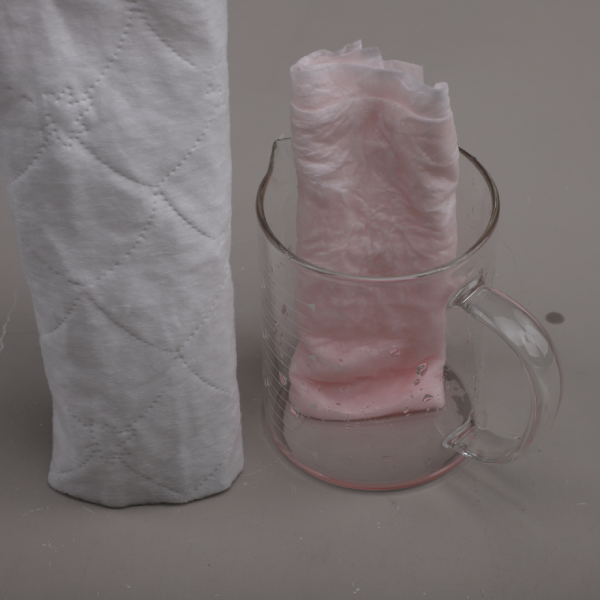
How Should Buyers Test the Material in the Finished Filter?
Testing a piece of absorbent felt on its own can help buyers understand its initial performance, but it may not reflect how the material will behave in the finished filter cartridge. Therefore, before proceeding to bulk purchasing, buyers should evaluate the material in a component that closely resembles the actual product and operating conditions whenever possible.
The first step is to define the test conditions. Buyers should specify the liquid, liquid temperature, contact method, test duration, and installation state of the material within the component as clearly as possible. If different suppliers use different test conditions, their results may not be directly comparable, even when the reported values are similar.
The second step is to observe the material according to its intended function. If the main objective is absorption, check whether liquid enters the material as expected and whether the material undergoes significant structural changes after absorption. If liquid distribution or drainage is also required, observe liquid movement within the component rather than judging overall performance by absorption capacity alone.
The third step is to assess the material's effect on component operation. For example, buyers should check whether the material expands, deforms, or shifts significantly after absorbing liquid, whether it affects the liquid flow path, and whether it interacts adversely with adjacent materials. The specific inspection items should be determined by the filter design and actual operating conditions.
If the finished product has defined requirements for particle retention, flow rate, pressure drop, chemical compatibility, or other performance characteristics, these must be verified separately using appropriate test methods. Absorption test results alone cannot establish the filtration performance of the complete filter.
For long-term purchasing projects, buyers should also retain approved samples and records of the test conditions as references for subsequent production batches. This helps purchasing, engineering, and quality teams use consistent criteria to determine whether the material meets requirements, rather than relying on appearance or subjective hand-feel each time an order is placed.
What Information Should Buyers Include in an RFQ for Filter Components?
When requesting a quotation, buyers should provide information that reflects the actual application as closely as possible. If the only requirement is “absorbent felt for filter cartridges,” it may be difficult for the supplier to determine whether the intended function is absorption, liquid retention, liquid distribution, or another material function.
First, provide basic information about the finished product, including the purpose of the filter or filtration component, the installation position of the material, component drawings, available dimensions, and how the material will be fixed or combined with other layers. If complete drawings are not yet available, existing samples, product photos, or structural sketches can be useful starting points.
Second, describe the liquid and operating conditions, including liquid type, contact temperature, contact time, static or flowing conditions, and whether the material will be exposed to compression, continuous flow, or other mechanical forces. For products involving special chemical liquids or strict operating requirements, disclose these limitations early so that suitability is not judged solely by water absorption tests.
Third, clearly state the intended function of the material layer. Buyers can specify whether the primary objective is absorption, temporary retention, liquid distribution, or assistance with drainage, and provide any existing performance standards, test methods, or reference samples. If numerical targets are not yet available, describe the desired result in the finished product and any problems with the current material.
Finally, provide the estimated order quantity, sample requirements, converting methods, and anticipated bulk purchasing plans. If the product requires customized width, thickness, GSM, die-cut shapes, or a composite structure, include these requirements as part of the development information rather than adding them only after sample approval.
An effective RFQ does not necessarily require buyers to determine every material parameter at the beginning. More importantly, it should provide enough application information for the supplier to assess whether the material is worth developing and what samples and tests are needed for further validation.
How Can Buyers Move from Sample Approval to Bulk Purchasing?
A sample that meets expectations does not guarantee that bulk production will deliver the same performance. For liquid filter components, buyers should confirm the material version, specifications, and test conditions associated with the approved sample and ensure that these details can be used as references for future orders.
During sample approval, record the fiber composition, GSM, thickness, dimensions, processing method, and key performance requirements agreed upon by both parties. If the finished component has been validated under specific liquid and installation conditions, retain the relevant test records as well. This helps prevent later material substitutions based only on the material name or appearance.
Before placing a bulk order, buyers should also agree with the supplier on which parameters must be controlled and how deviations from the approved specifications will be handled. For materials requiring cutting, lamination, or other downstream processing, confirm that the processed dimensions and structure meet the component requirements.
Buyers should also evaluate whether the supplier can support ongoing supply, customized development, and batch quality management. For long-term projects, stable raw material supply, production process control, and sample traceability are more meaningful than a single successful sample evaluation.
HuiZhou JinHaoCheng Nonwovens Co., Ltd. provides needle punched nonwoven, needle punched felt, and related composite nonwoven materials, with customized processing and OEM/ODM project support. For liquid filter component projects, buyers should still provide the specific application, component structure, and performance requirements first, so that the suitability of existing materials or customized solutions can be evaluated against the actual operating conditions.
Conclusion: Define the Function Before Choosing the Absorbent Felt
When sourcing absorbent felt for liquid filter components, the most important first step is not to select a particular fiber type or GSM. It is to define what the material layer needs to do in the finished product.
Liquid absorption, temporary retention, liquid distribution, drainage, and particle filtration are different functional requirements. Even if a material can perform one of these functions, that does not mean it can automatically meet the others.
For buyers, a more reliable process is to provide the component structure, liquid type, operating conditions, and target function first, then validate material performance through samples and testing in the actual component. Bulk purchasing should proceed after the test criteria, approved sample version, and production control requirements have been confirmed.
If you are developing a liquid filter component, start with how the finished product operates and the specific role of the absorbent layer rather than simply asking a supplier whether they have “absorbent felt for filter cartridges.” Clear application information helps both parties assess material suitability more accurately and reduces the risk of repeated sampling and specification changes later.




